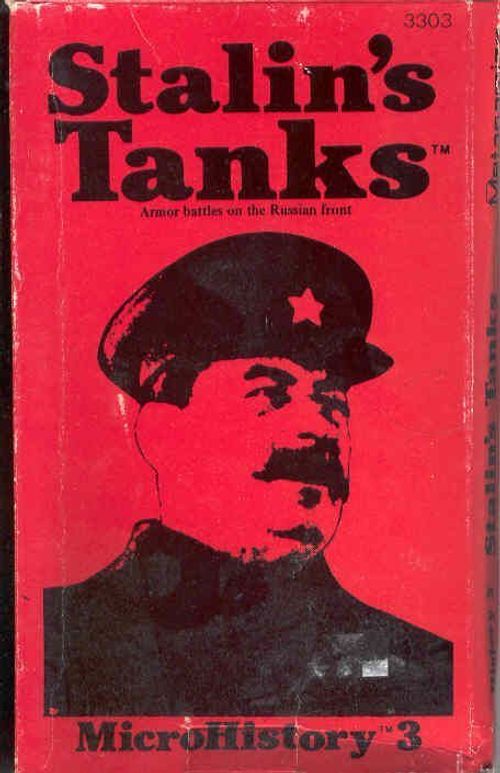
Stalin's Tanks: Armor Battles on the Russian Front
Stalin's Tanks: Armor Battles on the Russian Front Rulebook
Table of Contents
Table of Contents
- 1.0 Introduction
- 2.0 Map
- 3.0 Counters
- 4.0 Preparation for Play
- 5.0 Game-Turn Sequence
- 6.0 Movement
- 7.0 Terrain Effects on Movement
- 8.0 Facing
- 9.0 Line-of-Sight (LOS)
- 10.0 Anti-Tank Combat
- 11.0 Dice Roll Modifiers (DRM's)
- Advanced Rules
- 12.0 Terrain Effects on Defense Factors
- 13.0 Anti-Personnel (AP) Combat
- 14.0 High Explosive (HE) Fire Versus Armor
- 15.0 Infantry
- 16.0 Close Assault
- 17.0 Transport
- 18.0 Off-Board Artillery
- 19.0 Mines
- 20.0 Hidden Initial Placement
- Optional Rules
- 21.0 Range Attenuation
- 22.0 60 Degrees Full Frontal Face (60 Degrees FFF)
- 23.0 Overrun
- 24.0 Soviet Suicide Assault
- 25.0 Scenarios
- Turn Sequence Summary
- Charts
1.0 Introduction
On June 22, 1941, Hitler unleashed Operation Barbarossa: an all-out attempt to crush the Soviet Army in a swift, decisive blow. On that day, three-and-a-half million men surprise-attacked four million men. Four years of the grimmest fighting ever known would follow.
The most important weapon of the campaign was the tank. Behind the battles for territory were the battles in technology. At first the Germans were overconfident because of their swift victories over Poland and France, and saw little need for heavier tanks than their Panzer IIIs and IVs. However, the Soviets harbored no such illusions, and produced some remarkable tanks: the T34 and the KV. These tanks would prove to be a mighty shock to the first German soldiers encountering them.
Initially the Soviets had poor tactical doctrine and little command-control, which gave the better-organized German Wehrmacht some easy victories. Slowly, the Soviet leaders learned bitter lessons. The German war machine came to a grinding halt at the gates of Moscow, in the heart of the Russian winter.
In response to the Soviet armor, the Germans pushed the development of heavier tanks. With the arrival of the Tiger and Panther, the Germans achieved a slight edge on quality. However, the new tanks came too late. The lessons of the war were heeded by the Soviets, and with brilliant counterstrokes the Red Army relentlessly pushed the invaders from their land.
2.0 Map
The map represents a small area in Russia. The brown shaded areas represent hills. Brown tree symbols represent wooded areas. The irregular blue line represents a stream. A swamp is also indicated in blue. The brown, rectangular figures represent large buildings. The thin, parallel lines indicate a road. A bridge is indicated where the road crosses the stream. Each hex represents a distance of 50 meters. The scatter diagram in the upper right corner of the map is explained in the advanced rules.
3.0 Counters
Each counter represents either one tank, one self-propelled gun, one anti-tank gun, one halftrack, or one infantry squad. The red counters represent Soviet units and the black ones represent German units. Counters are also included to mark artillery impact hexes in the Advanced Game.
Sample Counters. The printed sample shows a tank counter (Panther: Anti-Personnel Factor 15, circled Anti-Tank Factor 40, Armor Class C, Movement Factor 6); a self-propelled gun counter (Stug g: Anti-Personnel Factor 15, Anti-Tank Factor 27, Armor Class E, Movement Factor 5, marked "SP"); an infantry counter (AP Factor 6, AT Factor 4, Defense Factor 6, Movement Factor 2); an anti-tank gun counter (88 Flak: AP Factor 20, AT Factor 30, Defense Factor 6, Movement Factor 2); and a halftrack counter (HT: AP Factor 0, AT Factor 0, Armor Class J, Movement Factor 6).
Each unit has its type at the top of the counter. At the bottom of each counter are three numbers: the unit's Anti-Tank (AT) Factor, the unit's Armor Class if it is armored or its Defense Factor if it is unarmored, and the unit's Movement Factor. The number on the left side of the counter is the unit's Anti-Personnel Factor (AP Factor - used only in the Advanced Game). Self-propelled guns have an "SP" on the right side of the counter.
A circled AT Factor indicates improved accuracy. A circled Armor Class letter indicates improved flank armor.
Unit Types. Two basic types of units are included. Those with a letter as the Armor Class are armored. Those with a number are unarmored.
German Tanks (Armored):
- IIa: A Panzer IIa light tank with a 20mm gun.
- IIIg: A Panzer IIIg medium tank with a 50mm gun, short barrel.
- IIIj: A Panzer IIIj medium tank with a long barrel 50mm gun.
- IVd: A Panzer IVd medium tank with a short 75mm gun.
- IVfz: A Panzer IVfz medium tank, an updated IVd with heavier armor and a longer 75mm gun.
- IVh: A Panzer IVh medium tank with heavier armor and a longer 75mm gun than earlier versions of the Panzer IV.
- Panth.: A Panzer V (Panther) heavy tank; one of the best tanks of the war with a very long 75mm gun and well-designed armor.
- Tig 1: A Panzer VIa (Tiger 1) heavy tank with an early-model 88mm gun.
- Tig 2: A Panzer VIb (Tiger 2) heavy tank with very heavy armor and a long 88mm gun, also known as the King Tiger.
German Self-Propelled (SP) Guns (Armored):
- Stug b: A Sturmgeschütz IIIb assault gun with a 75mm howitzer.
- Stug g: A Sturmgeschütz IIIg assault gun, an updated IIIb with a longer 75mm gun and heavier armor.
- Nash: A Nashorn self-propelled 88mm gun.
- Hetzer: A Hetzer self-propelled 75mm gun.
- PzJg V: A Panzerjaeger V (Jagd Panther) tank destroyer with a long 88mm gun.
- PzJg VI: A Panzerjaeger VI (Jagd Tiger) tank destroyer with a 128mm gun.
- El: An Elefant assault gun with massive armor and a long 88mm gun.
Other German Units:
- 75: A 75mm anti-tank gun (Unarmored).
- 88 Flak: An 88mm anti-aircraft gun used as an anti-tank gun (Unarmored).
- 88 Pak: An 88mm anti-tank gun (Unarmored).
- Inf: A squad of infantry (Unarmored).
- HT: A transport halftrack (Armored).
Russian Tanks (Armored):
- BT-7: A BT-7 light tank with a 45mm gun.
- T34a: An early model T34 medium tank with a short 76mm gun.
- T34b: An updated T34a with a longer 76mm gun.
- T34c: A version of the T34 with heavier armor than the T34b and a 76mm gun.
- KVIa: An early model of the KVI heavy tank with a 76mm gun.
- KVIc: A more heavily armored model of the KV line of tanks with a 76mm gun.
- T34/85: A T34 fitted with an 85mm gun.
- KV85: A KVI with an 85mm gun.
- JSII: A JSII heavy tank with a 122mm gun.
Russian Self-Propelled Guns (Armored):
- SU76: A self-propelled 76mm gun.
- SU85: A self-propelled 85mm gun.
- SU100: The "Cat Killer", a self-propelled 100mm gun.
- SU122: A self-propelled 122mm gun.
- SU152: A self-propelled 152mm gun.
- JSU122: A heavily armored, self-propelled 122mm gun.
- JSU152: A heavily armored, self-propelled 152mm gun.
Other Russian Units (Unarmored and Armored):
- 57: A 57mm anti-tank gun (Unarmored).
- 76: A 76mm anti-tank gun (Unarmored).
- Inf: A squad of infantry (Unarmored).
4.0 Preparation for Play
STALIN'S TANKS has several scenarios (see section 25.0) each of which is a separate game. Players may also design their own scenarios. Players should try the basic scenarios before attempting the advanced scenarios.
One player chooses the German side and the other chooses the Russian. Players select their counters and set up as indicated in the scenario rules.
5.0 Game-Turn Sequence
Each turn consists of several phases which must be done in order.
5.1 First Player Turn.
- A. First Movement: The first player moves his units.
- B. Stationary Fire: The first player fires any units which did not move in the First Movement Phase.
- C. Defensive Fire: The second player fires his units.
- D. Mobile Fire: The first player fires any of his tanks or infantry which did move in the First Movement Phase. Tanks fire with a penalty in this phase.
- E. Second Movement: The first player may move any of his units a limited distance, regardless of prior activity.
5.2 Second Player Turn. Repeat phases A. through E. with the players reversed.
6.0 Movement
6.1 General. During each of his movement phases, a player may move some, all, or none of his units. During his First Movement Phase, a player may move each unit a number of consecutive hexes equal to its Movement Factor. EXAMPLE: A Panther, with a Movement Factor of six, may move six hexes in the first movement phase of the German player-turn.
6.2 Friendly Units. A unit may move freely through hexes occupied by friendly units. However, it may not end its movement in a hex occupied by a friendly unit. (Except when transport is used. See 17.0.)
6.3 Enemy Units. A unit may not enter a hex occupied by an enemy unit.
6.4 Second Movement Phase. In the Second Movement Phase of his player-turn, a player may move each unit up to half its Movement Factor. When halving, round fractions down. EXAMPLE: A KVIa, with a Movement Factor of five, may move two hexes in the Second Movement Phase.
6.5 Entering the Map. When a unit enters the map, the map edge hex on which it enters counts as the first hex of its movement. If more than one unit enters on a single hex, the hex counts double for the second unit, triple for the third, and so on.
6.6 Exiting the Map. Units may exit the map, but may not re-enter if they do so.
7.0 Terrain Effects on Movement
7.1 General. Various terrain features affect movement by increasing or decreasing the cost in Movement Factors of entering the hex.
7.2 Roads. Tanks and SP guns spending the entire phase on the road may move one-and-a-half times their Movement Factor (round fractions down) in their First Movement phase. EXAMPLE: A Panther, with a Movement Factor of six, could move nine hexes on the road. A KVIa, with a Movement Factor of five, could move seven road hexes. All other units may move twice their Movement Factor in their First Movement Phase, if they spend the entire phase on the road. Units receive no road bonus in the Second Movement Phase.
7.3 Hills. A unit must use two hexes of its Movement Factor to enter a hill hex. EXAMPLE: A KVIa, with a Movement Factor of five, could move three clear hexes and then enter a hill hex.
7.4 Woods. An infantry unit uses one hex of its Movement Factor to enter a woods hex (i.e. normal movement). Any other unit must use two hexes of its Movement Factor (i.e. movement is halved through woods).
7.5 Swamp/Stream. A tank or SP gun must use three hexes of its Movement Factor to enter a swamp or stream hex. Halftracks may not enter swamp or stream hexes. Any other unit must use two hexes of its Movement Factor to enter a Swamp/Stream hex.
EXAMPLE: The Tiger could move to any of the indicated hexes. Facing changes are explained below.
7.6 Building. An infantry or anti-tank gun unit must use two hexes of its Movement Factor to enter a Building hex. All other units are prohibited from entering.
7.7 Bridge. A bridge negates the stream in its hex. The bridge hex is considered a road hex for all purposes.
7.8 Freedom of Movement. A unit may always move one hex in any friendly movement phase as long as the hex entered is not prohibited for that unit.
8.0 Facing
8.1 General. Each tank and self-propelled (SP) gun is facing the hex towards which the gun is pointed (the top of the counter). Other units have no facing.
8.2 Direction of Movement. A tank or SP gun may only move to the hex that it is facing, or to either of the two hexes adjacent to this hex. (Exceptions: Backing-up and changing facing; see below). After it enters one of these three hexes, its rear must be towards the hex it was just in.
8.3 Change of Facing. A tank or SP gun may change its facing to any of the six adjacent hexes at any point during its movement. This facing change costs one Movement Factor. EXAMPLE: A T34a could only move five hexes, not six, if it changed its facing at any point during its First Movement Phase. It could only move two hexes, not three, if it changed facing at any point during its Second Movement Phase. (Remember that a unit can turn one hex side while moving forward; see above.)
8.4 Backing-up. A tank or SP gun may move to the hex directly to its rear at any point during its movement. This type of movement doubles the cost of terrain in the hex entered. EXAMPLE: A clear hex would count as two hexes of the unit's movement, and a hill hex would count as four.
8.5 Side and Flank Armor. A tank or SP gun with a circled Armor Class has its Armor Class lowered one level if the attacker is to its side or rear. EXAMPLE: An Armor Class of E would be an F. A tank or SP gun with an Armor Class that is not circled has its Armor Class lowered two levels if the attacker is to its side or rear. EXAMPLE: An E would become a G. See diagram.
EXAMPLE: Side & Flank Armor. The shaded area represents the frontal area of the Panther. A unit in Hex A would fire at the Panther's Frontal Armor Class (C), while a unit in Hex B or Hex C would fire at the Panther's flank Armor Class (E). If the Panther were an SP gun, it could only fire into the shaded area.
8.6 Turrets. A tank may fire in any direction regardless of facing.
8.7 SP Guns. Self-propelled guns are turretless, and may only fire at targets to their front.
9.0 Line-of-Sight (LOS)
9.1 General. The LOS between units is a straight line (use a taut string or straightedge) from the center of the hex occupied by the firing unit to the center of the hex occupied by the target. A unit cannot fire at an enemy unit if the LOS to that unit is blocked.
9.2 Blocking Terrain. Woods, buildings, and hills block LOS. If the LOS passes through any part of a hex with one of these features, then it is blocked for all hexes beyond that hex. LOS always penetrates into (but never beyond) a blocking hex. See diagram below.
9.3 Blocking Hexsides. If LOS passes along the length of an obstructing hexside and that hexside forms part of only one blocking hex, then LOS is not blocked. If the hexside forms part of two blocking hexes, then LOS is blocked.
EXAMPLE: See diagram: B can see F; B can see E; B to C is blocked (9.2); B to D is blocked (9.3); A can see C (9.3).
10.0 Anti-Tank Combat
10.1 When Combat Occurs. During an appropriate fire phase, each unit may fire at one enemy unit to which it has an unblocked LOS. Each unit may fire once during its Stationary Fire Phase, and once during its Defensive Fire Phase. Tanks and infantry, but not SP guns and AT guns, may fire once in their Mobile Fire Phase, if they're eligible. (See Section 5.0.)
10.2 Procedure. Attacks are announced and resolved one at a time. First, the player who is doing the firing announces which of his units are firing at which enemy unit. Two dice are rolled, and the "To Hit" table is consulted to determine if the target was hit. This dice roll may be modified by various Dice Roll Modifiers (see section 11.0). If the target is hit, two dice are again rolled and the "Hit Effects" table is consulted to see if the target was destroyed. Destroyed units are removed from play.
10.3 Roll to Hit. An addition or subtraction may be made to this dice roll to take into account weapon accuracy, target cover, or other conditions. (See 11.0). All attacks in the Mobile Fire Phase must have three added to this dice roll in addition to other modifiers. Then the range is determined. Two dice are rolled. If the modified dice roll is equal to or less than the number indicated for that range on the "To Hit" table, then the target is hit. Otherwise, the shot missed.
An unmodified dice roll of "2" ("snake eyes") is always a hit, regardless of range or Dice Roll Modifiers.
10.4 Range. The range is the number of hexes from the firing unit to the target unit by the shortest path. The target unit's hex is counted but not the firing unit's hex. Any unit may fire at any range, although the probability of a hit decreases as range increases.
EXAMPLE: The range is six hexes. Either unit would need a dice roll of eight or less to hit.
10.5 Hit Effect Dice Roll. If the target is hit, two dice must be rolled to determine whether or not the shot penetrated the unit's armor. The Armor Class of the target may be modified by the target's facing (see 8.5) or by a hill (see 10.7). Then the dice roll needed for that Anti-Tank (AT) Factor and that modified Armor Class is found on the "Hit Effects" table. The firing player must roll this number or less on two dice to destroy the target. Otherwise, the target is unaffected. EXAMPLE: A Panzer IVh has an AT Factor of 27. It would use the "25-29" column on the "Hit Effects" table. If it were firing at an Armor Class E target, a dice roll of seven or less would be needed to destroy the target.
10.6 Automatic Results. A "—" on the "Hit Effects" table indicates that the target cannot be destroyed. An "X" indicates that the target is automatically destroyed.
10.7 Terrain Effects on Armor Class. A tank or SP gun has its Armor Class increased by one level if it is on a hill hex. EXAMPLE: A Tiger 2, with a normal Armor Class of B, would have an Armor Class of A on a hill. If fired at from the flank or rear, it would have an Armor Class of C. (Down two classes for being a flank shot and up one class for being on a hill.)
11.0 Dice Roll Modifiers (DRM's)
11.1 General. Dice Roll Modifiers are numbers added to or subtracted from, the "To Hit" dice roll. DRMs are cumulative; more than one may apply to a given shot. These modifiers are summarized on the DRM table (see Charts).
11.2 Weapon Accuracy. When a German unit with a circled AT Factor is firing, two may be subtracted from the "To Hit" roll.
11.3 Target Cover. If the target is in a hill hex, the firing player must add three to the "To Hit" roll. If the target is in a woods hex, two must be added to the "To Hit" roll.
11.4 Mobile Fire. If the firing unit moved or changed facing within its hex in the First Movement Phase, three must be added to the "To Hit" roll in the Mobile Fire Phase. EXAMPLE: A Panther (-2 for Weapon Accuracy) moved in its First Movement Phase and is firing in its Mobile Fire Phase (+3) at a target on a hill (+3). The final DRM would be +4.
END OF BASIC GAME RULES: Scenarios 25.1, 25.4, and 25.7 may be played. As players become acquainted with the game system, they may read the Advanced rules and play the Advanced scenarios.
Advanced Rules
12.0 Terrain Effects on Defense Factors
12.1 Hills and Woods. An unarmored unit in a woods or hill hex has its Defense Factor doubled. EXAMPLE: A Soviet Infantry unit has a Defense Factor of 10, not 5, in a woods hex.
12.2 Buildings. An unarmored unit in a building hex has its Defense Factor tripled.
13.0 Anti-Personnel (AP) Combat
13.1 General. AP Factors for tanks, SP guns, and Anti-Tank (AT) guns represent high explosive (HE) shells and machine guns. Infantry AP fire represents small-arms fire and low-level explosives such as grenades. As with other combat, each unit may fire at one enemy unit to which it has a clear Line-of-Sight.
13.2 Roll to Hit. As with Anti-Tank Combat, the range is determined, two dice are rolled, Dice Roll Modifiers are applied, and the "To Hit" table is consulted. However, the DRMs are different than those for Anti-Tank Combat. The firing player must add two to ALL "To Hit" rolls for AP Combat. An additional +3 DRM applies for Mobile Fire (see 11.4). The DRMs for Weapon Accuracy, hills, and woods do not apply.
An unmodified roll of "2" always hits, regardless of DRMs and range.
Infantry units always hit; see 15.2.
13.3 Odds Ratio. If the unarmored target was hit, an odds ratio must be computed. This is the firing unit's AP Factor divided by the target's Defense Factor. This ratio is rounded off in the defender's favor to one of those shown on the Anti-Personnel Table. EXAMPLE: A Panther, with an AP Factor of 15, firing on a Soviet Infantry unit with a Defense Factor of five, is 15-5 or 3-1. If the unarmored target is in a building, hill, or woods hex, its Defense Factor is doubled or tripled (see 12.0).
EXAMPLE: The range is four hexes. The Panzer IV needs a roll of seven or less to hit (taking the +2 DRM for AP fire into account). The infantry's Defense Factor is doubled to 10, so the odds are 15-10, which simplifies in the defender's favor to 1-1.
13.4 Hit Effect Dice Roll. If the unarmored target was hit, two dice are rolled after the odds ratio is computed. If the dice roll is less than or equal to the number shown for that odds ratio on the Anti-Personnel Table, the target is destroyed. Otherwise, it is unaffected. EXAMPLE: For a 1-1 attack, a seven or less must be rolled.
14.0 High Explosive (HE) Fire Versus Armor
14.1 General. Tanks, SP guns, and AT guns, but not infantry, may fire HE and smoke shells at enemy armored units. This is unlikely to destroy the target, but it might disrupt it for a turn. Whenever a unit fires at an enemy armored unit, the firing player may announce that it is an HE attack, before any dice rolls are made. A clear Line-of-Sight is necessary.
14.2 HE Roll to Hit. Two dice are rolled, Die Roll Modifiers are applied, and the "To Hit" table is consulted. The DRMs are the same as in AP Combat: an automatic +2 and an additional +3 for Mobile Fire.
If the unmodified dice roll is a two, the target is not only hit; it is destroyed. Range and DRMs are irrelevant on a roll of two.
14.3 Disruption. No "Hit Effect" roll is made. If the target was hit by a roll of something other than two, the target is automatically disrupted. The unit types don't matter. The counter is turned upside down. It may not fire in the immediately upcoming fire phase in which it would have been eligible to fire, nor may it move in the upcoming movement phase. After this, the counter is turned face-up again and the unit functions normally. Thus, tanks which are disrupted in the Defensive Fire Phase may not fire in the Mobile Fire Phase or move in the Second Movement Phase.
15.0 Infantry
15.1 Anti-Personnel (AP) Combat. An infantry unit may fire at an enemy unarmored unit if it has an unblocked LOS. This is done as in 13.0, with three exceptions: A) The infantry unit's AP Factor is doubled if the range is one hex, B) The range may not be greater than ten hexes, and C) The infantry unit always hits; no "To Hit" dice roll is made.
15.2 Multiple Attackers. More than one infantry unit may attack a single target either by adding all the AP Factors together into one combined AP Factor, or by each unit firing separately with its own AP Factor. Infantry may only combine firepower with other infantry.
15.3 Ranged Attacks on Armored Units. An infantry unit may fire at an enemy armored unit within four hexes if it has an unblocked LOS. The infantry unit always hits; no "To Hit" roll is made and thus DRMs are irrelevant. The "Hit Effect" roll is done normally, by looking up the infantry's Anti-Tank Factor (four) and the target's Armor Class (modified for facing and hills) on the Hit Effect table.
16.0 Close Assault
16.1 General. An infantry unit that does not fire its AP or AT Factor may close assault an adjacent enemy unit in any friendly fire phase. Any type of unit may be close-assaulted. An infantry unit may only close assault once per fire phase.
16.2 Procedure. A player announces that an Infantry unit is executing a close-assault. Two dice are rolled. If the assaulting unit is German Infantry, a "7" or less destroys the target. If the assaulting unit is Soviet Infantry, a "6" or less destroys the target. Terrain effects, Armor Class, and Defense Factors are ignored.
16.3 Movement After Close Assault. After a successful Close Assault the infantry unit must occupy the hex vacated by the defender. If the assault was unsuccessful, then the assaulting unit remains where it is.
17.0 Transport
17.1 Loading. A halftrack may tow an AT gun or carry an infantry unit by moving into the hex of that unit in the First Movement Phase. It may move no further than that phase. Units to be transported may move prior to loading. A halftrack may only transport one unit at a time.
17.2 Movement. A halftrack transporting an AT gun or infantry unit may move normally in its First and Second Movement Phases, beginning in the Second Movement Phase after the initial loading. The unit being transported moves with the halftrack.
17.3 Unloading. In its Second Movement Phase, a halftrack may move normally (one-half Movement Factor) while leaving the transported infantry or AT gun in its original hex. Unloading is not permitted in the First Movement Phase. The halftrack may not move prior to unloading in the Second Movement Phase in which it unloads. Transported units may move after they are unloaded.
17.4 Combat. Units may not fire while being transported nor at any time in which they occupy the same hex as a halftrack. They may fire (or Close Assault) in the Defensive Fire Phase after they unload. If a halftrack is destroyed, all other units in the same hex are also destroyed.
18.0 Off-Board Artillery
18.1 Targeting Procedure. If a player has an artillery barrage available, as dictated by the scenario being played, he may place an artillery marker in any hex to which one of his units has an unobstructed Line-of-Sight (LOS). The target marker is placed at the beginning of the owning player's First Movement Phase, before any units have moved. The barrage falls at the end of the Mobile Fire Phase of that Player-Turn. Once a target marker is placed, it may not be moved (except for scatter; see below) and must fall that player-turn.
18.2 Scatter. To determine if scatter has occurred, roll one die. A roll of "1" or "2" indicates that the barrage has scattered. Any other die roll indicates the barrage has fallen on the original target hex. If a scatter occurs, roll one die again and consult the scatter diagram in the upper right hand corner of the map. The target marker is moved one hex in the direction indicated by the scatter diagram.
18.3 Barrage Effects. The hex the target marker is in and the six adjacent hexes are barrage hexes. Two dice are rolled for each unit that is in a barrage hex (friendly or enemy). If the scenario indicates that the barrage is light, a roll of "6" or less destroys the target. If the scenario indicates that the barrage is heavy, a roll of "7" or less destroys the target. The target's Armor Class, Defense Factor, cover, and facing are irrelevant.
19.0 Mines
19.1 Placement. If a player has mines available in the scenario, he secretly writes down the numbers of the hexes he wishes to mine.
19.2 Mine Attacks. Each enemy unit that enters a mined hex is destroyed on a two die roll of "7" or less. A unit which is not destroyed may remain in the hex without undergoing further mine attacks, or it may continue moving. Units are never attacked by mines owned by their own side.
19.3 Permanence of Minefields. Hexes remain mined for the entire game.
20.0 Hidden Initial Placement
Some or all of the units of one side may set up hidden in certain scenarios. In these scenarios, the owning player writes down the hex number in which each hidden unit is located. The hidden unit is not placed on the map until it moves, fires, or an enemy unit enters a hex adjacent to it. The owning player keeps the hex number hidden until this time.
Optional Rules
For additional realism the following rules may be used.
21.0 Range Attenuation
Armor-piercing shot loses velocity as range increases. The printed Anti-Tank Factor applies to a range of two hexes. For every two hexes beyond this initial range, the AT Factor has one subtracted from it. However, German units with circled AT Factor have an initial range of four hexes and lose one from the AT Factor for every four hexes beyond this initial range. A simple way to do this is to put your finger on the hex in the initial range of the firing unit (two or four hexes away) and announce the normal AT Factor. Move your finger two (or four) hexes in the direction of the target and announce the next lower number. Continue until the target is reached. This final number is the attenuated AT Factor and is used instead of the printed AT Factor. EXAMPLE: A T34a has an AT Factor of 18 for the first two hexes in the direction of fire, 17 for the third and fourth hexes, 16 for the fifth and sixth, and so on.
22.0 60 Degrees Full Frontal Face (60 Degrees FFF)
A tank or SP gun has its Armor Class increased by one level if the attacker is to its front, but at the edge of the frontal field. This is cumulative with the effect of a hill on Armor Class (see 10.7) though Armor Class may never be above A.
EXAMPLE: The Panther would have an Armor Class of B if fired at from a hex marked with an X.
23.0 Overrun
23.1 General. Tanks may overrun unarmored targets in clear or woods hexes only. Overruns may only occur in the First Movement Phase and are resolved immediately as they occur. Tanks may not fire in the player-turn in which they perform an overrun. SP guns may not overrun.
23.2 Procedure. The overrunning tank is moved through the target hex, exiting into the hex opposite the one entered. The tank must spend one Movement Factor over and above the cost of entering the hex to be overrun. The exit hex may be of any terrain, but may not be occupied by another unit, friendly or enemy. The tank may not move any further, nor may it change facing. A hex may be overrun by several tanks in a single turn.
23.3 Resolution. Two dice are rolled. If the target is in a clear hex, it is destroyed if the dice roll is 9 or less. If the target is in a woods hex, it is destroyed if the roll is 7 or less.
24.0 Soviet Suicide Assault
A Soviet infantry unit may attempt a suicide assault instead of a Close Assault. The procedure is the same as for a Close Assault except that the Soviet player only needs to roll an 8 or less to destroy the target. If the target is not destroyed, the attacking infantry unit is destroyed instead.
25.0 Scenarios
25.1 First Encounter (Basic). An advanced German armored column encounters a rare, organized counterattack by heavier Soviet tanks in the earlier years of the campaign.
Forces:
- German: 4(IIa), 4(IIIg), 4(IIIj), 2(IVd), 2(Stug b). (The printed figure for the Panzer IVd is smudged on the scan and is read here as 2.)
- Soviet: 4(BT-7), 2(T34a), 3(T34b), 2(KVIa). (The printed figure for the last Soviet unit is read as the KVIa, the early KV heavy tank listed in section 3.0.)
First Move: The German player moves first, entering his units on the north edge of the board. The units must enter on the road and stay on the road until a Soviet unit enters the map. They may enter anywhere and move freely after a Soviet unit enters the map. The Soviet player moves second. Soviet units may enter the south, west, or east edge of the map, on the first, second, or third turns. However, all Soviet units must enter on the same map edge on the same turn.
Game Length: Eight turns.
Victory Conditions: The side with the most units on the board at the end of turn eight wins.
25.2 Pakfront (Advanced). A Soviet tank force attempts to break through an area of the front line with a high density of anti-tank guns and infantry.
Forces:
- German: 2(75), 2(88Flak), 2(88Pak), 9(Inf)
- Soviet: 2(T34a), 4(T34b), 6(T34c), 4(KVIa), 2(KVIc), 2(SU152)
Set-up: The German player sets up hidden units anywhere on the board. Four infantry units must be set up on board, unhidden.
First Move: The Soviet player moves first, entering all his units on turn one from the north map edge.
Artillery: The Germans get one light barrage per turn on turns two and three.
Game Length: Five turns.
Victory Conditions: The Soviet player gets one point for each tank or SP gun that he exits the south map edge, two points for each 88Pak destroyed, and one point for any other AT gun destroyed. A total of 18 points for the Soviet player is a decisive victory; 15-17 points is a marginal Soviet victory; 10-14 points is a marginal German victory, and fewer than 10 points is a decisive German victory.
25.3 Kursk: Into the Salient (Advanced). This scenario represents the opening days of the battle of Kursk, the last major offensive of the German army on the Eastern Front.
Forces:
- German: 4(IId), 6(IVh), 2(Panth.), 3(Tig. 1), 2(Stug b), 8(Inf), 8(HT)
- Soviet: 2(SU76), 1(SU85), 2(SU122), 2(57), 2(76), 8(Inf), 6(Mined Hexes)
Set-up: The Soviet player sets up all units and mines on or south of the hex row from 2413 to 1213 and from 1213 to 1223.
First Move: The German player moves first, entering on the north map edge. All units must enter on turn one.
Artillery: The Soviets have one light artillery barrage per turn. The Germans have two heavy barrages during the game, which may be used on or after turn two.
Game Length: Six turns.
Victory Conditions: To win, the German player must A) exit six tanks (not SP guns) off the south map edge, or B) exit six halftracks transporting infantry, or C) destroy all Soviet SP guns and exit four tanks. The Soviet player wins if the German player does not win.
Special: Treat all stream, swamp, and road hexes as clear terrain.
25.4 Kursk: Counterattack (Basic or Advanced -- skip the artillery for Basic Game). The Soviets committed their vast armor reserves in the largest tank battle of the war, decisively defeating the Germans, although taking heavy losses themselves.
Forces:
- German: 2(IIIj), 2(IVd), 1(IVfz), 6(IVh), 4(Panth.), 4(Tig. 1), 1(Stug g), 1(Nash.), 1(El.)
- Soviet: Start: 4(KVIc), 2(SU85), 2(SU122). Reinforcements: 2(T34a), 4(T34b), 6(T34c), 4(KVIa), 4(KV85), 1(SU100), 1(SU152)
Set-up: The Soviet Start forces set up anywhere.
First Move: The German player moves first. All German units enter on the east map edge on the first turn.
Soviet Reinforcements: The Reinforcement units enter on turn two on the north, south, and west edges. They do not all have to enter on the same side.
Artillery: Each side gets one light barrage per turn.
Game Length: Eight turns.
Victory Conditions: To win, the German player must have more units on the board than the Soviets at the end of eight turns. Any other condition is a Soviet victory.
25.5 Close to the End (Advanced). In the later years of the campaign, German forces became more rag-tag. Any units that could be gathered into a group were thrown together to plug holes in the line and repel breakthroughs. This scenario depicts one such force coming to the aid of a weakly-held sector under heavy attack.
Forces:
- German: Start: 1(Hetzer), 1(88Pak), 8(Inf), 8(HT). Reinforcements: 2(IVh), 1(Panth.), 1(Tig. 2), 1(PzJg VI)
- Soviet: 6(T34c), 5(T34/85), 1(KV85), 2(JSII), 1(SU100), 1(SU122), 2(JSU122), 2(JSU152)
Set-up: The German player sets up his Start forces anywhere on the map. Units in woods or building hexes may be hidden.
First Move: The Soviet player moves first. Soviet units enter on the south map edge on turns one and two.
German Reinforcements: All reinforcement units enter the north map edge on turn two.
Game Length: Six turns.
Victory Conditions: The Soviet player gets five points for every unit he exits off the north map edge; five points for each German tank or SP gun or AT gun destroyed, and one point for each German infantry unit destroyed. The German player gets two points for each Soviet unit destroyed and one point for each infantry unit that exits the north map edge loaded on a halftrack. At the end of the game, the German victory points are subtracted from the Soviet victory points, and victory is determined by the difference.
- 25 or more: Soviet victory
- 10 to 24: Draw
- 9 or less: German victory
NON-HISTORICAL SCENARIOS: Scenarios 25.6 and 25.7 represent tactically interesting, if non-historical situations.
25.6 Take the High Ground (Advanced).
Forces:
- German: 4(IVh), 2(Panth.), 2(Stug g), 1(Nash.), 6(Inf)
- Soviet: 6(T34c), 1(T34/85), 2(KVIc), 2(SU122), 1(SU152), 8(Inf)
First Move: The German player moves first, entering all units on the northern map edge on turn one. The Soviets move second, entering all units on the south edge on turn one.
Game Length: Six turns.
Victory Conditions: The player who controls the most hill groups at the end of six turns is the winner. A hill group is either one hill hex or any group of continuous hill hexes. To control a hill group, a player must have a friendly unit on any hex of that hill group, then neither side controls it.
25.7 The Gauntlet (Basic). Soviet units attempt to break out of an encirclement.
Forces:
- German: 2(Panth.), 1(Tig. 1), 1(Tig. 2), 1(Stug g), 1(Nash.), 1(PzJg V), 1(PzJg VI)
- Soviet: Force 1: 6(T34c), 5(T34/85), 4(KVIc), 2(JSII). Force 2: 2(JSU122), 1(SU100). (The printed Force 2 designation reads "JUS122"; read here as JSU122.)
Set-up: The German units are set up anywhere on the map, face-down. The German units must be at least two hexes from the south map edge.
First Move: The Soviet player moves first. The Force 1 units enter on the south map edge, between hexes 2926 and 3125 inclusive. The Force 2 units enter the north map edge. All Soviet units must enter in the First Movement Phase of turn one. All German units are turned face-up at the beginning of the German Defensive Fire Phase.
Game Length: Six turns.
Victory Conditions: Victory is determined by the number of Soviet tanks (not SP guns) that exit the north map edge:
- 8 or more: Decisive Soviet victory
- 7: Marginal Soviet victory
- 5 or 6: Draw
- 1 to 4: Marginal German victory
- None: Decisive German victory
Turn Sequence Summary
- First Movement Phase: Artillery markers placed by attacker; attacker moves; Mine attacks resolved; Load for transport; (overruns, if used, are resolved.)
- Stationary Fire Phase: Attacker fires units which did not move; Infantry units that did not move may close assault.
- Defensive Fire Phase: Defender may fire any units or close assault with infantry.
- Mobile Fire Phase: Attacker fires tanks and infantry that moved in the First Movement Phase; Infantry that moved may close assault; Barrage falls.
- Second Movement Phase: Transported units may unload; Attacker may move any units up to one-half their Movement Factor.
Charts
Dice Roll Modifiers: Anti-Tank Combat
| DRM | Condition |
|---|---|
| -2 | The firing unit has a circled AT Factor (Weapon Accuracy) |
| +2 | The target unit is in a woods hex |
| +3 | The target unit is in a hill hex |
| +3 | The firing unit moved in the First Movement Phase and is firing in the Mobile Fire Phase |
Dice Roll Modifiers: Anti-Personnel Combat
| DRM | Condition |
|---|---|
| +2 | All attacks |
| +3 | Attacks during Mobile Fire Phase (in addition to the +2 DRM) |
Note: All Dice Roll Modifiers are cumulative.
To Hit Table
| Range in hexes | Modified Die Roll Needed |
|---|---|
| Adjacent | Automatic* |
| 2-5 | 9 or less |
| 6-12 | 8 or less |
| 13-19 | 7 or less |
| 20 or more | 6 or less |
*Except during the Mobile Fire Phase, when a 9 or less is needed to hit an adjacent target.
Anti-Personnel Table
The upper row shows the simplified odds. The lower row has the number that must be rolled, or less, on two dice to destroy the target for each odds.
| Odds | 1-4 | 1-3 | 1-2 | 1-1 | 2-1 | 3-1 | 4-1 | 5-1 | 6-1 |
|---|---|---|---|---|---|---|---|---|---|
| Dice | 3 | 4 | 5 | 6 | 7 | 8 | 9 | 10 | 11 |
Hit Effects Table
Notes: "—" means no effect; "X" means target automatically destroyed. The number indicated is what must be rolled, or less, on two dice to destroy the target. Destroyed units are removed from play. (If using the optional range attenuation rule, and the AT factor reaches zero, then it has no effect.)
| Armor Class | 1-4 | 5-9 | 10-14 | 15-19 | 20-24 | 25-29 | 30-34 | 35-39 | 40-44 | 45+ |
|---|---|---|---|---|---|---|---|---|---|---|
| A | — | — | — | — | 2 | 3 | 4 | 5 | 6 | 7 |
| B | — | — | — | 2 | 3 | 4 | 5 | 6 | 7 |