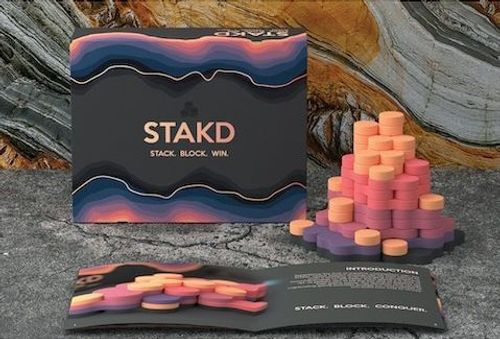
STAKD
STAKD Rulebook
Table of Contents
Table of Contents
Setup
Game Pieces
The game contains 66 pieces in five types:
- BASE x6 (dark grey, the largest piece)
- UNI x24 (small round piece)
- DUO x18
- TRIO x12
- QUAD x6
Every piece has Nodes, which are invisible circular areas (or sections) of a piece. A BASE piece has five Nodes; a UNI piece has one Node; a DUO piece has two Nodes; a TRIO piece has three Nodes; a QUAD piece has four Nodes.
Pieces Per Player
Each player takes the following pieces, depending on the number of players:
| Player Count | BASE | UNI | DUO | TRIO | QUAD |
|---|---|---|---|---|---|
| Solo | x2 | x16 | x10 | x6 | x4 |
| 2 Players | x2 | x12 | x8 | x4 | x2 |
| 3 Players | x1 | x6 | x4 | x2 | x1 |
| 4 Players | x1 | x6 | x4 | x2 | x1 |
| 5 Players |
Game Play
Stack your way to the top. Take turns strategically stacking your pieces while you work toward the top of the play area. Last player to lay a piece wins the round.
Step 1: Lay the Base Foundation
The youngest player starts by laying their base piece. Take turns in clockwise order laying out your Base pieces.
After the first Base piece is laid, at least two (2) Nodes must always touch another Base piece. After the Base layer is laid, any subsequent piece can connect by only one (1) Node instead of two (2).
Base pieces cannot stack. They must only lay side by side at the bottom.
Step 2: Stack and Block
STACK: Take turns stacking one (1) piece each per turn.
BLOCK: Strategically place your pieces to prevent others from making a play.
The first piece laid on a new layer can be placed anywhere on top. It must align with the Nodes below. Subsequent pieces must connect by at least one (1) Node.
- A new layer started with all Nodes aligning to Base Nodes below.
- A subsequent piece properly connected to an adjacent piece. Nodes aligned.
- Although Nodes are aligned to the pieces below, the pieces are NOT connected.
No Overhanging
Pieces cannot overhang. All Nodes must completely sit on a piece below.
- A game piece is properly laid as it is not overhanging.
- This Node is overhanging and is therefore improperly laid.
One Piece Type Allowed Per Piece Below
You can only lay one type of piece on top of a piece below.
For example, once a DUO is placed on top of a TRIO, no more DUOs can be played on that TRIO. Other piece types like UNI, TRIO, or QUAD are allowed.
- This play is legal as both DUO pieces are placed on top of different pieces below.
- This play is incorrect as both DUO pieces are placed on top of the same TRIO piece below.
No Duplicate Stacking
Identical piece types cannot be stacked in the same position.
For example, a TRIO piece would have to stack in an alternate position. Additionally, a UNI piece could never be stacked as it would always be in the same position.
- This play is legal as the TRIO piece on top is staggered from the TRIO piece below.
- This play is incorrect as the above TRIO piece is placed in the same position as the TRIO piece below.
Step 3: New Layers
A new layer cannot be started until after six (6) pieces have been laid on the current layer, unless there are no legal moves to make.
- A new layer can be started because there was at least 6 pieces on the layer below.
New layers cannot be started with a UNI piece unless you have no other pieces in hand.
- This UNI piece cannot be placed to start a new layer (unless you have no other pieces in your hand).
Once a new layer has started, no play can be made on a layer below.
- This UNI piece cannot be played on the layer below after a new layer has been started.
- This DUO piece cannot be played on the layer below after a new layer has been started.
Step 4: Repeat
Repeat steps 2-3 until there are no more plays that can be made.
If you cannot make a play you are out for the remainder of the round. You can never draw new pieces and you cannot pass your turn.
Step 5: Win
The last player to be able to place a piece wins the round, earning one (1) point. The winner of the round starts the next round.
If a player knocks over the play area, the round ends and that player gets deducted one (1) point. A player can earn negative points.
The first player to earn three (3) points wins the game!
Solo Mode
For Solo Play, you must lay all your pieces to win.
If you can't play all the pieces, you lose.
Only play one (1) round. You do not play three (3) rounds.