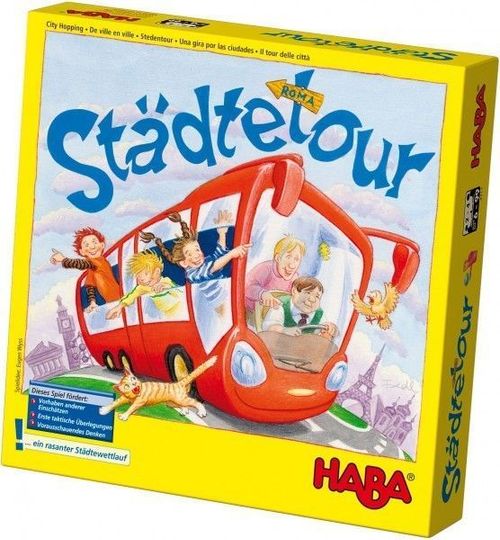
Städtetour
Städtetour Rulebook
Table of Contents
Table of Contents
Contents
- 1 game board
- 1 bus
- 47 bus tickets
- 28 travel destination cards
- 5 wooden stars
- 1 fabric bag
- Set of game instructions
Game Idea
The players travel together on a bus. But each of them thinks up a different destination that the others don't know. Alternately the players take on the role of the tour guide who moves the bus towards his planned destination. In doing so, the players try to determine each other's destinations in order to bypass them.
As soon as a bus reaches one of their desired destinations the players receive tickets and stars as their prize. The aim of the game is to have the highest pile of tickets and stars at the end.
Preparation of the Game
Place the game board in the center of the table. The game board shows a map with 48 stops (28 destinations and 20 intermediate stops) and roads connecting the bus stops. The map legend distinguishes destinations, roads and intermediate stops.
Place the bus on any intermediate stop.
Watch out: The bus can always move in two directions when departing from a bus stop. When placing the bus, its direction should be evident.
Put the tickets in the bag and mix them up well by shaking the bag. Get the wooden stars ready.
Shuffle the destination cards and put them in a provision pile next to the game board. Each player draws a card, has a secret look at it and places it in front of him. You can look at your destination card again at any time during the game.
Hint: The colored circles around the destinations on the game board will help you to quickly identify these locations.
How to Play
Play in a clockwise direction. The player who has been on a bus most recently may start. If you cannot agree, the youngest player starts. He is the first tour guide. Pull a ticket out of the bag and place it face up next to the game board.
What kind of ticket did you pull out of the bag?
- A single ticket: Move the bus forward one stop. Later on in the game you can move the bus as many stops as tickets face up next to the game board.
- A return ticket: First turn the bus around so that it moves in the opposite direction. Then move it as many stops as there are tickets next to the game board.
- A round trip ticket: Free passage to your destination! As a bonus you place a star on the ticket and then move the bus to your destination regardless of the number of tickets next to the game board.
Important:
- If a bus reaches a junction the tour guide is free to choose which direction to take.
- When you reach your destination, you show your destination card and collect all the tickets next to the game board, including the star if there is one. Next you draw a new destination card from the provision pile. If there are none left the discard pile is shuffled and placed as a new provision pile in the center of the table. Then it's the turn of the next player to be the tour guide and pull a ticket out of the bag.
- If you reach the destination of another player while moving the bus, then this player takes all the tickets spread out (refer to "Destination of other player").
Then it's the turn of the next player to be the tour guide. He pulls a ticket out of the bag and moves the bus.
Example
-
move: Simon starts the game and pulls a single ticket out of the bag. He places the ticket next to the game board and moves the bus one stop further on.
-
move: Now Jana pulls a return ticket out of the bag and places it to the right of the single ticket from the previous move. She turns the bus around in the opposite direction and drives the bus two stops in the new direction.
-
move: Then it's the turn of Max. He pulls out a single ticket and places it next to the two tickets next to the game board and moves the bus three stops in the driving direction.
Destination of Other Player
If a bus comes to the destination of another player, this player immediately shouts "Stop!" The game is interrupted even if not all the tickets have been used.
To prove it, the player in question shows his destination card and places it face-up in the center to form a discard pile. He takes all the tickets lying next to the game board and piles them face down in front of him. If a star is there, he also collects the star.
Next the player draws a new destination card from the provision pile. If there are none left the discard pile is shuffled and placed as a new provision pile in the center of the table. Then it's the turn of the next player to be the tour guide and pull a ticket out of the bag.
End of the Game
The game ends as soon as a player has collected the fifth star.
The players all pile up their tickets and stars in one pile in front of them. The player with the highest pile wins the game. In case of a draw there are various winners.
Destination Information
The English section of the instructions closes with a short note on each of the 28 destination cities, giving the capital and a landmark.
Albania
Capital: Tirana. The statue stands in Tirana and represents Gjergj Kastrioti named Skanderbeg. He was an Albanian prince and became famous for his defense of Albania against the Ottoman Empire.
Algeria
Capital: Algiers. The word "oasis" originates in the semitic ancient Egyptian term "waste" and means kettle. Most oases are found in deserts and arise thanks to the existence of a well or water point. There are several large oases in Algeria, with gardens, mosques and shops.
Austria
Capital: Vienna. The picture shows a rider of the Spanish Riding School in Vienna. The school was originally established to train the horses for the Imperial Court.
Belarus
Capital: Minsk. The Orthodox Church "Peter and Paul" was constructed in the Russian Byzantine style and stands in Bereza.
Cyprus
Capital: Nicosia. The beautiful Apollo's Temple at Kourion is a very popular tourist attraction and has been partly restored.
Egypt
Capital: Cairo. The Great Sphinx of Giza is the biggest Egyptian sculpture depicting a lying lion with a human head. In the background is the Pyramid of Cheops the tallest pyramid of the world.
Estonia
Capital: Tallin. Steeped in history, Tallin is the capital of Estonia and was called Reval up to 1918. The medieval town of Tallin was declared in 1997 World Cultural Heritage by UNESCO.
Finland
Capital: Helsinki. Reindeers are widespread in Finland. They belong to the giant mammals living farthest North.
France
Capital: Paris. The Eiffel tower is the landmark of France. The tower is 324 meters tall and was built between 1887 and 1889 for the World's Fair, marking the centenary of the French Revolution.
Germany
Capital: Berlin. Standing 368 meters tall, the television tower is Germany's tallest building.
Greece
Capital: Athens. The Acropolis in Athens, with its remarkable collection of buildings, is the most famous fortress of Ancient Greece.
Ireland
Capital: Dublin. Ireland where there are twice as many sheep as inhabitants.
Italy
Capital: Rome. The Colosseum in Rome is the biggest amphitheatre built in ancient Rome and the largest closed building of the Roman Empire.
Libya
Capital: Tripoli. The Sahara desert covers nearly 85% of the country. Bedouin tents punctuate this fascinating landscape.
Morocco
Capital: Rabat. Camels are masters at "saving water". In the event of a water shortage they can extract water from their fatty humps and can survive for up to 17 days in temperatures of up to 50ºC without drinking water. This makes them a very valued escort in the hot and dry regions of Morocco.
Netherlands
Capital: Amsterdam. The Netherlands is also called the country of the windmills. Even today windmills are considered landmarks of the Netherlands and are very popular tourist attractions.
Norway
Capital: Oslo. Oslo is a city of contrasts, a mix of old and new architecture, parks, hills, museums, monuments, lakes, forests and the fjords. One of the most noticeable buildings is the city hall where each year the Nobel Peace Prize is awarded.
Poland
Capital: Warsaw. A typical wooden house that even today can be found in many places.
Portugal
Capital: Lisbon. The Belém Tower at the mouth of the Tagus river was originally a lighthouse and is one of Lisbon's most famous landmarks. It was used as a prison and an armory until the 19th century.
Romania
Capital: Bucharest. In 1897, Bram Stoker wrote the novel "Dracula" creating a character that has never been forgotten. It is generally accepted that he used the Romanian prince and commander Vlad III as the inspiration for "Count Dracula". Due to this many tourists still visit Romania today.
Russia
Capital: Moscow. Saint Basil's Cathedral is one of Moscow's landmarks. Its proper name is "Cathedral of the Protection of the Mother of God" and it was built between 1555 and 1561.
Spain
Capital: Madrid. No dance that reflects more the beauty and temperament of Spain better than Flamenco. It is considered the traditional dance of Spain however the music is based on influences from different cultures.
Sweden
Capital: Stockholm. This is a typical Swedish frame house. This architectural style is now also becoming increasingly popular outside Sweden.
Switzerland
Capital: Bern. The St. Bernard Dog became famous for their use as avalanche rescue dogs by the monks from the St. Augustine hospice in the St. Bernard Pass. Nowadays generally German shepherds are used for alpine rescues.
Tunisia
Capital: Tunis. The Al-Zaytuna mosque (an Arab term that means olive tree mosque) stands in Tunis. It is also known as the Great Mosque and is the most important mosque in Tunis.
Turkey
Capital: Ankara. The Hagia Sophia or Santa Sophia church was originally a Byzantine church, that was later converted into a mosque and is now a museum. Its name originates in Greek and means Holy Wisdom.
Ukraine
Capital: Kiev. St. Michael's Minster was demolished in the 1930s and the reconstruction of the abbey church only finished in 1999/2000.
United Kingdom
Capital: London. Big Ben is one of London's most famous landmarks. However, the name "Big Ben" refers not to the tower that is almost 100 meters high but to the main bell that weighs approximately 13 tons.