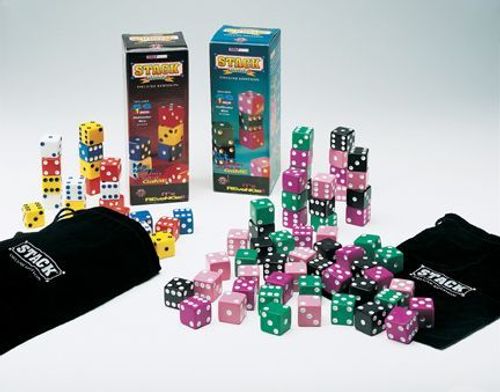
Stack
Stack Rulebook
Table of Contents
Table of Contents
Equipment
Each player gets a different color set of 14(ish) dice.
Starting a round
All players gather their dice and roll them into one big pile. Don't make the pile too compact, or you'll have trouble playing.
How to play
On their turn, a player selects a die of their own color.
That die must not be in a stack with other dice, only solo dice can be picked up.
The player then has two options...
1. Place the die
Select a die or stack on the table of the same value to put your die on top of.
You may not put a die on top of a die of your own color.
You may not place a die on a stack that already contains 4 dice.
2. Roll the die
After selecting a die, you may roll it. You MUST then place it according to the "Place the die" rules above.
If you cannot place the die in accordance with rule 1, your turn is over.
Knocking over stacks and ending the round
If you accidentally knock over a stack of dice, you must return that stack to the way it was.
When a player runs out of playable (unstacked) dice, every other player gets one more turn, then scoring begins.
Scoring
Single, unstacked dice do not score, so they can be removed.
Players score for each stack their color is on top of.
Ones score TEN points each, all others score the value of the top die.
Player with the most points wins!
Strategies
-
Keep track of the other player's score. If someone starts pulling away place your dice on their's whenever possible. Especially on high-scoring stacks.
-
Consider NOT stacking a third dice on a pre-existing, high-value stack. If you are playing with thinking players they will hurriedly close the stack and you won't score anything.
-
Always roll twos. There is only a 1/6 chance your score won't improve. Think about rolling threes as well, since there is a 1/3 chance for improvement and only a 1/6 chance for a lower point value.