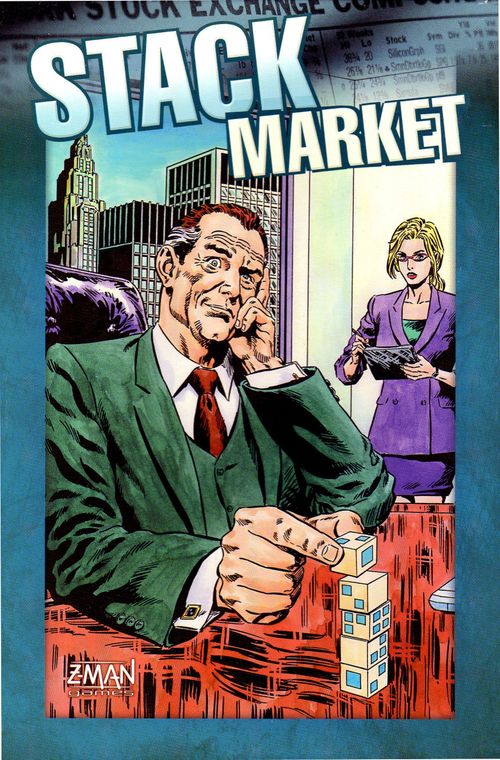
Stack Market
Stack Market Rulebook
Table of Contents
Table of Contents
Contents of the game
- 60 dice with the numbers 0, 0, 1, 2, 3, 4
- Investor markers: 8 pieces, 2 for each colour (different colours, round)
- Company markers: 4 pieces of different colour, rectangular
- Company cards: 4 pieces, in the same colours as the company markers
- Marker for the highest building (red, rectangular)
- Card for the highest building (red)
- Height sheet: 1
- Money: 40 bills (30 bills of 10.000 $, 10 bills of 50.000 $)
- Scale: 1
Preparation
- Each player chooses a colour and takes the two investor markers of this colour.
- Each player receives 50.000$. The money should be stored covered so that the others players do not know the value of your assets. The rest of the money is set aside in the bank.
- As many Company cards are placed on the table as players participate in the game, i.e. either in the shape of a triangle or a rectangle. The space between the cards should be a large as possible (minimum 30 cm).
- In front of each company card 3 dice are stacked onto each other. The number on top of the two lower dice is of no importance, only the visible number of the highest dice is determined by throwing the dice (refer to the picture below). The number of dice represents the height of the building of the company.
- When playing with 4 players all 60 dice are used. With 3 players 10 dice have to be removed from the game. The dice are placed as the dice supply in the middle of the table.
- The height sheet is placed on the table separated from the buildings. The company markers are always placed on the height sheet according to the present height of the buildings, i.e. in the beginning the game all markers are placed on field no 3. Whenever the height of a building is changed, the position of the company markers has to be adjusted.
- The marker for the highest building is placed on field no 15.
- The starting player is determined. Starting with the starting player all players invest in a company in clockwise order, i.e. each player places one of his investor markers on a company card on the table. At maximum two investor markers can be placed at each company. The second investor marker is put in front of each player to denote the colour the respective player. It is not used to invest in a company.
[Sample situation in the beginning of the game: the diagram shows the "Game start" layout, with 2 players investing, a building at height 3, the height sheet, and the dice supply.]
Sequence of play
The players stack dice on the building they are investing in clockwise order. A round is finished when all dice are used in buildings or removed from the game. A game consists of 3 rounds.
During his turn each player must invest in the company where his investor marker is placed at. The rules for the investment is given below. If a company collapses during investment, the player looses money. If the company seems to have become too unstable for further investment, the player should shift his investment to another company.
At the end of each round the players get money according to the height of the building they are investing in. It is also possible to make money during each player's turn by stacking a certain number of dice. The player who earned most during three rounds will win the game.
Starting with the starting player each player conducts the following three actions during his turn in clockwise order.
- Throw the dice: mandatory
- Stack dice on a building: mandatory
- Change of the investment: optional
Each action is explained in detail in the next paragraphs.
1. Throw the dice
The player takes as many dice from the dice supply as dice are already stacked to form the building he is investing in at the moment. He throws all the dice. Take care not to destroy any of the building. It is best to use the game case to throw the dice.
If there are not enough dice left in the dice supply, the player uses all remaining dice. If he succeeds in stacking all the dice, the round is finished (see below: end of a round).
2. Stacking the dice
The dice have to be stacked on the building the player is investing in. The number on the top of the dice may not be changed.
- If there is a dice among the thrown dice with a higher number than the number of the top dice of the building, this dice has to be stacked on the building. By stacking dice the number of the top dice changes continuously. As long as there exists a thrown dice with a higher number than the top dice of the building, dice have to be stacked.
- If the number of the top dice of the building is equal to 4, a thrown dice with the number 0 has to be stacked on top. Dice showing the numbers 1, 2 or 3 cannot be stacked on a dice with the number 4.
If there are many pairs of 0 and 4, many dice can be stacked on the building. As long as dice can be stacked according to the rules they have to be stacked. In the following pictures examples are given for stacking dice.
[Stacking example 1: in this example the thrown dice can be stacked in 4 different ways. Depending on the way of stacking, the number of dice a player has to stack may be different.]
[Stacking example 2: in this example all dice have to be stacked, possibly in the order 4 -> 0 -> 4 -> 0 -> 1. There is no way not to stack all of the dice.]
If many pairs of 0 and 4 are thrown the height of the building increases rapidly.
When stacking the dice the player have to obey to the following rules:
- you are only allowed to use one hand
- the dice of the building may not be touched or moved
- the order of the dice has to be decided before starting to stack the dice. The dice have to be placed in the desired order in front of the player. It is not possible to change the order to reduce, for example, the number of dice that have to be stacked.
- Dice can be stacked individually or in groups. To form the groups in front of the player one can use two hands, however when placing the dice on the building, only one hand is allowed.
- If the dice are stacked neatly it is easier to construct high buildings. However, players may stack the dice less neatly to increase the difficulty for the other player investing in the same building.
- Unused dice are returned to the dice supply.
- The height of the building is immediately adjusted on the height field.
- Players may only stack one dice on top of another dice. A stack like in the picture below is not allowed.
[Figure: a stack that is not allowed (shown in the printed picture below the rule).]
If a company collapses, it will be dealt with as follows:
- All players investing in this company, i.e. their investor marker is lying on the company card, have to pay $20.000 to the bank. If a player does not own enough money to completely pay his debts, he has to give all his remaining money to the bank.
- The dice of the collapsed building are returned to the dice supply. The building is re-erected with a initial height of 3 dice. The number of the top dice is determined by throwing the dice.
- After each collapse 5 dice of the dice supply are removed from the game. Towards the end of a round there might not be enough dice left in the supply to remove 5 dice. In this case the player may finish his turn as explained below. After this the round will be over.
- Even if 5 dice could be removed from the game the player may change the company he is investing in.
- If a building collapsed although nobody was stacking dice on the building (e.g. it was hit by a dice or the table was rocked), the building is reconstructed according to the height on the height sheet. If the number of the top dice is not known anymore, it is determined by throwing the dice.
- The collapse of a building is only valid if a player is constructing the building and is responsible for the collapse.
If certain conditions are met during stacking the dice, the player receives a stacking bonus from the bank.
- If the height of a building is increased by 5 or more dice during a turn and the building does not collapse until the end of this turn, the player receives $10.000 from the bank. The player receives this bonus only one once per turn, even when stacking 10 dice or more.
- The first player to reach a height of 15 dice receives the card for the highest building. If another player breaks this record by constructing a higher building and the building is still standing at the end of the turn, the card has to passed over to the new record holder. The record has to be marked on the height sheet. The record height marker is only moved upwards, never downwards. Even if the highest building collapses later during the game, the record holder can keep the card. The player who owns the card in the end of a round will receive an additional bonus.
3. Change of the investment
At the end of his turn each player can change his investment. He places his investor marker onto a free spot on the company card of another company.
4. End of a round
A round is over when no dice are left in the dice supply.
End of a round
When there are not enough dice left in the dice supply to throw the necessary number of dice, the round might be over. The player has to stack the remaining dice onto the building he is investing in. If the building does not collapse the round is over. If the player does not succeed in the stacking and the building collapses, the dice are returned to the dice supply according to the rules governing the collapse of a building. If at the end of the turn dice are still left in the dice supply, the game continues.
After the end of a round the highest and lowest building are determined. A building must consist of at least one dice to count as a building. If two buildings are of the same height, the higher number of the top dice decides about the highest building. If the number of the top dice are also the same, the highest building is decided by throwing dice for the two buildings.
The player investing in the company with the highest building finally have to succeed in the takeover of the company with the lowest building.
1. Takeover
Takeover can only occur between companies which are invested in, i.e. at least one investor marker must lie in front of the building. The company with the highest building has to take over the company with the lowest building. All dice of the smaller company have to be stacked on the building of the bigger company. If the takeover is successful, the investors receive a bonus, if unsuccessful they will loose money.
The takeover proceeds according to the following rules:
- if two players are investing in the company with the highest building, they have to decide who is in charge of the takeover.
- The dice of the lowest building are placed in front of the player who will take care of the takeover.
- All dice have to be stacked onto the building. The number of the dice is not taking into account, i.e. one cannot reduce the number of dice to be stacked.
- The dice of the building may not be touched or moved, the new dice however may be stacked using both hands.
- The building has to stand for 3 seconds after the last dice has been placed on the building and the hand have been removed from the building in order for the takeover to be successful. If the building starts to collapse during the first 3 seconds, the takeover is not successful.
2. Income / Loss after the takeover
- The players investing in companies which did not take part in the takeover receive $10.000 for each investor marker lying on the company card, i.e. the players receive either $10.000 or $20.000.
- The profits of the players investing in companies which did take part in the takeover depend on the result of the takeover.
- The takeover was successful. All investors of the company with the highest building each receive $10.000 for each investor marker lying on the company card, i.e. in maximum they receive $20.000. In addition the receive of takeover bonus of $20.000 from the bank. Players investing in a company which was successfully taken over do not receive any money.
- The takeover was not successful. The investors of the company with the highest building each have to pay $20.000 to the bank. If the player do not have enough money to pay their debts, they have to pay all their remaining money to the bank. The players investing in the company which was supposed to be taken over receive $10.000 for each investor marker lying on the card of the company.
- The player who possesses the card for the highest building receives $20.000 from the bank, if he received at least $10.000 of income from other sources. If the player invested in the biggest company and the takeover was not successful or he invested in the smallest company and the takeover was successful, he will not receive the bonus for the highest building.
On to the next round... or on to the end of the game
All buildings are converted to buildings of height 3. All other dice are returned to the dice supply and the height marker of the building set to 3.
The game is over after 3 rounds. The player with the highest amount of money wins. If several players have the same amount of money, all will be the winner. Alternatively these player can conduct a final dice stacking contest to decide the winner.
Some hints ...
When investing in a company which is likely to be taken over, the player should defend against the takeover by stacking as many dice as possible on the company. If the takeover is unsuccessful, the player of the smallest company still receive income, while the opponents suffer a big loss.
When investing in a company together with another player, one option is to stack badly on purpose, get money out of the company by stacking at least 5 dice and afterwards shifting the investment to another company, leaving the other player with a very unstable company which is very likely to collapse.
If two players are investing in the same company, the profits at the end of the round are higher, therefore it has to be carefully considered if it is advisable to promote the collapse of a company as written above.
The name of the game (add. Information of the translator)
In the Japanese language there are very many onomatopoeia, i.e. words consisting of 4 syllables which express emotions, states, sounds, etc. Some examples are:
- zara-zara: smooth, flat
- gusu-gusu: hesitating
- piku-piku: sharp (pain)
- ...
There is a enormous number of such words in Japanese, almost everything can be expressed using words like these.
The title of the game also uses such a word. Gra-Gra is written gura-gura in Japanese and gives the impression of something unstable, staggering. The best example of the use of gura-gura is when talking about drunk people, who can hardly walk straight anymore. By hearing the word gura-gura, Japanese immediately get the impression of such a drunk person, which fits perfectly with the buildings constructed during this game.