Stack & Attack
Stack & Attack Rulebook
Table of Contents
Table of Contents
Overview
Background
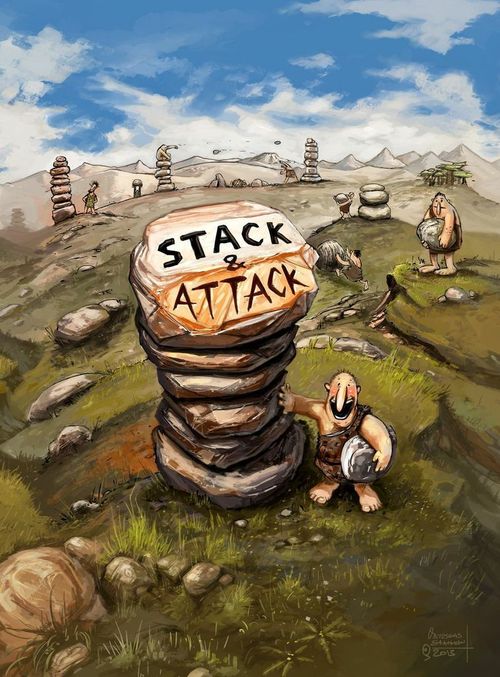
In Stack & Attack, players take on the role of Stone Age Neanderthals who worship the gods of Earth, Sun, and Wind by stacking stone towers to the sky.
Winning Conditions
A player is immediately declared the victor, and is admired by every cave-dweller in the land, if they:
- Complete a tower that is 15 "arms" tall
- If they have the tallest tower when the quarry deck is exhausted (no more face-down cards remain in the quarry deck)
Setup
Starting Deck
The Starting Deck consists of the following rocks:
- 3x Small Flat
- 1x Medium Flat
- 1x Big Flat
- 3x Small Round
- 1x Medium Round
- 1x Big Round
Shuffle this deck and place it face-down in front of you. To the right of this deck is the player's face-up discard pile, representing cards recently purchased from the quarry or used in combat.
Note: At any time you can ask another player how many cards are in their deck.
Scoring Track
Place a scoring track above your deck and discard pile.
Determine the Starting Player
Each player reveals the top card of their deck. The player who flips the highest attack value goes first; other players follow in clockwise order. If there's a tie, tied players flip additional cards until the tie is resolved. All players then shuffle their deck and draw their starting hand.
Starting Hand
Draw three cards from the top of your deck and look at them. Keep these cards hidden from other players.
The Quarry
The Quarry consists of the following:
- Three-Player Game – 32 cards
- 4 copies of six different rock cards
- 2 copies of four different effect cards
- Four-Player Game – 40 cards
- 5 copies of six different rock cards
- 2 copies of five different effect cards
The quarry deck is shuffled together and placed in the center of the table face-down. Flip five cards from the top of the quarry deck and place them face-up to the left of the quarry deck. These cards are available for purchase during each player's turn. To the right of the quarry deck is the face-up rubble pile, containing all of the rocks that have been destroyed during combat.
(See Figure 1, Game Setup, in the printed rulebook for the layout: face-up cards for purchase, quarry deck, rubble pile, player hand, player deck and discard pile, and scoring track.)
Turn Order
Each player completes the following tasks in order during their turn:
1: Spend Energy
You get four energy to spend during your turn. These points can be divided any way you choose between three different actions:
- Stack Rocks
- Purchase Rocks & Effect Cards
- Throw Rocks
Note: Effect cards can be played (discarded to the player's discard pile) from a players hand for no cost whenever specified on the card.
Energy cannot be "saved" from one turn to the next; any unspent energy is lost when the turn ends.
2: Discard Hand
Place your hand face-up into your discard pile.
3: Shuffle Discard Pile into Deck
Flip your discard pile face-down and shuffle it into your deck.
4: Draw New Hand
Draw up to three cards from the top of your deck.
Resolving a Tie
If the quarry deck runs out and two players are tied for the tallest tower, then victory is awarded to the player with the most round rocks in his/her tower. If there is still a tie, then victory is awarded to the player with the most small rocks in his/her tower. If there is still a tie, then victory is awarded to the player with the most combined cards in their deck, hand, and discard pile.
Actions
Stack Rocks
You can stack a rock from your hand on top of the tower by paying its weight value in energy. The following restrictions apply:
- Big Rocks – Require three energy to stack and have a height of three "arms". Big rocks cannot be stacked if the existing tower is seven "arms" tall or taller (note that you can place a big rock at heights 6-7-8 or 7-8-9).
- Medium Rocks – Require two energy to stack and have a height of two "arms". Medium rocks cannot be stacked if the existing tower is twelve "arms" tall or taller (note that you can place a medium rock at height 12-13).
- Small Rocks – Require one energy to stack and have a height of one "arm". Small rocks have no stacking height restrictions.
(See Figure 2, Rock Stacking, in the printed rulebook: the example shows a stacked Small Round Rock increasing the tower height from 3 to 4 "arms". Steps: 1. Select a rock from your hand. 2. Pay its weight value. 3. Stack it on your tower so that the picture for the rock below is completely visible.)
Purchase Rocks and Effect Cards
Face-up rocks and effect cards to the left of the quarry can be purchased by paying their weight or cost value in energy. When a card is purchased, it is placed face-up in that player's discard pile.
Purchased cards from the quarry are immediately replaced from the quarry deck, so there are always five face-up card to the left of the quarry. If the quarry deck is exhausted the game ends immediately, with the player with the highest tower claiming victory.
(See Figure 3, Rock/Effect Purchasing, in the printed rulebook: flip a new card from the quarry deck; pay the card's weight/cost and move it to your discard pile.)
Throw Rocks
You can throw a rock from your hand at another player's tower by paying their weight value in energy:
- Select a rock on the opponent's tower to target. Height restrictions apply for throwing just as in stacking. A thrown big rock cannot target a rock that starts above a height of seven "arms"; a thrown medium rock cannot target a rock that starts above a height of twelve "arms"..
- Each player flips two cards from their deck for their Attack/Defense Draw.
- Total Attack Value = Attack value of the rock thrown + Attack value of all Attack Draw cards + Effect Bonuses
- Total Defense Value = Defense value of rock targeted + Defense value of all rocks stacked above the rock targeted + Defense value of all Defense Draw cards + Effect Bonuses
(See Figure 4, Rock Throwing, in the printed rulebook: the diagram labels Total Attack Value as the attack of the rock thrown, the Attack Draw and its effect cards; and Total Defense Value as the defense of the rock targeted, the defense of rocks stacked above it, the Defense Draw and its effect cards.)
Successful Attack
- If the Total Attack Value is greater than or equal to the Total Defense Value, the attack is successful.
- The thrown rock and the targeted rock are both sent to the rubble pile.
- All rocks stacked above the targeted rock are discarded to the defending player's discard pile.
- All Attack Draw and Defense Draw cards are discarded to their respective players' discard piles.
Unsuccessful Attack
- If the Total Attack Value is less than the Total Defense Value, the attack is unsuccessful.
- The thrown rock is discarded to the defending player's discard pile.
- All Attack Draw and Defense Draw cards are discarded to their respective players' discard piles.
Additional Notes
Stacking Bonus
These effects trigger immediately once a certain stack height is reached.
- Draw +1 – If your stack height is at least five "arms" tall you may draw up to four cards, rather than three cards, at the end of each turn.
- AP +1 – If your stack height is at least nine "arms" tall you may spend up to five energy, rather than four energy, during each turn.
- Hold +1 – If your stack height is at least twelve "arms" tall you may choose to hold one card in your hand (rather than discarding it) at the end of your turn.
Rule Variations
- #1 Discarding Effect Cards – Once per turn, you may discard an effect card from your hand to get one additional action point.
- #2 Scaffolding – You may ignore height restrictions when stacking a big rock by paying twice its weight value.
- #3 Quarry Clean-up – During your turn you may spend two energy to shuffle the five face-up quarry cards into the quarry deck, then flip five new face-up quarry cards.
- #4 Grand Reward – The first player to successfully attack a big rock may select one of the five face-up quarry cards and add it to their discard pile.
- #5 Stone Rampage – Keep track of the defense value of all the rocks you destroy. When the game ends, add +1 to your tower height for each five point of defense you've destroyed.
Two-Player Rules
Easy Difficulty
- Setup the Quarry Deck for a 3-player game (4 copies of 6 different rock cards, 2 copies of 4 different effect cards).
- Each human player gets a standard 10-card deck and scoring track.
- The simulated player, caveman Lorff, gets just a scoring track.
- Each round, Lorff takes his turn after both players have gone.
Lorff's Turn – Flip the top card of the Quarry Deck:
- If it is an effect card, trash it to the rubble pile and draw again.
- If it is a flat rock, stack it on Lorff's tower (ignore height restrictions).
- If it is a round or spiked rock, throw it at the player with the tallest tower.
- If both human players have towers of equal height, Lorff prefers to target the player with the most flat rocks in their tower. If he still can't decide, he prefers to attack the non-starting player.
- Lorff always targets the highest rock that he is legally able to target (following height restrictions).
- For the Attack Draw, flip over the top two cards from the Quarry Deck, then shuffle them back into the Quarry Deck when combat ends.
- Other players can attack Lorff's tower to prevent him from winning; he draws two cards from the Quarry Deck for his Defense Draw, then shuffles them back into the Quarry Deck when combat ends.
Note: in a 2-player game, the game does not end if there are two or less cards on the Quarry Deck when a simulated player does an Attack or Defense Draw (because those cards are returned to the Quarry Deck, it is not really "exhausted").
Hard Difficulty
- Setup the Quarry Deck for a 4-player game (5 copies of 6 different rock cards, 2 copies of 5 different effect cards).
- Play the game with the same rules as for an Easy 2-Player game except with two simulated players, Lorff and Fregg.
- Lorff goes after the first player, Fregg goes after the second player.
FAQ
1. Do I shuffle my deck at the end of every turn?
That's correct; at the end of your turn you discard your hand, shuffle your discard pile into your deck, and draw a new hand. Note that this is different than most deckbuilding games, where you only shuffle your deck once you've ran out of cards to draw. Some players find it a bit tiresome at first, but there are some very interesting strategic reasons why we've made the rules that way.
2. When I reach height 9 on my stack do I get the extra energy right away?
That's right; you get the +1 energy right away.
3. I'm a bit confused about where I can stack big rocks. Can I stack one at height 6-7-8? What about 7-8-9?
When stacking rocks all that matters is their starting height. As long as a big rock starts at height 7 or below you're fine. It is quite common for players to stack big rocks at heights 6-7-8 and 7-8-9. The same basic principle applies for medium rocks at height 12; there is no restriction against stacking a medium rock at height 12-13.
4. What about when I throw a big rock?
When throwing a big rock all that matters is the lowest height of the rock you are targeting. So you can throw a big rock at an opposing big rock stacked at 6-7-8 or 7-8-9, or at an opposing medium rock stacked at 7-8. Again, the same principle is true for medium rocks; you can throw a medium rock at an opposing medium rock stacked at 12-13.
5. Why would a player ever draw less than a full hand at the end of turn? Does a player have to announce how many cards he/she will draw before looking at them?
You declare how many cards you plan on drawing, then you draw that many cards. A player may choose to draw fewer cards if they want to keep more cards in their deck to defend/attack with.
6. If a player reaches a stack height of 15 does the game end immediately or at the end of the round?
The game ends immediately. This was a typo on some of the earlier scoring tracks that was corrected in later editions.
7. Does the game end when the quarry deck runs out or when all the face-up quarry cards are gone?
The game ends immediately when the quarry deck runs out.
8. Can a player ever look through the cards in his/her deck?
Nope, you can only look at the cards in your hand.
9. Do Rock Solid and Big Hit add their bonuses even if no cards are flipped during the Attack/Defense Draw?
Yes, they add their bonus to 0.
(Note: the printed rulebook does not define the effect cards "Rock Solid" or "Big Hit" in its text; they are transcribed here as printed.)
10. What does it cost to play an effect card?
Effect cards can be played from your hand for no cost. Unlike rock cards, you only pay the cost value when the card is acquired from the quarry.
11. Are there any limitations to how many effect cards I can play in one turn?
No, play as many as you want.