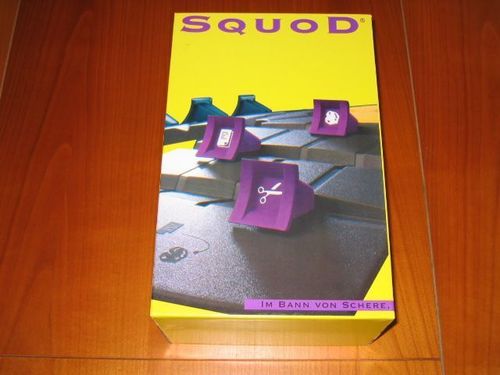
Squod
Squod Rulebook
Table of Contents
Table of Contents
Contents of the Box
- 1 yellow central ring
- 4 grey ramps
- 24 pieces (8 paper, 8 rock, 8 scissors)
Assembly
2 players: Slide two ramps into the yellow ring. The ramps must form a right angle. The players sit next to each other (Fig a).
4 players: Slide four ramps into the yellow ring. The ramps must form a cross. The players who face each other are teammates (Fig b).
The Pieces
Between the three types of piece (paper, rock, scissors) there is a circular strength relationship, as in the classic game "paper, rock, scissors":
- Paper beats rock: "Paper wraps rock."
- Rock beats scissors: "Rock breaks scissors."
- Scissors beat paper: "Scissors cut paper."
No piece is therefore "the strongest" or "the weakest." Depending on the opponent's piece, one can win or lose.
Distribution of the Pieces
Each player receives 6 pieces: 2 paper, 2 rock, 2 scissors.
The pieces differ in colour (dark or light) and in shape (rounded end or hollow end). There are therefore only six pieces of identical shape and colour. Each player receives six identical pieces, for example light and hollow, dark and hollow, light and rounded, or dark and rounded.
- 2 players: One player takes 6 light pieces (rounded or hollow, as chosen). The other player takes 6 dark pieces (rounded or hollow, as chosen).
- 4 players (2 teams of 2): One team takes the light pieces and the other team takes the dark pieces. Caution: each player within a team must have 6 identical pieces, either all hollow or all rounded.
Piece Positions
The pieces have a small stem underneath, which slides into the rails of the ramp. On the yellow ring, the pieces are placed in the holes. Each player can thus see which piece it is.
First Player and Starting Positions
First, draw lots to decide which player begins. Each player chooses one of its pieces. The players show their chosen piece to each other at the same time. The player whose piece wins may begin. If the two pieces are identical, start again.
Each player places its six pieces on starting lines 1 and 2, taking care to hide its arrangement from the opponent(s). Opponents are always to your left or right. If you are playing with four players, your teammate is the person facing you.
The first player advances one piece, in a straight line or diagonally, toward the Squod line. Each player then advances in turn.
Fig 1 (booklet diagram) key:
- A = Squod line
- B = starting line 2
- C = starting line 1
Playing the Game
On the Ramp (Fig 2)
On the starting lines, players may advance their pieces one row, in a straight line or diagonally. Pieces cannot move backward.
On the Squod line, players must advance their pieces in a straight line toward the ring, onto the position directly opposite, if that position is not occupied by a piece of the same player. If that position is occupied by an opposing piece weaker than the piece advancing, the player may capture that piece and occupy the position.
When a piece is on the Squod line, a player may also attack an opponent by playing a SQUOD MOVE. This is one of the game's particularities and is described in its own section below.
On the Yellow Ring (Fig 3)
On the yellow ring, pieces are placed image side up. A piece may move to an adjacent position (left, right, forward or backward) if that position is free. If that position is occupied by an opposing piece weaker than the attacking piece, the player may take that piece and occupy the position.
- You cannot attack an opponent with a piece weaker than the opponent's piece.
- Once on the ring, a piece can no longer return to the ramp.
- Pieces never move diagonally on the ring.
Four Players
When playing in teams, the teams take turns clockwise. Once on the ring, the pieces of one team become shared by both teammates. On the ring, a player may move either its own pieces or those of its teammate.
Captured Pieces
Losing pieces are removed from the board and are always returned to their owner. In a four-player game, the rounded or hollow end of the pieces helps identify them.
A losing piece may be placed back on its owner's ramp, but only on a free position of starting line no. 1. Replacing a losing piece on the ramp does not count as a move.
Winning (Fig 4)
To win, a player or team must line up three of its pieces, one rock, one scissors and one paper, either vertically or horizontally.
When playing with four players, a winning line may be formed with the pieces of both teammates (pieces of identical colour).
The Squod Move
The Squod move is one of the great particularities of the game.
A Squod move allows a player to attack, from the Squod line, a piece that is on the opponent's Squod line. Because these pieces are still on the ramp, one does not know in principle which piece is being attacked.
To play a Squod move, the player must wait for its turn and be in one of two situations:
- Have one of its pieces on the Squod line (Fig 5), or
- Chain a Squod move after having climbed from starting line no. 2 onto the Squod line, in the same turn (Fig 6).
The attacker says "SQUOD" and names the piece it attacks. Each player then shows its piece.
Where a Piece Goes After a Squod Move (Fig 5 and Fig 6)
The winning piece is placed at the intersection of the imaginary lines that run from the two Squod positions.
In case of a tie, each piece stays on its position on the Squod line.
When the attacker has chained a Squod move after climbing from starting line no. 2 onto the Squod line, it occupies, on the Squod line, the position from which it attacked the opponent. It does not return to starting line no. 2.
The losing piece is handled as described under Captured Pieces.
Attention
- A Squod move cannot be played when the intersection of the two Squod lines on the ring is occupied by another piece, whatever that piece is.
- When an attacker loses its Squod move and, as a result, an opponent's piece takes a position on the yellow ring, it is again the opponent's turn to play.
- When playing with four players, a player may attempt a Squod move on a piece of its opponent to its left or right.
Consumer Service
The publisher states that it takes the greatest care in manufacturing the SQUOD game. If, despite this, you notice an error at the time you receive the game, please let the publisher know.
(The publisher's postal address printed under this heading is omitted as publisher contact information.)