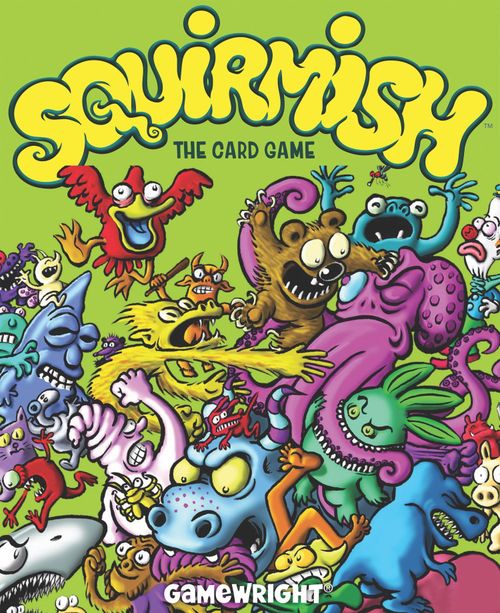
Squirmish
Squirmish Rulebook
Table of Contents
Table of Contents
To Play You Will Need
- A deck of Squirmish cards (70 included)
- Six-sided dice (4 included)
- Googly-eye hit counters (40 included)
- Chutzpah (not included)
Setup
- Shuffle the cards and deal out six face down to each player. Stack the remaining cards in a face down pile off to one side, which will be the deck. Reveal the top card and place it next to the deck to start the discard pile.
- Familiarize yourself with your cards. (See "Anatomy of a Squirmish Card" for details about each card.)
- Give each player a die.
- Place the hit counters in a pile off to one side.
Anatomy of a Squirmish Card
Each card shows the following parts:
- Starting Hit Points: the number in the brown circle at the top left of the card. This is how many hit counters the card starts with and so how much damage it can take.
- Moniker: the card's name, shown at the top of the card's right side.
- Card Number: shown at the top right corner (for example, "A49/70").
- Mug Shot: the picture of the beast or bully.
- Basic Attack: the attack the card makes when it attacks, with the amount of damage listed for each die roll range.
- Special Attack: an additional attack, listed under the basic attack, that is used on specific die results.
- Group Ability: an ability shared by cards of the same group. It is shown on the lower left of the card, with the group's name above the text.
- Ability Symbol: a symbol showing the ability type. The ability types are Attacking, Defensive and Weird.
- Special Ability: the card's own ability, shown on the lower right of the card, with its ability symbol.
- Battle Cry: the quote at the bottom of the card.
- Border: the border colour shows the card's group.
Sequence of Play
- Attack!
- Resolve any abilities.
- Place a card (or move), if you wish.
- Draw a card, if you wish.
How to Play
To start a Squirmish, each player picks one of their cards and places it face down in front of them. Then everyone reveals their chosen cards at the same time. The player who revealed the poor, pathetic card with the lowest hit points goes first by placing it face up in the center of the playing area. Going clockwise, each other player places their chosen card adjacent (top, bottom, left or right) to another card until each player has a card placed in the Squirmish.
Note: If more than one player reveals a card with the same hit points, each tied player rolls a die. Lowest roll places first. Highest roll winces in nervous anticipation.
After this round, the game continues clockwise, starting with the player who placed their card first. On each turn, take the following steps, in order:
Step 1: Attack!
To attack an opponent's card, first declare which one of your cards is attacking which other card. (For example, "Boots Bat is going to beat the butter out of Apebeard.") Cards can only attack adjacent cards (top, bottom, left, or right) unless the card says otherwise.
Then roll your die and read the effects in the basic attack at the top of your card. Depending on the outcome, place hit counters on the attacked card to record the amount of damage done (or, if it is a healing attack, remove them.)
IMPORTANT! The first time you attack with a card, if you say the "battle cry" at the bottom of the card out loud in a silly voice, you earn a +1 DAMAGE or +1 HEALING modifier to your roll with that card on that turn. If multiple cards are affected by your attack, the modifier only applies to the first attack.
Notes:
- Some attacks heal rather than doing damage. This is a sick game.
- When applying modifiers to an attack, addition or subtraction modifiers are always applied before any multiplication or division modifiers.
- An attack result of "NO EFFECT" cancels all modifiers, including from a battle cry.
- REMEMBER! If you forget to declare an attack before rolling, the attack has no effect.
Step 2: Resolve Any Abilities
Every card has a special ability listed on it. Special attacking abilities happen on attack, defensive abilities happen when defending against an attack, and weird abilities happen when specified by the card.
Note: Cards in play with weird abilities can be resolved by their owners even if they are not involved in an attack. These abilities are so weird they even work in outer space!
Some cards also have group abilities, which are similar to special abilities, but are affected by other group member cards in play. Group cards have a border color specific to that group, and the group abilities share this color.
Group abilities are only activated when more than one member of that group is in play (and they are activated even if the cards in play are controlled by different players).
Read the cards and remember your abilities so you can use them at the appropriate time. If you forget to use an ability until after the turn it applies to has passed, it is too late to use it.
Note: Any serious dispute over interpretation of a particular ability on a card should be resolved with rock-paper-scissors. Any silly disputes should be resolved by hitting each other with socks filled with jelly.
Step 3: Place a Card (or Move), if You Wish
Before a card can fight, it must be placed in The Squirmish.
To place a card you can either:
- Set a card from your hand adjacent to another card in play, OR
- Replace a damage-free card you already have in play with a card from your hand. (Discard the replaced card in the discard pile.)
Notes:
- At most, a card can have FOUR adjacent cards, one on each side.
- You may have up to FIVE cards in play at a time.
- Insects have SIX legs. Spiders and centipedes are not insects. They are just bugs.
Face your cards in play towards you, which is how you keep track of who controls them. Alternately, you can just smell your opponents on them.
If you choose not to place a card, you may instead move one of your cards. To move a card, simply swap its position in The Squirmish with an adjacent card.
Step 4: Draw a Card, if You Wish
To end your turn, you may choose to draw the top card of the deck and add it to your hand. You may have up to five cards in your hand at any time. If you have more than five cards, you must discard one. After you draw a card, the next player clockwise starts their turn.
Knockout!
If a card has hit counters equal to or greater than its hit points, it is knocked out and goes into the attacker's victory pile.
Notes:
- You may attack your own cards but if you knock them out, they are discarded instead of going in your victory pile (unless a card says otherwise).
- CONSOLATION PRIZE: If your last card in play has been KO'd and the game isn't over, you may immediately place a card from your hand anywhere in the Squirmish. Then draw a new card. Feel better now!
- You may still resolve special abilities on cards in play before a card is officially knocked out. Go down fighting!
Any cards disconnected from the Squirmish by a knockout must be immediately re-attached to any open card edge around the perimeter of the Squirmish by its controlling player. If multiple cards are disconnected, re-attach starting with the cards of the active player and go clockwise.
Winning the Game
The first player with three cards in their victory pile wins the game!
Note: For a longer game, play to 4 or 5 cards, or cover the dice in molasses.
The Defenestration Variation: For some different strategy, alter the sequence of play to: 1. Draw a card, if you wish. 2. Place a card (or move), if you wish. 3. Attack! 4. Resolve any abilities. Alternately, try playing standing on your heads.
Terminology
Active Groups: Groups with two or more of that group's cards in play (regardless of who controls them).
Adjacent: Cards that share edges to the top, bottom, left or right of another card. Diagonally located cards are not adjacent. Most cards can only attack adjacent cards.
Basic Attack: Each card has a basic attack at the top of the card which is resolved by rolling a six-sided die and reading the results. Attacks can do damage or heal, and often have other effects as well.
Battle Cry: The quote at the bottom of a card. If said out loud in a funny voice the first time a card attacks, that card does +1 DAMAGE or +1 HEALING on one attack on that turn.
Card Limit: Each player is limited to five cards in play at a time.
Damage: Number of hit counters added to a card. These go against its hit point total.
Group Ability: Group abilities are activated when more than one card of that group is in play. (Note that this is true even when the group cards are controlled by different players.)
Groups: Some cards are members of groups, denoted by different color card borders unique to that group. Groups will often be referred to by acronyms on that group's cards (example: SVC for the Spooner Valley Cryptids group).
Hand: Cards held by a player that have not been placed in the Squirmish. Hands are not generally shown to other players.
Healing: Number of hit counters a healing attack removes from a card's hit point count (up to a card's starting hit points).
Hit Points (HP): The number in the circle in the upper left corner of all cards is the card's starting hit point count, which is also the maximum number of hit points that card can have. If a card has damage on it, it can't be replaced in play by the player controlling it.
In Play: Cards are in play when they are in the Squirmish.
Modifiers: Effects of special abilities or special attacks that alter the results of an attack (example: 2x DAMAGE).
Move: When a card is moved, it changes positions with another card in play. Cards can only move to adjacent positions unless an ability says otherwise.
No Effect: If a card attacks and gets a result of NO EFFECT, that attack does no damage or healing and any attack modifiers are ignored.
Placed: A card is placed when a player takes it out of their hand and puts it into the Squirmish.
Replaced: A card is replaced when a player chooses to put a new card in the position of a card they have in play that has no damage. Replaced cards are discarded.
Re-Roll: Ignore the results of a roll and roll again.
Round: The time from the beginning of a player's turn to the beginning of their next turn.
Special Abilities: Abilities listed on a card after its basic attack. These vary greatly, and are used at different times in the game depending on the ability.
Special Attack: A named attack that happens on high die rolls.