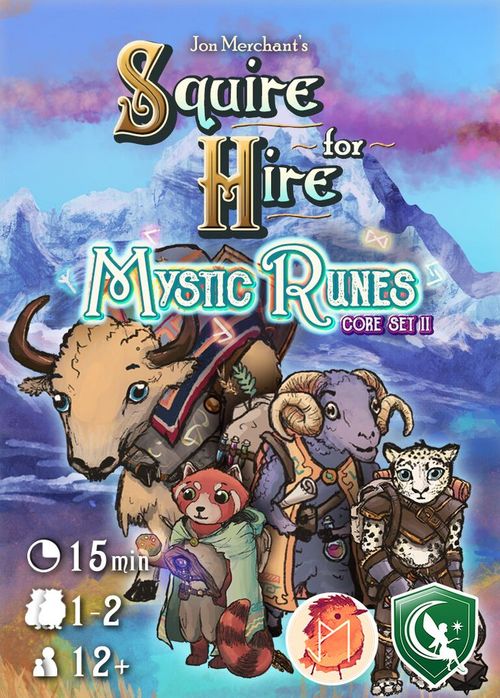
Squire for Hire: Mystic Runes
Squire for Hire: Mystic Runes Rulebook
Table of Contents
Table of Contents
Squire / Rune Reference Cards
- Bonus loot towards completing story cards, and alternate junk scoring, are printed on the top right of each Squire card.
- Bonus points for adjacent items are printed at the bottom of each Squire card.
Runes
Runes are powerful stones that can manipulate a Squire's bag. Rune abilities are active as long as they are visible in your bag. Runes are worth 1 point at the end of the game, and gain an extra point if placed adjacent to any other Rune.
- The VOID rune cannot be covered by any items or loot cards. Any adjacent junk items are worth 0 points regardless of Squire abilities.
- The MORPH rune can take the shape of any one item at game end, except another Rune. Can only be scored as an item or a rune.
- The HIDE rune allows you to place new cards under existing ones in your bag, not in-between. The top card must follow normal item placement rules. (You cannot use an item to complete a Story card this way.)
1. Setup
Deal 1 random Squire card to each player and remove the rest from the game. (Note the bonus item value on the top right, and bonus points for adjacent items at the bottom.)
Shuffle the deck and deal two Loot cards to each player. Each player chooses one card to place as their starting bag, and passes the other card to the player on their left. Add your new card on top of the first (see: To add a new Loot Card). In a single player game, the second card must cover a non-junk item.
Place the deck Story-side up in the middle of the playing area. Flip the top two cards to either side of the deck, Loot-side up. The player who last packed a bag goes first by reading the first Story card out loud.
2. Story and Loot Cards
To earn a loot card, you may:
(A) Check your bag of cards to see if you have enough Item Value (Item Value is the total number of tiles of a given item type) of the type shown.
— OR —
(B) If you don't have enough tiles, a story card may instead require you to use an item in your bag by covering it up. To do this, pick up the Loot card you want as a reward first, and fully cover the item you want to use as the cost.
- Item value required — e.g. Weapons (Bows, Daggers or Swords totalling 2 spaces).
- Use an item — e.g. Cover any 1 valuable item (Coins, Chest, or Ring).
To add a new Loot card to your bag, fit at least one full item from the new card onto the same number of tiles in your bag. You may cover any number of other items or junk, as long as the entire item is covered.
Once you have placed a Loot card, or chosen to pass, end your turn by flipping the Story card to an empty side of the deck. If both sides have Loot cards, cover either card.
3. End Turn
End your turn by flipping the Story card into an empty spot beside the deck. If both sides already have Loot cards, cover one card of your choice.
If you run out of story cards, reshuffle any leftover loot cards once to continue. If only 2-3 cards remain, flip one into a Story card. If one card remains, the next player may choose to take it for free on their turn. In a 1 player game, do not reshuffle loot cards.
Once all possible Loot cards are claimed, add up each Squire's points to determine the winner! In the event of a tie, the player with the least amount of junk wins. Score 25 points or more in solo mode to get hired!
- Your Item Value equals the combined number of tiles that item type takes up in your bag (i.e. the Statue and two necklaces totals 7).
- Place identical items together to score 1 point for the pair.
How to Win
Once all Loot cards are placed, tally your scores as shown below. Items can be counted multiple times for multiple scoring methods. Score 25 points or more in Solo to get hired!
- +1 pt for each Weapon, Armour, Magic, Valuable, Potion or Rune placed anywhere in your bag.
- +1 pt for each pair of identical adjacent items (corner-to-corner doesn't count).
- +X pts for adjacent item combinations and alternate junk scoring shown on your Squire card.
- -1 pt for every visible Junk item.
Combined Decks (3-4 Players)
These rules adjust standard gameplay to allow for up to a 3-4 player game by reducing the playtime required for combined decks and offering players extra choice when completing story cards.
However, they are not required - you may use standard rules when playing with combined decks for a longer game.
You may also wish to use these rules when playing solo or two player games with combined decks.
Setup
Shuffle any two core sets together for a 3-4 player game. Split the combined deck back into two equal decks.
Next, flip the top two cards to either side of each deck as normal.
Gameplay
On your turn, you may attempt to complete either of the two Story cards. However, you may only take the Loot card from beside the Story card you completed.
When flipping a Story card, fill any empty space, or cover any existing loot card if all spaces are filled.
Story cards can be flipped into an empty loot card space if one exists, or into a filled space covering an existing loot card.
Once either Story deck runs out of cards, you may reshuffle only the loot cards beside that deck once.
If either deck runs out of story cards, the game ends. All players add up their points to determine a winner!
Solo Variant
If playing a solo game using the above combined decks rules, solo mode requires 35 points or more to "get hired" instead of the standard 25.