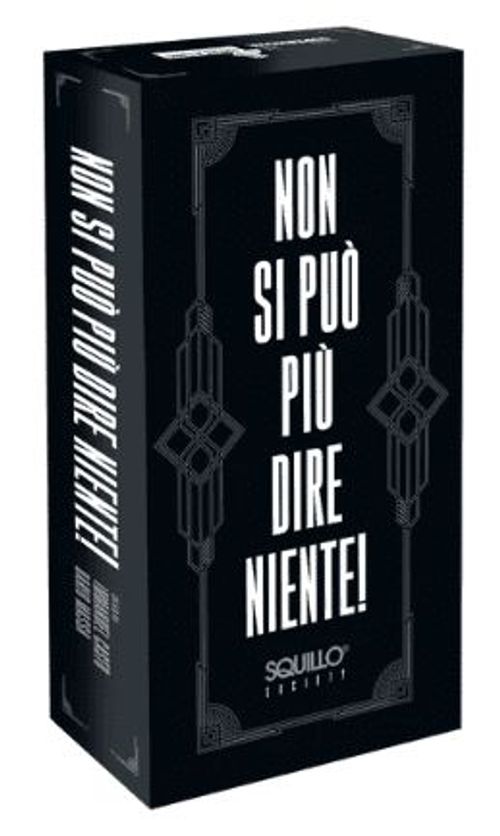
Squillo Society: Non si può più dire niente
Squillo Society: Non si può più dire niente Rulebook
Table of Contents
Table of Contents
Components
- 100 image cards (Carte immagine)
- 2 YES / NO cards (Carte SÌ / NO)
- 20 role cards (Carte ruolo)
- 115 clue cards (Carte indizio)
Role cards carry the role name and a numeric modifier at the bottom of the card. The rulebook cover shows the role cards for the Outraged Citizen and the Troll (the full text of each role is printed on its card, which the rulebook does not reproduce):
- Outraged Citizen (Sei un Cittadino Indignato): win if the Naive One guesses the outrage card. Modifier +2.
- Troll (Sei un Troll): win if the Naive One does NOT guess the outrage card. Modifier -4.
Clue cards carry a number in the bottom corner. The rules do not explain what these numbers mean; the example round below refers to the clue cards by name only.
Setup
- Shuffle the image card deck and the clue card deck, and place both within everyone's reach, face down.
Round Preparation
- Randomly select one player, who will be the Naive One. The Naive One receives the YES / NO cards and places them in front of them.
- The other players each draw 6 clue cards and keep them secret.
- Prepare the role card deck according to the number of players and deal one to each player, except the Naive One (whose role is already defined).
At the end of the rulebook there is a table with the recommended roles for the first games, but you are free to experiment with the composition!
Players look secretly at their role card.
- The Naive One closes their eyes and falls asleep, unaware of the controversy they are about to witness. The player to the right of the Naive One draws the first image card from the image card deck and shows it to the other players. This card represents the object of the controversy and is the one the Naive One must guess.
- Still the player to the right of the Naive One takes 5 more image cards from the top of the deck and shuffles them together with the card drawn earlier.
Having done this, that player lays out the 6 cards (1 correct + 5 wrong) in front of the Naive One.
The Naive One may now open their eyes!
Example of setup, as the Naive One finds it in front of them when they open their eyes. The YES / NO cards may be placed anywhere, considering only that the clue cards will be placed on top of them.
Round Play
1. The Controversy Erupts!
Starting with the player to the left of the Naive One, each player chooses 1 of their clue cards and hands it to the Naive One, deciding whether to put it on YES or on NO.
A clue placed on YES indicates that the concept expressed by that clue is relevant to the image the Naive One must guess.
Conversely, a clue placed on NO indicates that the concept expressed is in conflict with the image, or in any case is NOT relevant.
The outraged citizens will play to get the Naive One to guess the card, while the troll will try to mislead them into getting it wrong!
2. Guessing the Card
After all players have given a clue, the Naive One may try to guess the card by touching it.
If the Naive One chose correctly, they and the outraged citizens win the round, while the troll loses.
If instead the Naive One got it wrong, the only winner will be the troll (or trolls)!
Throughout the entire process the other players must remain in religious silence. They are only allowed to laugh!
3. Asking for More Clues
If the Naive One does not feel ready, they may ask for another round of clues, but to do so they must turn face down at least one image card, excluding it.
If in doing so they turn over the card they were supposed to guess, the Naive One has lost, and with them the outraged citizens.
Important: the other players do not draw more clues and must choose among the ones remaining in their hand.
The Naive One may ask for further rounds of clues until only one face-up card remains (which will then be their choice).
Example Round
(From the perspective of the Naive One)
The Naive One is playing with 4 other players, each of whom has given 1 clue. 3 clues have been placed on YES and 1 on NO.
With the clues received, the Naive One does not feel able to choose the card, so they ask for another round of clues.
To do so they must turn over at least one image card, excluding it from the final choice.
The Naive One chooses to remove 2: the image showing coprophagia and the one with the flat Earth, judging them to be poorly related to the clues received. Had the removed set excluded the correct image, the Naive One and the outraged citizens would have lost, while the troll would have won.
In light of the 4 new clues received, the Naive One focuses on the card depicting domestic violence, sensing which were the troll's comments: Teoria gender (Gender theory) placed on YES and Abusivo (Abusive) placed on NO, which were meant to mislead them.
The Naive One announces their choice by touching the card. The other players confirm or deny that the choice is correct, thereby establishing who has won the round.
New Round
The player to the left of the Naive One becomes the new Naive One.
The role cards are reassigned randomly to the other players, who draw until each has 6 clue cards.
The game then continues with a new round, following the same rules.
It is recommended to continue until everyone present has played the role of the Naive One.
Recommended Roles for the First Games
(The number of cards is 1 less than the number of players, because the Naive One does not receive a role card.)
- 4 players: 2 Outraged Citizens, 1 Troll
- 5 players: 3 Outraged Citizens, 1 Troll
- 6 players: 3 Outraged Citizens, 1 Dimwit (Ritardato), 1 Troll
- 7 players: 4 Outraged Citizens, 1 Dimwit, 1 Troll
- 8 players: 5 Outraged Citizens, 2 Trolls
- 9 players: 5 Outraged Citizens, 1 Dimwit, 2 Trolls
- 10 players: 6 Outraged Citizens, 1 Dimwit, 2 Trolls
- 11 players: 6 Outraged Citizens, 1 Dimwit, 3 Trolls
How each role works (for example, the Dimwit) is explained on the card itself.
Mix Up the Roles
You may change the roles every round; perhaps you can agree that the Naive One of the moment selects the roles. Consider, however, that the combination of roles will make guessing the card more or less easy.
The numeric modifier printed at the bottom of each role card tells you how much the role makes the challenge easier (+) or harder (-).