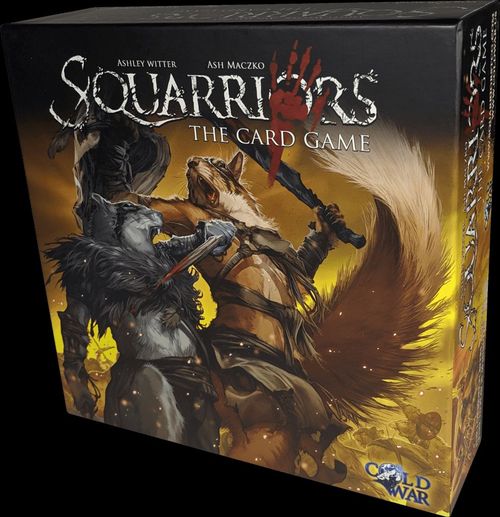
Squarriors: The Card Game
Squarriors: The Card Game Rulebook
Table of Contents
Table of Contents
Introduction
Squarriors the Card Game is a tabletop game based off of the comic book series, Squarriors. In Squarriors TCG, there is no deck of cards to draw from, instead all cards start either in play or in your hand. Your "deck" (known as your Tribe in STCG) consists of 20 points worth of creatures, three domains to defend (your Council, Army, and Vanguard), and 10 tactic cards that start in your hand; all of which are chosen by the you.
During the game, each of your creatures are on the battlefield in one of your three domains. Each of these domains has a strength that will rise and fall as the game progresses. If a domain falls below 1 strength it is permanently destroyed. When a domain is destroyed, all cards in its strategy chain are discarded and all creatures that were there must be expended and moved to another domain.
You have 2 other types of cards besides your domains: creatures and tactics. Creature cards represent the different members of your tribe. Creatures may use abilities, make attacks, block, reinforce, move around the battlefield, and initiate challenges.
Tactic cards, which start in a player's hand, serve two roles. Initially, they can be used as a command, trap, instant, or mark. But after they have been played, they serve a second function when added to a strategy chain. Each of your three domains hosts a strategy chain and each chain adds more layers of abilities and enhancements to your tribe. Each card in a strategy chain can gain new abilities or functions depending on the other cards connecting to them in the chain. Tactics are added to each chain from left to right, with the card on the right always being the most recently played card.
Winning
A player is immediately eliminated from the game if they have lost 2 domains or all of their creatures. Every card they own is removed from the game. The last player remaining, after all opponents are eliminated, is the winner.
Card Anatomy
Creature
- Provision: The Power it takes to upkeep this creature.
- Might: The damage this creature does in combat.
- Will: The tenacity and influence of this creature.
- Blood: The amount of damage this creature can take before dying.
- Tribe Value: You can have up to 20 points of Creatures and 20 points of Domains in your tribe.
- Creature Types: The creature's tribe, species and strategy type.
- Game Text: The keywords and active/passive abilities of the creature.
Tactic
- Power Cost: The Power you must spend to play the card.
- Card SubTypes: Tactics can be a Command, Mark, Trap, and/or Instant.
- Game Text: The action that happens when this card is played.
- Strategy Text: The effect this card has while it is in a strategy chain.
Domains
- Code: Represents your Council.
- Land: Represents your Vanguard. (You can have more than one in play, but only 1 Land can be active at a time. You can change your active Land during your action phase.)
- Stronghold: Represents your Army.
Creatures & Tactics
Creatures
- Tribe: You can have up to 20 points worth of unique creatures in your tribe.
- Types: Creatures have a tribe, species, and a strategy type listed in their creature type rocker. Some cards may target a specific sub-type of creature.
- Moving: Creatures may move from one domain you control to another by expending.
- Attacking: Creatures are used to make attacks. The type of attack they can perform depends on the domain they are in.
- Challenges: Creatures in your Council may initiate and participate in leadership challenges.
- Domain specialization: Some creatures may have a domain listed with a passive or activated ability noted. This creature has this ability while at that domain.
- Keyword: Words listed in bold, at the top of the text box, are keywords. These keywords grant the creature special abilities such as Flying, Swiftness, or Guard.
- Dying: When a creature dies, the player that killed it adds it to one of their strategies.
- Banished: If a creature is banished during the provision phase, it goes to the banished location.
- Strategy chain: While in a strategy chain, creatures don't count as tactic cards, but their strategy type counts towards fulfilling strategy type requirements.
Tactics
- Tribe: You start the game with up to 10 tactics in your hand. You may only have up to 3 copies of each card.
- Cost: The number in the top right corner (red moon) is how much Power you must spend to play the tactic card.
- Subtypes: There are 4 sub-types: commands, instants, marks, and traps. Tactics also have at least 1 of the 4 strategy types, Dominance, Leadership, Manipulation, and/or Stealth.
- Command: May only be played during your action phase, when you have privilege.
- Instant: May be played any time you have privilege, even when it's not your turn.
- Mark: Targets a creature, domain, or other card and stays attached to that card until removed. The controller of the mark may detatch it and add it to one of their strategy chains any time they have privilege.
- Trap: Played face-down in the trap location. When the event noted on the card happens, the controller may activate the card for an instant effect or action.
- Discard: Tactics that are countered or otherwise don't successfully resolve are sent to the discard location.
- Strategy text: The text in the bottom box is the strategy text. This is the effect the tactic has on the game while in a strategy chain.
- Strategy chain: Tactics that resolve successfully are placed in a strategy chain. While in a strategy chain, the tactic has a different effect. This effect may be based off of other cards in the chain, so placement of the tactic can be important. Cards added to a strategy must be placed to the right of the current cards in the chain.
Game Set-Up
The set-up diagram labels three domains: Vanguard (Lands, Stealth Attacks), Army (Stronghold, Dominance Attacks), and Council (Code, Leadership Challenges).
- Domains: You can have up to 20 points worth of domain cards. You must have 1 Code, 1 Stronghold, and at least 1 Land. The domain a creature is in determines what kind of attacks/challenges it can perfom. During your action phase, you may change your active Land -- this can be done at any time you could normally play a command tactic card.
- Domain strength: Each domain's strength is represented by a 6-sided die. At the start of the game, you may set each domain strength to whatever number you choose as long as the sum of all 3 domains is equal to or less than 12. When a domain reaches 0 it is destroyed instantly. The strength of each domain has a name: Vanguard is Discipline, Army is Morale, and Council is Influence.
- Creature: You can have up to 20 points of unique creatures in your tribe. All creatures must be at a domain at the start of a game. Remember that some creatures may be more effective at certain domains.
- Fate die: You will need a 6-sided die for fate rolls and for stealth and manipulation attacks.
- Your hand: You can have up to 10 tactic cards in your hand. You can't have more than 3 copies of any card.
- Power: Use a 20-sided die to keep track of your Power. Power is used to play tactic cards, buy recruits, and pay for abilities. At the beginning of each turn, you gain Power equal to your highest domain strength.
Turn Structure
Phases, Privilege, and the Queue
Active player: When it's your turn, you are the active player (all other players are inactive players). To ensure that all players (both active and inactive) have equal opportunity to perform actions there is an ordered structure to follow; this is known as "privilege" and the "privilege cycle." NOTE: During the first round of a game, players may not target other players, target cards other players control, or initiate challenges.
Privilege: When a player has privilege, that player is exclusively eligible to perform an action (play a tactic card, move a creature, use an ability, etcetera). The actions that player can perform depends on many factors, like whether they're the active player (or not), what phase of the turn they're in, whether an attack/challenge is taking place (or not), etcetera.
Privilege cycle: This is the sequential passing of privilege to and from each player in the game. Each time the active player receives privilege, a new privilege cycle is started. Once the active player performs an action or declines to do so, the next player (in turn order) receives privilege. Once all other players have acted (or declined to do so) and privilege returns to the active player, a new privilege cycle begins.
The queue: When a player performs an action, that action does not happen immediately. Instead, that action is added to the queue so that all other players have a chance to respond before the action resolves. Once all players have declined to responed to the most recent action, that action resolves and a new privilege cycle begins. The queue resolves in the order of the most recent action to the oldest (the original) action in the queue.
Turn phases: Each turn is divided into five phases. At the beginning of the provision phase and action phase you gain privilege. Players don't receive privilege during other phases unless an ability forces a privilege cycle to begin. Once a privilege cycle completes during which the queue was empty, the current phase ends and the next begins. The five phase are:
- Ready: Ready all of your expended creatures.
- Power: Gain Power equal to the highest domain strength you control.
- Provision: Add the provision value of all of your creatures. Banish creatures you control until the total provision value is equal or less than the sum of your domain strengths.
- Action: Play tactics, move creatures, change your active Land, attack, declare challenges, buy recruits, and use abilities. These actions may happen in any order.
- End: Once you have finished doing everything you wanted to do, you move to your end phase. Effects that happen "at the end of your turn" happen now.
Card Locations
The card location diagram shows three columns, Vanguard, Army, and Council.
- Trap location (between Vanguard and Army, and between Army and Council): Play traps in either of these locations.
- Strategy chain (Vanguard): After successfully playing tactic cards or killing creatures, put them into a strategy chain.
- Strategy chain (Army): Shown in the diagram with no caption printed beside it.
- Strategy chain (Council): After successfully playing tactic cards or killing creatures, put them into a strategy chain.
- Banished: Banished creatures go here.
- Discard: Tactics that are countered, fail to resolve, or are destroyed go here.
- Hand: You start the game with up to 10 tactic cards. Don't reveal your tactics to other players.
Attacks
Dominance
Dominance attacks allow you to take one or more of the creatures in your ARMY and attack one of your opponent's domains. You may only make 1 dominance attack per turn.
- DECLARE: Simultaneously expend the creatures in your Army that you want to perform the dominance attack and announce which of your opponent's domains they're going to attack.
- FLEE: The defending player now has a chance to command the creatures in the targeted domain to avoid combat. The defending player can expend any ready defending creatures to remove them from the combat entirely. Creatures who flee are moved to any other domain the defending player controls.
- REINFORCE: If the domain you targeted wasn't an Army, the defending player may reinforce his defenders by expending ready creatures in their Army. These creatures (if any) are now also defenders and contribute their might to the battle. (Reinforcements don't move anywhere while they're reinforcing.)
- SWIFTNESS DAMAGE: Creatures with Swiftness deal damage now. When dealing damage, players who control the creatures taking damage place damage counters on their participating creatures, divided any way they choose. Remove dead creatures. (Since Ghost has Swiftness, you would have to distribute 2 points of damage onto your attackers.)
- NORMAL DAMAGE: Both players' creatures deal damage to their opponent's creatures equal to the total might of all of their creatures without the Swiftness keyword. Remove dead creatures. MORALE BONUS: Anytime there is an Army attacking and an Army defending/reinforcing, the player with the highest Morale (Army domain strength) adds the difference in Morale to the total damage they deal. (If you had 4 Morale and the defender had 3, you would deal 1 additional point of damage in this attack.)
- VICTORY: If you dealt more damage or there are no remaining defenders, you win! You may increase your Morale (Army strength) by 1 or decrease the domain strength of the domain you targeted by 1.
NOTE: At the end of each step, players may play instants and/or use activated abilities (see the Turn Structure section).
Stealth
Stealth attacks allow you to take a creature in your VANGUARD and directly attack one of your opponent's creatures. A creature may only be targeted by a stealth attack once per turn.
- DECLARE: Expend a creature in your Vanguard to perform the stealth attack and simultaneously target one of your opponent's creatures.
- BLOCK: The defender may expend a creature in their Vanguard to attempt to block the attacker. If they choose to block, they must roll 1D6. If that roll is higher than the Discipline (Vanguard domain strength) of the attacker, the attack is blocked. The attacking creature and blocker both deal damage (Swiftness first) to each other and the attack is over -- skip remaining steps. If the block fails or a blocker is not declared, move to step 3.
- INFILTRATION: Roll 1D6. If the roll is greater than the domain strength where the defender is, the attack is successful; deal damage to the defender equal to the attacker's might.
- VICTORY: If your infiltration roll was successful, you win! You may increase your Discipline (Vanguard strength) by 1 or decrease the strength of the defender's (the creature targeted by the stealth attack) domain by 1.
NOTE: At the end of each step, players may play instants and/or use activated abilities (see the Turn Structure section).
Manipulation
Manipulation attacks allow you to take a creature you control and use it to attempt to convince an enemy creature to join your tribe. A creature may only be targeted by a manipulation attack once per turn.
-
DECLARE: Expend a creature you control to perform the manipulation attack and simultaneously target one of your opponent's creatures.
-
PERSUASION: Roll 1D6. The attack is successful if the result plus the attacker's will is greater than the defender's domain strength plus the defender's will. Otherwise, the attack is over -- skip remaining steps.
[Transcriber note: the printed rulebook has no step 3 for manipulation attacks; the numbering goes from 2 to 4 as printed.]
-
VICTORY: If your infiltration roll was successful, you win! If the defender already has a manipulation counter on it, take control of that creature; expend it and place it in a domain you control. Otherwise, put a manipulation counter on the defender.
[Transcriber note: step 4 refers to an "infiltration roll"; as printed. The manipulation attack's only roll is the persuasion roll in step 2.]
-
TRAITOR: If you took control of a creature, it gains the keyword: Traitor. (Traitors retain all counters and marks when they change sides.)
NOTE: At the end of each step, players may play instants and/or use activated abilities (see the Turn Structure section).
Challenges
Leadership
Leadership challenges are powerful displays of will, influence, and leadership. Only creatures in a player's COUNCIL can participate. This is not considered an attack, but still allows you the chance to modify domain strengths.
- DECLARE: Expend a creature in your Council and announce that you are starting a leadership challenge. All other players (in turn order) may expend a creature in their Councils to participate (or decline to do so). Repeat this until nobody adds creatures to the leadership challenge. (Every time a new creature is added to the challenge, all other players have the chance to add more creatures.)
- DETERMINATION: Each player adds the will of their participating creatures to their Influence (Council domain strength). The player with the greatest sum of will and Influence wins. If one or more players are tied for the greatest sum, the challenge ends with no victory step.
- VICTORY: The winner of the leadership challenge may raise or lower any domain strength in the game by 1 point.
NOTE: At the end of each step, players may play instants and/or use activated abilities (see the Turn Structure section).
Recruits & Principal Rules
Recruits
Recruits are non-unique creatures you can add to your tribe during the game.
- Buying: During your action phase you may buy recruits with Power -- the cost of a recruit is in the top right of the card (like tactic cards). You can buy and promote recruits any time you could play a command tactic card.
- Promoting: During your action phase, you may pay 2 Power to promote a recruit. Once paid, replace the current recruit card with the new version of that recruit. All counters, marks, and states transfer to the new card.
- Strategy tree: Recruits can only be promoted to a version of that recruit in the same strategy tree (see below).
- Dying: When a recruit dies, it does not go to a strategy chain; it is removed from the game.
The recruit card shows Train (2 Power): This creature becomes a level 2 Recruit.
The strategy tree is printed as follows:
- Recruit
- Student
- Influencer
- Leader
- Soldier
- Rogue
- Warrior
- Student
Principal Rules
- During the first round of a game, players may not target other players, target other players' cards/domains, or initiate challenges.
- In any case where the text of a card explicitly allows or requires a player to violate one or more rules, the card's text takes precedence.
- In any case where the interaction of card texts have mutually exclusive results, the most restrictive result takes precedence.
- Cards removed from the game are no longer a part of the game they were removed from. Cards removed from the game can't be targeted and can't return to the game under any circumstance.
- In any case where a single effect requires more than one player to perform an action or sequence of actions simultaneously, each of those players perform the first of those tasks in turn order starting with the active player.
- If the target of an ability or card is no longer a legal target when that ability or card resolves, the entire text of that ability or card is ignored during that resolution.
- When a creature dies, or a card is destroyed, all counters, marks, and attached cards are destroyed with it.
Glossary
- Action Phase: The active player may make attacks, start challenges, move creatures, buy recruits, and play tactics -- in any order -- during this phase.
- Active Player: The player who's currently taking their turn.
- Armor Counter: If a creature would receive a damage counter, if it has an armor counter, remove an armor counter instead.
- Army: This is the name of the center domain. It is represented by a stronghold card. Creatures here can initiate dominance attacks and can reinforce.
- Banished/Banish Location: A creature who is removed from a tribe during the provision phase is banished. It is removed from its domain and placed into the banish location.
- Block: Creatures in your Vanguard can block creatures making stealth attacks.
- Blood: The fourth value of a creature's numeric properties. This is the amount of damage the creature can take before it is killed.
- Command: A tactic subtype that can only be played by the active player during their action phase.
- Council: This is the name of the domain all the way to your right. It is represented by a code card. Creatures here can participate in leadership challenges.
- Damage Counter: These are placed on creatures when they receive damage. If a creature has damage counters that are equal to or exceed their blood value, they are killed.
- Discipline: This is the name of the Vanguard's domain strength.
Attacks and Challenges Reference
The final page of the rulebook is a reference sheet summarising the four attack and challenge types.
Dominance Attack
Attack from: Army. Target: An enemy domain.
- Expend attackers.
- Defender may FLEE ready defenders.
- Defender may REINFORCE from their ARMY.
- Deal SWIFTNESS damage (MIGHT). Remove dead creatures.
- Deal normal damage (MIGHT), including MORALE bonus. Remove dead creatures.
- If you dealt more damage, or there are no remaining defenders, you win. Increase your MORALE by 1 or decrease the strength of the domain you targeted by 1.
Stealth Attack
Attack from: Vanguard. Target: An enemy creature.
- Expend an attacker and target a defender. 2a. Defender may BLOCK with a ready creature in their VANGUARD. Otherwise, move to step 3. 2b. Defender rolls 1D6. If the roll is higher than your DISCIPLINE, the attacker is blocked. Creatures deal MIGHT damage to each other and the attack is over. Otherwise, move on to step 3.
- You roll 1D6. If it is higher than the domain strength where the defender is, move to step 4. Otherwise, the attack is over.
- Deal damage to the defender equal to the attacking creature's MIGHT.
- Increase your DISCIPLINE by 1 or decrease the strength of the domain the defender was in by 1.
Leadership Challenge
Challenge from: Council. Target: There is no target, all players can play.
- Expend at least 1 creature in your COUNCIL.
- Each other player gets a chance to expend a creature(s) to participate. Players may continue, in order, to add creatures to the challenge by expending them. Do this until no players want to add creatures to this challenge.
- Participating players add the WILL of all of their participating creatures and their INFLUENCE together.
- The player with the highest total wins.
- The winner may increase or decrease any Domain strength in play by 1 point.
Manipulation Attack
Attack from: Any creature you control. Target: An enemy creature.
- Expend an attacker and target a defender.
- Roll 1D6. The attack is successful if the result plus the attacker's WILL is greater than the defender's domain strength plus the defender's WILL. Otherwise, the attack is over.
- If the defender has a manipulation counter on it, take control of that creature and move to step 4. Otherwise, put a manipulation counter on the defender and end the attack.
- The defender gains the TRAITOR keyword. (NOTE: There are no domain strength changes for manipulation attacks.)