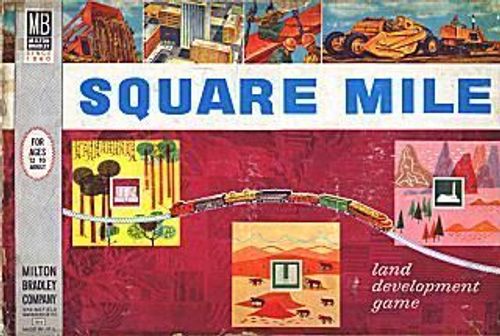
Square Mile
Square Mile Rulebook
Table of Contents
Table of Contents
Equipment in the Game
- The GAME BOARD represents a Square Mile of land divided into 16 TRACTS. There are 25 black BOUNDARY Markers in one of the trays along with the white BUILDINGS. These small "button-like" markers are to be pushed into the square holes of the game board from the BACK (red) side.
The Cross on the "button" goes ACROSS the hole, NOT DIAGONALLY. SNAP the square part of the "button" into the board. The round base should be against the back of the board while the "cross" will protrude above the playing surface. These BOUNDARY MARKERS remain there PERMANENTLY.
-
The PLANNING CARDS in the center tray are divided into squares as is the game board. A different square is darkened on each card. The cards also show a RAILROAD line and a ROAD section (wide black line).
-
The ZONING CARDS are the small colored squares found under the PLANNING CARDS. They are used during the game to show how each TRACT is ZONED. Carefully break them apart.
-
The VALUE CARD should be set up to form an easel. It is referred to throughout the game.
-
The pyramid-shaped PAWNS, in the center tray, are given to the players. Each player has 5 of his own color.
-
RAILROAD - The two strips of black and white plastic are the RAILROAD TRACKS. These are in a long tray.
-
The ROAD and BRIDGE SECTIONS, as pictured on the VALUE CARD, are in with the Railroad. When used, the slots on them fit over the crosses on the BOUNDARY MARKERS.
-
The SUBDIVISIONS, as shown on the VALUE CARD, are also in this tray. These are used after the roads are built.
-
This tray also contains MONEY, a PAD of paper, and separate TRACT CARDS. The use of these cards is explained later.
-
The BUILDINGS are in the tray with separators. They are used after a TRACT is subdivided.
THE GAME IS PLAYED IN TWO STAGES: The PLANNING STAGE, during which the players work together to map out and zone the "Square Mile." The DEVELOPMENT STAGE, when the players compete with each other to make money, as they build Roads, Subdivisions, and Buildings.
THE OBJECT of the game is to be the player who has the MOST MONEY when the game ends.
Planning
The players, as members of the planning board, lay out the RAILROAD and zone TRACTS for Industry, School, Shopping Center, Apartments and the Church.
- The PLANNING CARDS are shuffled and placed FACE DOWN in a pile.
- Each player, in turn, draws one card. The card is held so that the "Square Mile" at the bottom of it FACES the SAME DIRECTION as "Square Mile" on the playing board.
- RAILROAD - The FIRST card drawn shows the location of the RAILROAD. Lay the two Railroad Strips, with their ends overlapping against the row of 5 BOUNDARY MARKERS as pictured on the card.
Immediately, place red INDUSTRIAL ZONING CARDS, one in the center of each of the 4 TRACTS through which the Railroad runs.
- SCHOOL - The second card drawn - The darkened square on this card shows the TRACT where the green SCHOOL ZONING CARD is placed. The TRACTS bordering (not diagonal) the School TRACT, are zoned with green HOUSE CARDS, if not already zoned INDUSTRIAL.
Note: - When a drawn PLANNING CARD'S darkened square is already zoned, draw another card.
-
SHOPPING CENTER - The darkened square on the third card shows where the orange SHOPPING CENTER CARD is placed. The TRACTS bordering the SHOPPING CENTER are zoned with blue APARTMENT CARDS, unless previously zoned.
-
CHURCH - The darkened square on the fourth card drawn shows the tract on which the green CHURCH CARD is placed.
-
UNZONED TRACTS - The remainder of the TRACTS are left UNZONED. Here owners may construct whatever type building they choose. Zoned TRACTS are restricted. Buildings constructed on them MUST match the ZONE CARD.
-
Each planning board member (player) is awarded ONE FREE TRACT. He draws one PLANNING CARD. The darkened square on it becomes his tract. He places one of his colored PAWNS there to show OWNERSHIP.
-
One player is chosen BANKER. He gives each player $100,000 in bills, one $50,000, three $10,000, three $5,000, and five $1,000. The Banker also takes care of the pieces during the game.
-
SEALED BID AUCTION. - Players now have a chance to buy land at bargain prices. Using paper from the pad, they SECRETLY write down their bids as "Tract C - $4,000", "Tract K - $5,000", and so forth. DO NOT BID on Tracts containing colored PAWNS. When there are 4 players in the game, each may bid on 1 TRACT. Three Players may bid on 2 TRACTS; and 2 Players may bid on 4 TRACTS. The Banker then points to one TRACT at a time and asks what was bid on it. The HIGH BIDDER, after paying the Bank, places his PAWN on the TRACT he purchased. When High Bids are tied, the players involved secretly bid again. Very often, after the auction, some players will own more TRACTS than others.
-
BUILDING THE FIRST ROAD - One more PLANNING CARD is now drawn. The heavy BLACK LINE on it shows where the first ROAD SECTION is built. The Banker places a Road Section between the Two BOUNDARY MARKERS at that location. If the road crosses a river, he uses a BRIDGE SECTION. Now each player, in turn, starting with the one who drew the card, places one (only one) ROAD or BRIDGE SECTION. It MUST be attached to the END of the LAST section placed on the board making a continuous road. It may be placed in a STRAIGHT line or at RIGHT ANGLES to it. These Road Sections are FREE (no cost).
Summary of Planning Stage
- Lay Railroad and zone Industrial.
- Locate School - zone Houses.
- Locate Shopping Center - zone Apartments.
- Locate Church.
Free Tract - Each player draws one card.
Sealed Bid Auction - Players bid secretly.
First Road (Free) - Draw card to start, each player lays one section.
Development
From here on, the players act as Developing Contractors. Starting with their present assets (cash and land), they BUILD ROADS to enclose their TRACTS, lay SUBDIVISIONS in the enclosed TRACT, and erect BUILDINGS within these subdivisions. The players compete with each other as they SELL and BUY property on the "Square Mile." The player who makes the most money wins the game.
It COSTS money to develop a TRACT. As improvements are made, the MARKET VALUES increase. The final BUILT-UP VALUE of a Tract is about 20 times its original COST. (See Value Card).
Development Rules
-
Players take turns playing clockwise to the left. Each draws another PLANNING CARD, player with the highest number starts first.
-
EACH TURN IS PLAYED IN THREE PARTS - First part is SELL. Second part is BUILD. Third part is BUY. PARTS ARE ALWAYS PLAYED IN THIS ORDER.
-
FIRST PART OF TURN SELL. In order to obtain cash to develop some TRACTS, a player may want to SELL others he owns to the BANK. They are ALWAYS SOLD to the Bank at the MARKET VALUE as shown on the VALUE CARD. For example, a TRACT zoned for HOUSES is worth $10,000. When it has ROAD sections on two sides of it, the market value has increased to $40,000 . . . $15,000 for EACH ROAD SECTION.
-
SECOND PART OF TURN BUILD. A TRACT is developed in 3 steps; Step 1 - Build ROADS, Step 2 - Lay SUBDIVISIONS, Step 3 - Construct BUILDINGS.
A player can build ANY ONE STEP in ANY ONE TURN. He must announce which STEP he plans to do. For example, he can build ROADS or SUBDIVISIONS in a turn, but he CANNOT DO BOTH.
a.) Step 1 - ROADS. To enclose a TRACT, the player BUYS ROAD SECTIONS from the Bank and places them between the Boundary Markers around his property. The slots on each end of a section fit over the "crosses" on the Boundary Marker. A BRIDGE section must be used where there is a river to cross. ROAD sections cost $10,000, while BRIDGE Sections cost $15,000. A player may buy as many sections as he can afford and place them around his own TRACTS. A TRACT may be FULLY ENCLOSED; i.e. Road sections on all sides, or left partially enclosed with fewer sections around it. A FULLY ENCLOSED TRACT (ready for subdivision) has a MARKET VALUE of $75,000 regardless of how zoned.
b.) Step 2 - SUBDIVISIONS. A TRACT MUST be FULLY ENCLOSED (4 Sections) before a SUBDIVISION can be laid in it. One or more may be laid in a turn. Pay the Bank $25,000 for each Subdivision. The MARKET VALUE of a Subdivided TRACT is $125,000 regardless of how zoned.
Note: - The owner of the SWAMP TRACT must "fill" it (cost $5,000) before Subdividing.
c.) Step 3 - CONSTRUCT BUILDINGS. A TRACT must be subdivided before a BUILDING can be constructed on it. One or more buildings may be constructed in a turn. If a TRACT is zoned, only that type of building can be constructed on it.
For example, the School goes on the Tract zoned "school"; Apartment buildings on a TRACT zoned "apartment", and so on. The Banker must reserve enough buildings in the tray to build up all Zoned TRACTS. Any available building may be constructed on an UNZONED TRACT. Only ONE building may be constructed on a tract. (For example, to construct "Houses and Church," use the "Church" building only, same for "School.") Buildings cost from $25,000 to $100,000 (See Value CARD). The BUILT-UP Value of a TRACT ranges from $200,000 (Houses) to $300,000 (Apartments).
REMEMBER, a player may BUILD only ONE step each turn.
The MARKET VALUE of a TRACT increases more than its development Cost.
- THIRD PART OF TURN BUY. In this last part of his turn, a player is allowed to buy ONE TRACT which is not owned by another player (as shown by the pawn on it). The TRACT can be in any stage of development, except one which is entirely BUILT-UP.
The player selects a TRACT and puts it up for PUBLIC AUCTION. He must open the bidding for at least the MARKET VALUE (See Value CARD). It is sold to the highest bidder. If he is outbid, he may select another TRACT for Public Auction and so on, until he succeeds in acquiring one. An opponent who outbid him on one TRACT is eliminated from further bidding IN THAT TURN.
- BANK - When a player BUYS a TRACT, he pays the Bank and places his colored Pawn on it. When he SELLS a TRACT, the Bank pays him and he removes his Pawn from it.
REMEMBER, in his turn, a player MAY (if he wishes) do any or all of the following, IN THIS ORDER: 1 SELL . . . 2 BUILD . . . 3 BUY.
- When a Tract has been fully developed (BUILT-UP for final sale), and sold to the Bank, it is OUT OF THE GAME.
The GAME ENDS when a player BUYS the LAST UNOWNED TRACT. This Tract can be in ANY STAGE OF DEVELOPMENT.
Players now total their assets. Each TRACT is counted at its Market Value, plus the Money a player has on hand. The player with the highest total WINS THE GAME.
Suggestions for Better Play
Players should NOT display their cash assets openly, since the other players can take advantage of this knowledge in their bidding.
A player, when putting in a ROAD section that will also benefit another player's tract, may wish to negotiate with him to induce him to contribute a share of the cost of that section. This also applies when laying the road sections during the Planning Stage.
Square Mile TRACT CARDS for Advanced Players
To add more play value and greater variety to the game use the TRACT cards!
-
At the very beginning of the game, the Banker breaks them apart, shuffles and places them face down in a pile.
-
Each player, in turn, draws the top card and places it squarely between 4 Boundary Markers on the game board.
-
When a card showing a River is drawn, care must be used, as all River cards must be placed so that the River Sections on them are connected.
-
If necessary, a card may be placed facing a different direction, even up side down, to make these connections.
-
Do not place a card so that the River is blocked, preventing it from flowing to an edge of the Square Mile.
-
When both ends of the River reach the edge, no further River Cards are used.
-
If a card cannot be placed, without violating the above rules, it is returned to the bottom of the pile and the player draws another.
-
If, after repeated drawings, a player cannot place a card, he may remove one card from the board that will make it possible to continue. This card is reshuffled into the pack and he draws again until he can place a card.
-
After 16 cards are placed on the board the game continues starting with the Rules for PLANNING, etc.