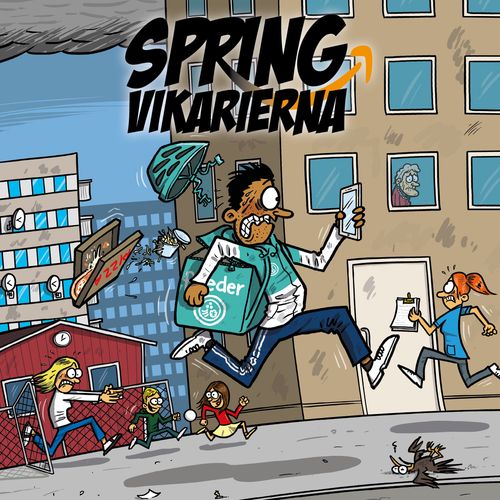
Springvikarierna
Springvikarierna Rulebook
Table of Contents
Table of Contents
Before the Game Begins
Shuffle the event cards (deck [1]) and the job cards (deck [2]) separately and place them on the table.
Each player takes the five desperation cards [3] in their colour and puts them in their hand.
Place the health track [4] on the table.
Place each player's heart on the Heart space as their health marker.
Lay out the calendar cards [5]. The game consists of 14 turns (days) spread over two weeks. Place the turn marker in front of Monday, week 1. When each day begins, move the marker one step forward. Some days have payments to make; these are made at the end of the turn.
Place money in various denominations on the table [6].
The money symbol can have different amounts, for example: +600.
Health
The health symbol is a heart.
When you GAIN health, move your health marker along the path that leads upward in the picture.
When you LOSE health, move your health marker in the opposite direction.
If you would have to move your health further down than the health scale allows, you become burnt out and have lost the game.
If you cannot pay during the game, you are forced to take an SMS loan [7]. You then immediately receive 1000 kr but −2 health. As soon as you begin a turn with at least 1500 kr, pay 1500 kr and discard the loan card.
Then you are forced to stay home with 80% of 0 kr in sick pay, and are guaranteed to be evicted.
Playing a Turn
1. How desperate are you today?
All players secretly choose how desperate they are today by placing one of their desperation cards face down in front of them on the table. Everyone turns their card face up at the same time. Everyone moves their health marker as much as the desperation card shows.
The desperation cards are: Desperate (−5 health), Stressed (−3), Tense (−1), Relaxed (+0), and "Free" ("Ledig", +3). Their captions are: Desperate — "Phone in hand! On the toilet, in bed, everywhere!"; Stressed — "The phone in your pocket, checks it every other minute"; Tense — "Well, you don't really dare to start anything while waiting around"; Relaxed — "Start a laundry or cook food, surely you're allowed to do that anyway?"; Free — "Today I had planned to do something else. But I'll see what turns up."
2. Is any of these jobs actually worth having?
Turn face up as many work cards (arbetskort) as there are players in the game in total.
The most desperate player (the highest number in the corner of the desperation card) chooses first from among the jobs that turned up. If tied, the player with the best health chooses first.
Is it still the same? Discuss with each other who has the most secure employment in real life. The person chosen first. You may take several jobs in the same day, but each job takes up a certain time. You may not choose a job that takes up the same time as a job already chosen.
When you choose a job, you take its income and move your health marker according to the card.
3. And what are we going to figure out today?
Everyone draws their own event cards. Show them in the same order as the jobs were chosen, most desperate first. An event card's effect usually applies only to you (green card), and some cards require time or a choice. The rules are given on the card text. If you have time and the card does not say "choose", you cannot choose to avoid it.
Some event cards affect everyone (purple cards). Show your event cards one at a time, make any decision, then move your health markers and pay or receive money.
Example:
You chose "Stressed" so you could pick up a few sloppy jobs.
You took the shared shift and squeezed in a pass as a bike courier in between. The bike couriers work by piece rate, and you choose to max out there to get 300 kr. Total −6 health for the job.
You drew "Pizza with the mates", but have no time to hang out. Another player drew the card "Understaffing", so you lose a total of 3 health on the event cards.
That is a total of −12 health for 1000 kr. It's a hard life...
If You Get Sick
Sometimes you get sick. Then it is good for your employer that you are hardly employed in any sensible sense.
Some event cards can make you need to "Skip" one or two turns. Then you may not play a desperation card, choose a job, or draw new event cards.
Cold (Förkylning) — choose one:
- "Work on..." — −8 health
- "*One day, then again later" — −4 health. *) Skip one turn.
- "**But I AM sick" — **) Skip two turns.
Stomach bug (Kräksjuka) — ALL in Preschool: Skip two turns.
Who Wins?
The game ends after the second Sunday, when the rent is paid. SMS loans do not help here! Everyone who cannot pay loses the game. The others have finished! (For this time.)
The gig economy has no winners (except the capitalists, then).
Game Variants
Before victory criteria: It is recommended that all players have played at least once.
Secret goals: Before the game begins, all players write down how many steps of health they want to have left from "the wall", and how many hundred-kronor notes they want left after the rent is paid. The goals are secret until the end. Whoever completes the rent wins.
If several players complete the rent, the winner is the one who also reached their goal. If several players reach their goals, the one with the harder goal wins. Here, 1 step of health and 100 kr are considered equally hard to achieve.
Life goals: This is a variant in which you create a character. Before the game begins, all players write down a secret "life goal" that can cover something about how things should be at the end, but also things that happen during the game. These are hidden until the end, for example:
- Relationship builder: "I want to take as many jobs in home care and preschool as possible; I value health and social contacts highly."
- Spender: "I will never say no to expenses, but I also want to have a lot of money left at the end. Health matters less."
At the end of the game there is a free discussion about how well the goals were met.
Playing in Pairs (with or without victory criteria)
Try to keep together a relationship where no one knows where or when they work, and at the same time compete with each other.
If you play in pairs, all costs on the weekly schedule are doubled. The money is shared, but health is still separate: each of you has your own colour and chooses desperation cards and jobs as usual.
In addition to the usual "health costs", at the end of each turn you get:
- −1 health if you were free together at 1 or 0 time slots.
- +1 health if you were free together at 3 or 4 time slots.
Some event cards are marked with a symbol of a hand holding another hand. These cards can be chosen jointly and are counted as being free together. Any money costs must be paid by both if the card is used jointly.
For two players
The game works for two players with the normal rules, but there are a few more choices that become obvious and therefore less interesting. A good variant is to play with each player as a "pair" according to the rules above. That is, each player controls two people who cooperate. Then you have two colours, two health markers, two sets of desperation cards, and so on.