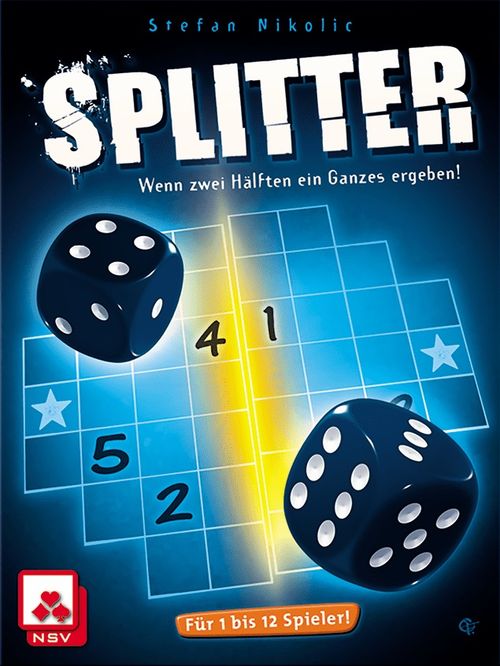
Splitter
Splitter Rulebook
Table of Contents
Table of Contents
Idea of the Game
Every round, all players write down the same numbers (1-6) on their score sheets, but (usually) in different positions. After 22 rounds, each player will have completely filled in their score sheet. If at the end of the game, exactly two 2's are directly adjacent to each other, you score 2 points. If exactly three 3's are directly adjacent, you score 3 points. For exactly four adjacent 4's, you score 4 points, and so on. The two star spaces double the points you score there.
How to Play
Each player receives an identical score sheet and a pencil. For your first game, we recommend using game pad A. You can find the rules for game pad B and the solo variant at the end of this rulebook.
The youngest player goes first. He or she rolls both dice once. Next, all players (including the one who rolled) must write down both numbers on their sheets. Each player may freely choose where to write down these numbers, but there is one rule they must follow:
- Both numbers must be symmetrical to the center line: they must be written down in the same row, at an equal distance from the center. You may choose which number you want to write down on the left, and which on the right.
Diagram: a score sheet row with a center line and two star spaces. The two numbers written this round, 4 and 1, sit in the same row at equal distance either side of the center line.
Tim rolls a 4 and a 1. All players must now write down these numbers on their sheets, in a row of their choice. Sarah writes down both of her numbers in the second row from the top, symmetrical to the center line.
Once all players are finished, the next round starts and the next player in clockwise order rolls the dice as described above: he or she rolls both dice once, after which all players must write down both numbers in a position of their choice, symmetrical to the center line.
Diagram: the score sheet now shows two rows filled in — the top row with 4 and 1, and a second row with 5 and 4, each symmetrical to the center line.
Marie rolls a 5 and a 4. All players must now write down these numbers on their sheets, in a row of their choice. Sarah writes down both of her numbers in the middle row, symmetrical to the center line.
The game continues like this until 22 rounds have been played.
End of the Game and Scoring
The game ends after 22 rounds. Each player's score sheet should now be completely filled in. Points are calculated as follows:
- For each 1 that's on its own, meaning there are no other 1's orthogonally adjacent to it (diagonally is allowed), you score 1 point.
- If exactly two 2's are orthogonally adjacent, you score 2 points.
- If exactly three 3's are orthogonally adjacent, you score 3 points.
- If exactly four 4's are orthogonally adjacent, you score 4 points.
- If exactly five 5's are orthogonally adjacent, you score 5 points.
- If exactly six 6's are orthogonally adjacent, you score 6 points.
Note: Numbers that are diagonally next to each other are not considered adjacent. You're allowed to create multiple, separate groups of the same number. For example, if you manage to create three separate groups containing exactly three 3's, you score 3 points per group.
Very important: both star spaces double the value of a valid group.
Diagram: a completed score sheet. Reading it out: the top row has 4, 4, 1, 6; the next row has 5, then 4, 4, 6, 6, 1, 4; the next row has 4, then 1, 6, 6, 6, 5, 4, 4, 4; the next row has 4, then 10, then 5, 5, 5, 2, 1, 6, 4, 2; the next row has a fraction mark, then 4, 5, 5, 2, 1, 3, 3, 3; the next row has 1, 2, 5, 3, 2, 1; the bottom row has 29, then 5, 3, 3, 2.
Sarah has five single 1's, which means she scores 5 points. Both of her separate groups of 2's score 4 points. Both separate groups of 3's score 6 points. The four 4's at the top left score 4 points. The five 5's on the left are doubled because of the star space. The 6's don't score any points, because the group contains only 5 of them. Sarah's final score is 29 points.
The player with the highest final score wins. If there's a tie, those players share the victory.
Game Pad B
The play area on game pad B also contains 44 spaces, 2 of which are star spaces. The same rules as in the normal game apply: there are no changes. However, the three heart spaces are new, which means the following rules are added:
- Numbers are written down in the three heart spaces according to the normal rules. If at the end of the game you managed to write down the same number in all three heart spaces, you score 5 bonus points.
Note: it doesn't matter whether these numbers are part of a valid group or not.
Example: Max managed to write down a 2 in each of his 3 heart spaces. He scores 5 points.
Solo Game
Splitter also works great as a solo game. With a bit of practice, a solo game will only take around 5 minutes. The same rules as in the normal game apply: there are no changes. You can use the following table to determine how well you scored. The table applies to both game pads. Game pad B allows you to score 5 bonus points. However, its rows are shorter, which increases the difficulty.
Theoretically, it's possible to score 56 points on game pad A and 61 points on game pad B.
| Score | Result |
|---|---|
| 27 points or less | you lose |
| 28-30 points | welcome to the club |
| 31-33 points | okay |
| 34-36 points | decent |
| 37-38 points | nice |
| 39-40 points | great |
| 41-42 points | top notch |
| 43-44 points | world class |
| 45-46 points | amazing |
| 47-48 points | spectacular |
| 49-50 points | unbelievable |
| 51 points or more | otherworldly |