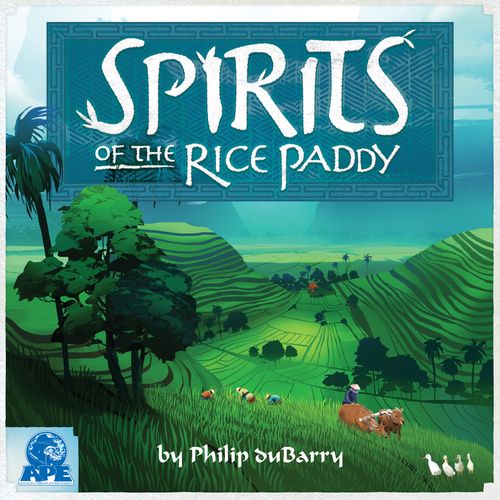
Spirits of the Rice Paddy
Spirits of the Rice Paddy Rulebook
Table of Contents
Table of Contents
Components
Spirits of the Rice Paddy includes:
- 1 rule booklet
- 1 main board
- 4 player boards
- 9 Setup cards
- 12 Rain cards
- 40 Spirit cards
- 24 Achievement tiles
- 30 water discs
- 7 Magic Water discs
- 1 pawn
- 16 rock tokens
- 80 walls (grey sticks)
- 24 gates (black sticks)
- 80 laborers (unpainted)
- 24 livestock tokens
- 24 weeds
- 24 pests
- 12 fertilizer cubes
- 40 die-cut Planted/Grown tiles
- and rice counters.
Main Board
Game Round Track: The black pawn is used to track the current round of play. There are seven rounds and two Spirit Card Drafts.
Harvest Yields: The scores for harvested paddies are affected by several factors, including the number of weeds and pests in the paddy, whether the paddy has been fertilized, and the size of the paddy.
Rain Card: The current Rain card shows the amount of water available in the current round, and whether weeds or pests affect the paddies.
Play Sequence
- Reveal Rain Card.
- Play a Spirit Card.
- Claim water on Rain Card.
- Resolve Spirit Cards.
- Allocate Labor.
- Resolve Farm Actions. (Immediate Grow Round 6)
- Claim Achievements.
- Market (not Round 6).
- Advance Round Marker.
Round 7 (special)
- Remove all pests.
- Allocate Labor.
- Weeds & Ducks.
- Harvest (Bonus Yield).
- Calculate Final Score.
Harvest Yield Chart
Paddy size (number of hexes), across the top: 1 hex / 2 hexes / 3 hexes / 4 hexes / 5+ hexes / 5+ hexes (fertilized). Each cell lists two values: use the black number when harvesting during Rounds 1 through 6, and the grey number for Round 7 (see "Harvest" below):
| Paddy contents | 1 hex | 2 hexes | 3 hexes | 4 hexes | 5+ hexes | 5+ hexes (fertilized) |
|---|---|---|---|---|---|---|
| No weeds, no pests | 5 / 8 | 12 / 20 | 20 / 35 | 35 / 60 | 50 / 90 | 70 / 120 |
| Pests | 3 / 5 | 8 / 15 | 15 / 25 | 25 / 45 | 35 / 60 | 55 / 95 |
| Weeds | 2 / 3 | 4 / 7 | 10 / 15 | 15 / 25 | 25 / 45 | 40 / 70 |
| Pests and weeds | 1 / 2 |
Fertilized paddies count as +1 hex. (Limit 1 per Paddy.)
Player Boards
Farm Actions: Each round, players assign their laborers and livestock to perform various Farm Actions, which are resolved in order from the top down.
Field: Players use walls and gates to divide their field into a number of paddies. At the start of the game, each player builds a free 1-hex paddy in the top left corner of their fields.
Walls: Walls and gates are placed between hexes to form paddies. The green bamboo around the top and left of each field are walls present at the start of the game.
Market: Players hire laborers and purchase livestock from the market at the prices listed. There is an extra "tax" for buying more than one item in a single round.
The Market price track (cost of each successive hire/purchase, left to right):
| 1st | 2nd | 3rd | 4th | 5th | 6th | 7th | 8th | 9th | 10th | |
|---|---|---|---|---|---|---|---|---|---|---|
| Labor | 4 | 4 | 4 | 6 | 6 | 6 | 9 | 9 | 9 | 13 |
| Livestock | 4 | 4 | 5 | 5 | 6 | 6 | — | — | — |
Tax (extra cost for buying more than one item in the same round):
| Buy | 1 | 2 | 3 | 4 | 5 |
|---|---|---|---|---|---|
| Pay | 0 | 4 | 9 | 16 | 25 |
Spirit Cards
Number: Higher-numbered cards are more powerful, but receive the precious water later in the round.
Effect: Some effects occur each time the Spirit cards are resolved while others remain in effect all the time.
Planted/Grown Tiles
These tiles are placed in paddies, Planted-side up, during the Plant Action and are flipped to the Grown side during the Grow Action.
Game Terms
Field – The entire ten hex area on a player's board.
Reservoir – Each field has a reservoir in the top left corner, where water enters the player's field through the starting paddy.
Paddy – Hexes in a player's field that are completely surrounded by walls. Most game actions can only be performed in a paddy, not in the open field. The exceptions are removing rocks and building walls. Water can only be added to complete paddies. A paddy that is full of water is called "flooded". A paddy with no water is called "dry".
Livestock – Oxen and ducks are referred to collectively as "livestock". Any livestock token can be used as either oxen or ducks, depending on the situation.
For example, a livestock token can be placed ox-side up next to a Build Walls or Remove Rocks Farm Action. In the next round, that same token could be placed duck-side up next to the Pests/Fertilize Farm Action to remove pests and fertilize the paddy.
Spirit Cards and Game Rules
The Spirit cards will often contradict the game rules. In all cases, Spirit cards take precedence.
Setup
A. Place the main board in the middle of the play area.
B. Remove 8 water discs for a 3-player game or 15 water discs for a 2-player game and return them to the box.
C. Shuffle the two Spirit card decks separately and place them face-down near the main board.
D. Shuffle the Rain card deck and place it face-down next to the Current Rain Card section of the main board.
E. Shuffle the Achievement tiles. Randomly select six more tiles than the number of players (so, 8 in a 2-player game) and place them face up on the table where all players can see them.
F. Place the black pawn on the "Spirit Draft 1" circle of the Rounds track.
G. Give each player a player board, 2 walls, 1 gate, 1 Planted/Grown token, 1 water disc, 20 laborers, and 6 livestock tokens.
H. Each player fills the Laborer Market spaces on their player board with 10 laborer cubes—one laborer per space, placing the remaining laborers beside their player board. The laborers beside the board are available to that player at the start of the game. Similarly, all of the player's livestock tokens are placed on the Livestock Market spaces (either side may be face-up – it doesn't matter).
I. Each player builds a 1-hex paddy in their field as shown. The black gate can be placed in any position.
J. Shuffle the Setup cards and deal one to each player. These are revealed, and each player modifies their field accordingly, adding four rock tokens as shown and taking any bonus resources (walls, rice, laborers, livestock) listed at the bottom of the Setup card. Then, return all Setup cards to the box.
- Bonus walls are set aside for now, and can be built during the first Build Walls Action without spending any laborers or livestock. Bonus walls can be taken as walls or gates. See "Build Walls" for more information.
- Bonus laborers and livestock are taken from the top-most (lowest-numbered) spaces in the player's market.
Achievement Tile Examples
- "5+ hexes grew this round." — worth 10.
- "All your laborers were productively allocated this round." — worth 10.
- "Harvested a 2-hex paddy this round." — worth 7.
- "5+ hexes in your farm contain water or magic water." — worth 10.
- "Cleared 2+ pests this round." — worth 10.
- "Every hex in your farm is enclosed in a paddy. Hexes may be empty." — worth 25.
- "Cleared 3+ weeds this round." — worth 10.
- "Allowed a 2-hex or larger paddy to rot this round." — worth 10.
Playing Spirits of the Rice Paddy
Drafting Spirit Cards
The game begins with the first Spirit Card Draft. Deal four "Spirits 1-20" cards to each player, who then selects one of those cards to keep and passes the other three cards to the player on the left. Each player then selects another card from the new set of three cards, and passes the remaining two cards to the left. Finally, each player selects a final card and discards the last card face down to the top of the Spirits 1-20 deck. This deck can then be set aside—it will not be used again during the game. Move the black pawn to the Round 1 circle.
Playing Hint: During each round, you will play one of your Spirit cards (see "Play Overview"). When drafting cards, keep in mind that your cards will be resolved in the round they are played and during every following round. Choosing lower-numbered cards will increase your chance of having first access to water, the first chance to claim an Achievement, and the first choice in the market. Higher-numbered Spirit cards are more powerful, but decrease these opportunities.
Later in the game, between Rounds 3 and 4, there will be another card draft using the "Spirits 21-40" cards. Again, four cards are dealt to each player and the players select new cards in the same manner as before, except this time the cards are passed to the right. The second draft Spirit cards are more powerful than the draft one cards, and many of them have special late-game or end-of-game bonuses. Move the black pawn to the Round 4 circle once the second draft is completed.
Play Overview
The game is divided into seven rounds. Rounds 1 through 5 are conducted as shown below. Round 6 is very similar, but there are a few changes. The last round of the game is much shorter. The special rules for Round 6 and Round 7 are explained later.
The normal procedure for a round follows these eight steps, in order:
- Reveal a Rain Card
- Play Spirit Cards
- Claim Water From the Rain Card (first player)
- Resolve Spirit Cards
- Allocate Laborers and Livestock to Farm Actions
- Resolve Farm Actions
- Claim Achievements
- Hire Laborers and Buy Livestock (skipped Rounds 6&7)
Step 1
Reveal a Rain Card
First, turn over the top card of the Rain card deck and place it on the Current Rain Card section of the main board. This card shows the amount of rainfall for the season and any new pests or weeds that will infest players' fields.
Place the indicated number of water discs on the Rain card, based on the number of players (or as many as are available in the general supply if there are not enough). Then, follow any instructions at the bottom of the Rain card to see if there is any pest infestation or new weed growth.
Step 2
Play Spirit Cards
Next, each player will secretly choose a Spirit card to play (from those they drafted earlier). The selected cards are then revealed simultaneously. The players compare their highest cards (indicated by the rank number on the card). Spirit cards played on previous rounds are included in this comparison. These values determine the turn order for the round: The player whose highest card has the lowest value among those compared becomes the First Player, followed by the next-lowest and so on.
Example: After revealing a second Spirit card during Round 2, Shawn has cards 2 and 15, Jonathan has 6 and 7, Brent has 14 and 17, and Rebecca has 10 and 12. Jonathan's highest card is the lowest among the players (his highest card is 7), followed by Rebecca (highest card 12), then Shawn (15), and finally Brent (17). Jonathan is the First Player, followed by Rebecca, Shawn and Brent.
For ease of play, players may wish to hide the numbers on all but the highest-numbered Spirit cards they have played.
Example: Here, Rebecca has hidden the numbers on all but her highest-numbered Spirit card, number 27.
Step 3
Claim Water From the Rain Card
The First Player takes all the water discs from the Rain card and adds them to the reservoir on his player board.
(Rain cards list the number of water discs by player count, e.g. 2p: 2, 3p: 4, 4p: 6.)
Step 4
Resolve Spirit Cards
Now each player, in order, resolves all their played Spirit cards, starting with the First Player. Some of these cards award resources or other aid to the player. Many Spirit cards are active and take effect only during this phase, and are marked with the Active icon. Other cards are passive, and have an effect that applies only during certain phases of the round or which continue to take effect for the entire game. These have the Passive icon.
Example: Pure Spirit (Card 28) keeps weeds from being added to a field at all times for the rest of the game. This card has the Passive icon, so is always in effect.
Note that all Spirit card effects are optional – the controlling player may choose not to use the card's effects. But, if a player does choose to use a Spirit card, it must be resolved in its entirety.
Step 5
Assign Laborers and Livestock to Farm Actions
Next, the players simultaneously assign their laborer and livestock pieces to the Farm Action spaces on their player board. (Note that, unless a Setup card provided bonus livestock, players will only have laborers for the first round.)
Laborers and livestock can be assigned to Farm Actions by placing them next to the board by the action as follows:
Build Walls: Three laborers or one livestock can build one wall. Place livestock tokens Ox side up to show that the oxen are building walls.
Remove Rocks: One livestock can remove one rock from anywhere in the player's field. Place livestock tokens with the ox side up to show that the oxen are removing rocks.
Remove Weeds: One Laborer per paddy hex can remove one weed cube from a paddy. This can only be done with no water in the paddy.
Example: A 2-hex paddy with 2 weeds would require 4 laborers to remove all of the weeds. 3 laborers would be required to remove 1 weed from a 3-hex paddy.
Remove Pests and Fertilize: One livestock can remove one pest from one paddy, regardless how large. Additionally, if the paddy is already planted but not grown, the paddy also becomes fertilized. Add a fertilizer token to the paddy.
Place the livestock token with the duck side up to show that the ducks are removing pests and fertilizing. This can only be done with no water in the paddy.
Example: A 2-hex paddy with 2 pests would require two livestock tokens to remove both pests. It is also fertilized if it has not already grown.
Harvest: Two laborers per paddy hex are required to harvest a paddy. This can only be done with no water in the paddy.
Example: A 4-hex paddy requires 8 laborers to fully harvest.
Plant: One laborer per paddy hex can plant rice. This can only be done with water in the paddy.
Example: A 3-hex paddy requires 3 laborers to plant.
Important: Actions listed in blue can only be taken in paddies that are flooded. Actions listed in red can only be taken in paddies that are dry.
Each Farm Action is described in more detail below.
A player may perform the same Farm Action more than once by assigning a multiple of the required resources.
Example: Two livestock can remove two rocks in a single round, or three laborers and one livestock can build two walls.
In general, it requires one laborer per hex to perform actions. For actions that livestock can perform (Build Walls, Pests/Fertilize) it requires only one livestock token per paddy.
Step 6
Resolve Farm Actions
Once all players are satisfied with their assignments, the following actions are performed in the order listed. All players can resolve each action simultaneously except Water Out and Water In, which must be completed in turn order.
Build Walls or Gates
Walls surround and define paddies, keeping water in or out, as desired. A player may build wall sections by assigning three laborers or one livestock for each wall.
A paddy must be completely enclosed by walls and gates in order to hold water. It is not necessary to build all of the walls to enclose a paddy in a single round, but it is not considered a paddy until it is finished, and incomplete paddies cannot be flooded, planted, etc.
Players can decide how large they want each paddy to be—as small as a single hex and as large as five hexes. Note that large paddies can be very difficult to manage!
The green border along the top and left of each field is a natural barrier where no wall sections are needed.
Paddies may be any shape, as long as they contain no more than five hexes.
Wall sections are green—the black pieces are gates. Gates are built exactly like walls, and are used to control the flow of water. Each paddy must have one entry gate and one exit gate. (The entry gate for the starting paddy is the reservoir.) The location of the gates is up to the player, as long as the gates allow for a single continual flow of water through her paddies.
Water initially flows into the starting paddy from the reservoir on the upper left, then through the gates into the other paddies of the field.
Example: Rebecca has assigned 6 laborers to build 2 walls this round. She decides to take one wall and one gate and places them in her field to finish a 3-hex paddy. The gate can be placed in either location, and will be the entry for her next paddy.
Using Walls and Gates
In general, players will want to build their paddies connected to each other, so that water flows from one paddy to the next. It is possible to build unconnected paddies, but they will not receive water until they are connected to the series of paddies that are already connected to the reservoir.
Walls cannot be moved after they have been built. But, the location of a gate in a paddy may be changed after the paddy is complete as long as the shape of the paddy does not change, the paddy still has the required entry and exit gates, and the new exit gate does not open into another already-completed paddy. Moving a gate does not require laborers.
A completed paddy may be divided into smaller paddies by the addition of new walls, but only if the paddy is completely empty (it has no water, weeds, or pests, and is not planted or grown).
Remove Rocks
During Setup, fields were given rock tokens. Paddies that contain rocks cannot hold any water and cannot be planted. All rocks must be removed from a paddy before it can be used.
A player may remove one rock from anywhere in his field for each livestock assigned to the Remove Rocks Action.
Water Out
Before fresh water is let into a player's field, she may choose to release some or all of the water that's already in her paddies. The Farm Actions marked in red (Remove Weeds, Pests/Fertilize, and Harvest) can only be done while a paddy is dry, so the Water Out Action is important to ensure that these paddies contain no water during those actions.
The Water Out Action is always taken in turn order, starting with the First Player.
It is not necessary to assign laborers or livestock to perform the Water Out Action.
To release water, the player collects all the water tokens she wants to release from her field and places them in the next player's reservoir. If the last player in turn order releases water out of her field, it flows into the sea—return those water tokens to the general supply by the main board.
At the same time, the player may transfer water from a higher paddy (closer to her reservoir) to a lower paddy by having it "flow" through her gates. This water can never travel "uphill"—i.e., from a paddy to one that is closer to the reservoir. Also, water can only flow into completed paddies, never into an open field, a partially-completed paddy, or a paddy that has a rock in it.
Water may flow through paddies that already contain water.
There can only be one single water token in each paddy hex.
A player may leave a paddy partially filled with water after the Water Out Action, but she will not be able to use that paddy during the Remove Weeds, Pests/Fertilize, or Harvest Actions.
Example: Rebecca can move water from her starting paddy, through the 2-hex paddy that already contains water, and into her newly-completed 3-hex paddy. It's okay for this paddy to be only partially filled after the Water Out Action is complete.
Magic Water is never removed from a paddy once placed there. It remains in that hex for the rest of the game.
Remove Weeds
Once water has been released from a paddy, it can be cleared of weeds (green cubes) and pests (black cubes). A single weed cube can be removed by a number of laborers equal to the number of hexes in the paddy.
Example: Rebecca's 3-hex paddy has 2 weeds. 6 laborers must be allocated to remove both of them. 3 laborers can remove 1 weed, leaving 1 behind.
Remove Pests and Fertilize Paddies
Only livestock can remove pests. Each livestock assigned can remove one pest cube regardless of the size of the infested paddy.
As a bonus, the livestock also adds one white fertilizer cube to any planted (but not grown) paddy—grown paddies cannot be fertilized. Livestock can fertilize a paddy even if it did not contain any pests. Only one fertilizer cube may be added to each paddy.
A paddy must be dry in order to be cleared of pests and fertilized. Adding water to a field later does not remove the fertilizer.
Harvest
Harvesting can only occur in a dry paddy with Grown tiles. Two laborers are required to harvest each hex. Refer to the Harvest Yield Chart to determine the amount of rice produced:
Paddies with no weeds or pests score the top row. Paddies with one pest score the second row, and those with one weed score the third row. If a paddy has more than one weed and/or pest, it scores the fourth row.
Fertilized paddies count as being one hex larger.
The player takes the indicated amount of rice from the general supply. Use the black numbers when harvesting during Rounds 1 through 6 and the gray numbers for Round 7.
After scoring a harvested paddy, remove all Grown tiles and fertilizer cubes. Any weeds and pests remain in the paddy.
Example: Shawn receives 2 rice when harvesting his 1-hex paddy because it contains a single weed. He also receives 20 rice for his 3-hex paddy because it has neither weeds nor pests. Neither paddy was fertilized.
Rotting Paddies
Grown rice paddies must be harvested in order to collect any rice. Any grown paddies that are not harvested will rot instead, and are immediately cleared. The player must remove all Grown tiles and fertilizer cubes from the paddy. Any pests or weeds are also removed from a rotted paddy. Players receive no rice for rotted paddies.
Partial Harvesting
A player may choose to harvest only some of the hexes in a grown paddy. Rice is collected as though the paddy only had the number of hexes actually harvested. But, all weeds and pests in the entire paddy are counted when harvesting.
Example: Shawn harvests only 2 hexes in his 3-hex paddy, so he only gets 12 rice.
When clearing a field after a partial harvest, the player must remove all of the Grown tiles and fertilizer cubes from the entire paddy as normal. Weeds and pests remain.
Water In a Paddy After Harvesting or Rotting
Any water that is left in any paddy after harvesting or rotting remains in that paddy.
Playing Hint: Normally, there cannot be any water in a paddy after harvesting, but some Spirit cards may allow you to harvest a flooded paddy. Also, if you are planning to let a grown paddy rot, you may leave the water there during the Water Out Action.
Water In
During this step, water stored in a player's reservoir (either from the Rain card or released by other players during the Water Out Step) flows into the paddies.
The Water In Action is always taken in turn order, starting with the First Player.
It is not necessary to assign laborers or livestock to perform the Water In Action.
Like the Water Out Step, water must flow "down" from the reservoir through the starting paddy, then through gates to each paddy in order, and finally out into the next player's reservoir (or, in the case of the last player, into the sea and back to the supply).
Farm Actions colored blue (Grow and Plant) can only be performed in paddies that are flooded.
Players cannot have any partially-flooded paddies at the end of this phase.
To perform the Water In Step, a player takes all available water from her reservoir and distributes it to any paddies she wants to fill. This new water can "flow through" any paddies on its journey through the field. Any leftover water is transferred to the next player's reservoir.
Since paddies cannot be only partially flooded during the Water In Step, if a player cannot completely fill a paddy, any water in that paddy must flow into a lower paddy of her field or into the next player's reservoir (or the sea, in the case of the last player).
Example: Rebecca has 4 water in her reservoir at the start of the Water In Step. She places 1 water in her starting paddy, and 2 more in her 2-hex paddy to completely fill it. Since she cannot completely fill the 3-hex paddy with the last water, it goes to the next player.
Grow
Any paddy that has already been planted and contains water now grows.
The players flip any Planted tiles in all watered paddy hexes over to the Grown side. No laborers are needed—growing happens automatically. Any planted paddy that is not flooded does not grow, but the paddy remains planted—there is no penalty for a planted paddy without water failing to grow.
Grown paddies can only be harvested during the next round.
Plant
Once all growing has been completed, any flooded paddy with no Planted/Grown tiles can be planted. One laborer must have been assigned to each paddy hex to be planted.
Players place a Planted/Grown tile with the Planted side up on each hex planted. A paddy cannot be partially planted—every hex in the paddy must be planted at the same time.
Planting an empty flooded paddy is optional. There is no penalty for leaving a flooded paddy empty.
During Round 6 there is an additional Grow Action right after planting. Any flooded paddy that has been planted (during this or an earlier action) immediately grows. See "Playing Round 6".
Step 7
Claim Achievements
In turn order, each player may claim one of the available achievement tiles if she has satisfied the requirements listed on the tile, collecting the indicated rice and returning the achievement tile to the box. No player may claim more than one achievement per round.
Step 8
Hire Laborers and Buy Livestock
Players may hire laborers and purchase livestock from their private market on the left side of their player boards. Players may acquire as many laborers or livestock as are available, paying the indicated costs (in rice) for each. Laborers and livestock cannot be sold or traded—they will remain with the players until the end of the game.
If a player acquires more than one item, he must pay an additional tax as indicated on the Tax Table on the player board. This tax is in addition to the normal cost of the items. There is no tax to take just one item, two items cost a tax of 4 extra rice, and three costs an extra 9 rice. This tax is incurred regardless of the mix of laborers and livestock taken.
This step is skipped on Rounds 6 and 7.
Example: Brent hires a laborer for 4 rice and a second for 6 rice. He also buys a livestock for 5 rice. Since he purchased three items, he must pay a tax of 9 rice, for a total of 24 rice. The next round he buys just one livestock for 5 rice, and incurs no additional tax.
Playing Round 6
During Round 6, the following changes from normal play apply:
There is an additional Grow Action immediately after the Plant Action.
There is no Hire Laborers and Buy Livestock Step.
Playing Round 7
During the last round, players resolve only some of the normal steps, while adding a few unique ones.
Do not reveal a new Rain Card, and do not play or resolve any Spirit Cards.
Round 7 is divided into these six steps:
- Remove all Water from Paddies – Since there will be no more planting or growing, water will not be needed. Removing all the water makes resolving the other steps a bit easier.
- Allocate Labor – This step is done as normal. However, laborers and livestock can only be added to the Remove Weeds, Pests/Fertilize, and Harvest action spaces. Walls cannot be built, rocks cannot be removed, and paddies cannot be planted.
- Remove Weeds – This action is taken as normal.
- Pests/Fertilize – This action is taken as normal.
- Harvest (Bonus Yield) – This action is also taken as normal, except the players receive the gray yield numbers during Round 7—These numbers are higher than the normal yield numbers.
- Calculate Final Score – Finally, each player counts their rice. The player with the most rice is the winner! In the case of a tie, the tied player with the highest-numbered Spirit Card is the winner.
Magic Water: Magic water is provided by some Spirit cards. These Spirit cards resolve only once - not every Round like other cards. Magic water remains in the selected hex for the rest of the game, and counts as water being present in that hex or not, as the player desires during any step.
The Rahdo Rule
The Spirits game preview on the very popular Rahdo Runs Through Youtube game channel was instrumental to the game being so well-funded on Kickstarter (https://www.youtube.com/watch?v=1oga6yz3V4k).
Rahdo suggests that players wanting to remove some of the game's inter-player aggression can make changes as follows during Setup:
- Remove the following Spirit cards: 3, 4, 14, 22, 26, 34.
- Remove the Rain cards with the following numbers in the lower right: 10, 11.