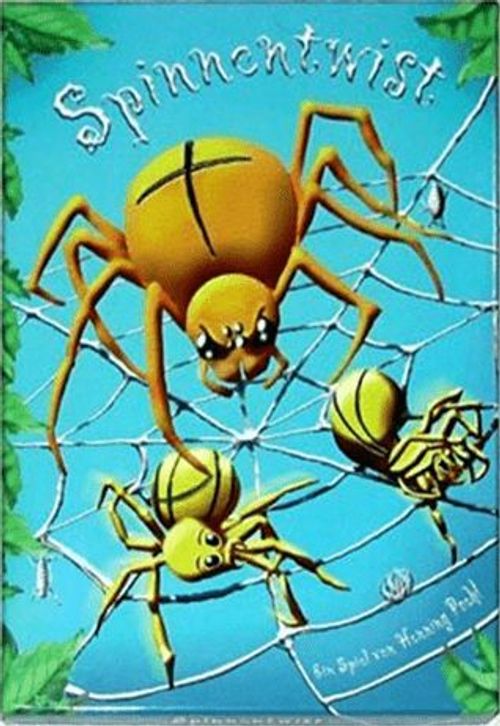
Spinnentwist
Spinnentwist Rulebook
Table of Contents
Table of Contents
Components
- A double-sided game board with two different webs (spider webs).
- One female spider (large yellow playing piece).
- 20 male spiders (small playing pieces) - 10 white and 10 black.
- One six-sided die.
Object of the Game
In this game each player leads a band of male spiders that try to mate with the female spider in the web, without being eaten by the female.
Setup
The two sides of the game board show two different spider webs. One web is chosen and placed in the middle of the table (for the first game the simple web "Sommermorgen" (Summer Morning) is recommended).
The female spider is placed in the centre of the web.
Each player receives ten male spiders of one colour and lays them out in front of himself. These males form his supply.
The players roll the die. The player with the highest number begins the game. In case of a tie, roll again.
Turn Sequence
The game is played in alternating turns.
The player whose turn it is may move each male spider of his colour that is in the web at the start of his turn, and in addition may place one new male spider into the web (as long as he still has males in his supply). On the first turn of the game a player must place a male, since there are no spiders in the web yet.
Every movement (or placement) of a male spider in the web is followed by a reaction of the female spider. The reaction of the female spider is carried out by the opponent.
Board Terms
Movements are carried out on the spider web.
A spider web consists of a number of spokes (dashed lines in the example illustration) that run from the centre of the web outwards. Between the spokes run various cross-connections (solid black lines).
Where spokes and cross-connections intersect there are crossing points (the black dots).
1. The Male Spiders
The male spiders are always led by the player whose turn it is.
a) Placing a New Male Spider
Once per turn a player may, at any moment of his turn, place a male spider from his supply onto any free field at the edge of the web.
Male spiders may only be placed on the outermost field of a spoke (the large light-grey highlighted fields in the example illustration).
A male spider that has just been placed into the web may not move again in the same turn.
The marker of the spider is turned over (so that the spider is no longer visible) to show that the spider may not be moved again during the player's turn.
A player does not have to place a spider during his turn; he may forgo placing one if he wishes.
b) Moving Male Spiders
During a turn the player may move each male spider of his colour that is in the web at the start of his turn once.
Movements are always carried out along the lines (spokes or cross-connections) and always lead from one crossing point to another.
A male spider may only move one field at a time (that is, always only to an adjacent crossing point).
A male spider may not move onto a crossing point occupied by another male spider.
After the movement, the player turns the marker of the spider over to show that the spider may not be moved again during the player's turn.
A player does not have to move a spider; he may also forgo moving a spider. He then simply turns the marker of the spider over at the place where the spider stands, to show that he does not want to move that spider again during this turn.
Note: a player whose turn it is must make at least one movement with a male or place a spider. In other words, a player must provoke at least one reaction from the female spider each turn (see below).
c) Matings
A male spider that stands on a crossing point directly next to the female may move onto the female's field and carry out a mating.
The male that moves onto the female's field has automatically completed a successful mating. It is immediately removed from the web and placed on the field "Mated".
Only one male of each player (colour) may mate in a single turn.
Note: a mating only takes place when a male moves onto the female's field. Conversely, if the female moves onto the field of a male (see below), no mating takes place; the male is eaten by the female.
When a player has turned over all of his male spiders and all reactions of the female spider have been carried out, he turns the spider markers back over to the other side.
Then the other player is on turn.
2. The Female Spider
Whenever the web is shaken, the female is caused to react.
The web is shaken as soon as a male spider is placed into the web or a male spider moves within the web.
Note: if a male spider's marker is merely turned over without the male having moved beforehand, the web is not shaken and the female does not react.
The reactions of the female spider are always carried out by the opponent.
a) Moving the Female Spider
Unless she is busy eating (see below), the spider always reacts to a shaking of the web by moving.
The female spider cannot be moved freely; she must be moved according to the following rules:
- The female spider always moves in the direction of the last male spider that moved or was placed.
- The distance the female spider moves depends on how strongly the web is shaken. The strength of the shaking is decided by the number of male spiders sitting on the spoke where the shaking takes place. The distance the female spider moves therefore always equals the number of male spiders (regardless of colour) sitting on the spoke on which the last moved male ended its movement (or was placed).
- If a male moves onto the crossing point in the centre of the web, then the spoke with the most males on it is counted for the female's movement. As long as the male stands in the centre of the web, it counts towards all spokes.
- The female spider always uses the shortest possible path.
- If several paths are of equal length, the female spider always prefers paths on which she can catch prey.
- If the female cannot catch a male on any of the possible paths, the player who controls the spider decides which path the female takes.
- If the female can catch a male on several different paths, the player who controls the spider decides which path the female takes. The female does not have to run to the nearest available prey. If she can catch prey on her path, it does not matter where she catches it.
- The female keeps moving until she reaches an occupied crossing point or has used up the available number of crossing points. The female may not break off her movement early without reason.
- If the spider moves onto an occupied field, she immediately eats the male spider on that field (regardless of its colour). That male spider is removed from the game at once and placed on the field "Eaten".
- If a male moves onto the female's field to mate, the female reacts by not moving, and the mating is carried out.
b) Eating
Whenever the female spider moves onto an occupied crossing point, she eats the male on it. How long the female is occupied by eating is determined by rolling the six-sided die. The die is placed on the spider with the rolled number showing, to show that the female is busy eating the male.
While she is eating, the female makes no movements.
Now, each time the female would have to react because a male moves or a new male is placed into the web, instead of moving, the die is turned down by one (the number showing is always reduced by only one, regardless of how far the movement would have taken her).
If the die already shows one when it has to be turned down, it cannot be turned down any further, and is instead removed from the female by her. The female has then finished eating and may move again.
Note: a female that is eating may also mate with males. The die is also turned down by one when a mating takes place.
3. End of the Game
The game ends as soon as a player has only one spider left in total (in the web and in supply).
4. Scoring
Each of your own male spiders on the field "Mated" scores +2 points, and each of your own male spiders on the field "Eaten" scores -1 point.
The player with the most points at the end wins.
5. Examples
The example illustrations are not reproduced; the German text describing them is transcribed below.
Player A has placed a male spider on crossing point 1, or has pushed it there from a neighbouring crossing point. Two males now sit on that spoke (one of player A and one of player B). The female will therefore move two crossing points in the direction of the last moved/placed male. The shortest connection from the female spider (the large dot with the cross) to the last moved (or placed) male spider on crossing point 1 is 5 crossing points.
There are several alternative routes (dashed lines). The player who controls the female may choose whether to move the spider to crossing point 2, 3 or 4.
Second example: Player A has placed a male spider on crossing point 1, or has pushed it there from a neighbouring crossing point. The shortest connection from the female spider to the last moved (or placed) male spider on crossing point 1 is 5 crossing points. Males sit on two of the crossing points that the female can reach. The player who controls the female may choose whether to move the spider to crossing point 2 or 4, where the female can eat. He may not move the female to crossing point 3.
Third example: Player A has placed a male spider on crossing point 1, or has pushed it there from a neighbouring crossing point. The shortest connection from the female spider to the last moved (or placed) male spider on crossing point 1 is 5 crossing points. A male sits on one of the crossing points that the female can reach. The player who controls the female must move the female to crossing point 3, where the female can eat.
If player A has not yet moved the male on crossing point 5, he may then carry out a mating by moving that male onto the female, who is eating on 3.