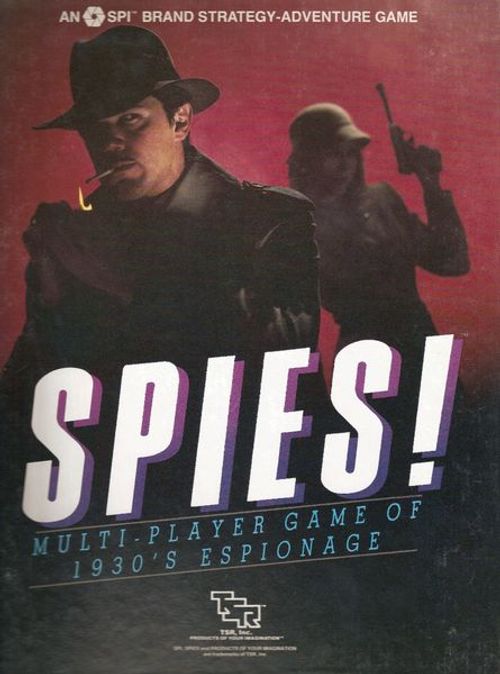
Spies!
Spies! Rulebook
Table of Contents
Table of Contents
- Components
- Event Tile: Front (Back is blank)
- Secret: Front
- Secret: Back
- Counterspy: Front
- Counterspy: Back
- Police (Russian): Front
- Police (Russian): Back
- Spy (Italian): Front
- Spy (Italian): Back
- Action Chit (Discovery): Front
- Action Chit (Any): Back
- Sanctioned Spy Marker: Front / Back
- Bank Marker: Front / Back
- Game Year Marker: Front / Back
- Standard Game Rules of Play
- Long Game Rules of Play
- Event Tile Reference
- Playing Piece Roster
Components
Each copy of Spies! comes complete with the following components:
One 22" x 34" mapsheet, one sheet of 50 Event Tiles, one sheet of 200 assorted playing pieces, one four-page standard rules booklet, one four-page long-game rules booklet, one 11" x 17" display.
The Mapsheet. The Spies! mapsheet shows the major nations and colonies of Europe, the Middle East, and North Africa, including the important cities, capitals, ports, and land, air and sea routes. In addition, the mapsheet features various summaries, records, tracks, and other material that summarizes and enhances most of the essential rules of the game. As you read the rules, be sure to refer to the mapsheet whenever appropriate to familiarize yourself with the map itself and with the various play aids.
Playing Pieces. The Event Tiles, secrets, police pieces, spies, and Action chits and markers used in the game feature the following information:
Event Tile: Front (Back is blank)
- Years in which tile can be played (e.g., 1937–39)
- Nationality (e.g., Ge for Germany) and ID number
- Event (e.g., "Czech Crisis!")
- Action chit/money award (e.g., 3c: Berlin, Prague. 2c: Paris, Moscow, Bucharest, Warsaw. 2£: Budapest, Vienna, Bratislava.)
†This number serves a particular purpose only in the Long Game.
‡This information has no effect on the game per se, but is included to lend color or serve as a means of identification.
*An Event Tile with an asterisk has a special effect on play in addition to its normal effect (see 3.22 in the Long Game rules).
Secret: Front
- Secret name (e.g., "Improved Bombsight")
- Victory Value (e.g., 3)
Secret: Back
- Blank face marked "SECRET"
Counterspy: Front
- Labeled "Counter Spy"
- Strength (e.g., 5)
Counterspy: Back
- Blank face marked "SECRET"
Police (Russian): Front
- Name (e.g., "NKVD")
- Strength (e.g., 3)
- National symbol (a star, for Russia)
Police (Russian): Back
- Blank face marked "POLICE"
Spy (Italian): Front
- Name (e.g., "Piccolo")
- Strength (e.g., 1)
- Symbol (a running figure)
Spy (Italian): Back
- Blank face marked "ITALY"
Action Chit (Discovery): Front
- Type (e.g., "Discovery")
- Cost to play (e.g., 3£)
- Symbol
Action Chit (Any): Back
- Marked "A"
Sanctioned Spy Marker: Front / Back
- Front marked with a skull symbol; back blank
Bank Marker: Front / Back
- Front marked with country name and "£" (e.g., "Russia £"); back marked with country name and a bonus amount (e.g., "Russia +100 £")
Game Year Marker: Front / Back
- Front marked "Game Year"; back blank
Standard Game Rules of Play
How to Begin the Game
Choosing Countries. Select the country you will play. The turn order in which you set up and take your turns is always the same: Germany, Italy, Russia, France, Britain.
Setting Up the Bank Track. Place your Bank marker on the Bank Track (see mapsheet) in the numbered box containing your country's name. Record the amount of money you have during the game, in thousands of pounds (£), on this Track.
Drawing Event Tiles. Take the 7 Event Tiles coded for your country; shuffle the 15 Tiles marked random, spread them face down, and draw 3 of these random Tiles blindly for a total of 10 event Tiles.
Drawing and Deploying Secrets. Shuffle all 40 secrets, spread them all face down on the table, and draw your allotment at random. Place the 8 remaining secrets face-down, one per city, in the 8 cities marked SECRET; then place your secrets face-down, one per city, in any cities in your territory.
Deploying Police. Place your police face-down, no more than 2 per city, in any cities coded for police (including your capital) in your home country.
Selecting and Deploying Spies. Select whichever spies of your nationality you prefer, up to the number specified on the Starting Set-Up (see mapsheet). Place your spies face-down, without restrictions, in any cities on the map.
Drawing Action Chits. Mix all Action chits (except Double Cross, Intercept, Drop, and Source, which are not used) in a cup and draw your allotment at random. The remaining Action chits stay in the cup to be used during the game.
Setting Up the Year Track. Place the Game Year marker in the top row under 1933 on the Time and Victory Record (see mapsheet). Each time the British player ends a turn, advance the marker one year until 7 are completed.
Note: It is suggested that you limit each player's turn to 5 minutes.
What You Can Do During Your Turn
Playing Event Tiles. At the start of your turn, you must either discard any Event Tile face-down, or play face-up an Event Tile marked with the current year (for instance, a Tile marked 1934–35 can be played only in 1934 or 1935). Read aloud the information on the Tile. The codes 1c, (2c, etc.) and 1£ (2£, etc.) indicate awards of Action chits (c) or money (£). Every player receives the indicated number of Action chits or amount of money for each city listed in which he has a spy, provided the spy is not in its own territory. There is no additional reward for having 2 or more spies in a city. When you receive Action chits, draw the indicated quantity at random. You can never have more than 7 Action chits. If you draw chits so you have more than 7, immediately return the surplus chits of your choice to the cup.
Re-Arranging Your Police. Re-arrange your police among your home country cities in any way, but place no more than 2 per city.
Searching for Enemy Spies. Immediately after re-arranging your police, you can search for enemy spies in every city containing your police and one or more enemy spies. Announce which enemy spy you are searching for first, if there is more than one in a city. You and your opponent privately compare the strength of your police (both police combined if there are 2 in the city) and the enemy spy. If your police strength is greater, the spy is immediately captured. If the spy's strength is greater or the same, the search has no effect. Your police can search once per turn for each enemy spy in any city containing your police. Note: A spy can avoid a strength comparison by playing a Papers or Escape chit.
Capture and Counterspies. You can capture a spy as a result of a search in which your police strength is greater than the spy's (provided the strength comparison is not evaded by a Papers or Escape chit). You can also capture an enemy spy with a counterspy. Whenever a spy discovers a secret that you control and that secret is a counterspy, make a strength comparison by looking at the enemy spy's strength. If the counterspy is stronger, the enemy spy is captured; if the enemy spy is as strong or stronger, the counterspy has no effect. Whatever the outcome of the strength comparison, remove the counterspy from play. Place any spy you capture on your Time and Victory Record under the Year in which it was captured. Note that captured spies can return to play by an Escape chit. If one of your spies is captured by a counterspy in a neutral country, place that spy in the Spies Captured in Neutral Countries box, not on the Time and Victory Record.
Moving Your Spies. After you have searched for enemy spies, you can move your spies. Each spy can move a maximum of 5 spaces per turn, and each city or sea zone entered counts as a space moved. You can move a spy by rail lines, air lines, and/or sea. A spy can move along any combination of routes up to the maximum of 5 total spaces per turn. Move a spy to sea from a port to a ship symbol in the same sea zone; move a spy by sea from the ship symbol in one sea zone to the ship symbol in an adjoining sea zone; move a spy from sea from a ship symbol to a port in the same sea zone. A spy cannot end its movement at sea. You must finish moving one spy before you begin moving another.
Controlling Secrets. A secret that is still in play is always in one of three states:
- You control it: You have a police piece or spy on top of it, guarding it.
- It is uncontrolled: No player has a police piece or spy on top of it.
- It is enemy-controlled: Some other player has a police piece or spy on top of it.
A secret is no longer in play once one of your spies, who controls the secret, has moved it to your capital city and cashed it in. When you cash in a secret, you immediately get 20£ and an Action chit, and the secret is placed in your Time and Victory Record under the Year you cashed it in. Secrets are divided into two broad categories, depending on how they began the game:
- Original secret: A secret that began the game in your home territory.
- Foreign secret: A secret that began the game in a neutral country or another player's home territory.
A secret's category never changes, regardless of its control state. You may cash in only foreign secrets during the game. Your original secrets can be placed on your Time and Victory Record only under all of the following conditions:
- It is the end of the game
- They are in your home territory
- They are not enemy-controlled (whether you control them or not).
You receive no money or Action chits for original secrets cashed in; you receive only the Victory Points indicated on the Time and Victory Record. To control a foreign secret, you must always play a Discovery chit and, if successful, place the spy who has made the discovery on top of the secret. To control one of your original secrets, that is in your territory and not enemy-controlled, you must place a spy or police piece on top of it; you need not play a Discovery chit. If one of your original secrets is enemy controlled and/or not in your home territory, you can gain control of it only as you would a foreign secret. You may, while moving your spies, transfer a secret you control from one of your spies to another by moving the spy with the secret into a city containing your other spy and placing this second spy on top of the secret. The second spy may then move with the secret (provided he has not moved already). Note: Only one spy or police piece can control a secret at one time. If more than one spy or police piece are in a city with a secret, the controlling piece should be directly on top of the secret. If no one controls a secret, nothing should be on top of it.
Playing Action Chits. You can play the following five types of Action chits during your spies' movement: Discovery, Papers, Sanction, Recruit, Escape. The play of these Action chits is summarized on the mapsheet. To play a chit, spend the number of pounds specified and return the chit to the Action chit cup.
Initiating Diplomacy. At any time during your turn, you can try to negotiate with your opponents by offering trades or sales of chits, asking or granting concessions, and so forth. You cannot, however, exchange Event Tiles.
What You Can Do During Another Player's Turn
Searching for Arriving Enemy Spies. You can search for each enemy spy each time it moves into any city containing your police. You cannot search for a spy that has not moved. The procedure for search is the same during an opponent's turn as it is during your own.
Playing Action Chits. You can play Papers, Escape, and Cover chits during an opponent's turn (see the mapsheet).
Responding to Diplomacy. You can respond whenever an opponent initiates negotiations with you. You cannot initiate negotiations during an opponent's turn, and you must stop trying to negotiate when a player whose turn is in progress tells you to stop.
How to Win the Game
At the end of the British turn in 1939, every secret which is now in your territory and is not controlled by an enemy spy is placed in the 1939 column on your Time and Victory Record. Each secret, captured spy, and sanctioned marker is worth a number of Victory Points equal to its value times the multiple found in the box it occupies on your Time and Victory Record. The player with the highest total of Victory Points is the winner. In a tie, the richest player wins.
Playing the Game with Fewer Than Five Players
When you play with four players, one person plays Germany and Italy. When playing with three players, one person also plays Britain and France. When playing with two players, Russia is played on alternate years by the German-Italian and British-French players. When playing two countries, you cannot exchange Action chits, money, or secrets between them. Victory Points are totalled independently for each country, just as though they were played by two players.
Long Game Rules of Play
The Long Game booklet uses the same components as the Standard Game (see Components and Playing Pieces above), but replaces the Standard Game's How to Begin, What You Can Do During Your Turn, What You Can Do During Another Player's Turn, and How to Win sections with the numbered CASES below, and adds new rules for Spy Havens and Cousins.
[1.0] Introduction to Spies!
GENERAL RULE: Spies! is a game of espionage and intrigue for up to five players, set in the turbulent European era of 1933–1939. You represent one of the major powers of that era — Germany, Italy, Russia, France, and Britain — in the constant struggle to gather your opponents' secrets and return them safely to your own capital while protecting your own country's secrets.
[1.1] The Mapsheet. The Spies! mapsheet shows the major nations and colonies of Europe, the Middle East, and North Africa, including the important cities, capitals, ports, and land, air and sea routes. In addition, the mapsheet features various summaries, records, tracks, and other material that summarizes and enhances most of the essential rules of the game.
[1.2] The Playing Pieces. The markers, Event Tiles, secrets, police pieces, spies, and Action chits used in the game feature the information described in the Playing Pieces section above.
[2.0] How to Begin the Game
CASES:
[2.1] Choosing Countries. Select the country you will play. The turn order in which you set up and take your turns is always the same: Germany, Italy, Russia, France, Britain.
[2.2] Setting Up the Bank Track. Place your Bank marker on the Bank Track (see mapsheet) in the numbered box containing your country's name. Record the amount of money you have during the game, in thousands of pounds (£), on the Bank Track on the mapsheet.
[2.3] Drawing Event Tiles. Take the 7 Event Tiles coded for your country; mix the 15 tiles marked random in a cup and draw 3 of these random Tiles blindly for a total of 10 event Tiles.
[2.4] Drawing and Deploying Secrets. Shuffle all 40 secrets, spread them all face down on the table, and draw your allotment at random. Place the 8 remaining secrets face-down, one per city, in the 8 cities marked SECRET; then place your secrets face-down, one per city, in any cities in your territory.
[2.5] Deploying Police. Place your police face-down, no more than 2 per city, in any cities coded for police (including your capital) in your home country.
[2.6] Deploying Spies. Place all of your spies (all those color-coded for your country on the countersheet) face-down, without restrictions, in any of the cities on the map.
[2.7] Drawing Action Chits. Mix all Action chits in a cup and draw your allotment at random. The remaining Action chits stay in the cup to be used throughout the game.
[2.8] Setting Up the Time and Victory Record. Place the Game Year marker in the top row under 1933 on the Time and Victory Record (see mapsheet). Each time the British player ends a turn, advance the marker one year until 7 are completed.
Note: It is suggested that you limit each player's turn to 5 minutes.
[3.0] What You Can Do During Your Turn
CASES:
[3.1] Expending Action Points. During each of your turns, you have 12 Action Points to expend to play an Event Tile, conduct searches, play Action chits, and initiate diplomacy. You must expend Action Points to undertake these activities during your turn, but you never expend Action Points during an opponent's turn, even if you play an Action chit, search for arriving enemy spies, or respond to diplomacy. You need not spend all 12 of your Action Points during a turn, but you may never spend more than 12 per turn.
[3.11] Action Point Cost Summary. The number of Action Points you must expend to perform various actions are listed in this summary (see display). Note that Action Point costs to play Action chits are in addition to the cost in Pounds.
[3.12] Action Point Expenditure Track. At the beginning of your turn, place a blank playing piece on this Track (see display) in the 12 box. Each time you expend Action Points, move the playing piece along the Track to reflect the expenditure.
[3.2] Playing Event Tiles.
[3.21] At the start of your turn, you must either discard any Event Tile face-down (at no cost in Action Points), or play (at a cost of one Action Point) face-up an Event Tile marked with the current year (for instance, a Tile marked 1934–35 can be played only in 1934 or 1935). Read aloud the information on the Tile. The codes 1c, (2c, etc.) and 1£ (2£, etc.), indicates awards of Action chits (c) or money (£). Every player receives the indicated number of Action chits or amount of money for each city listed in which he has a spy, provided the spy is not in its own territory. There is no additional reward for having 2 or more spies in a city. When you receive Action chits, draw the indicated quantity at random.
[3.22] Event Tile Special Effect Summary. Certain Event Tiles (designated with an asterisk by their ID number) have a special effect on play. These are listed, together with their additional effects, on this summary (see display).
[3.3] Re-Arranging Your Police. Re-arrange your police among your home country cities in any way (at no Action Point cost), but place no more than 2 per city.
[3.4] Searching for Enemy Spies. Immediately after re-arranging your police, you can search for enemy spies in every city containing your police and one or more enemy spies (at a cost of one Action Point per city). Announce which enemy spy you are searching for first, if there is more than one in a city. You and your opponent privately compare the strength of your police (both police combined if there are 2 in the city) and the enemy spy. If your police strength is greater, the spy is immediately captured. If the spy's strength is greater or the same, the search has no effect. Your police can search once per turn for each enemy spy in any city containing your police. Note: A spy can avoid a strength comparison by playing a Papers or Escape chit.
[3.5] Capture and Counterspies. You can capture a spy (at no additional cost in Action Points) as a result of a search in which your police strength is greater than the spy's (provided the strength comparison is not evaded by a Papers or Escape chit). You can also capture an enemy spy with a counterspy. Whenever a spy discovers a secret that you control and that secret is a counterspy, make a strength comparison by looking at the enemy spy's strength. If the counterspy is stronger, the enemy spy is captured; if the enemy spy is as strong or stronger, the counterspy has no effect. Whatever the outcome of the strength comparison, remove the counterspy from play. Place any spy you capture on your Time and Victory Record under the Year in which it was captured. Note that captured spies can return to play by an Escape chit. If one of your spies is captured by a counterspy in a neutral country, place that spy in the Spies Captured in Neutral Countries box, not on the Time and Victory Record.
[3.6] Moving Your Spies. After you have searched for enemy spies, you can move your spies. Each spy can move a maximum of 5 spaces per turn (at a cost of one Action Point per space moved), and each city or sea zone entered counts as a space moved. You can move a spy by rail lines, air lines, and/or sea. A spy can move along any combination of routes up to the maximum of total spaces per turn. Move a spy to sea from a port to a ship symbol in the same sea zone; move a spy by sea from a ship symbol in one sea zone to the ship symbol in an adjoining sea zone; move a spy from sea from a ship symbol to a port in the same sea zone. A spy cannot end its movement at sea. You must finish moving one spy before you begin moving another.
[3.7] Controlling Secrets. A secret that is still in play is always in one of three states:
- You control it: You have a police piece or spy on top of it, guarding it.
- It is uncontrolled: No player has a police piece or spy on top of it.
- It is enemy-controlled: Some other player has a police piece or spy on top of it.
A secret is no longer in play once one of your spies, who controls the secret, has moved it to your capital city and cashed it in. When you cash in a secret, you immediately get 20£ and an Action chit, and the secret is placed in your Time and Victory Record under the Year you cashed it in. Secrets are divided into two broad categories, depending on how they began the game:
- Original secret: A secret that began the game in your home territory.
- Foreign secret: A secret that began the game in a neutral country or another player's home territory.
A secret's category never changes, regardless of its control state. You may cash in only foreign secrets during the game. Your original secrets can be placed on your Time and Victory Record only under all of the following conditions:
- It is the end of the game
- They are in your home territory
- They are not enemy-controlled (whether you control them or not).
You receive no money or Action chits for original secrets cashed in; you receive only the Victory Points indicated on the Time and Victory Record. To control a foreign secret, you must always play a Discovery chit and, if successful, place the spy who has made the discovery on top of the secret. To control one of your original secrets, that is in your territory and not enemy-controlled, you must place a spy or police piece on top of it; you need not play a Discovery chit. If one of your original secrets is enemy controlled and/or not in your home territory, you can gain control of it only as you would a foreign secret. You may, while moving your spies, transfer a secret you control from one of your spies to another by moving the spy with the secret into a city containing your other spy and placing this second spy on top of the secret. The second spy may then move with the secret (provided he has not moved already). Note: Only one spy or police piece can control a secret at one time. If more than one spy or police piece are in a city with a secret, the controlling piece should be directly on top of the secret. If no one controls a secret, nothing should be on top of it.
[3.8] Playing Action Chits. You can play the any type of Action chit during your spies' movement except Intercept. The play of these Action chits is summarized on the Action Chit Summary (not on the mapsheet). To play a chit, spend the number of pounds and Action Points specified and return the chit to the Action chit cup.
[3.9] Initiating Diplomacy. At any time during your turn, you can try to negotiate with your opponents (at a cost of one Action Point per opponent) by offering trades or sales of chits, asking or granting concessions, and so forth. You cannot, however, exchange Event Tiles.
[4.0] What You Can Do During Another Player's Turn
CASES:
[4.1] Searching for Arriving Enemy Spies. You can search for each enemy spy each time it moves into any city containing your police at no cost in Action Points. You cannot search for a spy that has not moved. The procedure for search is the same during an opponent's turn as it is during your own.
[4.2] Playing Action Chits. You can play Papers, Escape, Cover, Double Cross, and Intercept chits during an opponent's turn at no cost in Action Points (see the Action Chit Summary, not the mapsheet).
[4.3] Responding to Diplomacy. You can respond whenever an opponent initiates negotiations with you at no cost in Action Points to you. You cannot initiate negotiations during an opponent's turn, and you must stop trying to negotiate when a player whose turn is in progress says to stop.
[5.0] Spy Havens and Cousins
GENERAL RULE: Certain cities and spies in the long game have special attributes.
CASES:
[5.1] Spy Havens. Istanbul, Tangiers, and Geneva are considered spy havens, in addition to their normal attributes. You may never play a Discovery, Drop, or Sanction chit in a spy haven.
[5.2] Cousins. Each player has one spy named "Cousin." Your Cousin is never captured by a counterspy; if your Cousin discovers a counterspy, simply remove the counterspy from play. Your Cousin can never be killed by a Sanction chit unless the chit is played by an opponent's Cousin. If any other enemy spy attempts to Sanction your Cousin, that enemy spy is immediately killed instead, without an opportunity to counter in any way; place the enemy spy in the Sanctioned Spies Box and place a Sanctioned Spy marker on your Time and Victory Record.
[6.0] How to Win the Game
At the end of the British turn in 1939, every secret with which you began the game and which is now in your territory and under your control is placed in the 1939 column on your Time and Victory Record. Each secret, captured spy, and sanctioned marker is worth a number of Victory Points equal to its value times the multiple found in the box it occupies on your Time and Victory Record. The player with the highest total of Victory Points is the winner. In a tie, the richest player wins.
[7.0] Playing the Game with Fewer Than Five Players
When you play with four players, one person plays Germany and Italy. When playing with three players, one person also plays Britain and France. When playing with two players, Russia is played on alternate years by the German-Italian and British-French players. When playing two countries, you cannot exchange Action chits, money, or secrets between them. Victory Points are totalled independently for each country, just as though they were played by two players.
Event Tile Reference
The Spies! Event Tiles are reproduced here for reference and as an aid to reproducing lost or damaged counters.
Each entry below lists the tile's ID, the years in which it can be played, its event text, and the Action-chit/money award (c = Action chits, £ = thousands of pounds) for each listed city.
Russian Event Tiles
- Rs 15 (1936–38) — Soviet Black Sea Fleet sorties. 1c: Odessa, Athens, Taranto, Sevastopol, Constanta, Istanbul, Salonika, Famagusta.
- Rs 16 (1937–39) — Soviet-German Non-aggression Pact. 3c: Moscow, Berlin. 2c: Warsaw. 2£: Rome, London, Paris.
- Rs 17 (1936–39) — Shift in Soviet military strategy. 2c: Moscow. 1c: Bucharest. 2£: Istanbul, Ankara, Prague, Sophia, Budapest, Berlin.
- Rs 18 (Any Year) — Renewed purges shake Russia. 1c: Minsk, Smolensk, Leningrad, Kiev, Odessa, Sevastopol, Moscow, Tula, Rostov, Kharkov, Voronezh, Dneipropetrovsk.
- Rs 19* (1935–39) — Soviets seek alliance with Czechs. 2c: Moscow, Prague. 3£: London, Paris, Warsaw, Vienna, Berlin, Budapest, Rome, Geneva, Bucharest.
- Rs 20 (Any Year) — Stalin initiates new armaments programs. 2c: Moscow, Leningrad. 1c: Smolensk, Minsk, Kiev, Tula, Rostov, Sevastopol, Odessa, Kharkov, Voronezh.
- Rs 21 (Any Year) — Soviets pressure Finns over basing rights in Gulf. 2c: Helsinki, Moscow. 3£: Warsaw, Bucharest, Riga, Danzig, Stockholm, Leningrad, Konigsberg, Copenhagen.
German Event Tiles
- Ge 1* (1937–39) — Czech Crisis! 3c: Berlin, Prague. 2c: Paris, Moscow, Bucharest, Warsaw. 2£: Budapest, Vienna, Bratislava.
- Ge 2* (1938–39) — Polish Crisis! 3c: Berlin, Warsaw. 2c: Danzig, Riga, Prague. 2£: Vienna, Paris, London, Bucharest, Moscow, Rome.
- Ge 3 (Any Year) — Rhineland remilitarized! 3c: Essen, Brussels. 2c: Hamburg, Dusseldorf, Berlin, Stettin, Frankfurt. 2£: London, Paris, Hague.
- Ge 4 (1935–38) — Renewed agitation among Volksdeutsche! 1c: Riga, Prague, Danzig, Bratislava, Bucharest. 2£: Konigsberg, Warsaw.
- Ge 5* (1937–39) — Germany pressures Poland over Danzig and the corridor. 2c: Berlin, Danzig, Warsaw. 1c: Konigsberg, Lvov, Brest-Litovsk. 3£: Riga, Paris, Moscow, London.
- Ge 6 (Any Year) — German arms production soars! 2c: Essen, Hamburg, Berlin, Leipzig, Munich, Stettin, Dusseldorf, Frankfurt. 2£: Geneva.
- Ge 7* (1935–37) — Anschluss! 2c: Vienna, Prague, Budapest. 4£: London, Paris, Moscow, Riga, Warsaw, Belgrade, Rome, Munich, Leipzig, Nurnberg, Trieste.
Italian Event Tiles
- It 8 (1934–37) — Italy invades Ethiopia! 2c: Rome. 1c: Cairo, Port Said, Bengazi, Malta. 3£: London, Paris, Moscow. 2£: Geneva, Berlin.
- It 9 (1936–38) — Italian aircraft reveal defects in Spanish fighting. 1c: Madrid, Lisbon, Barcelona, Tangiers. 1£: London, Paris.
- It 10 (1933–37) — Italian borrowing to finance war with Ethiopia. 2c: Rome. 1c: Geneva. 2£: Milan, Florence.
- It 11 (1936–39) — Italian Fleet maneuvers in Sicily-Corsica channel. 1c: Naples, Tunis, Algiers, Barcelona, Marseilles.
- It 12 (1937–39) — Italy seeks military understanding with Greece. 2c: Rome, Athens. 2£: Trieste, Sophia, Belgrade.
- It 13 (Any Year) — Italian Army maneuvers reveal weaknesses. 2c: Rome, Venice. 2£: Florence, Marseilles, Turin, Belgrade, Tirane, Milan.
- It 14* (1937–39) — Italy takes formal control of Albania. 1c: Rome, Athens, Belgrade, Tirane. 3£: Istanbul, Moscow, Sophia, Berlin, Paris, London, Trieste.
French Event Tiles
- Fr 22 (Any Year) — Joint Anglo-French Naval Maneuvers. 1c: Brest, Lisbon, Bordeaux, Casablanca. 2£: Scapa Flow, Paris, Gibraltar, London, Tangiers.
- Fr 23 (Any Year) — French High Command draws up new defense plan. 2c: Paris. 1c: Prague, Warsaw, Bucharest, Belgrade. 2£: Geneva, Istanbul.
- Fr 24* (Any Year) — Hungary moves closer to the Axis over Rumania. 2c: Rome, Budapest, Berlin. 1c: Sophia, Istanbul. 2£: Vienna, Prague.
- Fr 25 (1936–39) — French military treaty with Rumania. 2c: Bucharest, Paris. 1c: Brest, Le Havre, Bordeaux, Marseilles.
- Fr 26 (Any Year) — Arab riots in the Palestine Mandate. 1c: Jerusalem, Port Said, Cairo, Famagusta, Beirut.
- Fr 27 (Any Year) — French Naval Forces conduct maneuvers in Atlantic. 1c: Brest, Lisbon, Bordeaux. 1£: Berlin.
- Fr 28 (Any Year) — Sitdown Strikes in French aircraft industry. 1c: Brest, Paris, Le Havre, Nancy, Strasberg, Lyons.
British Event Tiles
- Br 29* (1933–37) — Growing Austrian opposition to the Nazis. 1c: Vienna, Geneva, Munich, Budapest, Prague, Nurnberg.
- Br 30* (1936–38) — Czechs divided on opposing Hitler! 1c: Bratislava, Prague. 2£: Bucharest, Munich, Budapest, Nurnberg, Berlin, Vienna, Warsaw.
- Br 31 (Any Year) — Labor tensions in British industry. 1c: Glasgow, London, Manchester, Coventry, Birmingham, Liverpool.
- Br 32 (Any Year) — British deploy new tank force to Egypt! 3c: London. 1c: Rome, Cairo, Port Said, Gibraltar. 2£: Geneva, Istanbul, Tangiers.
- Br 33 (Any Year) — British commission new class of battleship. 2c: Scapa Flow. 1c: Belfast, London, Glasgow, Manchester, Liverpool, Ostend, Hague, Dublin.
- Br 34 (Any Year) — British foster anti-Nazi sentiment among Junkers. 1c: Berlin, Stettin, Hamburg, Konigsberg, Munich, Frankfurt.
- Br 35 (Any Year) — British cabinet secretly debates appeasement. 2c: London. 1c: Coventry, Manchester, Glasgow, Birmingham, Liverpool.
Random Event Tiles
- random 36 (Any Year) — Finns and Germans discuss Mutual Defense Pact. 2c: Berlin, Helsinki. 3£: Riga, Moscow, Leningrad. 2£: Geneva.
- random 37 (Any Year) — Turkish Army split over question of neutrality. 1c: Istanbul, Ankara. 2£: Sophia, Athens, Bucharest, Salonika, Budapest, Belgrade, Famagusta, Constanta.
- random 38 (Any Year) — Defector reveals plans for Soviet "Stalin Line." 1c: Geneva. 3£: Odessa, Kiev, Minsk, Smolensk, Leningrad, Tula, Moscow, Kharkov.
- random 39 (Any Year) — Polish officers show divided loyalties. 1c: Lvov, Warsaw, Brest-Litovsk, Danzig. 2£: London, Paris, Rome, Berlin.
- random 40 (Any Year) — Egyptian troops mutiny! 1c: Cairo, Bengazi, Port Said, Athens, Jerusalem, Salonika, Malta, Tunis, Taranto.
- random 41 (1936–38) — Spanish Republicans torn by internal strife. 1c: Barcelona, Madrid. 2£: Rome, Berlin, Moscow. 1£: Gibraltar, Lisbon, Tangiers.
- random 42 (Any Year) — Hungary presses a claim to Rumanian territory. 1c: Budapest, Bucharest, Berlin. 2£: Rome, Moscow, Warsaw, Sophia, Belgrade. 1£: Bratislava.
- random 43 (1936–39) — Spanish Nationalists torn by internal strife. 1c: Lisbon, Madrid, Barcelona, Tangiers, Gibraltar. 1£: London, Paris, Berlin, Rome.
- random 44 (Any Year) — Scandinavian Mutual Defense Pact talks open in Stockholm. 1c: Stockholm, Oslo, Copenhagen, Bergen, Helsinki.
Playing Piece Roster
The following rosters are reproduced from the Spies! counter sheets for reference and as an aid to reproducing lost or damaged counters.
Action Chit Cost Summary
| Action Chit | Cost | Notes |
|---|---|---|
| Papers | 2£ | Standard and Long Game |
| Discovery | 3£ | Standard and Long Game |
| Recruit | 4£ | Standard and Long Game |
| Escape | 10£ | Standard and Long Game |
| Sanction | 20£ | Standard and Long Game |
| Cover | 1£ | Long Game only |
| Intercept | 10£ | Long Game only |
| Drop | 20–30£ | Long Game only |
Secrets (30 named secrets, plus 10 Counterspies)
| Secret | Victory Value | Secret | Victory Value |
|---|---|---|---|
| Tactical Comm | 3 | Limpet Mine | 1 |
| RDF | 3 | Axial Engine | 1 |
| Synthetic Fuel | 4 | Low-wing Monoplane | 3 |
| Primitive Radar | 4 | Nerve Gas | 3 |
| Primitive Jet | 4 | Rocket Engine | 2 |
| Photo Recon | 3 | Highspeed Torpedo | 3 |
| Mobile Doctrine |
Counterspies: ten counters, in strength values 3, 3, 4, 4, 5, 5, 5, 5, 5, 5.
National Rosters
Russia — Spies: Georgi (1), Vanya (2), Merinka (2), Alexi (3), Cousin (4). Police: NKVD (2), NKVD (2), NKVD (4), NKVD (3), NKVD (3), NKVD (3), NKVD (3). Bank marker: Russia.
Germany — Spies: Erik (1), Heidi (1), Ernst (2), Gunther (2), Kurt (3), Cousin (4). Police: Gestapo (2), Gestapo (2), Gestapo (2), Gestapo (3), Gestapo (3), Gestapo (3), Gestapo (4). Bank marker: Germany.
Italy — Spies: Piccolo (1), Mario (1), Vicente (2), Carla (3), Cousin (4). Police: RRCC (1), RRCC (2), RRCC (2), RRCC (3), RRCC (3), RRCC (4). Bank marker: Italy.
Britain — Spies: Wil'y (2), Rose (2), Peter (2), Winston (3), Cynthia (3), Cousin (4). Police: Scotland Yard (2), Scotland Yard (2), Scotland Yard (3), Scotland Yard (3), Scotland Yard (4). Bank marker: Britain.
France — Spies: Marthe (1), Bruno (2), Theo (2), Jean (3), Cousin (4). Police: Police (2), Police (2), Police (2), Police (3), Police (4). Bank marker: France.
Each nation's spy and police strengths above correspond to the counters printed on Counter Section Nr. 2 of the countersheet; the Cousin for each nation is always the highest-strength spy (strength 4) and is subject to the special Cousin rule in the Long Game ([5.2]).