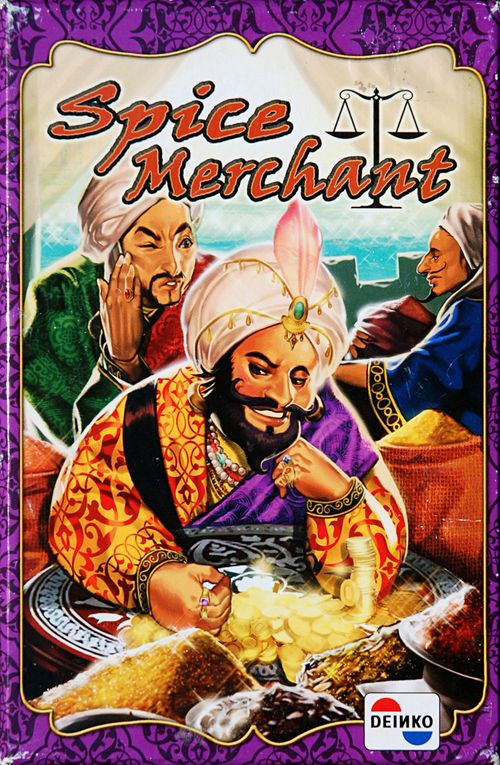
Spice Merchant
Spice Merchant Rulebook
Table of Contents
Table of Contents
Contents
- 6 Market markers
- 88 Play cards:
- 84 Spice cards: 16 Black pepper, 16 Ginger, 14 Cinnamon, 14 Clove, 12 Nutmeg & Mace, 12 Saffron (the rulebook's caption says 16 Saffron, but the counts only total 84 with 12; the price list card also says 12).
- 4 game information cards. Front: the price list for each spice. Back: first player marker.
Price list (number of cards in the market, and points):
| Spice | Cards | 1 card | 2 cards | 3 cards | 4 cards |
|---|---|---|---|---|---|
| Black pepper | 16 | 1 | 2 | 3 | 5 |
| Ginger | 16 | 1 | 2 | 4 | 6 |
| Cinnamon | 14 | 1 | 3 | 5 | 7 |
| Clove | 14 | 2 | 4 | 6 | 8 |
| Nutmeg & Mace |
The spice cards are used in two ways in the game. The spice card in front of you represents the good to sell. The spice cards placed around the center of the table, next to the market markers, represent the demand for a specific spice. So, to increase the value of the spice which you want to sell, you should make that spice be laid down a lot in the 6 market places. Remember the two ways ("goods" and "demand") of using the spice cards in leading the game by "distorting demand"!
Card information (example, Saffron): each spice card shows the scores according to the number of spice cards in the market (1 card, 3 points; 2 cards, 6 points; 3 cards, 8 points; 4 cards, 10 points), and the maximum number of spice cards of that kind in the deck (12 for Saffron).
Objective
Sell more valuable spices than the others, and gain the scores. To do that, you have to make the spice which you want to sell be laid down more than the others in the 6 centers of the world market. When the value of each spice is fixed, each player gets the score according to values from the market. At the end of the 4 rounds, the player who has the highest sum of the scores is the winner.
Preparation
Distribute the information cards and put them down with the front side up. The remaining cards are not used in the game. The player who uses black pepper in food the most is the first player; that player turns his/her information card to the back side to represent the first player.
Shuffle the 84 spice cards, and then distribute 7 cards to each player's hand, hidden. Make the deck in the center of the table with the remaining spice cards. Arrange the 6 market marker chips, which represent the 6 world markets, around the card deck (hexagon arrangement, as in the picture). The markets are labelled A to F in the examples (A at the top, then B, C, D, E, F clockwise).
Play
The game consists of 4 rounds. Each round always begins by registering "secret-trade goods" (putting down the spice cards which you want to sell with the back side up).
- 1st and 2nd rounds begin by registering 1 spice card.
- 3rd and 4th rounds begin by registering 2 spice cards.
- At this time, you can register spices of one kind (2 cards of the same spice in rounds 3 and 4).
If you register secret-trade goods, you should replenish 1 card (2 cards at 3rd and 4th rounds) from the deck in the center. (You always have 7 cards in your hand when your turn is finished.) When every player has finished registering his/her secret-trade goods, play begins clockwise from the first player. On your turn, you can do only one action out of the two actions described below.
Register open-trade goods
You can register one more spice card that you want to sell. If you register this, you put down the spice card that you choose next to the secret-trade card, with the front side up. You can do this action only once in a round, and you can register the same kind of card as your secret-trade one.
Fake demand
- The value of the cards that you put down in front of you to sell (open-trade goods, secret-trade goods) is fixed by faking demand.
- Fake demand action means putting down cards (1 to 4 cards) that you have on 1 market of the 6 markets in the center of the table. The number of cards on each market represents that market's demand. So if there are more cards, that spice will be sold at a more expensive price.
- If you put down cards to fake demand, you have to follow these rules:
- You have to put down 1 kind of spice to 1 market place.
- 1 market place can have only 1 kind of spice, with 4 cards as the maximum. So if you want to put down cards on an occupied place, you have to put down the same kind of spice cards as the occupying cards.
- The same kind of spice cards can occupy a maximum of 2 market places of the 6 markets. If some kind of spice cards occupy 2 market places already, that spice can't occupy another market place.
- And then, you should replenish your hand to 7 for the number of cards that you used.
The end of round
When all of the market places are occupied, or when 2 market places are full with 4 cards even if not all of them are occupied, the round ends.
When the round ends, all players indicate their score with their open-trade card and secret-trade cards. According to the market price, spin your cards to indicate it and put them down in front of you.
When cards exist in the center markets, you can sell your cards (open-trade, secret-trade). If they don't, you can't sell. 1 kind of spice will be sold for 1 market. So if you registered 2 cards that are the same kind, that kind of spice has to be in 2 market places to be sold.
Example 1: the conditions that end the round
In the example picture (Saffron on A, Ginger on B and F, Clove on C, Nutmeg & Mace on D, E empty; B holds 4 Ginger already and so cannot take more), the round ends immediately when the following conditions are satisfied:
- 1 more card in each of the A and D markets, 2 more cards in C, and 3 more cards in F, so that any two markets are filled with 4 cards.
- Anybody puts down any spice cards (1 to 4 cards) except Ginger on the E market. (Ginger can't be put on E because Ginger already occupies 2 markets, B and F.)
Example 2: the score calculation at the end of the round
In this example, someone puts down 2 cards of Black pepper on the E market, and the round ends.
- Robert registered Clove and Ginger to secret-trade goods, and Ginger again to open-trade goods. Clove has 2 demands in the C market, gaining 4 points. Ginger has 4 demands in the B market and 1 demand in the F market, gaining 6 points and 1 point. Therefore, Robert gains 11 total points in this round.
- Jane registered Black pepper and Ginger to secret-trade goods, and Black pepper again to open-trade goods. But Black pepper has demand only in the E market, so she can sell just 1 Black pepper and gain 2 points. The other Black pepper is discarded. (It will be shuffled into the new deck at the new round.) Ginger has 2 markets, B and F. She chooses the B market because it is more valuable, and gains 6 points. Therefore, Jane gains 8 total points in this round.
The beginning of a new round
The next player clockwise from the first player will be the new first player. Then, the old first player sets up his/her information card with the front side up, and the new first player sets up his/her information card with the back side up to represent the first player. The cards used to indicate scores and the cards in your hands remain. Put all of the other cards in the deck and shuffle them. Make a new deck and put it down in the center of the table. Begin the new round by registering secret-trade goods! (1 card for rounds 1 and 2, 2 cards for rounds 3 and 4.)
The end of the game
The game ends after the 4th round. Now, calculate each player's score; the player with the highest sum of the scores is the winner! In the case of a tie, the player who sold more goods than the other player is the winner. If there is a tie again, they become co-champions!