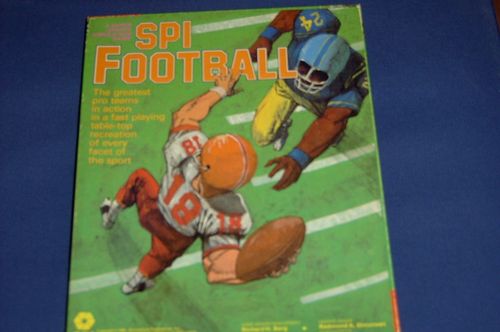
SPI Football
SPI Football Rulebook
Table of Contents
Table of Contents
- Read This First
- How to Learn to Play the Game
- Outline of Major Sections and Primary Cases
- 1.0 Introduction
- 2.0 General System of Play
- 3.0 The Kickoff
- 4.0 Master Play Chart
- 5.0 Running Plays
- 6.0 Pass Plays
- 7.0 Interceptions
- 8.0 Sacking the QB
- 9.0 Fumbles
- 10.0 Punts
- 11.0 Extra Points and Field Goals
- 12.0 Timing the Game
- 13.0 Penalties (Optional)
- 14.0 Limitations of Playing Time (Optional)
- 15.0 Clutch Ratings (Optional)
- 16.0 Dumping Off to the Backs (Optional)
- Team Sheets (1958, 1968 and 1975 Seasons)
- 1958 New York Giants (9-3-0)
- 1958 Cleveland Browns (9-3-0)
- 1958 Pittsburgh Steelers (7-4-1)
- 1958 Washington Redskins (4-7-1)
- 1958 Chicago Cardinals (2-9-1)
- 1958 Philadelphia Eagles (2-9-1)
- 1958 Baltimore Colts (9-3-0)
- 1958 Chicago Bears (8-4-0)
- 1958 Los Angeles Rams (8-4-0)
- 1958 San Francisco 49ers (6-6-0)
- 1958 Detroit Lions (4-7-1)
- 17.0 Designer's Notes
Read This First
The rules of this SPI simulation game are organized in a format known as the Case System. This system of organization divides the rules into Major Sections (each of which deals with an important aspect of play). These Sections are numbered sequentially as well as being named. Each of these Major Sections is introduced by a General Rule, which briefly describes the subject of the Section. Many times this General Rule is followed by a Procedure which describes the basic action the Player will take when using the rules in that Section. Finally, the bulk of each Major Section consists of Cases. These are the specific, detailed rules that actually regulate play. Each of these Cases is also numbered. The numbering follows a logical system based upon the number of the Major Section of which the Cases are a part. A Case with the number 6.5, for example, is the fifth Primary Case of the sixth Major Section of the rules. The numbering system is meant as an organizational aid. Using it, Players can always easily tell where a Case is located in the rules. As a further aid, an outline of the Major Sections and Primary Cases is given at the beginning of the rules.
How the Section and Case Numbers Work:
Major Section Number, then Primary Case Number, written as [6.5]. The preceding example would be the number of the fifth Primary Case of the sixth Major Section of the rules.
How to Learn to Play the Game
Familiarize yourself with all of the components. Read all of the General Rules and Procedures and read the titles of the Primary Cases. Set up the game for play (after reading the pertinent Section) and play a trial game against yourself referring to the rules only when you have a question. This procedure may take you a little longer, but it is the fastest and most entertaining way to learn the rules short of having a friend teach them to you. You should not attempt to learn the rules word-for-word. Memorizing all that detail is a task of which few of us are capable. SPI rules are written to be as complete as possible — they're not designed to be memorized. The Case numbering system makes it easy to look up rules when you are in doubt. Absorbing the rules in this manner (as you play) is a much better approach to game mastery than attempting to study them as if cramming for a test.
We hope you enjoy this SPI game. Should you have any difficulty interpreting the rules, please write to SPI, phrasing your questions so that they can be answered by a simple sentence, word, or number. You must enclose a stamped, self-addressed envelope. We cannot guarantee a proper answer should you choose to phone in your question (the right person is not always available — and since SPI has published hundreds of games, no one individual is capable of answering all questions). Write to: SPI, Rules Questions Editor for SPI Football, 257 Park Avenue South, New York, N.Y. 10010.
Outline of Major Sections and Primary Cases
1.0 Introduction 2.0 General System of Play 3.0 The Kickoff 4.0 Master Play Chart 5.0 Running Plays 6.0 Pass Plays 7.0 Interceptions 8.0 Sacking the QB 9.0 Fumbles 10.0 Punts 11.0 Extra Points and Field Goals 12.0 Timing the Game 13.0 Penalties (Optional) 14.0 Limitations of Playing Time (Optional) 15.0 Clutch Ratings (Optional) 16.0 Dumping Off to the Backs (Optional) 17.0 Designer's Notes
1.0 Introduction
SPI Football enables one or two people to recreate football games from past performances and seasons. The game is easy to learn and play, although it does pre-suppose a working knowledge of football. The game is designed to recreate the statistical aspects of the sport within a 3-5% deviation, given an adequate number of dicerolls. To play a game, simply pick the teams you want to play with from those included and then choose your line-up. The Offensive Coach chooses the players and play he wishes to run, while the Defensive Coach decides on his defensive alignment. The play choices are revealed, and the results of the play are determined. The teams included with this edition of the game are those of the 1958 N.F.L. season (all teams), considered by many fans to be the finest season in the history of the sport. Also included are four Super Bowl teams.
2.0 General System of Play
2.1 The Dice
SPI Football uses two different sized dice which are easily distinguishable from one another. In some instances, these two dice are added together; thus, a 1 and a 3 produce a 4. The Pass Gain and Return Table uses "added" dice. In other situations — mainly all running plays and pass completions — the two dice are read sequentially; thus, a 1 and a 3 are read as 13.
2.2 The Ratings
Individual Offensive Players are rated for their abilities to Run Inside (RIS), Run Outside (ROS), Run with Passes (Pass Gain), Complete Passes (Pass), etc., depending on what they actually did during that season. Players not rated in a given category either did not perform that function during the year or did it so infrequently that any rating would be ludicrous. However, there are a few players that were used infrequently and are rated, albeit with a limitation on their maximum usage. Teams are also rated for their overall Defensive abilities in three categories (Against Run, Against Pass Gains, and Ability to Limit Pass Gains), as well as a variety of other situations. Ratings — and their abbreviations — are explained throughout the body of the rules.
2.3 The Sequence of Play
The Sequence of Play generally follows the flow of the game of football. The Offensive Coach picks his Offensive Play, along with the player(s) he wishes to execute that play, while the Defensive Coach chooses one of the eight Defenses he has available. The results of such play-calling adjust the rating of the Offensive Player used on that play, as do the Defensive Ratings of the team on defense. After determining the adjusted rating for that player, the Offensive Coach rolls the dice and determines the result of the play, consulting the appropriate chart or table. He then proceeds to the next play.
2.4 Getting Ready for Play
It should take about 10 to 15 minutes to learn how to play the game, and, after running a few plays as practice, Players should be completely at ease with the system and the various charts and tables. This is an easy game, basically — with some optional rules available for increased complexity. Players may use any method they wish to keep track of the score and various statistics. Please remember that football rules tend to change from year to year; e.g., penalties that were once 15 yards are now 10 yards, while kickoffs in 1958 were from the 40 yardline, not the 35 as they are today.
2.5 Use of Players
Each Offensive Team must field six players: a QB, two or three running backs, and two or three ends (or flankers/wide receivers). The number of backs and receivers depends on the era being played. Prior to around 1958-9, most teams used three set backs: a fullback and two running (or half-) backs. There were usually only two ends (receivers). After that time, formations gradually switched to using two backs — a fullback and a running back — plus three receivers, called a variety of names, such as split end, flanker, wide receiver, tight end, etc. Simply let the opposing player know what type of formation you are using and who is playing where. Also, note that the team sheets list the number of passes thrown by each QB during that season. That will be of interest to those who desire to use pass plays in "historically accurate" proportions.
2.6 Game Components
A complete game of SPI Football should include a 16-page booklet (including rules, charts, and tables), one large six-sided die, and one small six-sided die. If any of these parts are missing or damaged, return the enclosed Complaint Card to SPI with the appropriate item checked.
3.0 The Kickoff
3.1 Regular Kickoff
The Coaches determine who will kick off to start the game. The kicking Coach then rolls two dice and adds the results together, consulting the Kickoff Table (Normal), 3.3. The result of the diceroll is the distance the ball has travelled from the point of kickoff. A diceroll of 12 means that the kick has gone out-of-bounds and must be kicked over, with a five yard penalty being assessed against the kicking team. The Receiving Team must run the ball back, unless the kick went into the end zone, in which case the coach may, if he wishes, run the ball out (see 3.4).
3.2 Onside Kicks
A Coach may have his team attempt an Onside Kick whenever he wishes (instead of a normal kickoff). Simply roll the dice as if for a normal kickoff and consult the Onside portion of the Kickoff Table (3.3). The result is the yardline (receiving team's end of the field) and the team (K = Kicking, R = Receiving) recovering the kick. There is no runback. If the Kicking Team is offside (2 or 12), consider it no kick and a five yard penalty against the Kicking Team. Kick again, but add five yards to the yardline result.
3.3 The Kickoff Tables
Normal Kickoff (Yardage of Kick)
| Dice | 2 | 3 | 4 | 5 | 6 | 7 | 8 | 9 | 10 | 11 | 12 |
|---|---|---|---|---|---|---|---|---|---|---|---|
| Yardage of Kick | EZ | 50 | 60 | 44 | 54 | 65 | 58 | 55 | 70 | 38 | OB |
Onside Kickoff (Yardline)
| Dice | 2 | 3 | 4 | 5 | 6 | 7 | 8 | 9 | 10 | 11 | 12 |
|---|---|---|---|---|---|---|---|---|---|---|---|
| Yardline | OS | 42r | 49r | 48k | 50r | 46r | 41r | 47k | 40r | 43r | OS |
EZ = Endzone (no runback); OB = Out-of-Bounds (5-yard penalty and kick over); OS = Kicking team Offsides (kick again). r = Receiving team recovers; k = Kicking team recovers.
3.4 The Receiver/Returner
Once the Receiving Team has determined where the kickoff has landed, that Coach determines who will run it back. He consults his Team Sheet under KOR (Kickoff Return) and rolls two dice, reading them sequentially and checking the results with the corresponding player. Thus, using the Colts, a diceroll of 23 would mean that Lenny Lyles would return the kick; a 53 and Lenny Moore would be the returner.
3.5 The Kickoff Return
Once the returner is established, the Coach checks the returner's KOR rating. This will be a letter followed by the Table to use: either the PGR (Pass Gain and Return) Table or the RG (Rushing Gain) Table. (It is usually the former.) He then throws two dice and determines the result from the correct column on the appropriate table. Thus, if Pricer of the Colts was the returner ("J" rating) and the Coach rolled a 9, the return would be 32 yards. The same diceroll for Moore ("I" rating) would get an 11 yard return. After the return is finished, the Coach rolls two more dice. If he throws a 2, there has been a fumble (see 9.0). If he rolls a 12, there is a possible penalty if Players use the optional penalty rules (13.0). When the return is completed, note the location of the ball and start normal play.
4.0 Master Play Chart
GENERAL RULE:
The Master Play Chart (MPC) is a matrix designed to show (somewhat abstractly) the effect of certain general defenses against certain offensive plays. The results on the MPC are all adjustments to be made to the Offensive Player's rating.
CASES:
4.1 Defensive Plays and Using the MPC
Before starting the game, the Players should make up 13 cards, representing the 13 types of defensive and offensive plays (4.6). (Index cards or one-quarter size pieces of paper work nicely.) When a play is run the Defensive Coach chooses one of these cards for his defense. (The MPC reveals what works best against what.) He holds the card while the Offensive Coach decides what play he will call. The Offensive Coach announces his play, and the Defense reveals his card/play. The two plays are cross-referenced on the MPC to get the adjustment to the Offensive Player's rating. Example: The Offense Runs Inside, and the Defense chooses a III Defense; the result is a +1 adjustment to the runner's RIS rating.
4.2 Rating Adjustments
All adjustments — except for those which affect Interceptions and Sacks — are to the player's letter ratings. All positive (+) adjustments favor the Offense; all negative (−) adjustments favor the Defense. Therefore, a two-letter positive adjustment (+2) to a "P" runner would make him an "N" runner. (Additional adjustments may be made for Team Defense, see 5.2.)
4.3 Goal Line Defense
Any play run inside the Defense's 10-yardline (inclusive) is run against the Goal Line Defense, unless the Defense chooses to Blitz (4.5). Thus within ten yards of the opposing goal, only two defenses are permitted: Goal Line and Blitz. In addition, the Offense may not throw a Long Pass inside the Defense's 20-yardline (inclusive), nor may they throw a Medium Pass inside the Defense's 10-yardline (inclusive).
4.4 Short Yardage Defense
Any time the offense has one yard to go for a first down, the Defensive Coach may use the Short Yardage Defense. However, this Defense may be used only when the ball rests in the Defensive team's side of the field or on the 50-yardline.
4.5 The Blitz
The Blitz is a risky defense that can produce extensive adjustments — one way or the other. In addition to the normal adjustments, the Blitz also increases the possibility of Interceptions and Sacks. These increases are noted on the MPC. Thus, when a Coach Blitzes against a Medium Pass, in addition to the −3 letter adjustment, the chances for a Sack or Interception are increased by two points (see 7.0 and 8.0). Further note that when the Blitz is used inside the Defense's 10 (4.3), the adjustment to the Short Pass is −3 (plus Sack and Interception possibilities), not +2. The latter result is used at all other times.
4.6 Master Play Chart
(The chart on the printed page is captioned "4.5 Master Play Chart"; the Case index in the text lists it as 4.6. Both refer to this chart.)
Master Play Chart — Offensive Play across the top, Defense down the side. Number results indicate the column adjustment vis a vis Offense.
| Defense | RIS | ROS | Pass(S) | Pass(M) | Pass(L) |
|---|---|---|---|---|---|
| I | 0 | 0 | 0 | 0 | 0 |
| II | −4 | +1 | −1 | +1 | +1 |
| III | +1 | −4 | +1 | 0 | +1 |
| IV | +1 | +1 | −3 | −3 | +1 |
| V |
P = Play prohibited within 10 yards of opposition's goal line.
Notes: (a) Add 1 to QB Interception Range and 1 to QB Sack Range; (b) Add 2 to QB Interception Range and 2 to QB Sack Range; (c) Add 3 to QB Interception Range and 2 to QB Sack Range; (d) Use this result only when inside the Defense's 10, inclusive (see 4.4), and add 1 to QB Interception Range and 2 to QB Sack Range.
Defenses: I = All Purpose; II = Good vs RIS; III = Good vs ROS; IV = Pass Prevent vs Short/Medium; V = Pass Prevent vs Long; Goal Line = Automatic when Offense is inside Defense's 10, inclusive; Blitz = May be called at any time. Short Yardage: See 4.4.
4.7 Solitaire Play
Many gamers will play SPI Football solitaire, and it is well-suited to that endeavor. When doing so, Players can simply ignore the MPC (and this will have no effect on the statistical accuracy of the game), or devise a method of drawing the Defensive Plays "blind" after choosing an Offensive Play. Either way is easily adapted to game play.
5.0 Running Plays
CASES:
5.1 RIS and ROS
Players with appropriate ratings may Run Inside (RIS) or Run Outside (ROS). Players are usually rated better in one category than in the other. Players with ratings in only one category may use only that category. (Usually, QB's can Run Inside only, while receivers may Run Outside only.)
5.2 How to Run
To call a Running Play, the Offensive Coach simply states Inside or Outside, plus the name of the Ball Carrier. The runner's rating for that type of run is then adjusted by the MPC (see 4.1) as well as the Defensive Team's Defensive Rating Against the Run. The Offensive Coach now rolls two dice, reading them sequentially. He consults the Rushing Gain (RG) Table (5.4) using the adjusted rating, cross-referenced with the diceroll. The result is the gain or loss on that play. Example: The Colts Coach calls Ameche "inside" and the Giants pick a III Defense. Ameche's RIS rating is "K"; the MPC adjustment is +1, but the Giants have a Team Defense Against the Run of −2, for an overall adjustment of −1. Ameche's rating one letter to "L." The Colt Coach rolls a 46, checks the RG Table under Column L, and sees that Ameche has gained one yard (+1).
5.3 Out of Bounds
At the bottom of the RG Table there is a Out-of-Bounds Chart. This shows which runs (or returns, when this table is used for such a purpose) are Out-of-Bounds (OB), thus stopping the clock (12.0). OB plays are listed for both Runs Inside and Runs Outside/Returns, and they depend on how much time remains in the Half. The Normal column refers to all dicerolls on the RG Table that occur at any time except after the two-minute warning for each half. The 2-Min column refers to all RG Table dicerolls with less than two minutes remaining in either Half. Note that for a Run Inside to be OB, it must gain five yards or more. Example: An ROS is played with a player with a "J" rating (adjusted), and a diceroll of 62. The result is a five-yard gain, but runner goes Out-of-Bounds, stopping the clock.
5.4 Rushing Gain Table
Rushing Gain (RG) Table — columns are the ROS or RIS Rating (A–U); rows are the two-dice reading (read sequentially).
| Dice | A | B | C | D | E | F | G | H | I | J | K | L | M | N | O | P | Q | R | S | T | U |
|---|---|---|---|---|---|---|---|---|---|---|---|---|---|---|---|---|---|---|---|---|---|
| 11 | L | +9 | L | +8 | +3 | +6 | −2 | +2 |
Out-of-Bounds Chart (printed beneath the RG Table)
| Column | Normal | 2-Min |
|---|---|---|
| RIS | 64-66* | 54-66* |
| ROS or Return | 61-66 | 34-66 |
*Runner must have gained at least 5 yards.
5.5 Medium and Long Gains
Certain results on the RG Table are MG (Medium Gain) or LG (Long Gain). If a player gets one of these results, he consults the Medium or Long Gain Table (5.6), rolls two more dice, and adds them together to get the yardage result.
5.6 Medium and Long Gain Tables
Medium Gain (MG) Run Table
| Dice | 2 | 3 | 4 | 5 | 6 | 7 | 8 | 9 | 10 | 11 | 12 |
|---|---|---|---|---|---|---|---|---|---|---|---|
| Gain | 13 | 26 | 8 | 9 | 18 | 15 | 12 | 20 | 25 | 5 | 10 |
Long Gain (LG) Run Table
| Dice | 2 | 3 | 4 | 5 | 6 | 7 | 8 | 9 | 10 | 11 | 12 |
|---|---|---|---|---|---|---|---|---|---|---|---|
| Gain | TD | 71 | 52 | 26 | 20 | 30 | 22 | 17 | 37 | 41 | TD |
6.0 Pass Plays
GENERAL RULE:
Pass Plays involve two Offensive Players and are thus somewhat more complex than runs, because of the number of ratings and possibilities involved.
CASES:
6.1 Calling the Pass
The Offense decides what type of pass will be thrown (Short, Medium, or Long) and to whom the pass is thrown. Any player with a Pass Gain Rating for that type of pass is eligible as a receiver. The Defense chooses its Defensive Play, then both Coaches consult the MPC. The MPC adjustment is combined with the Defense's Team Defense Against Pass Completions Rating (not the Pass Gain Adjustment, which is used later) to get an adjusted letter rating for the QB for that type of pass (S, M, or L). Once the QB's adjusted Pass Completion Rating is determined, the Offensive Coach rolls two dice, reads them sequentially, and consults the Pass Completion Table (6.5) to see whether he has completed the pass. (See also 16.0).
6.2 The Pass Is Complete
The Pass is complete if the dice fall within the numerical Range listed for that rating. Thus, to complete a pass with an "M" rating, a Coach would have to roll anything from 11 to 41; 42 and above would be incomplete. If completed, the Offensive Coach now checks the Pass Gain Rating of the Receiver for that type of pass (S, M, or L). This rating may now be adjusted by the Defensive Team's Pass Gain Adjustment in the same manner as other rating adjustments are made. The Offensive Coach now rolls two dice, adds them, consults the Pass Gain/Return (PGR) Table (6.6) and determines the yardage result. (Note that it is possible to complete a pass and lose yardage.) Example: Unitas throws a Medium Pass to Berry, against a Giant Defense III. Unitas' Medium Pass Rating is "R." There is no adjustment from the MPC (0), but the Giants have a Team Defense Against Pass Completions of −2, for a two letter adjustment in favor of the Giants. Unitas' Pass Rating is now "T," and he needs an 11-26 to complete the pass. The Colt Coach rolls a 24 and the pass is complete to Berry. Berry has a "J" Medium Pass Gain Rating, and the Giants have a Pass Gain Adjustment of zero, so the rating remains "J." The Colt Coach rolls two dice and gets an 8, for a gain of 14 yards.
6.3 The Pass Is Incomplete
The Pass is Incomplete if the Pass Completion diceroll falls outside the numerical Range necessary for a completion. If this occurs, the Defensive Coach must check to see whether there is a possibility of an Interception or if the QB has been Sacked. He does this only if the pass is Incomplete, regardless of the Interception or Sack Numbers. See 7.0 and 8.0 for further details.
6.4 Pass Completed Out-of-Bounds
Any Pass Gain (or Return using the PGR Table) diceroll that has the letters OB next to the diceroll (not the result) means that the play has gone Out-of-Bounds after the completion is made and the yardage gained. If a PGR diceroll has an OB2, it means the play is Out-of-Bounds only if inside the Two Minute mark of the second or fourth Quarter.
6.5 Pass Completion Table
| Passing Rating | Comp | Incomp* |
|---|---|---|
| A | 11-61 | 62-66 |
| B | 11-56 | 61-66 |
| C | 11-55 | 56-66 |
| D | 11-54 | 55-66 |
| E | 11-53 | 54-66 |
| F | 11-52 | 53-66 |
| G | 11-51 | 52-66 |
| H | 11-46 | 51-66 |
| I | 11-45 |
*If Pass is Incomplete, check for possible Interception/Sack. A positive (+) adjustment moves to lower letter (e.g., from F to A); a negative (−) adjustment moves to higher letter (e.g., from F to M).
6.6 Pass Gain and Return Table
Pass Gain or Return Rating (columns A–P, then OB?)
| Dice | A | B | C | D | E | F | G | H | I | J | K | L | M | N | O | P | OB? |
|---|---|---|---|---|---|---|---|---|---|---|---|---|---|---|---|---|---|
| 2 | TD | +21 | +26 | +15 | +10 | +32 | +9 | +7 | +15 | +10 | +35 | +5 |
TD = Touchdown; Number results = Yards gained. OB = Receiver Out-of-Bounds (stops clock); OB2 = Same as OB, but only if play occurs in last 2 minutes of 2nd or 4th Quarter.
7.0 Interceptions
CASES:
7.1 Interception Ratings (QB)
The QB's Interception Rating is expressed as specific diceroll numbers, or a range of numbers. Example: Charlie Conerly (Giants) has Interception Numbers of 64–66 (i.e., dicerolls of 64, 65, or 66). If a pass is incomplete and the completion diceroll was any of these numbers, the pass may be intercepted (see 7.2). Moreover, if the Defense has Blitzed, the QB's Interception range may be widened by 1, 2, or 3 numbers (see MPC, 4.6). When widening the Interception Range, always decrease the lower number; thus, a 64-66 range widened by two would be 62-66.
7.2 Intercepting a Pass
If the attempted Pass was incomplete and that diceroll fell within the QB's (adjusted) Interception Range (see 7.1), an Interception is possible, depending on the Defensive Team's Interception Range (see Team Sheets). To determine whether the pass was actually intercepted, the Defensive Coach rolls two dice, reads them sequentially, and determines if the result falls within his Team Interception Range. If it does, the pass is intercepted and may be run back (see 7.3); if not, it is simply incomplete.
7.3 Determining Length of Intercepted Pass
To run back an intercepted pass, the Defensive Coach must first determine how far the pass went. To do this, he rolls two dice and checks the PGR Table as if the pass had been completed to the intended receiver! (He ignores OB's.) He finds the yardage and then divides it by two, rounding up. Thus, if the pass was intended for an "H" receiver, and the Defensive Coach rolled a 7, the pass was intercepted 15 yards from the line of scrimmage (29 divided by 2 equals 14½, which is rounded up to 15). If the result would have been a TD, he rolls again until a number is the result. The Defense may now choose to run back the interception. He must run it back if it is intercepted at the given yardline determined by the diceroll. He may choose to run it back if it is intercepted in the end zone or he may choose possession of the ball at the 20-yardline. If the interception occurs, for some reason, beyond the end zone (i.e., 10 or more yards deep into the EZ), the pass is considered incomplete!
7.4 Running Back Interceptions
If the Intercepting Coach must (or chooses to) run back the interception, he checks his team's Interception Runback Rating (the letter next to the range). This rating also gives the table (usually PGR, but sometimes RG) to consult. He then rolls two dice as if it were a Pass Gain (see 6.2) for that rating and runs the interception back. At the end of the return he rolls two more dice. If he rolls a 2, the return has been fumbled; check to see who recovers (see 9.0). Do not check for a penalty or an Interception return; that is considered as part of the Pass Play itself. Note that if the pass is intercepted in the end zone, the Coach can choose to bring it back out to the 20 instead of returning it.
7.5 Individual Interceptions (Optional)
For anyone desiring to know which player on his team intercepted the pass, consult the section of the Individual Interception Rating Chart listing players on that team. Roll two dice, remembering to use the correct pass type (S, M, or L), and get the name of the intercepting player. Return ratings are still the same.
7.6 Individual Interception Ratings Chart (Optional)
Columns: S (Pass Interception Range, short) and M/L (medium/long). "X" = no interception number for that category.
| Player | S | M/L |
|---|---|---|
| New York Giants | ||
| Patton | 11-36 | 11-42 |
| Karilevecz | 41-45 | 43-51 |
| Crow | 46-54 | 52-56 |
| Huff | 55-62 | 61-63 |
| Svare | 63-64 | 64 |
| Tunnell | 65-66 | 65-66 |
| Cleveland Browns |
8.0 Sacking the QB
GENERAL RULE:
If a pass is incomplete, and the dice result falls within the QB's Sack Range, the QB has been sacked for a loss. The Sack Range works in the same manner as the Interception Range (7.1), except that if the incompletion diceroll falls within this range, there has definitely been a sack. The Sack Range may be increased by a Blitz, as in 7.1. The Offensive Coach, once his QB has been sacked, rolls two dice to determine the yardage lost. He adds the two dice and then adds one to the total. The result is the yards lost. He then throws two more dice. If he rolls a 2, the QB has fumbled and the Coach must check for recovery of such (see 9.0). Example: Conerly throws a Medium Pass to Bob Schnelker, with a Pass Completion Rating of "S." The Giant Coach rolls a 53, the pass falls incomplete, but the diceroll is within Conerly's Sack Range. (There has been no Blitz.) The Giant Coach now rolls two more dice, getting a 9; Conerly has been thrown for a 10-yard loss. The third diceroll is 4, so at least he didn't fumble.
9.0 Fumbles
GENERAL RULE:
Each team is rated for the number of times it fumbles on normal offensive plays, as well as its chance of recovering such fumbles. Fumbles on returns, sacks, etc., are standardized for simplicity.
CASES:
9.1 Rushing Fumbles
Each team has a Fumble Rating for both RIS and ROS plays. These numbers refer to specific dicerolls. Thus, if the Giants are Running Outside and the diceroll for determining the play result is a 22 or 23, the runner has fumbled at the end of the play. If the fumble occurs over the Goal Line, it is still a TD; if it occurs on the Goal Line, find out who recovers — it is either a TD or a Touchback.
9.2 Passing Play Fumbles
Each team is likewise rated for fumbles at the end of Pass Gains. This time the PGR Table diceroll is used, but it works just like the dicerolls for the RG Table.
9.3 Fumbles on Runbacks and Sacks
After any runback or sack that is not Out-of-Bounds, the offensive team's Coach rolls two additional dice and adds them. If the total is 2, there has been a fumble.
9.4 Recovery of Fumbles
Each team has a Fumble Recovery Rating found on the Team Charts, which is a range of numbers. When a fumble occurs, the team that fumbled rolls two dice, reading them sequentially. If the diceroll falls within that team's Recovery Rating, they recover the ball at the spot of the fumble. Otherwise, the other team recovers.
10.0 Punts
CASES:
10.1 Punting
Each team has at least one punter. If there is more than one, the number of punts actually made is listed as a guide for "historically accurate" usage. To Punt, consult the Punt Rating and roll two dice, adding them and then cross-referencing the total with the Punt Rating on the Punt Table (10.5). The result is the yardage of the punt (from the line of scrimmage). If the result is LP, this means a Long Punt has occurred. Consult the Long Punt Table (10.6), roll two more dice, add them, and read the total yardage. Punts Out-of-Bounds are abstracted into the No Runback column of Punt Returns. However, there is an optional Out-of-Bounds punting rule (10.3), for those who wish to use it.
10.2 Punt Returns
Any punt that is not out of the end zone or Out-of-Bounds (optional rule) may be returned. Punt Returns work in the same fashion as Kickoff Returns (see 3.4 and 3.5), except that the table usually used is the RG Table. In addition, there is a No Run Back (NRB) result. This encompasses Out-of-Bounds punts (even when using the optional rule), rolling punts, and fair catches. An NRB means there is no return, and play resumes from where the punt landed. Remember to check for fumbles after any actual return (diceroll of 2).
10.3 Punt Out-of-Bounds (Optional)
Players may wish to attempt to deliberately punt Out-of-Bounds. To do so, they simply state they wish to do so, punt normally, and then consult the OB Adjustment Table following. The punting Coach rolls one die and subtracts the given yardage from the normal punting yardage. That is where the punt goes OB. There is no runback. If the attempt is blocked, see 10.4.
OB Adjustment Table
| Die Roll | Yardage Adjustment |
|---|---|
| 1 | Punt blocked (see 10.4) |
| 2 | −20 |
| 3 | −15 |
| 4 | −10 |
| 5 | −5 |
| 6 | −5 |
10.4 Blocking Punts
The Defensive Player may attempt to block the Punt. To do so, he announces his intention and rolls two dice. If the diceroll is a 2 or 12, the Punt is blocked. The Blocking Coach now consults the Blocked Kick Table (10.7), Yardage Section. He rolls one die; the result is the number of yards behind (−) or beyond (+) the Line of Scrimmage at which point the blocked point is recovered. To determine who recovers, use the Kicking Team's Fumble Recovery Rating. If the Defensive (receiving) Team recovers, that Player may use the Run with Blocked Kick Table (10.7) to see if he gains any yardage (from the point of recovery), depending on the rules in effect for that year. If the diceroll is a 7, the punt is not blocked, but the defenders ran into the kicker. The penalty is 15 yards (10 in recent years) and an automatic first down. Any other diceroll means the block failed.
10.5 Punting Table
| Rating | 2 | 3 | 4 | 5 | 6 | 7 | 8 | 9 | 10 | 11 | 12 |
|---|---|---|---|---|---|---|---|---|---|---|---|
| A | L | 38 | 36 | 49 | 53 | 46 | 40 | 46 | 43 | 56 | L |
| B | L | 55 | 43 | 44 | 39 | 45 | 51 |
10.6 Long Punt Table
| Dice | 2 | 3 | 4 | 5 | 6 | 7 | 8 | 9 | 10 | 11 | 12 |
|---|---|---|---|---|---|---|---|---|---|---|---|
| Distance | 80 | 66 | 64 | 59 | 58 | 55 | 57 | 60 | 62 | 70 | EZ |
10.7 Blocked Kick Tables
Yardage of Block (one die)
| Dice | 1 | 2 | 3 | 4 | 5 | 6 |
|---|---|---|---|---|---|---|
| Yardage of Block | −20 | −15 | −10 | −10 | +5 | +10 |
Return (two dice)
| Dice | 2 | 3 | 4 | 5 | 6 | 7 | 8 | 9 | 10 | 11 | 12 |
|---|---|---|---|---|---|---|---|---|---|---|---|
| Return | TD | +25 | +5 | NR | NR | NR | NR | NR | +15 | +10 | +50 |
NR = No Runback.
Note printed beneath the punting tables: Please note that the accuracy of this game, in terms of statistical reproduction, is very high. However, the degree of accuracy will still depend on how you play the game. It also depends on the individual player: players who are not used too often will probably have a wider variance in accuracy, as they receive too few dicerolls to create the necessary statistical chance.
11.0 Extra Points and Field Goals
GENERAL RULE:
Each team has at least one Kicker rated for EP's and Field Goals. Some teams have two, with attempts given for usage guides.
CASES:
11.1 Extra Points
After any touchdown, check the Kicker's EP Range and roll two dice. If they fall within the range, the kick is good. If not, it is no good.
11.2 Field Goals
The Field Goal Rating/Range depends on the line of scrimmage yardline; that is, where the ball is. Thus, if the ball is on the 24, use the Kicker's 21-40 range. No Field Goal may be attempted from beyond the 50-yardline. Once the range is determined, FG attempts works the same as EP's. All missed FG's are considered Out-of-Bounds. Remember, there are different rules for where to place the ball after a missed FG, depending on the year. (There are no Missed FG runbacks.)
11.3 Blocked Field Goal Attempts
If the Kicking Coach rolls a 65-66 on any Field Goal attempt, the Field Goal has been blocked and the ball may be in play. Use the Blocked Kick Tables, as in 10.4, to determine yardline and team of recovery, and any run with blocked kick — if applicable.
12.0 Timing the Game
GENERAL RULE:
The Timing System works on a 30/15 theory (which is somewhat inaccurate individually, but will produce an accurate play count over an entire game): 30 seconds for a complete play, 15 seconds for an incomplete, OB, etc. Each Quarter contains 60 Time Points (with each point equal to 15 seconds). For a 15-second play, mark off one point; for a 30-second play, mark off two. Kickoffs with no return and EP attempts do not use up time.
Two Point Plays: All in-bound runs, runbacks, completed passes, sacks, etc., in which there is no penalty.
One Point Plays: Out-of-Bounds, incomplete pass, score, penalty (whether accepted or refused), the clock stops at the 2-minute warning. The clock stops at the 52nd point in the second and fourth Quarters; this is the two-minute warning. NRB Punt returns are also one point plays.
Timeouts: Each team may call up to three time-outs in a half. A play after which a timeout is called consumes no time; i.e., no timing points are used. Timeouts may not be called on more than two consecutive plays. They may be called on OB plays, if desired.
13.0 Penalties (Optional)
GENERAL RULE:
Penalties, although an integral part of football, are difficult to mesh into a game that is basically simple. Therefore, we have included an optional penalty system that is somewhat simplistic, although the penalty frequency is accurate. Game statistics are not diminished by excluding penalties. Penalties do affect the length of the game, however. The penalty rule also requires that the Coaches keep alert for the occurrence of certain diceroll results (which can be disconcerting).
CASES:
13.1 Team Penalty Ratings
Each team has certain Penalty numbers (dicerolls) for all Run and Pass Plays. (Example: For the Colts all running plays in which a diceroll of 41–43 is used to get the rushing result are possible penalties.) For Pass plays, the Penalty possibility occurs on the Pass Completion diceroll, not the Pass Gain. For other plays, such as runbacks, FG and EP attempts, etc., roll two dice after the play; if the total is 12, there is a possible penalty. On punts and kickoffs, the entire play must first be completed! There are no penalty dicerolls after Interceptions or Sacks; those possibilities are included in the original pass play. For assessing penalties after FG's and EF's, use the Running Play column.
13.2 Assessing Penalties
If there is a possible penalty, consult the Offensive Team's Penalty Range. The Offensive Team, for penalty purposes, is always the team whose Coach rolled the dice for that play. (For returns, it is the returning team.) This Coach now rolls two dice, reading them sequentially. If the result falls within his team's penalty range, the penalty is against his team. If outside the range, the penalty is on the other team. After establishing which team has incurred the penalty, consult the Penalty Table (13.3) under the type of play run and the team incurring the penalty. Roll two dice, add them, and see what penalty yardage is assessed. The opposing team has the option to accept or decline the penalty. Remember that you may never move more than half the distance to the Goal Line with a penalty.
Example: Colts run Moore outside, with an adjusted rating of "E." The Colt Coach rolls a 41 for an 8-yard gain. But the 41 is one of the Colts' penalty numbers for the run, so a penalty has occurred. The Colt Coach now rolls two dice, getting a 22, which is within the Colts' Penalty Range (11-34); the penalty is on Baltimore. The Colt Coach now throws two more dice, adding them to get a 7, and looks at the Penalty Table. The result, for a Rushing Penalty against the offense, is a 5-yard penalty. The opposing Coach now decides whether to take the penalty or the play.
13.3 Penalty Table
Penalty Results Tables (Penalty yardage)
| Dice | Run vs Off | Run vs Def | Pass vs Off | Pass vs Def | Returns Off | Returns Def |
|---|---|---|---|---|---|---|
| 2 | 5 | *5 (1) | †5 | *5 (1) | 5b | *15 |
| 3 | 5 | 5 (1) | 5 | 5 (1) | 5b | *15 |
| 4 | 15 | *15 (1) | 15 | *15 (1) | *15 | 15b |
| 5 | 15 | 15 |
Number results are Penalty Yardage (on PI, or Pass Interference, penalty yardage is measured by referring to Pass Gain rating of intended receiver; roll two dice to determine penalty yardage, to maximum of 45 yards). Note (1) indicates automatic 1st Down (except on FG and EP attempts). *Penalty measured from end of run, return or pass completion; if incomplete, roll to determine what yardage would have been. †Loss of Down (note that diceroll of 12, vs Off, Passing, Loss of Down applies only if pass was incomplete). a = Assess after ½ return yardage, rounded up. b = Assess from original Line of Scrimmage. Note: Unless otherwise stated or indicated, all penalties are assessed from the Line of Scrimmage.
14.0 Limitations of Playing Time (Optional)
GENERAL RULE:
This is an optional rule that allows the Coaches to make accurate usage of the players provided. It also avoids the necessity for an injury rule. Players may use this rule strictly or simply as a guideline. Remember, for the game to be accurate, the actual players should be used about the same as they were in real life.
CASES:
14.1 Limitation Ratings
Each Offensive Player has a Limitation Rating (Lim). This is the number of plays (see following definition) that player may be used in before he becomes "inefficient." A "play" is defined as one of the following:
- Any running play.
- Any Passing Play as targeted Pass Receiver (only), whether or not the reception is successful. QB's do not earn a "play" when they pass.
- Any non-QB that passes.
14.2 Exceeding Limitations
Each play (see 14.1) is worth one point. When a player has accumulated points equal to his Limitation Rating, he has reached his limitation. When the player exceeds his rating, he is reduced two grades in all categories (except returns). This includes non-QB passing ratings. Note that certain players have an asterisk (*) after their Limitation Rating. These players may never be used more than the number of plays listed in a game.
14.3 Missing Games
If a player is not used at all in a given game, he may double his limitation for the following game he plays. In no case may the rating be more than doubled. Asterisked ratings are never doubled.
15.0 Clutch Ratings (Optional)
GENERAL RULE:
All teams have been given a Clutch Performance Rating for both Offense and Defense. This is the number of Letter Adjustments that can be made, both offensively and defensively for rushing plays and pass completions (not pass gains) in favor of that team during one half of a football game. The maximum Clutch letter adjustment by a team to any one play is two, with each letter adjusted equal to one Clutch point. Both teams may use Clutch points on the same play (which would tend to cancel each other out), and Players should devise a method of revealing Clutch points. No team may exceed its allotted Clutch points, and some teams have no Clutch points.
16.0 Dumping Off to the Backs (Optional)
CASES:
16.1 The Dump Rating
Certain QB's are good at reading a Blitz and counteracting its effect by tossing short passes to their backs. Coaches may wish to do this during a game, and the QB's are rated for their ability to read the defense, spot the Blitz, and "dump" the ball off to their backs — the Dump Rating (the parenthesized number in the Pass Gain column). The Dump Rating may be used only if the offense has called a Long or Medium Pass and the Defense has countered with a Blitz Defense. In this case, the Offensive Coach may, if he wishes, attempt to dump off to his backs. (If he does not so choose, the play proceeds normally.)
16.2 How to Execute a Dump Pass
Roll two dice and check the QB's Dump Rating. If the diceroll is equal to or lower than that rating, the QB dumps the ball off; if not, he proceeds with his Long or Medium Pass attempt. However, in this case (failure to dump), the Coach adds two points to the QB's Sack Rating and one point to his Interception Rating, in addition to any other adjustments.
If he is successful in attempting the Dump, the play is changed to a Short Pass to the running back or fullback of his choice, with the following adjustments.
- Ignore any adjustments to Sack and Interception Ratings incurred by the Blitz Defense; and
- Note that although the receiver uses his Short Pass Reception Rating, this rating may not be better than "O." Thus, a back with a Short Rating of "M" would use the "O" column when receiving a dump-off Short Pass. A "P" back would still use "P." Ignore the Defense Pass Gain Adjustment.
All other rules and effects are treated normally, and note that, for purposes of Limitation (14.0), both the intended receiver and the dump-off back have used a point.
Team Sheets (1958, 1968 and 1975 Seasons)
Each team sheet lists the team's defensive ratings, clutch ratings, interception and fumble ranges, kick and punt returns (KOR, PRB), placekicking, and the offensive player ratings. A "–" in a cell means the player has no rating in that category. Pass Gain and Passing columns are the Offensive Player's letter ratings for the S (short), M (medium) and L (long) pass types; Int and Sack are the QB's Interception and Sack ranges; Lim is the Limitation Rating (14.0). For quarterbacks, a bracketed number after the name is printed on the sheet as shown, and the parenthesized number in the Pass Gain column is the number of passes that QB threw that season (see 2.5). Note (a) on each sheet: "May be used only once per game, maximum." Where a sheet lists a Lim of "1a," that player carries note (a).
1958 New York Giants (9-3-0)
- Team Defense: Def Rush −2; Def Pass −2; Pass Gain Adj 0
- Clutch: Offense 6; Defense 0
- INT Range: 11-41 (L/PGR)
- Fumbles: RIS (11); ROS (22,23); Pass Gain (4); Recover (11-41)
- Penalty: Run (31-33); Pass (12,53,63); Range (11-36)
- KOR: King (11-32) J/PGR; Maynard (33-52) H/PGR; Lott (53-61) K/PGR; Triplett (62-66) L/PGR
- PRB: Maynard (11-34) K/RG; Crow (35-45) M/RG; Tunnell (46-53) U/RG; NRB (54-66)
- Punting: Chandler (C)
- Kicking: Pat Summerall. EP: 11-64 Good. FG: 1-20 (11-44); 21-40 (11-33); 41-50 (11-22)
| Player | RIS | ROS | Pass Gain S | M | L | Passing S | M | L | Int | Sack | Lim |
|---|---|---|---|---|---|---|---|---|---|---|---|
| Gifford, hb/fl [10] | N | M | O | K | G | Q | Y | Z | 61-66 | 51 | 16 |
| Triplett, fb | M | P | N | I | D | – | – |
1958 Cleveland Browns (9-3-0)
- Team Defense: Def Rush −1; Def Pass +1; Pass Gain Adj 0
- Clutch: Offense 0; Defense 4
- INT Range: 11-32 (K/PGR)
- Fumbles: RIS (16); ROS (25); Pass Gain (2); Recover (11-33)
- Penalty: Run (31-34); Pass (13,53,62); Range (11-44)
- KOR: Mitchell (11-36) H/PGR; Bolden (41-62) H/PGR; Brown (63-66) H/PGR
- PRB: Konz (11-31) D/RG; Mitchell (32-45) A/RG; Shofner (46-52) R/RG; NRB (53-66)
- Punting: Deschain (F)
- Kicking: Groza. EP: 11-64 Good. FG: 1-20 (11-41); 21-40 (11-26); 41-50 (11-14)
| Player | RIS | ROS | Pass Gain S | M | L | Passing S | M | L | Int | Sack | Lim |
|---|---|---|---|---|---|---|---|---|---|---|---|
| Brown, fb | G | G | O | M | H | – | – | – | – | – | 25 |
| Mitchell, hb | I | E | P | L | I | – | – |
1958 Pittsburgh Steelers (7-4-1)
- Team Defense: Def Rush −2; Def Pass +1; Pass Gain Adj −1
- Clutch: Offense 3; Defense 2
- INT Range: 11-41 (M/PGR)
- Fumbles: RIS (11,12); ROS (25,26); Pass Gain (3); Recover (11-26)
- Penalty: Run (31-34); Pass (12,22,42,52,62); Range (11-42)
- KOR: Christy (11-35) I/PGR; Reynolds (36-63) I/PGR; Varrachione (64-66) L/PGR
- PRB: Reynolds (11-33) H/RG; Christy (34-52) C/RG; NRB (53-66)
- Punting: Orr (G)
- Kicking: Miner. EP: 11-66 Good. FG: 1-20 (11-44); 21-40 (11-32); 41-50 (11-21)
| Player | RIS | ROS | Pass Gain S | M | L | Passing S | M | L | Int | Sack | Lim |
|---|---|---|---|---|---|---|---|---|---|---|---|
| Tracy, hb [16] | L | N | M | I | D | O | W | Z | 54-66 | 45-46 | 21 |
| Younger, fb | M | P | N | L | G | – | – |
1958 Washington Redskins (4-7-1)
- Team Defense: Def Rush +1; Def Pass +1; Pass Gain Adj +3
- Clutch: Offense 0; Defense 2
- INT Range: 11-32 (M/PGR)
- Fumbles: RIS (16); ROS (22); Pass Gain (3); Recover (11-14)
- Penalty: Run (31,32); Pass (12,42,62); Range 11-32
- KOR: Watson (11-41) I/PGR; James (42-54) I/PGR; Scudero (55-62) F/PGR; Sommer (63-66) J/PGR
- PRB: Scudero (11-22) P/RG; Zagers (23-33) G/RG; James (34-43) F/RG; Watson (44-51) J/RG; Sommer (52-53) U/RG; NRB (54-66)
- Punting: Baker (B)
- Kicking: Baker. EP: 11-66 Good. FG: 1-20 (11-44); 21-40 (11-32); 41-50 (11-21)
| Player | RIS | ROS | Pass Gain S | M | L | Passing S | M | L | Int | Sack | Lim |
|---|---|---|---|---|---|---|---|---|---|---|---|
| Olszewski, fb | I | K | O | M | H | – | – | – | – | – | 11 |
| Bosseler, fb | L | N | P | L | – | – | – |
(a) May be used only once per game, maximum.
1958 Chicago Cardinals (2-9-1)
- Team Defense: Def Rush +2; Def Pass 0; Pass Gain Adj +1
- Clutch: Offense 0; Defense 0
- INT Range: 11-31 (N/PGR)
- Fumbles: RIS (14,15); ROS (21-23); Pass Gain (3); Recover (11-33)
- Penalty: Run (41-44); Pass (12,22,52,62); Range (11-36)
- KOR: Sears (11-43) I/PGR; Matson (44-56) E/PGR; Crow (61-64) I/PGR; Philpott (65-66) O/PGR
- PRB: Conrad (11-33) E/RG; Sears (34-52) E/RG; NRB (53-66)
- Punting: Gordon (I)
- Kicking: Conrad. EP: 11-64 Good. FG: 1-20 (11-34); 21-40 (11-23); 41-50 (11-12)
| Player | RIS | ROS | Pass Gain S | M | L | Passing S | M | L | Int | Sack | Lim |
|---|---|---|---|---|---|---|---|---|---|---|---|
| Matson, hb | O | M | N | J | F | – | – | – | – | – | 17 |
| Childress, hb | P | O | N | L | G | – | – |
(a) May be used only once per game, maximum.
1958 Philadelphia Eagles (2-9-1)
- Team Defense: Def Rush −1; Def Pass −1; Pass Gain Adj +1
- Clutch: Offense 0; Defense 0
- INT Range: 11-31 (L/PGR)
- Fumbles: RIS (12,13,14); ROS (24,25,26); Pass Gain (3); Recover (11-35)
- Penalty: Run (31,32,33); Pass (12,42,62); Range (11-33)
- KOR: Wells (11-26) I/PGR; McDonald (31-46) J/PGR; Riley (51-62) I/PGR; Bielski (63-66) L/PGR
- PRB: Wells (11-32) D/RG; McDonald (33-53) D/RG; Riley (54-62) N/RG; NRB (63-66)
- Punting: Van Brocklin (F)
- Kicking: Walston. EP: 11-66 Good. FG: 1-20 (11-41); 21-40 (11-26); 41-50 (11-15)
| Player | RIS | ROS | Pass Gain S | M | L | Passing S | M | L | Int | Sack | Lim |
|---|---|---|---|---|---|---|---|---|---|---|---|
| Barnes, hb [6] | P | O | N | L | G | C | M | W | 66 | – | 20 |
| Peaks, fb | O | Q | O | M | H | – | – |
(a) May not be increased by Blitz.
1958 Baltimore Colts (9-3-0)
- Team Defense: Def Rush −1; Def Pass −1; Pass Gain Adj −1
- Clutch: Offense 1; Defense 2
- INT Range: 11-61 (L/PGR)
- Fumbles: RIS (14); ROS (23,24); Pass Gain (3); Recover (11-43)
- Penalty: Run (41-43); Pass (13,53,63); Range (11-34)
- KOR: Lyles (11-31) E/PGR; Pricer (32-46) J/PGR; Moore (51-55) I/PGR; Simpson (65-63) J/PGR (range as printed); Rechichar (64-66) K/PGR
- PRB: Taseff (11-41) E/RG; Rechichar (42-66) M/RG; NRB (51-66)
- Punting: Brown (G) [41]; Horn (M) [19]
- Kicking: Myhra. EP: 11-64 Good. FG: 1-20 (11-36); 21-40 (11-25); 41-50 (11-14)
| Player | RIS | ROS | Pass Gain S | M | L | Passing S | M | L | Int | Sack | Lim |
|---|---|---|---|---|---|---|---|---|---|---|---|
| Ameche, fb | K | N | P | L | – | – | – | – | – | – | 16 |
| Moore, hb/fl | H | D | M | H | B | – | – |
1958 Chicago Bears (8-4-0)
- Team Defense: Def Rush −2; Def Pass −1; Pass Gain Adj 0
- Clutch: Offense 4; Defense 0
- INT Range: 11-42 (M/PGR)
- Fumbles: RIS (15); ROS (22,23); Pass Gain (3); Recover (11-32)
- Penalty: Run (41-44); Pass (12,42,52,62); Range (11-36)
- KOR: Morris (11-35) H/PGR; Galimore (36-53) D/PGR; Caroline (54-63) J/PGR; Zucco (64-66) J/PGR
- PRB: Zucco (11-21) S/RG; Morris (22-32) E/RG; Sumner (33-41) R/RG; NRB (42-66)
- Punting: Brown (E) [27]; Johnson (L) [18]; Bratkowski (G) [14]
- Kicking: Blanda. EP: 11-65 Good. FG: 1-20 (11-43); 21-40 (11-32); 41-50 (11-16)
| Player | RIS | ROS | Pass Gain S | M | L | Passing S | M | L | Int | Sack | Lim |
|---|---|---|---|---|---|---|---|---|---|---|---|
| Casares, fb [4] | N | P | O | M | H | V | Z | Z | – | 53-54 | 21 |
| Galimore, hb | L | J | M | H | B | – | – |
(a) May be used only once per game, maximum.
1958 Los Angeles Rams (8-4-0)
- Team Defense: Def Rush +1; Def Pass 0; Pass Gain Adj −1
- Clutch: Offense 1; Defense 3
- INT Range: 11-51 (K/PGR)
- Fumbles: RIS (15,16); ROS (21,22); Pass Gain (3); Recover (11-26)
- Penalty: Run (31-34); Pass (12,32,52,62); Range (11-43)
- KOR: Arnett (11-33) J/PGR; Wilson (34-56) J/PGR; Waller (61-66) K/PGR
- PRB: Arnett (11-25) A/RG; Waller (26-41) U/RG; Morris (42-45) T/RG; NRB (46-66)
- Punting: Shofner (F)
- Kicking: Cothren. EP: 11-66 Good. FG: 1-20 (11-46); 21-40 (11-35); 41-50 (11-23)
| Player | RIS | ROS | Pass Gain S | M | L | Passing S | M | L | Int | Sack | Lim |
|---|---|---|---|---|---|---|---|---|---|---|---|
| Arnett, hb | K | I | N | J | F | – | – | – | – | – | 18 |
| Marconi, fb | J | L | O | M | H | – | – |
1958 San Francisco 49ers (6-6-0)
- Team Defense: Def Rush +4; Def Pass −1; Pass Gain Adj −1
- Clutch: Offense 0; Defense 1
- INT Range: 11-32 (N/PGR)
- Fumbles: RIS (15,16); ROS (24,25,26); Pass Gain (2); Recover (11-45)
- Penalty: Run (44,45,46); Pass (13,43,63); Range (11-41)
- KOR: Smith (11-34) I/PGR; Woodson (35-54) I/PGR; Pace (55-66) K/PGR
- PRB: McElhenny (11-42) N/RG; Woodson (43-52) D/RG; NRB (53-66)
- Punting: Atkins (H) [25]; Jessup (J) [23]
- Kicking: Soltau. EP: 11-62 Good. FG: 1-20 (11-35); 21-40 (11-24); 41-50 (11-13)
| Player | RIS | ROS | Pass Gain S | M | L | Passing S | M | L | Int | Sack | Lim |
|---|---|---|---|---|---|---|---|---|---|---|---|
| Perry, fb | F | G | O | M | H | – | – | – | – | – | 15 |
| McElhenny, hb | O | M | N | L | G | – | – |
1958 Detroit Lions (4-7-1)
- Team Defense: Def Rush 0; Def Pass +1; Pass Gain Adj 0
- Clutch: Offense 1; Defense 0
- INT Range: 11-42 (L/PGR)
- Fumbles: RIS (13,14,15); ROS (21,22); Pass Gain (4); Recover (11-35)
- Penalty: Run (34,35,36); Pass (13,43,63); Range (11-36)
- KOR: Webb (11-22) I/PGR; Gedman (23-34) K/PGR; Cassady (35-44) J/PGR; Lewis (45-54) K/PGR; Barr (55-62) B/PGR; Whitsell (63-66) J/PGR
- PRB: Lary (11-36) D/RG; Barr (41-51) S/RG; Cassady (52-53) T/RG; NRB (54-66)
- Punting: Lary (D)
- Kicking: Martin. EP: 11-66 Good [28]. FG: 1-20 (11-35); 21-40 (11-24); 41-50 (11-13) [19]. Perry (second kicker). EP: 11-66 Good [1]. FG: 1-20 (11-63); 21-40 (11-36); 41-50 (11-13) [4].
| Player | RIS | ROS | Pass Gain S | M | L | Passing S | M | L | Int | Sack | Lim |
|---|---|---|---|---|---|---|---|---|---|---|---|
| Johnson, fb | K | M | O | M | H | – | – | – | – | – | 6 |
| Gedman, hb [3] | S | S | P | L | I | C | M |
1958 Green Bay Packers (1-10-1)
- Team Defense: Def Rush +2; Def Pass +1; Pass Gain Adj 0
- Clutch: Offense 0; Defense 0
- INT Range: 11-26 (L/PGR)
- Fumbles: RIS (13); ROS (22,23); Pass Gain (3); Recover (11-26)
- Penalty: Run (31,32,33); Pass (13,43,63); Range (11-31)
- KOR: Carmichael (11-42) I/PGR; Hornung (43-52) I/PGR; Taylor (53-61) H/PGR; McIlhenny (62-66) J/PGR
- PRB: Carmichael (11-33) L/RG; Shanley (34-55) D/RG; NRB (56-66)
- Punting: McGee (E)
- Kicking: Hornung. EP: 11-64 Good. FG: 1-20 (11-44); 21-40 (11-33); 41-50 (11-22)
| Player | RIS | ROS | Pass Gain S | M | L | Passing S | M | L | Int | Sack | Lim |
|---|---|---|---|---|---|---|---|---|---|---|---|
| Hornung, hb | M | K | O | M | H | – | – | – | – | – | 9 |
| Ferguson, fb | K | M | O | L | G | – | – |
(a) This play may be used only one time in a season.
1968 New York Jets (11-3-0)
- Team Defense: Def Rush −3; Def Pass 0; Pass Gain Adj 0
- Clutch: Offense 5; Defense 1
- INT Range: 11-44 (K/PGR)
- Fumbles: RIS (13); ROS (23); Pass Gain (2); Recover (11-41)
- Penalty: Run (33,43,53); Pass (14,24,44,64); Range (11-41)
- KOR: Christy (11-45) I/PGR; B. Turner (46-66) I/PGR
- PRB: Baird (11-21) G/RG; Christy (22-26) C/RG; Richards (31) L/PGR; NRB (32-66)
- Punting: Johnson (C)
- Kicking: J. Turner. EP: 11-66 Good. FG: 1-20 (11-61); 21-40 (11-45); 41-50 (11-26)
- (a) May run only once per game and twice total in year.
- (b) Sack number may not be increased by Blitz.
| Player | RIS | ROS | Pass Gain S | M | L | Passing S | M | L | Int | Sack | Lim |
|---|---|---|---|---|---|---|---|---|---|---|---|
| Snell, fb | L | N | P | L | – | – | – | – | – | – | 16 |
| Boozer, hb | R | P | P | L | I | – | – |
1968 Baltimore Colts (13-1-0)
- Team Defense: Def Rush −2; Def Pass 0; Pass Gain Adj −1
- Clutch: Offense 3; Defense 4
- INT Range: 11-51 (K/PGR)
- Fumbles: RIS (11); ROS (21); Pass Gain (2); Recover (11-35)
- Penalty: Run (35,45,55,65); Pass (13,33,43,63); Range (11-36)
- KOR: Pearson (11-33) E/PGR; Brown (34-56) J/PGR; Cole (61-66) H/PGR
- PRB: Volk (11-26) D/RG; Brown (31-41) D/RG; NRB (42-66)
- Punting: Lee (G)
- Kicking: Michaels. EP: 11-64 Good. FG: 1-20 (11-53); 21-40 (11-41); 41-50 (11-26)
- (a) May be receiver only once per game, a maximum of four times per year.
- (b) May use ROS only once per game.
| Player | RIS | ROS | Pass Gain S | M | L | Passing S | M | L | Int | Sack | Lim |
|---|---|---|---|---|---|---|---|---|---|---|---|
| Matte, hb | P | N | O | K | G | – | – | – | – | – | 17 |
| Cole, fb | M | N | P | L | – | – | – |
1975 Pittsburgh Steelers (12-2-0)
- Team Defense: Def Rush 0; Def Pass −3; Pass Gain Adj −1
- Clutch: Offense 3; Defense 2
- INT Range: 11-46 (K/PGR)
- Fumbles: RIS (11,12); ROS (21); Pass Gain (3); Recover (11-33)
- Penalty: Run (31,32,33,34); Pass (14,34,54,64); Range (11-36)
- KOR: Collier (11-44) I/PGR; Blount (45-56) K/PGR; D. Brown (61-66) J/PGR
- PRB: Edwards (11-24) M/PGR; D. Brown (25-41) M/PGR; Swann (42-44) B/RG; NRB (45-66)
- Punting: Walden (H)
- Kicking: Gerela. EP: 11-65 Good. FG: 1-20 (11-64); 21-40 (11-45); 41-50 (11-26)
- (a) May use ROS only twice per season.
| Player | RIS | ROS | Pass Gain S | M | L | Passing S | M | L | Int | Sack | Lim |
|---|---|---|---|---|---|---|---|---|---|---|---|
| Harris, fb | K | K | P | L | I | – | – | – | – | – | 25 |
| Bleier, rb | O | N | P | L | – | – | – |
1975 Dallas Cowboys (10-4-0)
- Team Defense: Def Rush −1; Def Pass −4; Pass Gain Adj +1
- Clutch: Offense 1; Defense 0
- INT Range: 11-44 (L/PGR)
- Fumbles: RIS (16); ROS (26); Pass Gain (2); Recover (11-24)
- Penalty: Run (41,42,43,44); Pass (13,33,53,63); Range (11-44)
- KOR: P. Pearson (11-34) I/PGR; Dennison (35-53) J/PGR; Woolsey (54-66) J/PGR
- PRB: Richards (11-26) A/RG; Woolsey (31-32) G/RG; NRB (33-66)
- Punting: Hoopes (H)
- Kicking: Fritsch. EP: 11-64 Good. FG: 1-20 (11-52); 21-40 (11-41); 41-50 (11-26)
- (a) May use ROS only once per season.
- (b) May use ROS only three times per season.
| Player | RIS | ROS | Pass Gain S | M | L | Passing S | M | L | Int | Sack | Lim |
|---|---|---|---|---|---|---|---|---|---|---|---|
| Newhouse, fb | L | M | P | L | I | – | – | – | – | – | 21 |
| Pearson, P., rb | O | N | N | K | F | – | – |
(The Design and production credits printed on the final page are not transcribed.)
17.0 Designer's Notes
This edition of SPI Football was designed to bring the gaming public a fast-playing, inexpensive yet highly accurate football game. The teams included with this edition are teams of the past. SPI plans, every summer, to bring out a new edition of players' sheets using the results from the previous year's play. In addition, if the feedback from the public warrants it, we will be publishing future editions on cards, the price of which will be approximately $12-14 for a full season's cards. Please write and let us know if you feel this is worthwhile, in terms of playing enjoyment and price.