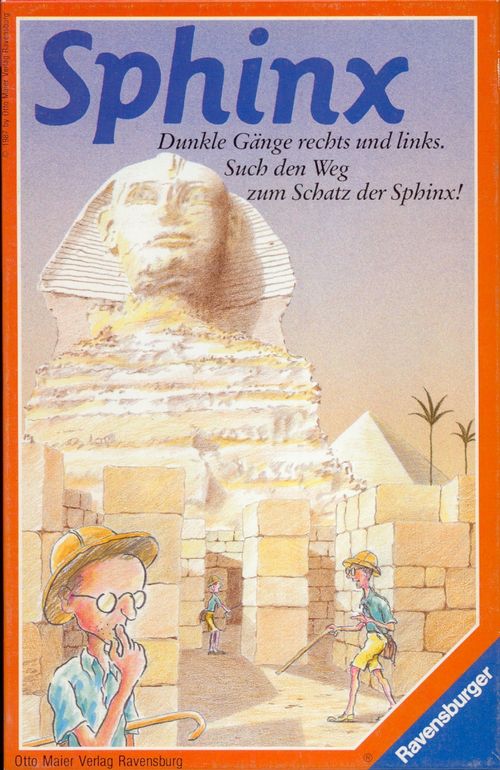
Sphinx (1987)
Sphinx (1987) Rulebook
Table of Contents
Table of Contents
Contents
- 4 game plans (the rooms under the Sphinx)
- 2 sphinx sight screens
- 4 blue wooden pieces (treasures)
- 4 white wooden pieces (entrances)
- 60 brown chips (walls)
- 60 yellow chips (paths)
The Aim of the Game
The aim of the game is to find a way through the walls and rooms under the Sphinx, and find the hidden treasure. The first player to find his way to his opponent's treasure is the winner.
Preparation
- Players sit opposite each other.
- Each takes two game plans and lays them next to each other so that he can read the numbering on the squares.
- Each player then sets up a sight screen in front of his left hand board.
- Each player takes two treasure markers (blue playing pieces), two entrances (white playing pieces) and 15 walls (brown chips).
- The remaining wall and path chips are placed in the centre of the table so that both players can use them.
- Players agree between themselves as to who is to start.
Game Rules
Both players start by building a concealed labyrinth (behind the Sphinx sight screen) using all 15 wall chips:
- The walls may be placed where you like but there must be at least one route through the maze to the treasure. Diagonals are not allowed.
- As soon as a player has got his maze ready, and marked the entrance and treasure with the appropriate pieces, it cannot be changed.
- Note that by using a lot of paths and chambers it is possible to get your opponent horribly lost!!
Players tell each other the location of the entrance and the treasure using the appropriate co-ordinates.
- Players mark the location of their opponent's entrance and treasure using the appropriate markers on the second game plan.
- These are the only hints that can be given during the game.
All players need to do now is determine the route from entrance to treasure. The first player starts and tries to find his way through the labyrinth in the dark. His starting point is the square in which the entrance is located. He can ask about an adjacent square in a horizontal or vertical direction. He does this by giving the co-ordinate of the square he is inquiring about.
- If he asks about a free square then he receives the response "Free", meaning that he can go in that direction. The square is marked on the route map using a yellow chip. Provided that a player continues to meet such free squares his turn continues. The yellow chips indicate the route taken. It is only possible to ask a question about a square that lies adjacent to the entrance or connected to it by route chips.
- If a player asks about a space where there is a wall then he receives the answer "Wall". The player marks the square on his map with a brown chip. The player has bumped into the wall and must take a short rest.
- It is now the other player's turn to ask questions until he, too, bumps into a wall.
The End of the Game
The first player to reach his opponent's treasure is the winner. The sight screens are removed and the mazes compared to each other.
Variants
Players can make the game harder by not saying where the treasures are hidden. Only the location of the start (entrance) is given. The aim is still to find the treasure - but where is it? Players must be honest and declare it when the treasure is finally discovered.
A further possibility is hiding two treasures without declaring their locations. The winner is therefore the first player to find both treasures.