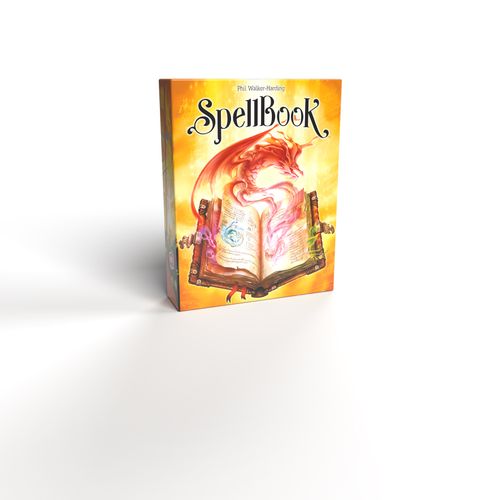
SpellBook
SpellBook Rulebook
Table of Contents
Table of Contents
Components
- 1 Vortex Pouch
- 105 Materia tokens (in 7 colors)
- 1 Altar tile
- 1 First Player token
- 4 Familiar boards (1 per player)
- 4 Spell decks (1 per player) of 21 cards each. Each deck is composed of three 7-card sets.
- 4 Player Aid cards (1 per player)
- 1 Discard box (to be assembled beforehand)
- This rulebook
Spell Cards
Each Spell card shows:
- Title: The Spell's name.
- Set: Indicates which of the 3 sets (set 1 / set 2 / set 3) the card belongs to (used during the first few games).
- Color: Indicates the color of Materia used to learn the Spell.
- Level 3 Effect: Indicates the Spell effect when learned by spending 3 Materia.
- Level 4 Effect: Indicates the Spell effect when learned by spending 4 Materia.
- Level 5 Effect: Indicates the Spell effect when learned by spending 5 Materia.
- Points: Indicates the number of points awarded by the Spell at the end of the game, according to its level.
- Action Symbol: When present, indicates the phase during which the Spell's action may be used.
The back of each Spell card includes 2 features:
- The Familiar identifying which player the card belongs to.
- The card's color (there are 3 cards for each of the 7 colors).
Materia
Materia tokens are used as "currency" to learn Spells. They can also be stored on a player's Familiar board to score points at the end of the game.
The 105 Materia tokens are divided into 7 colors (15 of each color) as follows: Red (Magma), Purple (Poison), Green (Plant), Black (Coal), White (Vapor), Blue (Mercury), Yellow (Gold).
Each Materia token also has a rune inscribed on it. Some Spells also reference certain runes for their effects (see the Appendix - Cards Walkthrough section). There are three different runes in the game. Each color of Materia has five tokens displaying each type of rune.
Setup
Place the Altar tile and the Pouch in the center of the table, then put all the Materia in the Pouch, mixing it thoroughly. Randomly draw 5 Materia from the Pouch and place them on the Altar's empty spaces. Place the Discard box nearby.
- Each player draws 2 Materia from the Pouch, which they place in front of them, forming their initial pool.
- Randomly determine who will be the first player, and give them the First Player token.
- Each player takes a Familiar board, which they place in front of them.
- Each player takes a Player Aid card, as well as the set of Spell cards with the matching Familiar icon on their backs. Some of these will be placed on the table, as described in the next sections.
First Game
For your first game, each player places the set of 7 Spell cards with the set 1 symbol in front of them, next to the Player Aid card. The exact arrangement of cards doesn't matter.
Future Games
To familiarize yourselves with the game, we recommend you play using the set 1 several times. Once players are comfortable with this set, proceed to use the set 2 for a few games, then the set 3. Once you have mastered all 3 sets (and all 21 Spells within them), you will be ready to play the classic game.
Classic Game
To play the classic game, you will have 1 Spell of each color. For each of the 7 colors, the first player shuffles the 3 cards of that color and draws one randomly. Every other player takes the same card from their deck. The chosen card is placed in front of them, and the other 2 cards of that color are returned to the box, as they will not be used. Repeat this process for each color.
Important: Instead of drawing the Spells randomly, players can instead agree on a specific combination of cards. Whatever method is chosen, each player should have the same 7 Spell cards, 1 of each color.
Game Turn
Starting with the first player, each player completes their turn (Day) before moving onto the next player. A Day is split into 3 phases: Morning, Midday, and Evening. During each phase, the player may perform a single action. At the end of their Day, the player resupplies the Altar, and play proceeds clockwise to the next player. This sequence continues until the game ends (see Game End).
Important: Players are limited to a single action in each phase. Performing an action in a phase is always optional, and any phase may be skipped (either by choice or because no action can be performed).
Each phase has one or two primary actions that are available for players to use at the beginning of the game. As players learn Spells (see Evening), additional action options may become available.
Pool Limit
Each player's pool is limited to a maximum of 9 Materia which cannot be exceeded at any time during the game. Materia in the pool can be stored (see Midday), spent to Learn a Spell (see Evening), or discarded when using a Spell's ability. When drawing or taking multiple Materia, do so one at a time.
Note: This limit may cause an action to only be partially completed. For example, if you use the ability of a Spell that allows you to draw 4 Materia from the Pouch and you already have 6 Materia, you would only draw 3.
Morning
At the beginning of the game, only two primary actions are available to the players during the Morning phase:
- Take 1 Materia: The player chooses 1 Materia from the Altar and adds it to their pool.
OR
- Draw 2 Materia: The player draws 2 Materia from the Pouch and adds them to their pool.
Example: For their Morning action, player A decides to take 1 Materia. They take the red Materia from the Altar and add it to their pool. Their Morning action completed, they proceed to the Midday phase.
Midday
At the beginning of the game, only one primary action is available to the players during the Midday phase:
- Store 1 Materia: The player takes 1 Materia from their pool and stores it on the first available space on their Familiar board (the space with the lowest value still visible).
Note: The number 18 is not a space, but is the point value at the end of the game if the Familiar board is filled (see Game End).
Note: If an action would allow you to store more Materia than there are remaining spaces on the Familiar board, the excess Materia remain where they are, and are not stored or discarded.
Example: For their Midday action, player B chooses to store 1 Materia. They choose the yellow Materia from their pool and store it on the first available space on their Familiar board. Having completed their Midday action, they now proceed to the Evening phase.
Evening
At the beginning of the game, only one primary action is available to the players during the Evening phase:
- Learn 1 Spell: The player spends Materia from their pool to learn a new Spell. These Materia must be the same color as the Spell they want to learn. One of the spent Materia is placed on the Spell card, on the space matching the amount of Materia the player spent. (For example, if 3 Materia are spent, one is placed on the bottom space of the Spell card, making it a level 3 Spell.) The other Materia are discarded into the Discard box.
When performing this action, the player may spend 3 Materia of any color that all have the same rune. Doing this counts as a wild Materia, providing 1 additional Materia of the color being spent. They can repeat this process to create several wild Materia, but they must spend at least 1 Materia that actually matches the Spell's color in order to place it on the card.
Example: The green, red, and black Materia all share the same rune. The player could spend these 3 Materia to gain a wild Materia, which can combine with the other 4 yellow Materia to learn the level 5 yellow Spell.
Important: A Spell can only be learned once. Thus, a player who learns a Spell at level 3 cannot use the Learn 1 Spell action later to upgrade it to a higher level.
Spells
When a player learns a Spell which includes a phase symbol in the top-left corner (Morning, Midday, or Evening), another action becomes available in the depicted phase from the next Day onwards. When a player uses a Spell as an action, they can choose to use the effect for the Spell's level or any lower level.
Note: The ability to use the effect of a lower level does not apply to cards that do not have a phase symbol.
Spells that do not have a phase symbol will have either a permanent or instant effect, or will provide points at the end of the game.
- Instant Effects: If a Spell effect has the instant symbol, the effect is applied immediately when the player learns the Spell. After that, it will provide no further effect (other than points at the end of the game).
- Permanent Effects: If a Spell effect has the permanent symbol, the effect applies for the rest of the game, whenever the conditions listed are met during your Day. (For details, see the Appendix - Cards Walkthrough section.)
Example: For their Evening action, player C decides to learn the Sacrifice Spell. They have 4 red Materia: they place 1 red Materia on the Sacrifice card at level 4 and discard the remaining 3. The next Day, the player uses the Sacrifice Spell as their single Morning action. Because they learned the Spell at level 4, they can use either the level 4 or level 3 effect.
Example: For their Evening action, player D decides to learn the Abundance Spell. They have 4 yellow Materia and want to learn it at level 5, so they discard an additional 3 Materia displaying the same rune. They place 1 yellow Materia on the Abundance card at level 5 and discard the remaining tokens. Since the Spell has the instant symbol, they immediately resolve the effect and draw 4 Materia from the Pouch, which are added to their pool.
Altar
After completing (or skipping) the Evening phase, the player resupplies the Altar.
- If there are fewer than 5 Materia on the Altar: Draw from the Pouch until 5 spaces are occupied.
- If there are 5-9 Materia on the Altar: Draw 1 Materia from the Pouch and place it on an unoccupied space on the Altar.
- If there are 10 or more Materia on the Altar: Discard all the Materia from the Altar, draw 5 Materia from the Pouch, and place them on the Altar.
Example: At the end of their Day, player D resupplies the Altar. As it is full, they cannot add any Materia to it. Therefore, the player discards all the Materia and draws 5 Materia from the Pouch, which they place on the Altar. The game then continues, with the next player clockwise taking their turn.
Depleted Pouch
If the Pouch is empty when a player must draw Materia (to perform an action or resupply the Altar), all previously discarded tokens are returned to the Pouch, and the game resumes drawing any Materia that still need to be drawn.
Game End
The game ends when any player fulfills one or more of the following requirements:
- They learn their 7th and final Spell,
- They fill the last available space (16) on their Familiar board.
Keep playing until all players have taken the same number of turns (the player to the right of the first player will take the last turn of the game). Then, everyone tallies their points.
- For each learned Spell, players score the number of points indicated by the level space occupied by the Materia.
- Players score the number of points indicated by the lowest visible value on the Familiar board.
Note: Some Spells are worth variable points (see the Appendix - Cards Walkthrough section).
The player with the most points wins the game. In case of a tie, the tied player who learned the most Spells wins. In case of a further tie between the same players, the tied player with the most Materia in their pool wins. In the unlikely event the players are still tied, they share the victory.
Example: It is the end of the game. Player A tallies their points. They score:
- 2 points for Sacrifice (level 4),
- 5 points for Levitation (level 5),
- 1 point for Purification (level 3),
- 0 points for Offering (not learned),
- 4 points for Time Travel (level 4),
- 0 points for Transmutation (not learned), and
- 7 points for Abundance (level 5).
They also score 7 points for their Familiar board (as the 7 is the lowest visible value). They score 26 points in total.
Glossary of Terms
- "Take x": Take the indicated number of Materia from the Altar.
- "Draw x": Draw the indicated number of Materia from the Pouch.
- "Store x": Store the indicated number of Materia from your pool onto your Familiar board (unless the ability says otherwise).
- "Discard x": Discard the indicated number of Materia from your pool.
- "Increase a Spell by 1 level": Move the Materia token on that Spell to the next higher level. A Spell at level 5 cannot have its level increased.
- "Swap x": Take a Materia from the specified location and replace it with any Materia in your pool. Do this the indicated number of times.
- Arrow symbol: The token referenced by the ability must match the rune placed on the Spell card.
Appendix - Cards Walkthrough
Red Spells
Sacrifice (Morning)
- Level 5: The player discards 1 Materia from their pool, then draws 4 Materia from the Pouch and adds them to their pool. Worth 3 points at the end of the game.
- Level 4: The player discards 1 Materia from their pool, then draws 4 Materia from the Pouch and adds them to their pool. Worth 2 points at the end of the game.
- Level 3: The player discards 1 Materia from their pool, then draws 4 Materia from the Pouch and adds them to their pool. Worth 1 point at the end of the game.
Note: Higher levels do not allow the player to draw additional Materia, but rather provide them more options to trigger the effect.
Eruption (Morning)
- Level 5: The player draws from the Pouch until they have 6 Materia in their pool. Worth 4 points at the end of the game.
- Level 4: The player draws from the Pouch until they have 5 Materia in their pool. Worth 3 points at the end of the game.
- Level 3: The player draws from the Pouch until they have 4 Materia in their pool. Worth 2 points at the end of the game.
Note: The Spell has no effect if the player's Materia pool already has the indicated number of tokens or more. For example, if the player already has 6 Materia in their pool, the player cannot use this Spell to gain more Materia.
Blaze (Morning)
- Level 5: The player draws 4 Materia from the Pouch and adds them to their pool. All other players take 1 Materia from the Altar. Worth 5 points at the end of the game.
- Level 4: The player draws 4 Materia from the Pouch and adds them to their pool. All other players take 1 Materia from the Altar. Worth 2 points at the end of the game.
- Level 3: The player draws 4 Materia from the Pouch and adds them to their pool. All other players take 1 Materia from the Altar. Worth 0 points at the end of the game.
Note: Starting with the player to the left of the player performing the action and proceeding clockwise, each other player must take a Materia from the Altar, unless the Altar is empty or they already have 9 Materia in their pool.
Purple Spells
Levitation (Morning)
- Level 5: The player takes 2 Materia from the Altar and adds them to their pool. Worth 5 points at the end of the game.
- Level 4: The player takes 2 Materia from the Altar and adds them to their pool. Worth 4 points at the end of the game.
- Level 3: The player takes 2 Materia from the Altar and adds them to their pool. Worth 3 points at the end of the game.
Note: It is not allowed to take 2 different runes. For example, a player who learns the Levitation Spell at level 4 can take 2 of one matching rune, but cannot take 1 of one rune and 1 of another.
Sharing (Morning)
- Level 5: The player takes 3 Materia from the Altar. All other players draw 1 Materia from the Pouch. Worth 4 points at the end of the game.
- Level 4: The player takes 2 Materia from the Altar. All other players draw 1 Materia from the Pouch. Worth 4 points at the end of the game.
- Level 3: The player takes 1 Materia from the Altar, then draws 1 Materia from the Pouch. All other players draw 1 Materia from the Pouch. Worth 4 points at the end of the game.
Note: At level 3, taking Materia must be performed before drawing Materia. Then, starting with the player to the left of the player performing the action and proceeding clockwise, each other player must draw a Materia from the Pouch, unless they already have 9 Materia in their pool.
Divination (Morning)
- Level 5: The player draws 2 Materia from the Pouch and adds them to the Altar, then takes 2 Materia from the Altar and adds them to their pool. Worth 4 points at the end of the game.
- Level 4: The player draws 2 Materia from the Pouch and adds them to the Altar, then takes up to 2 Materia of the same color from the Altar and adds them to their pool. Worth 3 points at the end of the game.
- Level 3: The player draws 2 Materia from the Pouch and adds them to the Altar, then takes 2 Materia from the Altar and adds them to their pool before discarding 1 Materia. Worth 2 points at the end of the game.
Note: The player can add Materia to the Altar even if its 10-space limit is exceeded, as this limit is only verified at the end of the player's Day.
Green Spells
Purification (Midday)
- Level 5: The player swaps 3 Materia from their pool with 3 Materia from the Altar. Worth 3 points at the end of the game.
- Level 4: The player swaps 2 Materia from their pool with 2 Materia from the Altar. Worth 2 points at the end of the game.
- Level 3: The player swaps 1 Materia from their pool with 1 Materia from the Altar. Worth 1 point at the end of the game.
Note: The player must swap an equal number of Materia; they cannot, for instance, place 2 Materia on the Altar and only take 1 from the Altar. However, the player can make the swap even if their pool is at the 9 Materia limit.
Cure (Midday)
- Level 5: The player draws 3 Materia from the Pouch and adds them to their pool; then, they discard 3 Materia from their pool. Worth 5 points at the end of the game.
- Level 4: The player draws 2 Materia from the Pouch and adds them to their pool; then, they discard 2 Materia from their pool. Worth 4 points at the end of the game.
- Level 3: The player draws 1 Materia from the Pouch and adds it to their pool; then, they discard 1 Materia from their pool. Worth 3 points at the end of the game.
Note: Drawing must be performed before discarding. Players must comply with the pool limit of 9 Materia when drawing. As such, it's possible a player may discard more Materia than they drew.
Growth (Evening)
- Level 5: The player takes 3 Materia from the Altar and stores them on their Familiar board's first 3 available spaces. Then, on their Growth card, they move their Materia down to level 4. Worth 6 points at the end of the game.
- Level 4: The player takes 2 Materia from the Altar and stores them on their Familiar board's first 2 available spaces. Then, on their Growth card, they move their Materia down to level 3. Worth 4 points at the end of the game.
- Level 3: The player swaps 1 Materia from their pool with 1 Materia from their Familiar board. Do not move the Materia token on the card. Worth 3 points at the end of the game.
Note: The points awarded at the end of the game are determined by the final position of the Materia token on the Spell card. If the token is at a higher level, the player can use the level 3 action without decreasing the Spell level by one.
Black Spells
Offering (Midday)
- Level 5: The player takes 4 Materia of the same color from their pool and stores them on their Familiar board's first 4 available spaces. Worth 6 points at the end of the game.
- Level 4: The player takes 3 Materia of the same color from their pool and stores them on their Familiar board's first 3 available spaces. Worth 4 points at the end of the game.
- Level 3: The player takes 2 Materia of the same color from their pool and stores them on their Familiar board's first 2 available spaces. Worth 2 points at the end of the game.
Note: Only the Materia's color matters, not the rune.
Focus (Evening)
- Level 5: The player takes 3 Materia from their pool whose runes match the one placed on the Spell and stores them on their Familiar board's first 3 available spaces; OR the player takes 2 Materia from the Altar whose runes match the one placed on the Spell and adds them to their pool. Worth 5 points at the end of the game.
- Level 4: The player takes 2 Materia from their pool whose runes match the one placed on the Spell and stores them on their Familiar board's first 2 available spaces; OR the player takes 1 Materia from the Altar whose rune matches the one placed on the Spell and adds it to their pool. Worth 4 points at the end of the game.
- Level 3: The player takes 1 Materia from their pool whose rune matches the one placed on the Spell and stores it on their Familiar board's first available space. Worth 3 points at the end of the game.
Feast (Midday)
- Level 5: At the end of the game, the player scores 1 point for each different color Materia stored on their Familiar board, in addition to the points awarded by the Familiar board itself. This level has no Midday action.
- Level 4: The player takes 1 Materia from the Altar and stores it on their Familiar board's first available space. Worth 2 points at the end of the game.
- Level 3: The player takes 1 Materia from the Altar whose color matches that of one of the stored Materia on their Familiar board and adds it to their pool. Worth 2 points at the end of the game.
Reminder: The effects of lower levels are always accessible.
White Spells
Time Travel (Evening)
- Level 5: The player discards 1 Materia from their pool, then increases the level of a Spell other than Time Travel by one. Worth 6 points at the end of the game.
- Level 4: The player discards 1 Materia from their pool, then increases the level of a Spell other than Time Travel by one. Worth 4 points at the end of the game.
- Level 3: The player discards 1 Materia from their pool, then increases the level of a Spell other than Time Travel by one. Worth 2 points at the end of the game.
Note: The same Spell can have its level increased several times. The level of the Growth Spell can be increased to allow its effect to be reused. Instant effects are not triggered when the Spell's level is increased, as they are only triggered by the Learn 1 Spell action. The point value of a Spell depends on the final level of the Spell at the end of the game.
Storm (Evening)
- Level 5: The player discards any number of Materia from the Altar and replaces them with an equal number of Materia drawn from the Pouch. Then, they take 3 Materia, which they add to their pool. Finally, on their Storm card, they move their Materia down to level 4. Worth 8 points at the end of the game.
- Level 4: The player discards any number of Materia from the Altar and replaces them with an equal number of Materia drawn from the Pouch. Then, they take 3 Materia, which they add to their pool. Finally, on their Storm card, they move their Materia down to level 3. Worth 6 points at the end of the game.
- Level 3: No effect. Worth 4 points at the end of the game.
Note: The points awarded by this Spell at the end of the game are determined by the final position of the Materia token on the card.
Clone (Midday)
- Level 5: The player discards 1 Materia from their pool whose rune matches the one placed on the Spell. Then, they choose a Spell learned by another player featuring a Morning action and apply its effect as if they had learned it themselves. Worth 6 points at the end of the game.
- Level 4: The player chooses a Spell learned by another player featuring an Evening action and applies its effect as if they had learned it themselves. Worth 5 points at the end of the game.
- Level 3: The player chooses a Spell learned by another player featuring a Midday action and applies its effect as if they had learned it themselves. Worth 4 points at the end of the game.
Note: This Spell can be used to copy another player's primary actions (e.g., Draw 2 Materia). If the player copies another player's Growth Spell, the level of the Clone Spell will be decreased. This Spell cannot be used to copy a player's own Spells (unless another player has also learned it), a Spell with an instant or permanent effect, or another Clone Spell.
Blue Spells
Transmutation (Evening)
- Level 5: The player may Learn 1 Spell, but instead of spending sets of 3 identical runes as a wild Materia, they may spend 2 runes matching the rune on this card, each counting as a wild Materia. Worth 4 points at the end of the game.
- Level 4: The player may Learn 1 Spell, but instead of spending sets of 3 identical runes as a wild Materia, they may spend 1 rune matching the rune on this card as a wild Materia. Worth 4 points at the end of the game.
- Level 3: No effect. Worth 4 points at the end of the game.
Note: The rune shown on the Materia placed on the Spell determines which rune can be used as wild Materia when taking this action. When used, this Spell's action replaces the Learn 1 Spell primary action; this means that if the player uses this Spell, they cannot create additional wild Materia using 3 identical runes. The primary action is still available to use, but it cannot be combined with this Spell.
Swiftness
- Level 5: (Permanent) Each Day, the player may perform 1 additional Morning action, for a total of 2 Morning actions available to them. Worth 0 points at the end of the game.
- Level 4: (Instant) When learning this Spell, the player immediately performs 1 Morning action available to them. Worth 6 points at the end of the game.
- Level 3: (Instant) When learning this Spell, the player immediately performs 1 Morning action available to them. Worth 3 points at the end of the game.
Note: The player can perform the same Morning action twice when using the level 5 effect. The primary Morning actions (Draw 2 OR Take 1) are always available to perform.
Mirage
- Level 5: (Permanent) During their Day, whenever the player takes 1 Materia from the Altar (not the Pouch) whose rune matches the one placed on the Spell, they draw 2 Materia from the pouch and add them to their pool. Worth 6 points at the end of the game.
- Level 4: (Permanent) During their Day, whenever the player takes 1 Materia from the Altar (not the Pouch) whose rune matches the one placed on the Spell, they draw 2 Materia from the pouch and add them to their pool. Worth 3 points at the end of the game.
- Level 3: (Permanent) During their Day, whenever the player takes 1 Materia from the Altar (not the Pouch) whose rune matches the one placed on the Spell, they draw 1 Materia from the pouch and add it to their pool. Worth 2 points at the end of the game.
Note: The effect of this Spell can occur several times during a player's Day, and even during a single action. However, this effect does not apply during other players' turns (such as with the Blaze Spell).
Yellow Spells
These Spells trigger effects allowing players to increase their scores.
Abundance
- Level 5: (Instant) When learning the Spell, the player immediately draws 4 Materia from the Pouch and adds them to their pool. Worth 7 points at the end of the game.
- Level 4: (Instant) When learning the Spell, the player immediately draws 3 Materia from the Pouch and adds them to their pool. Worth 5 points at the end of the game.
- Level 3: (Instant) When learning the Spell, the player immediately draws 2 Materia from the Pouch and adds them to their pool. Worth 3 points at the end of the game.
Note: The Instant effect can only be applied when learning the Spell. It must be resolved immediately, and cannot be saved until later or used again.
Knowledge
- Level 5: At the end of the game, the player scores 2 points for each learned Spell (other than Knowledge), in addition to the points awarded by those Spells.
- Level 4: At the end of the game, the player scores 2 points for each learned Spell (other than Knowledge) at level 4 or level 5, and 1 point for each learned Spell at a lower level; this is in addition to the points awarded by those Spells.
- Level 3: At the end of the game, the player scores 1 point for each learned Spell (other than Knowledge), in addition to the points awarded by those Spells.
Note: The points scored for the level 4 effect depend on the final level of the other Spells at the end of the game.
Communion
- Level 5: (Permanent) When learning a Spell (including this one), the player stores 2 of the discarded Materia onto the first 2 available spaces on their Familiar board. Worth 0 points at the end of the game.
- Level 4: At the end of the game, the player scores 1 point for each stored Materia on their Familiar board whose rune matches the one placed on the Spell, in addition to the points awarded by the Familiar board itself.
- Level 3: (Instant) When learning the Spell, the player takes 3 Materia from the Altar and stores them on the first 3 available spaces on their Familiar board. Worth 0 points at the end of the game.
Reminder: The player only scores the points matching the final level of the Spell at the end of the game. Thus, if the Spell is at level 3 or level 5, they do not score any points for this Spell. This Spell only awards points at level 4.
Solo Mode
The game is played using the usual rules, with the following adjustments:
- Setup: The player takes a second Familiar board and uses its reverse side to track their opponent's points. Place 7 Materia on the Altar (instead of 5).
- Altar: At the end of their Day, and before resupplying the Altar, the player takes 1 Materia of their choice from the Altar and places it on the first available space on their opponent's board. Then, they resupply the Altar to 7 Materia. If the space where they placed the Materia features the reset symbol, the player discards all Materia from the Altar and draws 7 Materia from the Pouch, which they place on the Altar.
- Game End: The game ends as normal (when the player learns their last Spell or when their Familiar board is full). They end their Day (and place one final Materia on the opponent's board). Additionally, the game will end if the opponent's last space (38) is filled. The opponent's score is equal to the lowest visible value on the track, plus 1 point for each Materia on the lower part of the board. The player calculates their score as normal, and compares their score to their opponent's. In the case of a tie, neither the player nor the opponent wins.
- Special Spell rules:
- Blaze and Sharing: When the player performs the action of either of these Spells, they must take 1 Materia from the Altar (Blaze) or draw 1 Materia from the Pouch (Sharing) and place it on the lower part of the opponent's board. The tokens placed in this area will award the virtual opponent 1 point at the end of the game.
- Clone: When the player performs the action of this Spell, they can copy the level 4 effect of a Spell they have not yet learned.
- Increased Difficulty: At the beginning of the game, seasoned players can choose to draw 1 to 3 Materia from the Pouch and place them on the lower part of the opponent's board.
Frequently Forgotten Rules
- A player's pool is strictly limited to 9 Materia at all times.
- The primary action Store 1 Materia is performed at Midday. The players must therefore decide to store before learning a Spell (Evening).
- Transforming 3 Materia showing an identical rune into a wild Materia can only be performed when the player learns a Spell. It cannot be done for any other effect.
- The instant effect is only applied when the player learns the Spell, and must be applied immediately.
- For learned Spells showing a phase symbol (Morning, Midday, or Evening), the player may use the effect at the level learned or any lower level.
- For Spells that do not have a phase symbol, only the effect of the level learned may be applied (you cannot use lower-level effects of these Spells).
Designer / Artwork
Phil Walker-Harding (Game Design)
"I've always loved board games and feel very blessed to have been designing them for fifteen years now. I aim to make games that are easy to learn, and that bring people of all ages and backgrounds together at the table for meaningful experiences. I live in Sydney, Australia, with my wife, Meredith, and cat, Remy. The design for SpellBook came from my fascination with rummy-style set-collection games. I wanted to make a game where every set you made would give you a special ability for the rest of the game, and the bigger the set, the better the ability. Learning spells seemed like a fitting theme, and it was brought to life by the amazing development work from the team at Space Cowboys. I hope you enjoy learning some magic!"
Cyrille Bertin (Artwork)
Armed with two A.A. degrees in design and visual communication, he joined the sorcerers of the Magic Cauldron (web design agency) in the Nantes region in 1999. At the end of 2003, he embarked on a solo adventure and worked for the web and advertising industries while participating in collectives and exhibitions. As a fan of playful witchcraft from an early age, he was thrilled to illustrate his first game, "Négoces," in 2006, followed by "When I Dream," "Team Team," and the tenth Unlock! scenario. During all that time, he kept busy colorizing comics ("Domes," "Sky-Doll," "Billy Brouillard," "Earthworm," etc.), filling his schedule as much as possible in case he would have to take a break (God forbid!).
This product has been manufactured with all possible care. However, if you encounter a problem with your game, please contact our Customer Service at [email protected]. We will respond to your issue in a timely manner.