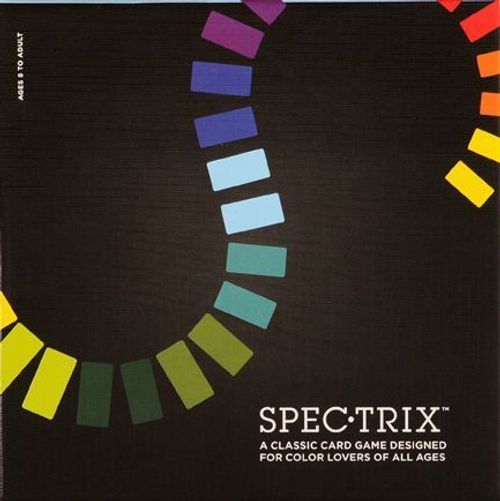
Spectrix
Spectrix Rulebook
Table of Contents
Table of Contents
Overview
Spectrix™ is a colorful take on the game of Rummy, played in multiple fast paced rounds. The object is to be the first player to get rid of all of the cards in your hand by placing them into color sequences based on the order of colors on the Spectrix™ guide card or into collections of the same color. Players who are left with cards at the end of each round are given points. Players who reach 100 points or more are eliminated from the game.
A piece of paper and writing instrument are needed to keep score in each round.
Players: 2 to 6
Winning
To win the round: The first player to play all of the cards in their hand wins the round. Each card left in the hands of the other players counts as 5 points. The losing players add the points to the point totals from previous rounds. Any player with a total of 100 or more points at the end of each round is eliminated from further play.
To win the game: The last player to reach 100 points wins the game.
Game Definitions
- COLOR COLLECTION: a minimum of 3 cards of the same color.
- COLOR SEQUENCE: a minimum of 3 consecutive color cards from the spectrum; can start at any color and proceed in any direction.
- WHITE LIGHT: a complete spectrum organized during a turn.
Starting the Game
Remove the 6 Spectrix™ guide cards from the deck and distribute one to each player. The guide card will be used as an important reference during game play.
The dealer shuffles the cards thoroughly, and deals the following number of cards face down to each player:
- 2-3 players: 15 cards each
- 4-5 players: 12 cards each
- 6 players: 10 cards each
Tip: Game play is easier if players sort the cards in their hands according to the order of colors displayed in the Spectrix™ guide card prior to beginning the round.
After dealing out the cards, the remaining deck is placed face down to the side of the playing area and becomes the pickup deck. The dealer role rotates to the left after each round. Play begins with the player to the left of the dealer.
Spectrix Game Play
When it is a player's turn, there are 5 valid moves that can be done. The player may place down as many cards as they can and is not restricted to just one action.
All cards on the table are fair game.
The defining feature of Spectrix™ is being able to make changes to the sequences and collections of cards already on the table. Each player, when it is their turn, may reorganize the cards in order to make new combinations that enable them to play more cards. All new combinations must be valid, and players cannot remove any cards already in play on the table. For penalty see move 5.
Valid Moves
1. Play the Color Collection
Three (or more) cards of the same color (a collection). For example, you can play 3 purple cards.
2. Play the Color Sequence
A sequence of at least 3 cards following the Spectrix™ guide card order and starting at any color. For example, you can play yellow, orange and red.
3. Play to the Existing Cards
Play one or more cards to a sequence or collection already on the table.
4. Forming 'White Light'
If a player is able to form a complete color spectrum at any point during the game, the player can claim 'White Light'! At this point, all of the other players automatically get 5 points added to their score. The 'White Light' spectrum is collapsed and removed from play and reshuffled into the pick up deck.
Twelve colors make up the white light spectrum and it can begin and end anywhere in the spectrum.
5. Combine
Take a card from a color collection or sequence and use it to help you put down cards from your hand. The important thing to remember is that each color collection and sequence on the table must have at minimum 3 cards. If a player rearranges cards on the table, and then realizes that the intended play will leave invalid combinations, then the player must return all of the cards to the original sequences and collections. If the player is unable to do this, then the player must draw 3 additional cards as a penalty. The other players will then try to restore the cards to their proper groups. Any invalid cards left on the table are shuffled back into the pickup deck.
Examples
Example 1: Valid Move
If there are three triplets on the table: dark blue cards, purple cards and magenta cards.
The current player wants to play a light blue card from his hand. They can change the combinations on the table to form three color sequences: each consisting of a dark blue, purple and magenta card. Now, the player can add the light blue card to one of the sequences.
Example 2: Invalid Move
With the following combinations on the table (as shown in the diagram): a stack of dark blue cards, a stack of magenta cards, a stack of purple cards, and a set of dark blue, purple and magenta sequences with a single dark blue card left over.
The current player wants to play a light blue card in their hand. The player attempts to modify the groups by creating three valid color sequences.
This play is not valid as it leaves a dark blue card that cannot be combined with any other combination on the table. The player must restore the combinations to the original layout and remove their card. Since this player cannot make a valid move, they must pick up a card from the draw deck.
End of Game
If the remaining players in the game each reach 100 or more points at the end of the same round then the player with the lowest number of points wins the game. If the remaining players have the exact same number of points at or above 100, then a sudden death round is played and the winner of this wins the entire game!
Tips:
- For a shorter game, decrease the point target to 50.
- For a longer game, increase the point target to 200.
- Instead of playing to a point total, play for a specified period of time (player with the fewest points wins).
Spectrix Cards Are Versatile!
Memory Game
Spectrix can also be transformed into an easy, colorful memory game great for younger children. Separate out two cards of each color to use in play. Shuffle the 24 cards and display them face down in 4x6 grid on a flat surface. Take turns trying to identify pairs of colors.
Choose a dealer and then begin the play to the left. Each player gets an opportunity to overturn two cards.
If they match the player can pick these up and then continue to try again to turnover two matching cards. When a player cannot match two cards, his turn ends and play continues with the next player. The game ends when all cards have been picked up in pairs. The player with the most pairs wins.
Color Flash Cards
Introduce small children to the wonder of color by turning Spectrix into a set of color flash cards!