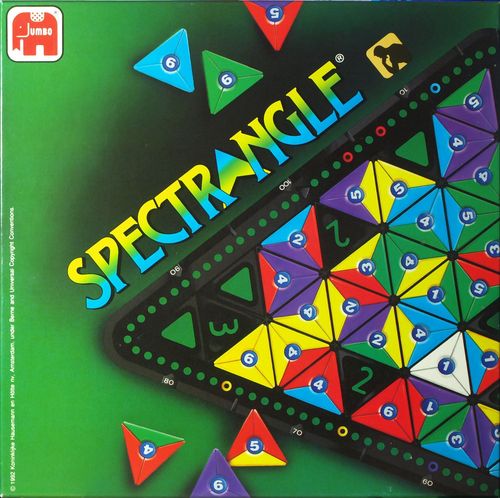
Spectrangle
Spectrangle Rulebook
Table of Contents
Table of Contents
Contents
- Game board
- 36 coloured triangular tiles
- 8 score counters in 4 colours
- 1 bag
- Game rules
Preparation
- Put all the tiles into the bag.
- Each player takes one tile from the bag. The one who gets the tile with the highest value starts the game.
- Each player now takes 3 more tiles from the bag, so that they have 4 tiles in total. The tiles are put on the table so that the other players can see them clearly.
- Each player or team takes two score counters of one colour.
Object of the Game
The object of the game is to score the highest number of points. You achieve this by aiming to score as high as possible and by trying to block other player(s) or teams.
The Game
The first player places a tile on the board; they may choose where they place the tile but it may not be a bonus space (space with a number). The player scores the number of points on the tile that they placed on the board. Now the player takes another tile out of the bag to restore the amount of tiles to four. The turn then moves clockwise.
Each player places a new tile when it is their turn; part of this tile must match at least one colour on one of the tiles already on the board. It must be placed so that the matching colours adjoin. There is one exception: the joker, which is all white, this can be used for all colours. Once the joker is on the board, any tile can be placed adjacent to it. Once a tile has been placed it cannot be moved (this applies to the joker too!). A player MUST play if able to do so.
If a Player Cannot Place a Tile
If a player cannot place a tile then they may:
- a. miss a turn.
- b. exchange one of their tiles for a new one and then pass their turn.
Each player must draw another tile at the end of their turn; if a player forgets to do this, then they must take another tile as soon as this has been discovered. It may happen that a player cannot place a tile but as soon as they can again, they are obliged to do so. The game is over when the bag is empty and no one can place another tile.
Score Calculation
The score of the players or teams is recorded on the outside track. The coloured score counters record the points of each player or team. Each player (team) has two, to make keeping score easy.
The score track starts at the tile next to the number 100. You start to count with 1. To make counting easier the 10s are marked and there is a line next to each "5". As soon as a player has placed a tile, the points are counted up. One of the score counters is then moved to this score on the track. After each subsequent turn, the points earned are added to the previous score and the second counter is placed at the latest score, so you can always check if a player has added correctly. A player who reaches "100" keeps on counting. If he ends, for example, in the hole "9", then his score is "109". After all the game is only over when all the tiles have been played! If two players or teams have the same score, then the counters are placed on top of each other.
Points Are Calculated Like This
- The first tile on the board and each following tile that matches on one side. Score: the value of the tile.
- A tile matches on two or three sides. Score: the number of matching sides times the value of the tile. Eg. Two matching sides with a tile value of 5 would be 5x2=10.
- A tile is placed on a bonus space (the spaces with a 2, 3 or 4). Score: the bonus times the number of matching sides, times the value of the tile.
To Summarise
Your score is always calculated like this. The value of the tile that you place, times the number of matching sides, times the (possible) bonus.
When the game is over and there are players who have tiles left over, then the value of those tiles is subtracted from their scores.
Try either to score maximum points or block your opponents as much as possible.
The game is made even more exciting if you play with four players in teams. Partners sit opposite each other. Then a player can set things up so that their partner can make a high score. Prepare combinations for each other. Teams use only one colour of the score counter.
It is a good idea to keep a record of the scores you get. This way you can determine the best score during a given period of time. The highest score of the month for example.