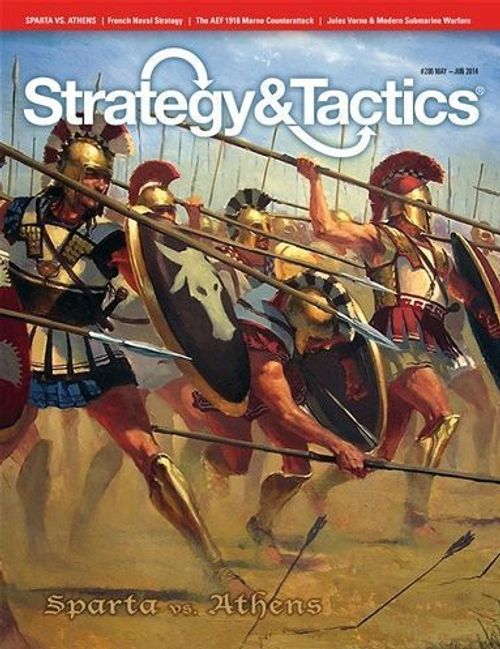
Sparta vs. Athens
Sparta vs. Athens Rulebook
Table of Contents
Table of Contents
- 1.0 Introduction
- 2.0 Components
- 2.1 The Game Map
- 2.2 Playing Pieces (Counters)
- 2.3 Combat Units
- 2.4 Leader Chits
- 2.5 Forces
- 2.6 Force Counters & Force Holding Boxes
- 2.7 Fort Counters
- 2.8 Informational Markers
- 2.9 Nationalities
- 2.10 Neutrals
- 2.11 Prestige Track
- 2.12 Prestige Optional Rule
- 2.13 The Athenian Revenue Table, the Spartan Revenue Table
- 2.14 The Year Track
- 2.15 Force Boxes
- 2.16 Delos Confederation Tribute Value
- 2.17 Revenue Track
- 3.0 Sequence of Play
- 4.0 The Campaign Phase
- 5.0 Forces
- 6.0 Leaders
- 7.0 Movement
- 7.1 How to Move Forces
- 7.2 Coastal Movement from City Locales
- 7.3 Expending Campaign Points
- 7.4 Transporting LSP
- 7.5 Effect of Enemy Forces on Movement
- 7.6 "Dropping Off" Units
- 7.7 "Picking Up" Units
- 7.8 Forts & Walled Cities
- 7.9 Naval Movement & Interception
- 7.10 Evading Naval Combat
- 7.11 Ports
- 7.12 Access to the Port of Corinth
- 8.0 Combat
- 9.0 Sieges
- 10.0 Revolts
- 11.0 Nation States
- 12.0 Logistics
- 13.0 Prestige
- 14.0 Governments
- 15.0 Random Events
- 15.1 The First War in Sicily & Italy Random Event (Year 427, 426, 425)
- 15.2 The Second War in Sicily & Italy Random Event (Year 416, 415, 414)
- 15.3 Athens Captures Syracuse Random Event
- 15.4 Syracuse Joins Sparta Random Event
- 15.5 Carthage Invades Sicily Random Event
- 15.6 War in the Northeast Random Event
- 15.7 The Peace of Nicias Random Event (Year 421)
- 15.8 Expiration of the Thirty Year Truce between Sparta and Argos Random Event (Year 420)
- 15.9 The League of Argos Random Event (Year 419)
- 15.10 Tegea Attempts to Join the League of Argos Random Event (Year 418)
- 16.0 Scenarios
- 17.0 City Location Aid
1.0 Introduction
1.1 Description
Sparta versus Athens is a two player strategic level game simulating epochs of the Peloponnesian War. Each inch equals ~18 miles. One naval strength point represents about 5 galleys of the era (Triremes). Land units can represent anything from 300 to 3,000 men, but the combat strength of the units in the game do not represent any specific number of men (though they may), but stronger land units typically represent heavy infantry, such as Hoplites, or cavalry, and weaker land units typically represent light infantry.
2.0 Components
2.1 The Game Map
The game-map represents the geographic area where the wars were waged, and uses a point-to-point movement system, which means that units move between locales via the movement "paths" printed on the map.
Note: Italy and Sicily have been rotated approximately 90 degrees at the heel of Italy so that they will fit on the game-map. Because there is no grid numbering system on the map, leaving players to hunt for cities that they may need to find, the last few pages of these rules includes an alphabetical listing of each city on the map, with an approximation of its position on the map.
2.2 Playing Pieces (Counters)
The die-cut cardboard playing pieces are referred to as counters. There are five types of counters: combat units, leaders, force counters, forts and informational markers.
Note: The game is provided with a couple dozen "coin" counters, which are intended to represent denominations of ten talents each. These are included to give player's a tactile experience in the way money was traded in antiquity. You may prefer to keep a written record instead.
2.3 Combat Units
The combat forces in the game are represented by game pieces with a soldier depiction (land strength points), representing infantry and cavalry, a ship depiction (naval strength points), representing warships and transports, as well as map-printed numbers within city locales (a black-circled number or a black-squared number), representing garrisons.
Land Strength Points (LSPs): Land strength points (LSP) represent the mobile armies of the period. Each game piece features a distinct amount of LSP, representing the size and/or the skill of that unit. The front of each game piece represents that force's full-strength of LSP, and the back of that game piece represents that force's weaker-strength "wavering" side, representing that unit's imminent fleeing from battle before it is eliminated.
Garrison Strength Points (GSPs): Garrison strength points (GSP) represent the garrisons of cities. Each city located on the map features a number (either in a black circle or a black square—the latter if a walled city). GSP represent the strength of that city if attacked, and therefore never move, but are otherwise treated exactly like LSP when calculating combat odds.
In effect, a city's garrison is to be treated as one individual land unit with a strength equal to the printed GSP therein (for example, Sparta's is assumed to have a garrison unit of "7" strength points).
Garrisons never move, but are added to any combat calculation if that city locale is attacked. However, if any enemy's combat result requires the elimination of half or all of the defending units that control that city, it only applies to the LSP (never the garrison GSP). Essentially, a garrison can only be eliminated (resulting in the capture of the city) if it is subsequently attacked after all defending units' LSP had already been eliminated or vacated (or if there were no defending LSP there in the first place when that city was attacked).
If the garrison is a walled city, the GSP is only applicable when calculating sieges (see 9.0).
Garrisons are not counted when considering stacking.
Naval Strength Points (NSPs): Naval strength points (NSP) represent the fleets of galleys common for the era. Each game piece features a distinct amount of NSP, representing the size and/or the type of that fleet. The front of each game piece represents that fleet's full-strength of NSP, and the back of that game piece represents that fleet's weaker-strength "wavering" side, representing that fleet's imminent fleeing from battle before it is eliminated.
2.4 Leader Chits
Leaders are represented individually by individual chits. The leaders allow any otherwise-inert combat units (as well as non-commanding leaders) to conduct campaign activity. They also grant shift bonuses when combat occurs.
2.5 Forces
A force consists of a stack of one or more leaders and one or more combat units that are conducting campaign activity as a single entity. A force of units may be moved together and fight together as if a single unit.
2.6 Force Counters & Force Holding Boxes
The force chits represent the forces deployed on the game map. The correspondingly numbered force holding boxes printed on the game map holds the counters contained in each force. A force chit and the units in the same-numbered Force Holding Box are the same entity for all rules' purposes.
2.7 Fort Counters
Fort counters represent the small fortified positions that existed and were built during the war. Forts possess their own LSP strength whenever a locale where a fort exists is attacked per 8.0. Additionally, forts allow friendly units to retreat into that fort and thus be immune to normal enemy attacks, requiring enemy siege attempts to be eliminated. See 7.8.
Fort counters are distinctly unique from walled cities inasmuch as their LSP strength applies to normal combat (8.0) and during siege calculations (9.0).
2.8 Informational Markers
Informational marker are used to keep track of game information, such as the current year (set-up on the turn track in the starting year indicated by the scenario being played), season (set-up on The Year disc, in the green Spring quarter), prestige level (set-up on the Prestige Track, per the starting prestige indicated by the scenario being played), talents x 1 counters (set-up on the Revenue Track, per the starting talents indicated by the scenario being played; see 2.17).
2.9 Nationalities
There are two primary opposing alliances in Sparta versus Athens and their potential allies, depending on events during the course of the game.
Athens: The term Athens or Athenian, is used to refer to Athens and its current allies and their locales.
- Athens (red units)
- The Delos Confederation (orange units)
- Athenian Allies (yellow units). See 15.1, 15.2
All of these units and locales are friendly to each other if allied.
Sparta: The term Sparta or Spartan, is used to refer to Sparta and its allies and their current locales.
- Sparta (blue units)
- The Peloponnesian Coalition (purple units). See 15.10.
- Spartan Allies (green units). See 15.3, 15.4, 15.5
- Persia (beige units). See 15.13
- Chalcidice (green units). See 15.6
All of these units and locales are friendly to each other if allied.
2.10 Neutrals
Argos is nominally neutral, but may potentially join either side depending on random events and circumstances (see 15.8, 15.9, 15.10).
If Argos is captured by either side, it is knocked out of the war; adjust the prestige track one level in that (capturing) side's favor.
2.11 Prestige Track
The Prestige Track on the map is used to keep track of the current prestige level of the opposing sides. The prestige counter is moved up and down the track to reflect the current prestige of one nationality or the other. Pro-Athens prestige levels are indicated by having the pro-Athens side of the prestige counter facing upward, while pro-Sparta prestige is indicated by having the pro-Sparta side of the prestige counter facing upward. If the current prestige level is zero, place the marker (either side up, it doesn't matter) in the "0" box.
2.12 Prestige Optional Rule
Ignore the city names below the prestige track; they have no bearing on play, but are included for a future on-line optional rule.
2.13 The Athenian Revenue Table, the Spartan Revenue Table
Each of these two tables are used to determine the amount of revenue (talents) provided to each side during the Revenue Phase of each year. Only Athens and Sparta receives revenue. Other cultures are either neutral or are allies, and only provide revenue in the form of tribute or by way of random events (see 2.16 and 15.0)
Errata: The Athenian Revenue Table [second paragraph] refers to tribute value as "the number in a black circle," but in fact should be stated as "the number in the red box, next to the blue box, adjacent to each city of the Delos Confederation."
Each scenario will indicate an amount of starting talents and revenue for Athens and Sparta, as well as other relevant considerations. The Athens Revenue Table and Spartan Revenue Table tabulate all of the other circumstances that add to or minus from each side's respective revenue.
Place the "Property Tax," "Reserve Fund," "Black Sea Toll," and the other "Reserve Fund" markers on the Athenian Revenue Table, each in the specific row referencing each such marker. When the listed government eventually comes into power (#2, #7, #8, #9), the Athenian player then collects the marker associated with the new government and adds it to his revenue (to indicate that he now receives the additional talents listed for that marker on the Athenian Revenue Table).
2.14 The Year Track
The Year Track is printed on the map and is used to identify the current year. Different scenarios begin during different years (place the year marker in the current year box). As each year is completed, move the year marker along the Year Track from a higher year (such as 431) to each successive lower year (such as 430).
Below the Year Track is the season disc (titled on the map as "The Year"); place the season marker in the Spring quarter, and move it clockwise into each quarter, completing the Spring, Summer, Winter, and Administration quarters (in that order).
Next to the disc is a table (also titled "The Year") with the description of the various quarters of the year. These descriptions outline what phases are to be accomplished during each quarter of a yearly turn.
2.15 Force Boxes
The map includes various force boxes for the Spartan side and the Athenian side. These boxes may (but are not required to) be used by their respective sides to hold stacks of units while a corresponding Force marker is placed and moved on the map. Each side is provided with various force markers (Force 1, Force, 2, Force 3, etc.), and each Force Box may contain as many units (of the same side, including allies) as stacking limits permit.
A Force Box may not include NSP, but NSP may transport a force if otherwise legal and adequate to carry the quantity of units in that Force Box.
The opposing player is always entitled to know exactly what units are in any Force Box, even if stacked together.
2.16 Delos Confederation Tribute Value
The Delos Confederation (the yellow area of the map that comprises the coasts surrounding the Aegean Sea) is comprised of nearly 80 city locales that will pay a tribute of talents (during the Revenue Phase of the Administrative quarter) to either Athens or Sparta.
Note: Most games will only see most Delos Confederation cities pay tribute to Athens, as Sparta has no navy and therefore must rely on the Peloponnesian Coalition navy to transport occupation forces into the Aegean and thereabouts.
A Delos Confederation city state will only pay a tribute to the side that currently has an LSP unit present in (occupying) that city (not merely besieging it) when the Revenue Phase of the Administrative quarter occurs; if the occupying LSP is Spartan (even if an ally), the tribute paid is indicated by the number printed within the blue square adjacent to that city state's location on the map. For example, the city of Ceos (just east of Athens) will pay a tribute of 1 talent to the Spartan side if it is occupied by any Spartan or Spartan allied LSP unit. If the occupying LSP is of the Athenian side (even if an ally), the tribute paid is indicated by the number printed within the red square adjacent to that city state's location on the map. For example, the city of Ceos (just east of Athens) will pay a tribute of 5 talents to the Athenian side if it is occupied by any Athenian or Athenian allied LSP unit. A city locale's tribute color (blue or red) indicates its affiliation (so long as it is occupied by an LSP of that side), either Sparta (blue) or Athens (red). As such, any occupying Spartan or Athenian LSP and/or NSP is assumed to be a city locale of its own nationality color (and thus does not require maintenance while present there). This does not apply to Allies, however (for example, Peloponnesian Coalition units do require maintenance when abroad, even if an ally of Sparta).
Historical Note: The presence of an LSP unit does not always imply a hostile occupation. Depending on the historical disposition of any particular city state, the presence of an LSP unit may actually represent nothing more than a port of call or friendly bastion sent to safeguard that city, or perhaps just envoys and material aid to elicit support from the population or government there. This is the reason some city states only pay a tribute to one side, indicating their general attitude or affiliation with that side or the other.
If there is no occupying LSP in a city state when the Revenue Phase occurs, that city does not pay tribute.
Note: No city state within the Propontus area of the map may pay tribute to either side if the Propontus is blocked (see 9.3).
Tribute can be tallied by the Athenian player by using the "Tribute" marker and the white numbered counters (1, 2, 3, 4, and 5) to form a one, two, or three digit number. For example, a "3" and "4" numbered counter next to the Tribute marker (placed in the first row of the Athenian Revenue Table) would indicate a tribute of 34 talents (then divided, as explained in the second paragraph of the table). The actual net tribute (after being divided) should then be represented by the Revenue Track.
A change to the tribute value of the Delos Confederation can affect the Prestige Track (see 13.0).
2.17 Revenue Track
The Revenue Track is used to openly record the amount of talents each player receives each year. Both players actually keep a stack of their own coin markers, off the map, which they may conceal from their opponent. Each coin represents exactly 10 talents, but any denomination beyond tens (in coin markers) are recorded on the Revenue Track using the "talents x1" marker, placing it in the numbered box to record the exact correct denomination of revenue (use the red-printed talents marker for Athens, and the blue-printed talents marker for Sparta).
Example: When playing The Ionian War scenario, Athens receives 10 talents (one coin, which the Athenian player keeps off the map), and Sparta receives 55 talents (five coins, while placing the blue talents x 1 marker in the "5" box of the Revenue track).
Players are free to keep a written record of their revenue and monetary holdings instead, but both players are always entitled to know the exact revenue and holdings of the other (representing spies).
3.0 Sequence of Play
3.1 Years
Each scenario will last a designated number of years. Each year is divided up into an administration quarter and three seasonal quarters (spring, summer and winter), which is printed on the map as a year disc (located just below the Year Track, just north of Sicily). Each quarter of the year disc is further divided into sequenced phases (listed next to the year disc).
3.2 Phases of a Year
-
Administration Quarter
- a) Calendar Advance Phase: Advance the year counter one year on the Year Track. For example, if the year is 431, move the year counter to 430 in this phase. Remove any ravage markers that had been placed during the previous year.
- b) Annual Prestige Adjustment Phase: The prestige level is adjusted to reflect the effects of various actions during the previous year, such as the loss of a battle, et cetera. Consult the Prestige Adjustment Table printed on the map during this phase to determine if any of the actions listed had occurred (see 13.0).
- c) Event Phase: The players conduct any die rolls to trigger random events and implement any random events that occur in the current year. See 15.0.
- d) Government & Leader Selection Phase: Except for the first year of the scenario, the Athenian player determines if his government changes this year (see 14.0).
Exception: In the year 428, the Moderate Party government automatically comes into power (regardless of prestige), but the Spartan player no longer automatically chooses to move first or second if the prestige track is not pro-Sparta.
Each Athenian government allows different Athenian leaders to appear in play (see the "Leaders Available" column of the Athens Government Table), in which case first remove all of the Athenian leaders already present on the map (although some may reappear during later governments; set them all aside), and then place the new leaders with any friendly LSP or NSP, within the limitations of the "Allowances" column of the Athens Government Table.
Next, consult the Allowances and Special Rules columns of the Athens Government Table and implement or adhere to the instructions given.
- e) Revenue Phase: Each player receives their revenue for the year, and their treasury levels are adjusted appropriately. Refer to the scenario instructions and each side's respective revenue tables (both of which are printed on the map).
4.0 The Campaign Phase
During each side's Campaign Phase, the phasing player's own forces may engage in sieges (9.0), movement (7.0), land combat (8.1), and naval combat (8.5). A player may also attempt revolts or counter-revolts, as well as naval interceptions. This is collectively referred to as campaign activity.
4.1 Limitations
A player may only conduct campaign activity with one stack at a time, and that stack (even if only comprised of a single LSP or NSP) must complete all of its intended campaign activity for that seasonal quarter before another stack may begin any campaign activity. An LSP or NSP unit may move and then attempt combat or sieges as part of the same campaign activity, but any LSP or NSP that engages in any combat or siege must end its campaign activity immediately thereafter. Otherwise, a player may always choose which stack to begin any campaign activity first, and each stack on the map is entitled to conduct campaign activity separately.
It is permitted for some units of a stack to conduct campaign activity separately from other units in that same stack by moving, attacking or besieging with them separately. A player may segregate the various units within a stack in whatever manner he chooses, but he may never split up or otherwise divide individual points of any single LSP or NSP unit to conduct separate campaign activity.
5.0 Forces
A force is defined as a single stack of LSP and/or NSP units that are commanded by a single leader. Each leader is therefore considered a separate force, but may be assigned to any quantity of LSP and/or NSP units in a stack (even none, if the owning player prefers) to comprise that force.
Note: All units in the game require a leader to conduct any campaign activity.
Multiple leaders may exist in the same stack, and may each be assigned to different units in that stack (or none at all), but never to the same units at the same time, and they may never combine their leadership shifts while stacked together. It is permitted for a leader to be assigned to another leader's force (and move, attack, and/or besiege with it), but only one leader may ever command one force at any one time.
5.1 Stacking Limit
The stacking limit for LSP units on land is 10 regardless of their printed strengths.
Exception: The stacking limit in any walled city locale is increased to 12 LSP units, regardless of their printed strengths.
The stacking limit for NSP fleets out in the open sea is unlimited, but in any sea locale that features any land depiction at all (even an island), NSP fleets are limited to a stacking limit of 5, even if among different alliances. However, the stacking limit for NSPs in port (any city printed with a port symbol) is unlimited.
In all cases, leaders never apply to stacking limits, and may stack in any quantity (although only one leader can ever apply his abilities to a force he is stacked with).
When opposing units occupy the same locale, their stacking limits are mutually exclusive. For example, a locale may contain up to 10 NSP and 10 enemy NSP.
Stacking is only enforced once a stack stops moving (not while moving), but if found to be in violation of the stacking limit, the owning player must eliminate enough units to bring that stack within the aforementioned limits.
5.2 The Force Holding Boxes
The map is provided with numerous force holding boxes, as well as corresponding force markers for each side. Rather than keeping unwieldy stacks on the map, players may place force markers on the map in their stead, placing the units of that force in the same-numbered holding box on the map.
Note: The quantity of force markers in the game is an intentional limit. Each side may only employ as many force markers as are provided with the game.
Force holding boxes also serve to conceal units. A player may stack units of a force in a holding box such that the opposing player does not know the makeup of that stack. Although, a force's makeup must be revealed as of the moment the units of that force are placed on the map, or that force becomes involved in any combat (whether as the attacker or the defender, or even if only besieging). In the latter cases, a stack may be examined freely by the opposing player (except for leaders; see 6.1).
Holding boxes can also be used to organize stacks. For instance, the "In Athens" holding box can be used by the Athenian player to separate his LSP from his NSP, or set aside leaders of the current government, etc.
5.3 Spartan Force #1
Spartan Force #1 is unique inasmuch as it increases the strength of each LSP unit of that force (stacked in that force box) while that force is present in the Sparta city locale only (representing the tenacity of the Spartans defending their home capital).
5.4 Spartan Force #1 Holding Box
The Spartan Force #1 holding box features numerous city state locales of the Peloponnesia so that the Spartan player can conveniently separate his Spartan units that may be in Peloponnesia from the Peloponnesian Coalition units there.
6.0 Leaders
6.1 Use of Leaders
The first function of a leader is to command LSP and/or NSP on the map, allowing them to campaign (move and attack) during a friendly Campaign Phase.
Exception: Naval interceptions never require the command of a leader.
The second function of a leader is to provide combat shifts when attacking or being attacked, assuming that leader is printed with a combat shift (some leaders are not, and are thus only useful for campaigning). The printed leadership number of each leader is the shift that is applied to the Combat Results Table during combat (see 8.0), whether naval combat (using the leftmost number) or land combat (using the middle number).
A leader's campaign point allowance is the movement that it is permitted to expend to conduct campaign activity during the Campaign Phase of a seasonal quarter.
Each leader may command one stack (of any size) in one locale only. A player is free to assign none, some or all of the LSP and/or NSP units in a locale to any one particular leader in that locale, and he may even subsequently switch out which leader(s) in the same locale are commanding any of the LSP and/or NSP units there, but only before any of those units conduct any campaigning during the current Campaign Phase. No LSP or NSP unit may ever be commanded more than once during the same Campaign Phase.
GSP, being unable to campaign per se, need not be commanded. But, if a lone leader is present in any locale with a garrison, he may add his leadership shift (if he possesses any) to the defense of the GSP there.
6.2 Leader Shifts
Named leader counters represent leaders skilled enough to have a combat leadership shift of one or greater (although some named leaders have no combat leaderships, which might either indicate their historical ineptitude, or that their command level was too high to influence a battle directly). Unnamed leaders are generic counters that represent the rest of the leaders in the war, and have combat leadership shifts of zero (but nevertheless may command forces). Leader counters have three numbers on them (from left to right).
The combat leadership number(s) of a leader is the shift that is applied to the Combat Results Table during combat (see 8.0), either naval or land. If a leader is printed with both a naval combat leadership shift and a land combat leadership shift, only one may be used during the same combat (if involving LSP and NSP). Of course, no leader may ever apply its naval leadership shift to land combat, or its land leadership shift to naval combat.
6.3 Spartan Leader Availability
The Spartan leaders that are provided in the game are only available as of certain years, and may not enter play until that year (although once in play, that leader may remain on the map until it is killed or voluntarily removed). The list of Spartan leaders and their specific year of arrival is listed as follows:
- Archidamus (431); Use the Cleomenes leader to represent Archidamus.
- Brasidas (year 431)
- Agis (year 418)
- Pythen (year 415)
- Gylippus (year 414)
- Chalcideus (year 413)
- Eteonicus (year 413)
- Antisthenes (year 412)
- Hermocrates (year 412)
- Pedaritus (year 412)
- Agesandridas (year 411)
- Mindarus (year 411)
- Pasippidas (year 410)
- Lysander (year 407)
- Callicratidas (year 406)
Errata: Remove the Cleomenes leader from the game; his inclusion is an error.
Leaders that are scheduled to arrive during a certain year may be placed anywhere on the map with any friendly GSP, LSP, or NSP during the Logistics Phase of any seasonal quarter. Once on the map, a Spartan leader may not be returned to the Turn Track. If a scenario begins during a later year, it is assumed to include all of the leaders that were eligible to arrive during previous years of that game.
6.4 Athenian Leader Availability
Athenian leaders only become available as a result of the current government that is in power during that year. The list of Athenian leaders and their appearance is under the "Leaders Available" column of the Athens Government Table. As such, those leaders are only in play when their government is in power; they are removed from the map when their government is not in power, and set off map (although some Athenian leaders, such as Nicias, will reappear when a new government is in power).
Errata: Government #5 should list the leader Cleon (rated as a 0-0-8); Use the Athenian unnamed leader "C" to represent Cleon. He will be removed when Government #6 comes into power.
Some allowances of Athenian leaders do not permit all of the leaders of that government to appear at the same time, requiring the Athenian player to make a choice as to which of them will appear on the map (see the Allowances column of the Athens Government Table). Leaders that are not placed onto the map remain off the map, but may be brought onto the map (placed anywhere on the map with any friendly GSP, LSP, or NSP during the Logistics Phase of any seasonal quarter) if a preceding leader (from that government) is eliminated in combat. One new leader may replace one eliminated leader.
Athenian leaders are removed at the instant that their government is no longer in power, and new leaders of the new government are then placed on the map immediately (as mentioned, some leaders remain in power through successive governments). Athenian leaders that are removed but are not scheduled to reappear with a later government are removed permanently. Athenian leaders that appear with a new government are placed anywhere on the map with any friendly GSP, LSP, or NSP, but must be placed as of the moment that the new government is in power (they may not be withheld to appear at a later time).
6.5 Unnamed Leaders
Both sides are provided with unnamed leaders. The unnamed leaders of each side are set aside in separate draw cups (a Spartan draw cup and an Athenian draw cup) from which they can be randomly drawn when circumstances dictate (see 6.8).
6.6 Transferring Leaders
At the end of a player's own campaign activity of a seasonal quarter, he may pick up any of his own leaders from the map and place them in any city locale where there is at least one friendly LSP or NSP.
6.7 Leader Casualties
When any leader is used during combat, from either or both sides, a player (it doesn't matter who) must roll two six-sided dice after combat is concluded (regardless of the result). If the dice roll is a "12," a Spartan leader (if any) is immediately killed; if the dice roll is a "2," the Athenian leader (if any) is immediately killed. Any other dice roll result is no effect.
Exception: A defending leader cannot be killed if the attack is on the lowest odds column (1:2). Likewise, an attacking leader cannot be killed if the attack is on the highest odds column (8:1).
If there are multiple leaders of the same side present in that locale, the enemy player chooses which leader is to be killed (the idea being that the bravest of the leaders there would be the one to join the fray and become killed).
Leaders can also be chosen as purposeful casualties to fulfill the loss requirements of a combat result (see 8.3).
6.8 Replacing a Killed Leader
If a leader is killed, it is immediately replaced by a single subordinate unnamed leader, which the owning player blindly draws from his own unnamed leader draw cup. The drawn unnamed leader is then immediately placed in command of that force. Unnamed leaders possess no combat shifts, but they are capable of commanding and therefore campaigning normally.
Exception: An unnamed leader is not drawn from the draw cup if there are no friendly LSP or NSP units remaining after that combat to command.
Once drawn, an unnamed leader remains on the map and in play until he himself is killed, even if (in the case of Athens) governments change during the course of the scenario.
When a leader is killed and replaced, that force is no longer considered to have any remaining campaign points for the remainder of that Campaign Phase.
6.9 Falling on your Sword
If all friendly strength points (LSP and NSP) in a locale are eliminated after combat, then any friendly leaders present there are killed immediately. No unnamed leader is drawn as a replacement in this case, of course.
Any leader that is used to add his leadership shift to the defense of a garrison (GSP) will be killed if that garrison is eliminated.
7.0 Movement
Only LSP, NSP and leaders may move (GSP never move), but LSP and GSP may only ever move if commanded by a friendly leader (except when moved or transferred by scenario instruction).
Moving LSP and/or NSP units are known as a force, whether it is only one moving unit or stack of units. Leaders may move individually, but LSP and NSP may never move without a leader.
7.1 How to Move Forces
Forces are moved individually from locale to locale via movement paths printed on the map via the expenditure of "campaign points" (which are derived from the commanding leader of that force). No movement is allowed between locales that are not connected by a movement path. Furthermore, a force must always end its movement in a locale (a force may never hold position along a movement path between locales).
Combat, if it occurs, always ends a force's movement.
Only a force containing LSP can move via a Land Route (a solid gray line between locales). Similarly, only a force containing NSP can move via a Sea Route (a solid white line between locales), although LSP can move with NSP via sea movement (see 7.10). Coastal Routes (a dotted gray line between locales), however, permit the movement of both LSP and/or NSP.
7.2 Coastal Movement from City Locales
LSP may move along any coastal routes freely. However, NSP that are in a city locale that is completely bisected by a peninsula or land bridge depiction do not allow NSP there to be moved from one side of that peninsula or land bridge to the other (even if a coastal route would otherwise seem to permit this).
Any NSP that moves into a locale via a sea or coastal route can only ever depart that locale by way of a sea or coastal route that is connected to the sea depiction from the direction it came.
7.3 Expending Campaign Points
Movement is conducted by expending campaign points, which are possessed by the leader commanding the moving force. Each leader is printed with a specific campaign point allotment (the rightmost number printed on that leader counter), which is the maximum campaigning he may conduct during any single friendly Campaign Phase.
The leader commanding a force expends campaign points from his campaign point allowance when entering each locale. Each locale costs one campaign points to enter. But, a force may not enter a given locale if the leader commanding it does not have the required number of campaign points remaining in his campaign point allowance to spend.
If a force is intending to conduct a siege against a fort or walled city, an additional five campaign points must be spent (in addition to the campaign point required to enter that locale). If a force is conducting an ongoing siege (that is to say, it was already in that locale), five campaign points are required to be spent again (which is merely a technicality if a siege attempt occurs because any combat ends a force's campaign activity anyway).
7.4 Transporting LSP
NSP may transport friendly LSP over sea routes on a one-for-one basis. That is to say, one NSP unit (regardless of its strength, and whether it is on its front or back side) may be designated as carrying one friendly LSP (regardless of its strength and whether it is on its front side or back side). Furthermore, any quantity of leaders may be transported by any friendly NSP unit. GSP, which do not move, may never be transported by any NSP.
An LSP unit or leader that is being transported by an NSP unit should be stacked directly beneath that NSP unit.
LSP units that are being transported by NSP units must remained stacked with that NSP for the entirety of its movement over a sea route. If an NSP unit that is carrying an LSP unit is eliminated (sunk), the LSP unit (as well as any leader) it is carrying is also eliminated (it may not be retrieved by any other NSP in the same stack or elsewhere).
NSP are not required to move any LSP along any coastal route, but may if the owning player desires (to avoid 7.5).
7.5 Effect of Enemy Forces on Movement
When a force enters a locale containing any enemy LSP, it must stop there and engage in combat with all of the enemy LSP present (unless retreated into a fort or walled city; see 7.8).
Exception: NSP are not required to stop and engage in combat unless intercepted (see 7.10). If transporting LSP, those transported LSP are also not required to stop while being transported.
If a force enters a locale that contains a lone enemy leader, that enemy leader is killed immediately.
7.6 "Dropping Off" Units
As it moves, a force may drop off units and/or leaders in any locale that it enters. Dropped off units may then be considered a new force or to be joined up with an existing force already there, but the dropped off units may not campaign further during that same Campaign Phase. Dropping off units requires no campaign expenditure. A unit and/or leader may not be dropped off and then picked up during the same Campaign Phase (see 7.7).
7.7 "Picking Up" Units
As it moves, a force may pick up units and/or leaders in any locale that it enters, provided that the units and/or leaders being picked up had not already campaigned during that same Campaign Phase.
Picking up any unit and/or leader as a force moves requires it to expend one additional campaign point.
A picked up unit and/or leader may not itself then campaign during that same Campaign Phase.
It is permissible for a unit and/or leader to be picked up and then dropped off (see 7.6), but not dropped off and then picked up (dropped off units may not campaign further during that same Campaign Phase).
7.8 Forts & Walled Cities
Forts and walled cities can shelter friendly LSP from enemy LSP and NSP that are in the same locale. Friendly LSP defending in a locale containing a fort or walled city can either defend outside the fort or walled city, or retreat into the fort or walled city (of that locale). When the phasing force enters the locale and declares his intent to engage in land combat, the non-phasing player must then immediately declare whether his units will defend outside the fort or walled city or retreat into the fort or walled city (inside or outside, not both.) If the defender chooses to defend outside the fort or walled city, then combat proceeds per 8.1. If the defender chooses to retreat inside the fort or walled city, then no land combat occurs. In the latter case, the phasing force may continue its campaign activity, or remain there to attempt a siege (see 9.0).
Whether during normal combat or a siege, a fort's LSP strength is added to the total strength of that locale. In that regard, fort counters are distinctly unique from walled cities inasmuch as their LSP strength applies to normal combat (8.0) and during siege calculations (9.0). A walled city's GSP strength only applies during siege calculations, however.
7.9 Naval Movement & Interception
When a force of NSP units enters a locale containing enemy NSP units, the phasing player may either announce that he intends to engage in naval combat with the enemy units there, or that he intends to continue movement. This announcement must apply to all of the NSP there (a player may not engage in combat with some NSP units while other NSP units in that force continue moving).
Note: The phasing player may not announce that he intends to continue movement if his force of NSP units cannot, in fact, move any farther (having moved to the limit of the commanding leader's campaign point allowance when entering that locale).
If the phasing player announced his intention to continue movement, the opposing player may then choose to declare his intention to conduct a naval interception (even if no leader is present). But, if the opposing player does not choose to conduct a naval interception, the phasing player must continue the movement of his force of NSP (out of that locale) as he announced.
To resolve an attempted naval interception, the opposing players must each roll one six-sided die, each adding the naval leadership shift of their own leader commanding that force (though an interception does not require a leader). If the intercepting player's net die roll is equal to or higher than the phasing player's die roll, that interception attempt is successful, and naval combat immediately begins (see 8.6), in which case the intercepting player is considered the attacker (though this requires no campaign expenditure). If the phasing player's net die roll is higher, that interception is not successful, and the phasing player's force of NSP must continue their movement (out of that locale).
It is possible for both players to avoid combat (if the phasing player announces his decision to continue moving, and the opposing player declines to attempt a naval interception).
Editor's note: the source refers to "naval combat (see 8.6)", but no section 8.6 is printed; the naval combat rules appear under the second heading "8.5 Naval Combat" below.
7.10 Evading Naval Combat
When a force of NSP units enters a locale containing enemy NSP units, the enemy player may announce his intention to evade naval combat (assuming the phasing player's force is not merely continuing movement per 7.9). An evasion must always be attempted—whether successful or not—before deciding to defend inside a port (see 7.11).
To resolve an attempted evasion, the opposing players must each roll one six-sided die, each adding the naval leadership shift of their own leader commanding that force (though an evasion does not require a leader). If the evading player's net die roll is higher than the phasing player's die roll, that evasion attempt is successful, and no naval combat occurs (though this requires no campaign expenditure). If the phasing player's net die roll is equal to or higher, that evasion is not successful, and naval combat must occur there immediately (see 8.6).
A force of NSP that is evaded may continue to move with whatever campaign points it has remaining (if any). An evasion, successful or not, costs no campaign expenditure from either side.
7.11 Ports
Ports are locations within certain city locales. There are only six ports on the map (these represent major ports of some size; all other coastal locales are considered to have small harbors, but are irrelevant in terms of these rules). These ports are: Syracuse, Corinth, Gytheum, Athens, Samos and Miletus.
Ports allow an unlimited stacking of friendly NSP (and therefore do not interfere with the stacking of other friendly units in the same city locale), and can shelter friendly NSP from enemy NSP that are in the same locale.
If friendly NSP have not evaded (per 7.10), defending in a locale containing a port can either defend outside the port (the coastline of that locale) or retreat into the port (the city of that locale). When the phasing force enters the locale and declares his intent to engage in naval combat, the non-phasing player must then immediately declare whether his units will defend outside the port or retreat into the port (inside or outside, not both). If the defender chooses to defend outside the port, then combat proceeds per 8.1. If the defender chooses to retreat inside the port, then no naval combat occurs. In the latter case, the phasing force may continue its campaign activity, or remain there.
It is permitted for some NSP to remain outside a port whilst other NSP retreat into the port, but once naval combat has commenced, the NSP in the port cannot join that naval combat.
Coastal locations without a port, even if a city is present there, are merely considered coastlines. NSP there do not benefit from any city in the same locale.
7.12 Access to the Port of Corinth
NSP may only enter and exit the port at Corinth via the northern Coastal Routes (from the Gulf of Corinth), never from the east side of the peninsula.
8.0 Combat
8.1 Procedure
The phasing player is always considered to be the attacker (except when intercepted). To resolve land combat, total the number of LSP and NSP of the attacking force, then total the number of all the defender's LSP, GSP and NSP present in the locale, and divide the defender's total into the attacker's total (round up any fractions), and reference that result on the Land Combat Results Table (CRT). The column of that result is the preliminary odds column to use for combat.
Note: Land combat attempted at odds less than 1 to 2 (after combat leadership shift adjustment) are resolved on the lowest column, although no named leader casualty for the defender is possible in such a case. Conversely, land combat attempted at odds greater than 8 to 1 (after combat leadership shift adjustment) are resolved on the highest column, with no named leader casualty possibility for the attacker.
Errata: The last result of the Combat Results Explanations table should be AH/D[E] = Attacker loses half of his units; round any fractions down. Defender losses equal to Attacker's losses.
Next, total the land combat leadership shift of all the leaders of each side, subtracting the defender's total from the attackers total to determine a leadership shift. That leadership shift is applied to the preliminary odds column determined above, shifting it up or down a number of incremental columns equal to the leadership shift (e.g., if the leadership shift is "2" in favor of the attacker, the preliminary odds column is shifted up two incremental columns). Leadership shifts in favor of the attacker are shifted up, but leadership shifts in favor of the defender are shifted down. This is known as the final odds column.
Note: NSPs may participate in land combat in conjunction with friendly land units. Each NSP equals one LSP, and is treated identically to LSP for purposes of land combat (these essentially represent the marines of antiquity). NSP are not eligible to participate in naval combat and act as LSP during the same engagement.
The attacking player must then roll one six-sided die, and cross-references his die roll result with the final odds column determined above (on the Land CRT).
8.2 Losses
Any losses suffered must eliminate units (not points) of the most numerous nationality in that force first, if more than one nationality participated in that combat. The combat results (see the Combat Results Explanations chart) will require one side and/or the other to either lose half or all of their units, as indicated by the Land Combat Results Table (however, losses can be downgraded; see 8.4).
Note: Fractions may be rounded up or down depending on the result (see the Combat Results Explanations chart below the CRT).
In all cases, a combat result is applied to actual units if they occupy a city locale where a garrison (GSP) is present. GSP are not eliminated unless there are no LSP or NSP there to eliminate instead. Otherwise, a player is free to choose which of his units are eliminated.
Exception: In a case where Athenian or Spartan units are present, they must always be eliminated first, unless that force contains twice as many LSP units from another nationality. In such a case, the other (usually most numerous) nationality must be eliminated first, until such time as there are not twice as many as there are Athenian or Spartan units (at which time then the Athenian or Spartan units must be eliminated before any other units of that other nationality).
Whichever side lost the most LSP units (regardless of the strength) is considered to have lost that battle. In the event of an equal number of losses from both sides, then the defender is assumed to have won that battle (for purposes of prestige). After a combat is concluded, the phasing force may continue conducting campaign activity, if possible (but not with the units that just participated in that battle).
8.3 Leader Casualty
After applying the combat results, roll two dice to determine if any participating leader became a casualty (see 6.7).
8.4 Downgrading Losses
When a combat result requires the loss of "half" or "all" of either side's units, both players may (but are never required to) instead opt to downgrade that result (in other words, a result that requires all units to be eliminated can be downgraded to only necessitating that half the units be eliminated, or a result that requires half the units to be eliminated can be downgraded to none of the units being eliminated). Both players are afforded this option if a combat result applies to both the attacker and the defender. Although, in such a case, the attacker is always obliged to announce his intention to downgrade or not before the defender does so.
If downgrading a combat result, all of the surviving units that participated in that combat must be flipped to their back (lower strength point) sides (thus, any units that were already flipped must therefore be eliminated instead).
Garrisons (GSP) cannot ever be affected or substituted for downgrade requirements.
8.5 Garrison Casualties
A garrison can never be attacked so long as there are any other friendly [to the garrison] LSP and/or NSP present in that same locale. To attack a garrison, all other compatriot LSP and NSP must be eliminated (or must have vacated) from that locale during a previous campaign (although a lone leader may contribute to the defense of a friendly garrison). Once a city is devoid of any compatriot LSP and NSP, the GSP of that city may be attacked per 8.1.
Exception: Walled city garrisons can only be attacked as a siege (see 9.0), and do not contribute to any combat occurring in the locale outside of that walled city.
During normal combat, a garrison is attacked exactly as if it is a single unit, with an assumed strength equal to the garrison strength printed in a black circle. GSP can only be attacked as land combat (not as naval combat), although NSP may participate in land combat if the locale is connected to a sea or coastal route (the NSP are assumed to be marines in such cases). A garrison is only eliminated if a combat result requires the defender to lose all of his units (anything less assumes that the population will draft replacements). However, garrison losses can never be downgraded.
Walled city garrisons are only included when calculating siege attempts (see 9.0).
8.5 Naval Combat
Editor's note: the source prints two sections numbered 8.5 (this one is the second); it is kept as printed.
Naval combat resolution is identical to land combat, except that the Naval CRT is used to resolve combat instead, and any leaders involved only apply their naval leadership rating.
Note: Combat resulting from an interception always causes the interceptor to be the attacker, and the intercepted to be the defender.
As stated above, NSP may not be used in naval combat and land combat during the same engagement. In a situation whereby both forces contain land and naval units, combat consists of both land combat and naval combat, and each player may decide how to apply his NSP (which he must decide before combat; furthermore, the attacker must always decide before the defender), which cannot be changed once the defender has decided how to apply his NSP. Only NSP not acting as marines are used to determine the odds and to take losses.
Note: Naval combat attempted at odds less than 1 to 3 (after combat leadership shift adjustment) are resolved on the lowest column, although no named leader casualty for the defender is possible in such a case. Conversely, naval combat attempted at odds greater than 5 to 1 (after combat leadership shift adjustment) are resolved on the highest column, with no named leader casualty possibility for the attacker.
7.17 Mandatory Combat
Editor's note: the source places this section after 8.5 and numbers it 7.17; it is kept as printed.
If two opposing forces start the Campaign Phase in the same locale without a walled city or a friendly port, then the phasing player must immediately move his force or engage in combat.
9.0 Sieges
Walled cities and forts may only ever be attacked and captured by sieges conducted by besieging LSP and/or NSP (place a siege marker atop the besieging units). A siege attempt requires the expenditure of five campaign points (in addition to the campaign point required to enter that locale if it didn't begin that Campaign Phase there), and is only ever permitted if the besieging force in that locale possesses at least as many LSP and/or NSP points (if the walled city or fort is also a coastal locale) as the enemy LSP, NSP, and GSP within that fort or walled city. The besieging player must besiege every enemy LSP, NSP (if any), and GSP that is present as a combined total (he may not besiege units separately from the garrison, or vice versa).
Note: The besieging player is not required to besiege with every unit that he has present in that locale, but he must be able to muster a 1:1 odds at least. Any additional units may be separated and considered to be not participating in the siege (this can be a wise tactic to ensure that a backup remains in the locale in the event that the siege goes badly). Place a siege marker atop those units that will be besieging, and beneath the units that are not besieging.
Siege attempts are optional, but are not permitted unless the enemy player has declared that his present LSP and NSP (if any) are retreating into that fort or walled city (if not, combat must be resolved normally per 8.1, as it would not be a siege in that case, and also would not include the GSP of a city).
Note: A defending force cannot have some units outside and other units inside of a fort or walled city within the same locale.
To resolve a siege, the phasing player divides the total defensive strength (including the garrison GSP and/or fort's LSP) into the total attack strength of the opposing forces (round any fraction up) to determine the odds column on the Siege Table to be used; he then rolls one six-sided die and references that die roll result on the Siege Table, applying the results as described adjacent to the Siege Table immediately.
Exception: Any siege attempt against the Minoa fort in Plataea (just north of Corinth in central Greece) is subject to a -3 die roll penalty (this represents the difficulty that the Thebans and later Spartans had trying to take the city there, which actually only fell when supplies were exhausted).
If a siege is successful (a DE result), all of the defending LSP and NSP (if any) are eliminated. Moreover, a fort is destroyed automatically (and permanently) by a DE result. A walled city becomes captured (it is not destroyed) immediately after a successful siege, and the garrison there is automatically eradicated (this is one of the downsides to retreating behind fortress walls instead of facing the enemy in the open).
Whether a siege is successful or not, the participating units must conclude their campaigning for the remainder of that Campaign Phase (although it is permissible for other units to subsequently enter that locale and attempt their own siege, or join the original force there, which ends their campaigning for the Campaign Phase).
If siege fails (a NE result), the besieged units there are considered to be trapped in the fort or walled city and cannot leave that locale or emerge from the fort or walled city except as a counter-siege (see 9.1 below), or until the besieging units are no longer conducting a siege there. The garrison remains intact, in full, however.
A siege is only ever ended either voluntarily by the besieging player (for whatever reason), as a result of a counter-siege (see 9.1), automatically if the besieging units are themselves attacked by other enemy LSP and/or NSP entering that locale from another locale, or if the besiegers vacate in full or in part (if leaving a ratio of points less than 1:1 in the latter case). Otherwise, besieging units may continue to attempt a siege each and every friendly Campaign Phase, or may instead remain in that locale indefinitely without actually conducting a siege attempt (if the owning player prefers), or leave that locale in whole or in part.
9.1 Counter-Siege
During his own Campaign Phase, the besieged player may declare a counter-siege during his own Campaign Phase, even if no leader is present or in command (this requires no campaign expenditure, but does constitute the entire campaign for that counter-sieging force). To do so, the counter-sieging force must then also conduct a siege die roll and consult the Siege Table.
Note: A +3 die roll bonus applies automatically to any counter-siege attempt.
A successful counter-siege (a DE result) allows the besieged units (except GSP) to emerge from that fort or walled city (and are therefore considered outside in the locale), where normal combat per 8.1 must then be conducted between the surviving forces of both sides. This automatically ends that siege. Note that a successful counter-siege does not ever eliminate the besieging units if a DE result is achieved.
Note: When resolving combat following a counter-siege, that combat must include all of the units (from both sides) in that locale, even if they were not designated to have been actually participating in the siege there. No units may be withheld from combat that occurs as a result of a counter-siege.
If the emerging units survive that combat, their campaigning is ended for that Campaign Phase (they are not considered within that fort or walled city). Emerged units can be subsequently attacked during a following enemy campaign, in which case they can remain outside of the fort or walled city, or retreat into the fort or walled city again (and may therefore be besieged again).
If a counter-siege is unsuccessful, no further counter-sieges are permitted there until a following Campaign Phase, and the besieged units remain trapped within that fort or walled city (except per the last paragraph of 9.0). A successful counter-siege is the only way that a besieged force can leave a besieged fort or walled city (while sufficient enemy units are still present in that same locale).
9.2 Ravaging
If a friendly force retreats into a fort or walled city of a locale, the enemy LSP or NSP force outside of that fort or walled city may ravage that locale instead of besieging the fort or walled city (but not both), representing the destruction of crops, livestock, water sources, etc., intended to starve out the local population.
To do so, the enemy player must roll two six-sided dice; if that dice roll is equal to or less than (<) the garrison strength (GSP) of in that locale, then that locale is considered to be ravaged (this represents the fact that it is easier to starve a larger population than a small population).
Note: A fort in a non-city locale cannot (and need not) be ravaged.
If a locale is not successfully ravaged, there is no effect, although no further ravage attempts are permitted for the remainder of that seasonal quarter. If a locale is ravaged successfully, its GSP is reduced to zero (0). Place a Ravaged marker atop that locale, which will remain there for the duration of the current year (regardless of when the ravaging occurred).
Design Note: This means that a ravage occurring during the winter seasonal turn will disappear as of the immediately following spring. In other words, ravaging during the winter when there are no crops to ravage, after the crops have been reaped, is not as devastating as ravaging during the Spring, for example.
9.3 Blockading the Propontus
If, at any time, the quantity of Athenian NSP within the Propontus area of the map (upper righthand corner) is outnumbed by the quantity of enemy (Spartan-ally) NSP, the Propontus is considered to be blockaded immediately (place the Blockade marker in the Propontus). In such a case, no tribute may be received by Athens for any city within the Propontus area.
10.0 Revolts
10.1 Confederation City Revolts
During his own Campaign Phase, the Spartan player may attempt to incite revolts in any Delos Confederation cities that are occupied by an Athenian or Athenian-allied unit (any city that is providing tribute). To incite a revolt, the Spartan player selects any city state that is currently contributing tribute to Athens, provided that there is at least one Spartan or Spartan-ally LSP or NSP adjacent to that city state's locale.
Note: It is possible, once per game, for the Spartan player to attempt to incite a revolt in Athens (see 10.5).
To incite a revolt in a Delos Confederation city state (that is contributing tribute to Athens), the Spartan player must roll one six-sided die; if that die roll is less than (<) the Spartan tribute value (the number in the blue box), that city revolts against Athens, and does not provide tribute to Athens throughout the remainder of the scenario.
Example: A Peloponnesian Coalition NSP is adjacent to Miletus (which is just below the Maintenance and Construction Cost Table) during the Spartan player's Campaign Phase. The Spartan player announces his attempt to incite a revolt in Miletus. Miletus' tribute value (for Sparta) is "6," and therefore the Spartan player would need to roll less than six to incite a revolt.
If a city state revolts, the Athenian or Athenian-allied unit there must be removed from the map and placed in the next seasonal quarter on the year disc; it will arrive during the Athenian player's Logistics Phase (at no cost of talents).
Note: Unless they have become neutral due to a random event, Confederation cities are always controlled by either Athens or Sparta.
10.2 Chios & Lesbos Revolts
When Chios or all three of the cities on Lesbos have revolted from Athens, the Chios and Lesbosian units that are still in play are not removed from the map per 10.1, but instead are considered immediately owned and controlled by the Spartan player (at no cost in talents, nor any maintenance requirement), regardless of their location on the map, for the remainder of the game.
However, the Spartan player may not rebuild them if they become eliminated.
10.3 Tanagra to Chalcis Land Bridge
There is no sea route between Opus Locris and Chalcis if Chalcis is contributing tribute to Athens. However, if Chalcis revolts against Athens, that sea route and the coastal route between Tanagra and Chalcis becomes useable by the Spartan player, provided that Opus Locris and Tanagra, respectively, is not Athenian or Athenian-allied controlled between each route.
10.4 Revolt Immunity
The cities of Histiaea, Chalcis, Eretria, Styra and Carystus are immune to revolt by Sparta if Athens controls Tanagra.
10.5 Athenian Revolt
Once per game, during the Campaign Phase, the Spartan player may attempt to incite a revolt in Athens, which has the effect of either eliminating the Athenian garrison GSP for the remainder of the current year, or eliminating all Athenian revenue (but not existing talents in his treasury) during the Revenue Phase of the upcoming Administrative Quarter (the Spartan player's choice). To do this, the Spartan player must roll two six-sided dice; if the dice roll is equal to or greater than (>) the current Athenian prestige level, a revolt immediately occurs in Athens, and the Spartan player must announce which of the two affects he wishes to impose (which he cannot alter, once he has declared his choice). However, none of the other effects associated with revolts above apply in this case.
Whichever affect the Spartan player has chosen, the Prestige Track is adjusted one level in Sparta's favor.
11.0 Nation States
Each city locale on the map represents a separate city state, usually with their own government and even culture, but are considered part of a larger nation state, which is identified on the map by a specific territorial background color. For example, the Peloponnesian Coalition is indicated on the map by a purple territory.
Some territories represent a collective of smaller city states (such as Spartan Allies), but are considered a nation state nonetheless for purposes of these rules, except when indicated elsewhere by other specific rules.
11.1 Knocking a Nation State Out of the War
An entire nation state can be knocked out of the war (in other words, forced into neutrality) if at least half of their cities have been captured (currently occupied) by any enemy units.
Exception: The city-states of Lesbos and Chios are never neutral. They are always allies of either Athens or Sparta.
For purposes of defining nation states and their cities, the list is as follows.
- Sparta = Blue territory (one city; see 11.5)
- Peloponnesian Coalition = Purple territory (16 cities; see 11.5)
- Spartan Allies = Green territory (12 cities)
- Athens = Red territory (one city)
- Delos Confederation = Orange territory (72 cities)
- Athenian Allies = Yellow territory (12 cities)
- Persia = Brown territory (one city)
- Chalcidice = Gray territory (two cities; see 15.6)
Note: Sparta is only knocked out of the war if Sparta is captured, which ends the game as an Athenian victory.
However, some cities are not counted as part of the half of cities required to be captured (these represent cities that were two small or geostrategically insignificant to have any effect on the war); these are listed under the following rules cases (see 11.2-11.9 below).
When a nation state becomes neutral (knocked out of the war), all of its units are removed, and all of the cities of that nation state are considered to be out of play for the remainder of the scenario (they have sued for peace). Any Spartan or Athenian forces within a nation state that is knocked out of the war must leave that nation state's territory at the first opportunity, moving in such a way so as to leave its territory as soon as absolutely possible. Any such unit that is unable to leave for any reason is eliminated instead.
11.2 Lesbos & Chios
For the Delos Confederation to be knocked out of the war, at least one Lesbosian city and Chios must be counted as part of the half of cities required to be captured; in other words, the Delos Confederation will not be knocked out of the war if the captured (currently occupied) cities do not include at least one Lesbosian city and Chios.
If Lesbos and Chios revolts, this is considered equivalent to being captured for purposes of knocking the Delos Confederation out of the war.
11.3 Chalcidice
Chalcidice (gray city-state just below the Athens Force #1 box) is a potential Spartan ally, contingent on random event 15.6. Chalcidice is a separate nation state, and includes the city of Spartolus (just southwest of Chalcidice). Chalcidice is not activated is the Spartan Allies (green) become allies of Sparta.
If Chalcidice is captured by the Athenian side, it is knocked out of the war; adjust the prestige track one level in Athen's favor.
11.4 Naupactus
For the Athenian Allies to be knocked out of the war, Naupactus (just below the "In Athens" box) must be one of the cities that are captured. Also, see 11.10.
11.5 Cyllene, Cythera, Gytheum, Tanagra
The capture of Cyllene and Tanagra have no effect upon the Peloponnesian Coalition when determining if the Peloponnesian Coalition is knocked out of the war.
Likewise, the capture of Cythera and Gytheum have no effect upon Sparta when determining if Sparta is knocked out of the war (in other words, Sparta cannot be knocked out of the war in this way, but merely conquered outright if Sparta has been captured by any enemy LSP or NSP).
11.6 Magara Neutrality
Magara (purple Peloponnesian Coalition city-state east of Corinth) was literally between Attica and Peloponnesia. It will automatically become neutral if any Athenian or Athenian-ally LSP or NSP enters the Magara locale (even if it is not ravaging or besieging the city there), but only so long as an Athenian or Athenian-ally LSP or NSP is present in that locale.
The effect of Magara's neutrality is that Magara is counted as part of the half-city requirement to knock the Peloponnesian Coaltion nation state out of the war (per 11.1), even if Magara is not captured. Magara's neutrality will end as of the moment that there are no Athenian or Athenian-ally LSP or NSP present in that locale.
Magara's neutrality also causes the loss of five talents from Sparta's revenue (see 12.1).
11.7 Anactorium Neutrality
Anactorium (green Spartan ally city-state east of Italy) was a trading post across the Ionian Sea from modern day Italy). It will automatically become neutral if any Athenian or Athenian-ally LSP or NSP enters the Anactorium locale (even if it is not ravaging or besieging the city there), but only so long as an Athenian or Athenian-ally LSP or NSP is present in that locale.
The effect of Anactorium's neutrality is that Anactorium is counted as part of the half-city requirement to knock the Spartan Allies nation state out of the war (per 11.1), even if Anactorium is not captured. Anactorium's neutrality will end as of the moment that there are no Athenian or Athenian-ally LSP or NSP present in that locale.
Anactorium's neutrality also causes the loss of five talents from Sparta's revenue (see 12.1).
11.8 Oeniadae Neutrality
Oeniadae (green Spartan ally city-state northwest of Pelopponesia) was a trading post (modern day Missolonghi) en route to the Gulf of Corinth. It will automatically become neutral if any Athenian or Athenian-ally LSP or NSP enters the Oeniadae locale (even if it is not ravaging or besieging the city there), but only so long as an Athenian or Athenian-ally LSP or NSP is present in that locale.
The effect of Oeniadae's neutrality is that Oeniadae is counted as part of the half-city requirement to knock the Spartan Allies nation state out of the war (per 11.1), even if Oeniadae is not captured. Oeniadae's neutrality will end as of the moment that there are no Athenian or Athenian-ally LSP or NSP present in that locale.
Oeniadae's neutrality also causes the loss of five talents from Sparta's revenue (see 12.1).
11.9 Corinth Neutrality
Corinth (purple Peloponnesian Coalition city-state west of Athens) was the primary trading post for the inland cities of Peloponnesia. It will automatically become neutral if any Athenian or Athenian-ally LSP or NSP enters the Corinth locale (even if it is not ravaging or besieging the city there), but only so long as an Athenian or Athenian-ally LSP or NSP is present in that locale.
The effect of Corinth's neutrality is that Corinth is counted as part of the half-city requirement to knock the Peloponnesian nation state out of the war (per 11.1), even if Corinth is not captured. Corinth's neutrality will end as of the moment that there are no Athenian or Athenian-ally LSP or NSP present in that locale.
Corinth's neutrality also causes the loss of five talents from Sparta's revenue (see 12.1).
11.10 Naupactus Minor Port
If any Athenian NSP is presently in the Naupactus locale (during the Operations Phase), the Spartan revenue is reduced by 15 talents during the next (following) Revenue Phase.
11.11 Mytilene
Mytilene (orange Delos Confederation city-state on Lesbos) became a hotbed of anti-Athenian sentiment and eventually revolted. Mytilene, along with Methymna, Eresus, and Chios (and all their units), will automatically become Spartan allies if there is not at least one Athenian LSP or NSP in Mytilene during the years 429, 428, and 427 (see the Year Track). Those city states pay no tribute and will remain Spartan allies until Mytilene is captured by an Athenian unit (at which time all of those city states and their surviving units become Athenian allies again).
11.12 Panactum
If the Athens & Sparta Back at War random event (15.11) has occurred, the Spartan player may place the Decelea fort in the Panactum locale if there is at least one Spartan LSP present there.
Editor's note: the source prints two sections numbered 11.8; the second, "City-States Changing Sides", is kept as printed (its number is not corrected here).
11.8 City-States Changing Sides
Cities only ever change sides when actually captured and currently occupied (not merely in the locale) by enemy LSP or NSP. While occupied, the city (and its port, if any) becomes friendly to the opposing side, although the inherent garrison in an occupied city is considered absent, but is immediately reinstated (for the original owner) as of the moment that the occupying enemy LSP or NSP departs or is eliminated. A city never changes sides permanently as a result of having been captured, but rather only so long as it is occupied by an enemy unit. A city can be captured and recaptured multiple times during a scenario, and its allegiance will change with each occupying unit.
Editor's note: the Maintenance and Construction Cost Table, the Revenue tables, the Prestige Adjustment Table, the Athens Government Table, the Land, Naval and Siege Combat Results Tables and the Siege Table are printed on the game map and are not part of the rules text file; they are referred to by name below but are not reproduced here.
12.0 Logistics
12.1 Spartan Revenue
There are only two sources of Spartan revenue: Basic Revenue and Revenue From Persia (see 15.13). Basic revenue is received automatically (see the scenario for the exact amount, although for the campaign game it is 45 talents) during the Revenue Phase of each administrative quarter (use the talent coin markers—as tens—and placing the Spartan "Basic Revenue" marker on the Revenue Track as ones).
Revenue is also received from Persia in every administrative quarter once the Persia-Sparta Alliance random event occurs (see 15.13).
Spartan revenue will be reduced by certain occurrences that may happen during the game:
- If Athens was ravaged last year (represents the spread of a plague): -5 talents
- If an enemy fort is in Pylos (represents interdiction of supply route): -5 talents
- If Magara was ravaged last year (represents interdiction of choke point): -5 talents
- If Magara is currently neutral (Magara's location is critical to both sides): -5 talents
- If the Minoa fort exists in Plataea (q.v., Spartan Revenue Table erratum): -5 talents
- If Anactorium is/was neutral (represents interdiction of choke point): -5 talents
- If Oeniadae is/was neutral (represents interdiction of choke point): -5 talents
- If Athenian NSPs in Naupactus (represents interdiction of choke point): -15 talents
- If Corinth is currently neutral (Corinth was a major trading port): -25 talants (sic, as printed)
The basic revenue is permanently reduced when the Athenian player achieves certain objectives, but Sparta's basic revenue may never fall below 10 talents per year (see the specific scenario for Sparta's starting revenue).
12.2 Athenian Revenue
There are four sources of Athenian revenue: Tribute, Property Taxes, the Black Sea Toll, and two Reserve Funds, each of which is added to Athens' revenue by successive governments (government #2, #7, #8, and #9). When the listed government eventually comes into power, the Athenian player then collects the marker associated with the new government and adds it to his revenue (to indicate that he now receives the additional talents listed for that marker on the Athenian Revenue Table) during each Revenue Phase thereafter.
Note: The property tax revenue only lasts a maximum of five years (place the Property Tax marker on the Turn Track in the fifth year after government #2 comes to power as a reminder), and the two reserve funds are one time stipends only. However the Black Sea Toll is permanent.
Some scenarios will begin after certain governments are out of power, in which case any revenue associated with that preceding government is ignored.
12.3 Maintenance Costs
Each seasonal quarter (during each player's Logistics Phase), the players must pay maintenance cost for friendly LSP and NSP that are currently present in any locale (including allied locales) outside of their own same-colored nation state (see the Maintenance and Construction Cost Table printed on the map). LSP and NSP in their own home territory (the region of the same color as their LSP and NSP units) do not require maintenance costs.
Note: An NSP in a port does not require maintenance, but any LSP it is transporting does require maintenance, nonetheless.
The cost of maintenance is always one talent per point, whether on land or at sea (so, an LSP with a printed strength of "7" would require the expenditure of seven talents by the owning side).
Exception: Spartan units with a printed strength of "2" or less do not ever require maintenance while in Peloponnesian (purple) city locales (it's assumed that they are maintained by the Peloponnesians; place a No Maintenance marker on any such unit), but do require maintenance normally if they move outside of Peloponnesia (purple city locales) and Sparta (blue city locales).
Exception: Chiosian, Lesbosian (orange) LSP and NSP, and Sicilian, Italian (green and yellow), and Persian (brown) LSP do not ever require maintenance (they are self-sustained allies). Place a No Maintenance marker on each such unit when abroad.
If any unit cannot be maintained in full (paying the full maintenance cost for each point of that unit), it is flipped over to its reverse side (or eliminated if it is already on its reverse side). A unit that is flipped (but not eliminated) because it was not fully maintained may still campaign normally, however (see 4.0).
Note: GSP require no maintenance in a city that has been captured.
12.4 The Treasury
Neither player's treasury may ever be negative. Also, players may never voluntarily leave units unmaintained (if talents are available, they must be spent to maintain units). Any mobilized strength point that the owning player can't pay for is, and the entire unit, permanently eliminated from play.
12.5 Construction
During a player's Logistic Phase, he may purchase any LSP and/or NSP units for his own side with talents he has currently available. He may purchase any units of his own side that are not already in play, even if eliminated previously. Each LSP/NSP point printed on that LSP or NSP counter costs exactly 1 talent per point, and must be purchased in total (for example, if a player is buying an LSP with a printed "7," he must therefore spend seven talents to purchase that unit in its entirety and to place it on the map; a player may not purchase any particular LSP or NSP for fewer points than is printed on the front side of that unit's counter).
Errata: the Maintenance and Construction Cost Table does not list LSP, but LSP may be purchased.
When any LSP unit is purchased, it may be placed on the map immediately, in any friendly city of the same nationality color (see 2.9) if not in excess of stacking limits there (see 5.1) or occupied by any enemy LSP. However, if any NSP unit is purchased, it must be placed on the year disc in the next seasonal quarter (for example, if an NSP unit is purchased in Spring, it must be placed in the Summer seasonal quarter; it will be brought onto the map at that time). During the Logistics Phase of that next seasonal quarter, the purchased NSP may be placed in any friendly port city (of the same nationality color).
Note: GSP cannot be purchased, even after being ravaged.
13.0 Prestige
Prestige measures the collective opinion of the Greek world as to whether Athens or Sparta is winning the war. The Prestige Adjustment Table on the map lists the actions (see the Actions column) that cause the prestige level to change.
Note: Rather than trying to remember what actions had occurred during the previous year, players may adjust prestige as the act [the source text is cut off at this point].
The actions that adjust the prestige level are:
- If Argos or Chalcidice is captured (see 2.10 and 11.3, respectively)
- Change in tribute value from the Delos Confederation (see 2.16)
- If the Decelea fort is placed by Sparta (see 15.12)
- The first two instance when Sparta ravages Athens (see 9.2)
- If no fort is in Plataea, and Megara is uncaptured or un-ravaged by Athens (see 9.2)
- If no fort is in Pylos, and no Peloponnesian locale is captured or ravaged (see 9.2), except while the Peace of Nicias is in effect.
- If Athens revolts (see 10.5)
- If Athens captures Syracuse (see 15.3)
- If Carthage invades Sicily (see 15.5)
Editor's note: the source does not print the direction or size of each prestige adjustment in the rules text; those values are on the Prestige Adjustment Table on the map.
14.0 Governments
14.1 Athenian Governments
The Athenian democracy is represented in the game by a set of distinct governments with specific leaders and applicable rules/restrictions when in power. The Athens Government Table lists a numerical tabulation of the various Athenian governments (from 1 to 12) that can come into power during a scenario, depending on events and prestige (note that the parenthetical years printed on the Athens Government Table are for historical reference only). The campaign game will begin with Athenian Government #1, but other scenarios will begin with different governments in power.
During the Government and Leader Selection Phase of the Administrative Quarter, the Athenian player must determine if Athenian prestige is higher or lower than it was during the previous year. If higher, the current Athenian government remains in power, and play proceeds to the next phase. If, however, the Athenian prestige is the same or lower than it was during the previous year, the current government is automatically replaced by the next government (in strict numerical order) listed on the Athenian Government Table.
Exception: Some governments automatically come into power regardless of prestige, and some governments only remain in power for one year, regardless of prestige.
The Athenian player may avoid a change of certain governments by instead eliminating certain leader(s). See the Athens Government Table to determine this option. Once a leader is eliminated, however, it is eliminated permanently. Furthermore, the avoidance of government change only applies that one time (that the prestige has dropped.) Should that government fall again, then it changes to the next government normally, regardless of any previous leader elimination.
Errata: The Allowances column of Government #7 refers to a Chios or Lesbos fort, but they are printed on the map as walled cities instead. Furthermore, the Allowances column of Government #3 refers to the Minoa fort in Minoa, but it should refer to the Minoa fort in Plataea.
15.0 Random Events
There are 13 random events that can occur during a game, either automatically when called for by a certain year on the Year Track, or by other random events. A random event that is scheduled by the Year Track cannot occur until that year turn occurs (but can sometimes occur later). When a year turn indicates a specific random event, or if an event is prompted by another event, consult the rules cases listed below for the specific effects.
Note that each random event can only occur once per game (once it does occur), but not again thereafter.
Editor's note: the rules text lists fourteen numbered random events (15.1–15.14); the "13 random events" count is kept as printed.
15.1 The First War in Sicily & Italy Random Event (Year 427, 426, 425)
If any Athenian or Athenian-ally NSP enters the Syracuse locale during 427, 426, or 425, the Athenian player may automatically and immediately bring the Athenian Allies (yellow) into the war as an ally of Athens (if not already an ally of Athens as indicated by the current scenario, in which case ignore this random event).
15.2 The Second War in Sicily & Italy Random Event (Year 416, 415, 414)
If the Peace of Nicias random event (15.7) did not occur in 421, the Athenian player may automatically and immediately bring the Athenian Allies (yellow) into the war as an ally of Athens (if not already an ally of Athens as indicated by the current scenario or another random event, in which case ignore this random event).
15.3 Athens Captures Syracuse Random Event
If any Athenian LSP or NSP capture Syracuse, the Spartan Allies (green) are immediately knocked out of the war. Moreover, all Spartan-ally (green) LSP and NSP units are immediately removed from the map, never to return.
If, however, any of the Athenian units that captured Syracuse subsequently leave Syracuse after this random event, Sparta is immediately awarded a prestige adjustment equal to each LSP or NSP unit (regardless of its strength) that exits Syracuse's locale. If the prestige level is currently pro-Athens when this random event occurs, The Peace of Nicias Random event (see 15.7) automatically occurs immediately.
15.4 Syracuse Joins Sparta Random Event
If any Spartan-ally NSP enters the Syracuse locale, the Spartan player may automatically and immediately bring the Spartan Allies (green) into the war as an ally of Sparta (if not already an ally of Sparta as indicated by the current scenario, in which case ignore this random event).
Otherwise, the Spartan player may attempt to bring the Spartan Allies (green) into the war as an ally of Sparta (if not already an ally). To do so, both the Athenian and Spartan player must each roll two six-sided dice, adding one to the dice roll per each level on the Prestige Track in favor of whichever side has the current higher prestige. If the Spartan player's dice roll is higher than the Athenian player's die roll, the Spartan Allies are immediately an ally of Sparta.
Note: The Spartan player will not be able to initiate 15.5 if he initiates this random event beforehand.
15.5 Carthage Invades Sicily Random Event
If The Second War in Sicily and Italy Random event (15.2) has occurred, the Athenian player may attempt to compel Carthage to invade Sicily. To do so, both the Athenian and Spartan player must each roll two six-sided dice, adding one to the dice roll per each level on the prestige track in favor of whichever side has the current higher prestige. If the Athenian player's dice roll is higher than the Spartan player's die roll, Carthage (which is not represented as an actual location on the map) is assumed to invade Sicily; all Spartan-ally (green) LSP and NSP units are immediately removed from the map (the Spartan Allies are knocked out of the war), never to return. Place the Carthage Index marker anywhere in Sicily to indicate that the Spartan Allies have been knocked out of the war (and cannot be returned to play by any subsequent event).
If this random event occurs, adjust prestige one level in Athens' favor.
15.6 War in the Northeast Random Event
When Athenian government #3 (War Party / Moderate Party Coalition) comes into power, Chalcidice (just below the Athens Force #1 box) becomes an immediate ally of Sparta, even if the Spartan Allies are not yet allied with Sparta (15.2) or were knocked out of the war (see 15.3), and thus may immediately campaign as Spartan-allied units (if already an ally of Sparta per 15.4 as indicated by the current scenario or a random event, ignore this random event). Also, see 11.3.
15.7 The Peace of Nicias Random Event (Year 421)
This random event automatically occurs in 421 unless the Prestige Track is pro-Sparta.
No attacks by any LSP or NSP from either side may occur anywhere on the map, all besieging LSP must be automatically moved to the nearest friendly locale, and no ravaging can occur (although any captured cities remain captured by the capturing side). Furthermore, none of the deductions imposed by the Spartan Revenue Table (see 12.1) are in effect, even if still applicable.
Athens Government #6 comes into power immediately (if not already in power), and Athens must deduct 60 talents from its revenue (representing the resumption of their civic building program) so long as Government #6 is in power.
This random event is only nullified by the Athens and Sparta Back at War random event (see 15.11).
15.8 Expiration of the Thirty Year Truce between Sparta and Argos Random Event (Year 420)
This random event automatically occurs in 420. If the current prestige level is pro-Athens or zero, then Argos becomes an automatic ally of Athens. If the current prestige level is pro-Sparta, then Argos is neutral.
If Argos is captured by either side, it is knocked out of the war; adjust the Prestige Track one level in that (capturing) side's favor.
15.9 The League of Argos Random Event (Year 419)
If the Expiration of the Thirty Year Truce between Sparta and Argos Event (see 15.8) has occurred, this random event occurs automatically in 419; if Argos has not been captured or is not currently besieged by Spartan or Spartan-ally units, then the Tegea Attempts to Join the League of Argos random event occurs during the Event Phase of the following year (see 15.10).
15.10 Tegea Attempts to Join the League of Argos Random Event (Year 418)
If the League of Argos Random Event (see 15.9) has occurred, this random event occurs automatically in 418 if Argos has not been captured or is not currently besieged by Spartan or Spartan-ally units. If Argos has not been captured or is not currently besieged by Spartan or Spartan-ally units; the Peloponnesian Coalition becomes an automatic ally of Athens, ending the game as an Athenian victory.
Editor's note: the source prints the same condition ("has not been captured or is not currently besieged") in both sentences of this section; it is kept as printed.
15.11 Athens & Sparta Back at War Random Event (Year 416, 415, 414)
If the Peace of Nicias random event (15.7) has occurred, both players must each roll one six-sided die during the Event Phase of year 416, 415, and 414. If the collective sum of both player's die roll is greater than (>) six, the Peace of Nicias ends, and Athens and Sparta (including all of their foregoing allies) are immediately back at war (and will remain at war for the remainder of the game).
If Athens and Sparta are not back at war before year 413, they will automatically be back at war as of year 413.
15.12 Sparta Fortifies Decelea Random Event
If the Athens and Sparta Back at War random event (15.11) has occurred, the Spartan player may place the Decelea fort in the Panactum locale if there is at least one Spartan LSP present there.
If this random event occurs, adjust prestige one level in Sparta's favor.
Errata: The reference to 15.12 on the map in the city of Iasus should be 15.13 instead (see below).
15.13 Persia-Sparta Alliance Random Event
If the Athens and Sparta Back at War random event (15.11) has occurred, Sparta receives two Persian land units (unless the prestige level is zero or pro-Athens). These Persian units may be placed in the cities of Antandrus, Elaea, Sardis, and/or Iasus (but not stacked together).
Furthermore, Sparta begins to receive revenue from Persia each year (see the Persia Revenue Table printed on the map, just above the Maintenance and Construction Cost Table). If this random event occurs before year 407, use the "0" column of the Persian Generosity Index. As of year 407 (or later), use the "1" column (407+) of the Persian Generosity Table.
15.14 Brasidas' Expedition to Thrace (Year 423)
If the Prestige Track is pro-Athens in the Spring of 423, the Spartan player may (but is not required to) place the Brasidas leader and any single non-Spartan LSP unit of his choice on the Amphipolis city locale. Brasidas and the LSP are considered to be besieging Amphipolis (place a siege marker there).
16.0 Scenarios
When deploying combat units at the beginning of scenarios, always deploy the highest number face up, then reduce strengths as called for in the scenario description.
Note: Regardless of a scenario's specific victory conditions, any game will end automatically if Sparta or Athens becomes conquered, and victory is awarded to the conquering side.
16.1 The Archidamian War (short scenario) & The Campaign Game (long scenario)
Archidamian War Scenario Start: 431 (Spring) to 421. Campaign Game Scenario Start: 431 (Revenue Phase Spring) to 400, or until Darius II dies (see the chart on the map, next to the Year Track).
Athenian Talents: 270 talents (revenue is only from tribute and government stipends).
Note: Athens' revenue can be decreased by random events (see 15.7).
Spartan Talents: 20 talents (revenue is 45 per year, but can be possibly reduced).
Note: Sparta's revenue can never be reduced below 10.
Athenian Government: 1 (place the Government marker in the first row of the Athens Government Table, and move it down the table as each new government comes into power, per 14.0).
Note: In 428, Government #2 automatically comes into power. While in power, the island of Mylos (southeast of Sparta) and Cythera (south of Sparta) may not be attacked by any power.
Starting Prestige Level: 0 Athenian Alliances: Delos Confederation Spartan Alliances: Peloponnesian Coalition
Note: All other nation states are neutral until brought into the war by random events.
Set-up: Set-up all of the units (Sparta sets-up first) provided in the game except for the following (of the player's choice), which are removed (though they may be purchased with available talents during a subsequent Revenue Phase normally).
- 3 Peloponnesian Coalition NSP units
- 2 Syracuse NSP units
- 1 Syracuse LSP unit
Except for units that start abroad (see below), all Spartan and Athenian LSP units must be set up in any city locales of the owning player's choice, if within the same color as the units' nationality (for example, Spartan units, which are blue, may only ever be set up in blue city locales), within stacking limits. All Athenian NSP units must be set up in Athens (in port). All Peloponnesian Coalition NSP units must be set up in Corinth (in port).
All other nationality units (except for Persia, which is only set up by a random event; see 15.13) must be set up in the territory or city locale as printed on each such unit. If a unit lists a territory rather than a city locale, the owning player (in other words, the allied-side player) may set up that unit anywhere in that same-colored nation as he prefers (for example, the three Achaean units may be set up by the Spartan player in Patrae, Pellene, and/or Cyllene).
Forts are set up in the city locale as printed on each such fort. If a fort lists multiple nations (such as Chios/Lesbos), the owning player may choose any of the locales in those nations to place that fort.
Starting Forces Abroad (outside of home cities):
- Cythera: 5 Athenian LSP units
- Potidaea Locale: 5 Athenian NSP and 5 Athenian LSP units with a siege counter
- Potidaea: 3 Peloponnesian (Corinth) LSP units (besieged)
- Corinth: 2 Peloponnesian NSP unit (in port)
- Ambracia: 1 Peloponnesian NSP units (at sea)
- Megara: 1 Peloponnesian NSP unit (at sea)
- Cyllene: 1 Peloponnesian NSP unit (at sea)
- Leucas: 1 Peloponnesian NSP unit (at sea)
- Anactorium: 1 Peloponnesian NSP unit (at sea)
Events in Play:
- Plague in Athens: During 430 or 429, a plague may possibly occur in Athens that will eliminate the garrison (GSP) in Athens for the entirety of the year that it occurs. To determine if the plague occurs, count the quantity of Athenian (not Athenian-ally) NSP units currently in play (in any locale or port) anywhere on the map, and roll two six-sided dice. If that dice roll is less than (<) the quantity of Athenian NSP units presently on the map, a plague has occurred in Athens (this represents the fact that the plague was brought to Athens' port by a ship that was carrying the plague from abroad).
- Sicilian Expedition: During 427 to 425, the Athenian player may automatically place any quantity of Athenian LSP and NSP directly into the Syracuse locale (as if they had moved there normally). In doing so, this will automatically and immediately make the Spartan Allies (green) nation state an ally of Sparta.
- Mytilene Revolts: Mytilene (orange Delos Confederation city-state on Lesbos) was a hotbed of anti-Athenian sentiment. Mytilene, along with Methymna, Eresus, and Chios (and all their units), will automatically become Spartan allies if there is not at least one Athenian LSP or NSP in Mytilene during the years 429, 428, and 427 (see the Year Track). Those city states pay no tribute and will remain Spartan allies until Mytilene is captured by an Athenian unit (at which time all of those city states and their surviving units become Athenian allies again).
Victory Conditions:
- The Archidamian War: Play until the end of 422, then determine the prestige level. Determine the Athenian prestige level in year 422, and then roll two six-sided dice. If that dice roll is less than (<) the Athenian prestige level, Athens has won the scenario. If the dice roll is equal to or greater than (>) the Athenian prestige level, Sparta has won the scenario.
- Campaign Game: Play until Athens or Sparta wins, or until Darius II dies (see the chart on the map). If the Athens or Sparta city states are ever captured by the other side, the capturing side immediately wins the game. Or, if the Syracuse city state is currently captured by the Athenian side, Athens will win the war if the Prestige Track is pro-Athens when Darius II dies. Place the Syracuse Index marker on the Prestige Track if Syracuse is currently occupied by any Athenian (not Athenian-ally) units.
16.2 The Peace of Nicias & The Sicilian Expedition
Scenario Start: 421 (Revenue Phase) to 413
Athens Talents: 0 talents (revenue is only from tribute and government stipends)
Note: Athens does not receive revenue for property taxes. Remove the Property Taxes marker from the game.
Sparta Talents: 45 talents (revenue is permanently reduced to 10 talents per each year).
Note: Sparta's revenue can never be reduced below 10, but Sparta's revenue can be increased by random events (see 15.4).
Athenian Government: 6 (place the Government marker in the sixth row of the Athens Government Table, and move it down the table as each new government comes into power. Note that random event 15.6 is not possible any longer).
Starting Prestige Level: 11 (pro-Athens) Athenian Alliances: Athenian Allies, Delos Confederation Spartan Alliances: Spartan Allies
Set-up: Set-up all of the units (Sparta sets-up first) provided in the game except for the following units (of the player's choice), which are removed (though they may be purchased with available talents normally).
Editor's note: the source prints this unit list in two side-by-side columns; the pairs are reconstructed here in reading order (left column, then right column) and are otherwise as printed.
- 1 Athenian NSP unit
- Oenoe fort
- Minoa fort
- 1 Corcyra NSP unit
- 1 Zacynthus LSP unit
- 1 Tegea LSP unit
- 6 Peloponnesian Coalition NSP units
- 5 Corinth LSP units
- 1 Opus Locris LSP unit
- 2 Syracuse NSP units
- 6 Athenian LSP units
- Panactum fort
- 1 Lesbos NSP unit
- 1 Naupactas LSP unit
- 1 Rhegium LSP unit
- 1 Boeotia LSP unit
- 1 Megara LSP unit
- 1 Phocis LSP unit
- 1 Syracuse LSP unit
Note: All other units are deployed in their home city, except Starting Forces Abroad (see below).
Starting Forces Abroad (outside of home cities):
- Pylos: Pylos Fort
- Troezen: Methana Fort
- Plataea: Minoa Fort
- Potidaea: 1 Athenian LSP unit
Events in Play:
- 15.7 (Peace of Nicias)
- The First War in Sicily and Italy random event (15.1) has occurred and ended.
Victory Conditions: Athens wins the game if it knocks the Spartan Allies out of the war (see 15.3 and 15.5), or if the Peloponnesian Coalition joins Athens (see 15.10).
16.3 The Ionian War
Scenario Start: 412 (Revenue Phase) to 400
Athens Talents: 10 talents (revenue is only from tribute and government stipends)
Note: Athens does not receive revenue for property taxes. Remove the Property Taxes marker from the game.
Sparta Talents: 45 talents (revenue is permanently reduced to 10 talents per each year).
Note: Sparta's revenue can never be reduced below 10, but Sparta's revenue can be increased by random events (see 15.4).
Athenian Government: 7 (place the Government marker in the seventh row of the Athens Government Table, and move it down the table as each new government comes into power. Note that Random event 15.6 is not possible any longer).
Starting Prestige Level: 5 (pro-Sparta) Athenian Alliance: Athenian Allies, Delos Confederation, Argos, Melos (Melos has no units) Spartan Alliance: Peloponnesian Coalition, Spartan Allies
Athenian Set-up: 7 Athenian NSP units, 9 Athenian LSP units, all orange units of the Delos Confederation, Oenoe (in Oenoe), Panactum (in Panactum), and Minoa (in Plataea) forts.
Spartan Set-up: 19 Peloponnesian Coalition units.
Note: All other units are deployed in their home city, except Starting Force Abroad (see below). Sparta sets-up first.
Starting Forces Abroad (outside of home cities):
- Pylos: Pylos fort
- Troezen: Methana fort
- Onugnathus: Onugnathus fort
- Epidaurus: 1 Athenian NSP units
- Mytilene: 1 Athenian LSP unit
- Thurii: 1 Coalition LSP unit, 1 Coalition NSP unit, 1 Syracuse NSP unit, Hermocrates (S4)
- Panactum: Decelea fort, 5 Spartan and/or Coalition LSP units
- Corinth: 1 Coalition NSP unit
- Gytheum: 1 Coalition NSP unit
Events in Play:
- 15.2 The Second War in Sicily and Italy random event is removed from the scenario.
- 15.11 (Athens and Sparta Back at War)
- 15.12 (Sparta Fortified Decelea)
- 15.13 (Persia-Sparta Alliance)
Victory Conditions: Play until Darius II dies (see the Darius II chart on the map, next to the Year Track). Athens wins if it survives until then without ever being besieged. Sparta wins if Athens is ever captured or besieged.
17.0 City Location Aid
Editor's note: section 17.0 in the source is an alphabetical gazetteer of roughly 200 city locales and nations, each with its type, nation colour and approximate map position (for example, "Abdera — Confederation mainland city (orange) on North Aegean coast"). It is printed in a multi-column layout whose columns do not come out in reading order from the PDF text layer, so it is not reproduced here. The city list that section 2.1 refers to is therefore not transcribed; the printed game map remains the reference for locale positions.