Spanish Checkers
Spanish Checkers Rulebook
Table of Contents
Table of Contents
- 2.1 The Board and Its Pieces
- 2.2 Moving the Men
- 2.3 Moving and Capturing a Man
- 2.4 Capturing Is Compulsory
- 2.5 Capturing the Greatest Number of Pieces Is Compulsory
- 2.6 Completing a Capture Sequence Before Removing Pieces
- 2.7 Moving a King
- 2.8 When Does a Game End?
- 2.9 Touch Means Play
- 2.10 Recording Moves Is Compulsory
2.1 The Board and Its Pieces
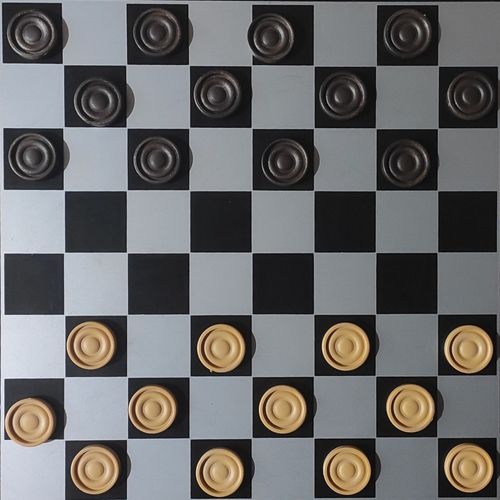
Formerly players played on the white squares, but today we play on the dark squares, numbered 1 to 32. The board is placed in front of the player so that the bottom right-hand square is dark.
Before the game begins, White places the pieces on squares 1 to 12 and Black on squares 21 to 32. Each player has 12 pieces (men, called peones).
2.2 Moving the Men
White begins the game by moving only diagonally forward one square. Black responds in the same way, and so on, alternating turns.
2.3 Moving and Capturing a Man
A man moves diagonally forward one square to an adjacent empty square. In the example, a man captures an opponent's piece. Note that you must capture only forward with your man, never backward.
2.4 Capturing Is Compulsory
If you can capture an opponent's piece you are obliged to do so. If your opponent forgets to capture one of your pieces, you simply point it out, because capturing is compulsory.
2.5 Capturing the Greatest Number of Pieces Is Compulsory
You must always capture the greatest possible number of pieces. In the example, White is to move and must capture 3 pieces.
Likewise, a king (dama) must capture the greatest possible number of pieces; in the example, the Black king must capture up to 4 pieces.
2.6 Completing a Capture Sequence Before Removing Pieces
This rule is very important. Captured pieces may be removed only once the whole capturing sequence (the multi-jump) has been completed. In the example, Black's king must capture, one after another, the pieces on squares 23, 12, 6 and 14. After this sequence, White captures the Black king with the man on square 15, the king finally resting on square 19, and in the same way White captures the man on square 26, with which White promotes and wins the game.
2.7 Moving a King
If your man reaches the final squares on the other side of the board, that is, the first row for your opponent, the man is promoted to a king (dama). This is done by placing a second piece of your opponent's on top of your man; the stack is called a "dama" (king). If your opponent forgets to crown your man, point it out, because the opponent is obliged to crown it. You may also crown it yourself if you wish. This matters, because a man does not behave as a king until it has been crowned.
A king moves much better on the board than a man. A king can move forward and backward, and it may be moved to any of the empty squares along its diagonal. The example shows that a king may move to any of the 8 empty squares on its diagonals; count them!
In the example, Black's king must capture and may place itself directly behind the captured piece or on one of the 3 remaining empty squares.
A king must also capture the greatest possible number of pieces. In the example, White must capture 2 Black pieces. Sometimes the full capture by a king is not immediately visible, so it is advisable to look at all the empty squares to which the king can move; this makes the capture easier to see.
When you have the option of capturing with a man or with a king, you must choose between the two options; that is, you are not obliged to capture with your king, as many players think. Be careful with this rule!
In the example, the White king can capture 2 pieces, or one piece and a king; the White man also has the possibility of capturing the same pieces. The choice is entirely free.
2.8 When Does a Game End?
When you cannot move, you have lost the game. In the examples, Black is to move, and since Black cannot move, Black loses. Of course, if you have no pieces left, you have also been defeated.
A game is a draw (tablas) if neither you nor your opponent can win. A player need not have the same number of pieces as the opponent to draw; it is possible to draw even with fewer pieces, although it is not easy. Three kings, one of which must permanently stay on the long diagonal (calle larga), always win against one king, but such an ending must be carried out in no more than 12 moves.
In the example where one side has a king and a man against a king and two men, the stronger side may require the opponent's men to be crowned immediately, which gives the same position as the earlier example with three kings. This is done so as not to waste too much time on unnecessary moves. The opponent may then insist that the other side wins within these 12 moves; if it does not, the game is automatically declared a draw. For the time being it is better not to dwell too much on this point, since this case applies mainly to games between masters.
2.9 Touch Means Play
If you touch a piece and it can be moved to an empty square, your opponent may require you to move it. So if you must move a man, think carefully before touching it, because once touched you must play it if your opponent requires you to do so. If you wish to adjust your pieces on their squares, you must inform your opponent before doing so.
2.10 Recording Moves Is Compulsory
This rule is practised mainly among players who take part in championships, and you need not take it into account now. However, it is useful to know that the board's numbers are used in recording moves, because without knowing them the study of draughts is much more difficult. After a little practice you will learn the numbering.