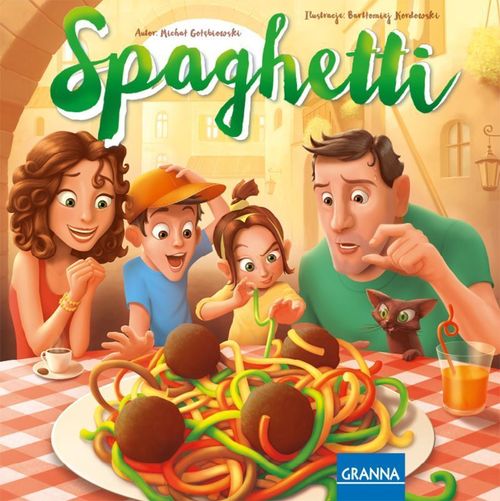
Spaghetti
Spaghetti Rulebook
Table of Contents
Table of Contents
Box Contents
- 27 tangled strands of pasta:
- 10 natural
- 8 tomato
- 6 spinach
- 3 squid-ink (sepia)
- 4 escaping meatballs
- 2 stylish plates (small and large)
- 12 unique Italian recipes
- a cookbook, which you are reading right now
- relentless time (an hourglass)
Aim of the Game
During the game of Spaghetti we fight to win as many valuable strands of pasta as possible, which will bring us points at the end of the game. Skilfully caught meatballs also translate into points. Beware! Eating spaghetti demands great precision: nothing may slip over the edge of the plate and dirty the table. To win the best morsels, a player has only 20 seconds!
The player who scores the most points wins.
Spaghetti di Base
Spaghetti di Base is not only the essence of excellent entertainment, but also the basis of all the proposed recipes for delicious fun.
Ingredients:
- 27 tangled strands of pasta
- 3 escaping meatballs
- relentless time
Serving method: Spaghetti should be served on the large plate.
Preparing the Spaghetti
Spaghetti di Base is served on the large plate placed in the middle of the table, so that every player has easy access to it. Carefully mix the coloured strands of pasta so that they tangle well. Then put them on the plate in such a way that no strand sticks out beyond its edge. Decorate the dish with three meatballs, placing them on the pasta. Stand the hourglass next to the plate.
Spaghetti prepared this way is ready for a delicious game.
The Pasta Feast - Course of Play
Players take their turns in clockwise order. The game is started by the person who most recently ate spaghetti.
The person sitting to the left of the active player turns the hourglass (it measures 20 seconds). The active player pulls out strands of pasta until all the sand in the hourglass has run through, or until one of the strands of pasta or a meatball touches the table. We call this situation making a mess.
Savoir-vivre at the Italian table
- Strands of pasta may be pulled out using only one hand.
- Strands of pasta must be pulled out one at a time, holding them at only one point; a pulled-out strand must be placed on your own pile, and only then do we reach for the next one.
- Helping yourself with the other hand is forbidden; if this happens, the player's turn is immediately interrupted and play passes to the next person.
- If during their turn a player starts pulling out a strand of pasta but does not manage it before the end of the regulation 20 seconds, they must put that strand back on the plate.
- During their turn a player may break off pulling out the chosen strand of pasta and try to reach for another one.
- Remember: in no situation may food be thrown; show respect for these excellent products!
Meatballs may be taken from the plate if they do not touch any strand of pasta (for example at the very end of the game, when only meatballs are left on the plate). Meatballs, just like strands of pasta, may be taken only one at a time: a caught meatball must be put on your own pile and only then may you reach for the next one.
If, while a strand is being pulled out, a meatball starts to fall off the plate, the player may let go of the strand and catch the meatball. At the moment of catching, however, the meatball must not touch any strand of pasta lying on the plate. The player puts the caught meatball on their pile; at the end of the game it will bring them an additional point. The player continues pulling out strands until their time runs out.
A mess is made when, at any moment of the player's turn, a meatball or a piece of a strand of pasta touches the table. The player must leave on the plate the strand or meatball whose pulling out caused the mess. Their turn automatically ends and play passes to the next person.
Examples of making a mess: (illustrated in the rulebook)
After finishing their turn (whether because time ran out or because of making a mess), the player may freely mix the remaining spaghetti, thereby preparing the plate for the next player. Just remember that no piece of the spaghetti may stick out beyond the plate.
End of the Feast
The game ends when there is no strand of pasta or meatball left on the plate. The players then proceed to count points.
Scoring
Below is the scoring for the individual kinds of strands of pasta and meatballs:
- natural = 1 point
- tomato = 2 points
- spinach = 3 points
- sepia = 4 points
- meatball = 1 point
The player who has won the most points wins. In case of a tie, the winner is the player who has gathered more strands of pasta. If that does not decide the win either, the players enjoy the victory together.
Example: At the end of the game Ania has 11 strands of pasta: 6 natural, 1 tomato, 3 spinach and 1 sepia. She also has 2 meatballs. Ania scored in total: (6 x 1 pt) + (1 x 2 pts) + (3 x 3 pts) + (1 x 4 pts) + (2 x 1 pt) = 23 points.
Tomek has 16 strands of pasta: 4 natural, 7 tomato, 3 spinach and 2 sepia. He also has 1 meatball. Tomek scored in total: (4 x 1 pt) + (7 x 2 pts) + (3 x 3 pts) + (2 x 4 pts) + (1 x 1 pt) = 36 points. The winner of this game is Tomek.
Spaghetti Difficili
Spaghetti Difficili is a refined game for true lovers of spaghetti. It differs from Spaghetti di Base in the number of ingredients and the method of serving.
Ingredients:
- 27 tangled strands of pasta
- 4 escaping meatballs
- relentless time
Serving method: Spaghetti should be served on the small plate.
(All other rules are as in Spaghetti di Base.)
Spaghetti Superiori
Appetite grows with eating. Spaghetti Superiori is a challenge for players hungriest for thrills. Here we not only fight for the tastiest morsels, but also have the opportunity to prepare delicious dishes according to the best Italian recipes. It differs from Spaghetti di Base in the number of ingredients, the free choice of serving method, and additional recipes whose quick completion can bring us victory!
Ingredients:
- 27 tangled strands of pasta
- 4 escaping meatballs
- relentless time
- recipes
Serving method: Spaghetti may be served on the small or the large plate, depending on the players' preference.
Preparing the Spaghetti
Shuffle the recipe tokens and then draw 6 of them. Place them face up next to the spaghetti plate, so that every player can see them well. Put the remaining tokens back in the box.
Italian Recipes
In the advanced variant, completed recipes can earn additional points at the end of the game. Each token shows elements of spaghetti; the player must pull them out of the plate to receive that token. All the indicated ingredients must be obtained in one turn, that is, within 20 seconds. During one turn a player may win only one recipe token. Pulled-out strands of pasta must be put on a second pile, so that it is clear which strands were won during the player's current turn. If the player manages to complete the recipe, they take the token and put it next to their won strands of pasta and meatballs.
Recipe tokens: the ingredients necessary to complete the recipe are grouped on the right side of the token. Each token shows the dish, the points, and the requirements.
Note: A new recipe token is not added in place of an already completed recipe! Sometimes the amount of pasta may turn out to be insufficient to complete all the recipes available in a given game. If at some moment there are no longer enough strands of pasta to win a given token, it becomes inactive, drops out of the game, and should be put back in the box.
When a player fails to complete a given recipe, the token remains in the pool of tokens to be won. The player keeps all the strands of pasta and meatballs that they managed to win during their turn. After finishing their turn, the player should combine their two piles, creating one large pile containing all the strands won so far.
Example: Ania would like to complete the recipe for Alla Norma pasta during her turn. To win it, she must pull out 2 tomato strands of pasta and 1 spinach strand. Ania manages to obtain all the ingredients needed to complete the recipe. Now she takes the recipe token and puts it next to her won meatballs and pasta. For the strands of pasta won in this turn she will get 7 points at the end of the game, and for the completed recipe an additional 2 points.
Tomek would like to complete the recipe for Napoletana during his turn. To win it, he must pull out three strands of pasta: 2 natural and 1 spinach. Unfortunately, he manages to pull out only 2 natural strands. While trying to get the spinach strand, a meatball falls off the plate, interrupting Tomek's turn. Tomek does not win the recipe token, but he does get 2 points for collecting two natural strands of pasta.
Recipe Table
Requirements are listed in the order of the printed columns: natural, tomato, spinach, sepia strands, and meatball. Only the ingredients a recipe needs are listed.
| Dish | Points | Requirements |
|---|---|---|
| Aglio e Olio | 2 | 2 natural, 1 tomato |
| Napoletana | 2 | 2 natural, 1 spinach |
| Tartufo | 2 | 1 natural, 2 tomato |
| Arrabbiata | 2 | 1 natural, 1 tomato, 1 spinach |
| Alla Norma | 2 | 2 tomato, 1 spinach |
| Carbonara | 3 | 3 natural, 1 tomato |
| Pesto verde | 3 | 3 natural, 1 spinach |
| Boscaiola | 3 | 2 natural, 2 tomato |
Special Blue Pasta
If you would like to receive the special blue pasta for the game Spaghetti, send your details to the publisher (Granna). The blue pasta is worth 5 points in the game. It should be added to the other strands of pasta when preparing the spaghetti plate for play.