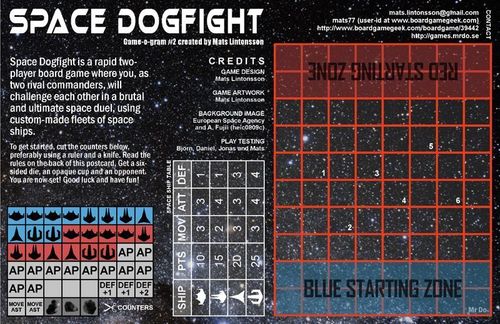
Space Dogfight
Space Dogfight Rulebook
Table of Contents
Table of Contents
Setup
Separate red and blue space ship counters by color and give the players one set each. The players then secretly create a space ship fleet each using any combination of own space ships with a total value of 80 points or lower. (See PTS column in the space ship table for space ships values.) Put unused space ship counters aside (face down), they will not be used in the game.
Lay out the board between the players. (Blue starting zone pointing at the player with the blue space ships and reverse.) For each of the three asteroids (dark gray counters), throw the die. Place an asteroid in the square on board containing the corresponding number. If the square is occupied, throw the die again.
Agree on a starting player (player one). Player one places one of his/her space ships from his/her fleet in his/her starting zone on the board. Player two places one space ship from his/her fleet in his/her starting zone. Take turns until there are no more space ships to be placed.
Put all light gray (AP, DEF +1/+2, MOVE AST and three blank) counters into the opaque cup. Shake it.
Sequence of Play
A game is divided into game turns (the two players alternate taking one game turn at a time, starting with player one) and one game turn consists of two actions:
[1] DISCARD COUNTERS: The player may optionally discard any number of counters he/she has in his/her possession back into the cup.
[2] The player must perform either sub-action [2a] or [2b].
[2a] DRAW COUNTERS: Shake the cup and randomly draw three counters or less. Keep them hidden from the other player. A player may never have more than five counters in his/her possession at any time during the game.
If the player draws a MOVE AST counter, immediately reveal it and randomly select one of the asteroids using the die. Then randomly determine which direction the selected asteroid will move. It may move in four directions (not diagonally). It cannot move out of the board edges or into a square containing another asteroid. Repeat until successfully moved one square. If the selected asteroid is moved into a square containing a space ship, that space ship is eliminated and removed from the board for the rest of this game. After moving the asteroid, discard the MOVE AST counter back into the cup and continue this sub-action. The drawing of the MOVE AST counter, counts towards the maximum drawing limit of three counters.
[2b] SPEND APs: The player spends any number of APs he/she has in his/her possession for any number of movements (see section MOVEMENT below) and/or combats (see section COMBAT below). For every spent AP, one AP counter is discarded back into the cup.
Movement
Movement of one friendly space ship costs 1 AP. The moving space ship must move at least one square, but not more than its maximum movement capability (see space ship table and the MOV column). It may never move diagonally or backwards (thus, only sideways or forward towards the other player's starting zone) or out of the board edges or into/through an occupied square (i.e. a square containing any space ship or an asteroid).
Combat
One combat costs 2 APs. One friendly space ship may attack one adjacent (not diagonally) enemy space ship. The attacker throws the die. If the result is less than or equal to the attacking space ship's attack value (see space ship table and the ATT column), then there is a potential hit, otherwise it's a total miss and this combat ends. If there is a potential hit, the defender throws the die. If the result is less than or equal to the defending space ship's defense value (see space ship table and the DEF column), then the defending space ship has blocked the hit and this combat ends, otherwise the defending space ship fails in blocking the hit and is eliminated and removed from the board for the rest of this game.
If the attacker has one or more additional friendly space ship (not counting the attacking space ship itself) adjacent (not diagonally) to the defending enemy unit, then the attacking space ship's attack value is increased by one (for this combat only).
If the defender has a DEF +1 or a DEF +2 counter in his/her possession at the start of the combat, he/she may reveal one such counter the moment before he/she is supposed to throw the die if there is a potential hit. The defense value of the defending space ship is then increased (for this combat only) by one (DEF +1) or two (DEF +2). Discard the DEF +1/+2 counter into the cup after use.
If the defending space ship survives a combat (either the attacking space ship misses or the defending space ship blocks the potential hit), the attacker may immediately repeat the same combat for 1 AP. A maximum of one such repeat is allowed per combat. Any discarded DEF +1/+2 counter from the main combat cannot be re-used in the repeated combat. However, the defender may use another DEF +1/+2 counter if he/she has one in his/her possession. Possible adjacent friendly space ships increasing the attacking space ship's attack value, do still count.
Space Ship Table
Transcribed from the front of the postcard. The four ships are the four columns of the table, read left to right; the postcard shows a silhouette icon for each ship, which is not reproduced here.
| Ship | DEF | ATT | MOV | PTS |
|---|---|---|---|---|
| 1 | 1 | 3 | 3 | 10 |
| 2 | 1 | 4 | 2 | 15 |
| 3 | 3 | 3 | 3 | 20 |
| 4 | 4 | 4 | 3 | 25 |
Game Ends
The game ends when one of these two scenarios occurs:
- A player's all space ships have been eliminated. The other player immediately wins!
- All (non-eliminated) red space ships have moved into the blue starting zone and all (non-eliminated) blue space ships have moved into the red starting zone. Each player then calculates their remaining space ship fleet value (do not count eliminated space ships) using each ship's respective PTS value. The player with the highest remaining space ship fleet value is the winner!