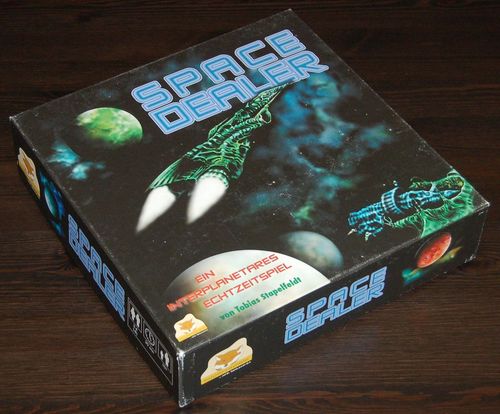
Space Dealer
Space Dealer Rulebook
Table of Contents
Table of Contents
Components (for 3 or 4 players)
- 10 robots (one-minute sand timers)
- 4 planets, each made of 3 parts
- 8 orbital fields and 18 connecting elements
- Connecting elements: "3" (3 players), "4-8" and "5-8" (4-8 players)
- 72 technology cards (of three types: 24 numbered 1, 28 numbered 2, and 20 numbered 3)
- 12 order cards (card back: neutral planet Gizzi)
- 5 spaceships, each made of 2 parts
- 88 round wooden tokens (victory point markers, 11 in each of 8 colors; technology level markers)
- 40 small wooden cubes (Goods markers, 10 each in red, yellow, blue, and green)
- 10 small black wooden cubes (attack markers)
- 1 CD (30-minute audio track and teaching video)
Before your first game: Remove all pieces from their punch-boards. Fold the sides of the spaceships to form a "W" and carefully snap them into the body of the spaceships.
Preliminary Notes
There are 8 player colors in each game. The planets, orbital fields, and spaceships are printed on both sides, so not all color combinations are possible in a 3- or 4-player game. For more than 4 players, two Space Dealer boxes are needed, combined to allow play with up to 8 players. A set of pieces in one unused player color is chosen from the unused victory point markers to serve as technology level markers (see Setup).
To make the game easier to learn, a CD with a video explanation is included; it presents the main rules together with the game components.
The rules that follow are divided into two parts: the basic rules, and the advanced rules for experienced players. Beginners are advised to play at least one game using only the basic rules that follow, in order to become familiar with the game. The advanced rules provide a higher level of interaction between players and, all things considered, a high level of game balance; the basic rules remain in effect throughout.
1. Overview
Players equip their planet, research and use technologies, and produce goods. With their spaceships, they travel to other players' planets to satisfy demands by delivering the required goods. While they do all this, time keeps running: all players play simultaneously, and each player has only two sand timers to coordinate all of their actions. As soon as a timer at a specific location has run out, the corresponding action takes effect.
2. Setup
The following cards are not used in the basic game: 2 Sabotage Probes, 2 Interstellar Rockets, 1 Orbital Station, 1 Transport Probe, 2 TechCenters, 2 Robot Factories, 12 order cards (back: Gizzi).
Depending on the number of players, the following cards are also not used (cards are — when required — chosen at random and put back face-down in the box):
- 3 players: 2 Generators, 1 Depot, 2 Solar Satellites, 1 Multi-Mine, 1 Mining Complex, 1 Converter, 2 Fusion Reactors, 1 Fusion Mine, 1 Metropolis, 1 Megacity, 1 Fusion Converter.
- 4 players: (all remaining cards are used).
- 5 players: prepare each of the two 3-player card sets, and remove from one of these sets: 2 Generators, 1 Depot, 2 Solar Satellites, 1 Multi-Mine, 1 Mining Complex, 1 Converter, 2 Fusion Reactors, and 1 Fusion Mine.
- 6 players: prepare each of the two 3-player card sets.
- 7 players: prepare one 3-player card set and one 4-player card set.
- 8 players: prepare each of the two 4-player card sets.
To begin, each player receives:
- The victory point markers of one color (their player color).
- The planet of that player's color. Place a technology marker at technology level 1.
- The spaceship of that player's color.
- The following technology cards: 3 Mines, 2 Generators, and 1 Depot.
- 2 timers.
Depots are shuffled and dealt face-down. In a 3- or 4-player game, the Mine cards are divided into 4 piles (sorted by color), shuffled separately, and made up as follows: one pile receives no red Mines, one pile no yellow, one pile no green, and one pile no blue. Each player receives one of these piles. (The remaining pile is not used in a 3-player game.)
Each player places their planet in front of them on the table. The victory point markers are placed on the planet image. A Generator is placed to the left or right of the planet. One of the Mines is placed on one of the power connections, which becomes energized at that moment. (At the start of the game, each player secretly chooses their Mine before all players reveal them.) Each player places the four remaining technology cards face-down to the side; these form their personal technology stack, ready for use.
The remaining cards are sorted face-down into two piles according to their technology level (a card's technology level equals the number printed on its back), shuffled separately, and placed in the center of the table. These form the common TechLevel 2 and TechLevel 3 stacks.
The Goods markers are also set out to form a common pool for all players. The attack markers (black), the two remaining timers, and the neutral spaceship are not used in the basic game.
The orbital fields of the players' colors, together with the same number of neutral orbital fields, are connected to form a ring using the connecting elements, alternating neutral planets with player planets. The ring is placed in the center of the table and surrounds the pieces making up the common pool. All players place one of their victory point markers on the red space printed on the ring. Each player places their spaceship outside the ring, facing the orbital field of their own planet. The orbital fields serve a double function: they act as a spaceship dock and as a victory point track.
Each player places their two timers, fully run out, in front of them below their planet. In this position, the timers are inactive. Flipping and placing an inactive timer activates it. A timer whose sand has fully run out after being activated is then usable (its job is complete).
A game lasts exactly 30 minutes. A timer is needed to start the game; the audio track on the included CD can be used for this, as can any other timer.
Note on the orbital ring: for a 4-player game, use the connecting tiles printed with a "4" on the back. For a 3-player game, use the connecting tiles printed with a "3" on the back. For a 7-player game (example), use the connecting tiles printed with "4-8" and "7" on the back. You need a second Space Dealer box to play with 5 to 8 players.
3. How to Play
All players play at the same time. At any moment, each player may:
- Play technology cards (see 3.1)
- Assign a job to one of their inactive timers (see 3.2)
- Exchange their goods (see 3.3)
- Satisfy orders in order to earn victory points (see 3.4)
3.1 Playing Technology Cards
At the top of each planet card is the player's planning area (magnifying-glass symbols on the planet), where up to two cards (chosen from the player's personal technology stack) may be placed. As long as a player has no free space in their planning area, they cannot place an additional card.
3.2 Assigning a Job to a Timer
A job can be assigned to an inactive timer in order to:
- Raise the planet's technology level (see 3.2.1)
- Build a technology card (see 3.2.2)
- Use a technology card (see 3.2.3)
- Move a spaceship (see 3.2.4)
3.2.1 Raising the Planet's Technology Level
Before a player is allowed to take a technology card from a common technology stack and place it in their planning area, they must first raise their planet's technology level. To do this, they activate a timer on the timer space (hourglass icon) of the planet. When the timer is usable, the planet's technology level marker moves up one position on the scale. Positions 2 and 3 represent a new technology level for the planet.
A player with technology level 2 is allowed to draw new cards from the common TechLevel 2 stack; with technology level 3, they may draw cards from both the common TechLevel 2 and TechLevel 3 stacks. This means that, instead of using cards from their personal technology stack, a player may draw two cards from a common stack: they examine both cards, put one back face-down under the stack, and place the other in their planning area.
3.2.2 Building a Technology Card
Each player may only equip their planet using the technology cards located in their planning area.
To build a card, the player must activate a timer on that card. When the timer is usable, the card may be placed on an appropriate build site. At that point the timer becomes inactive.
A planet's build sites consist of three rows. The top row is the planet row, containing the player's planet. The middle row is the action row. The bottom row is the order row.
- a) A power plant (Generator, Solar Satellite, or Fusion Reactor) may only be built in the planet row. A Generator is built directly adjacent to the planet, on its left or right side. A Solar Satellite may only be built on top of a Generator, and a Fusion Reactor may only be built on top of a Solar Satellite.
- b) A card with a single power connection must be built so that this connection is supplied with power by a power plant. The card is placed straddling both the action row and the order row.
- c) A card with two power connections must be built so that both connections are supplied with power by one or two power plants. The card is placed entirely in the action row.
- d) A card with no power connection is built — depending on the split between its action half and order half — so that its two halves are placed in the correct row. It must have at least one side adjacent to another side.
Cards may only be built over other cards, or over parts of other cards, in the action row. The effects of cards that have been built over, fully or partially, can no longer be used (see 3.2.3 Using a Technology Card).
3.2.3 Using a Technology Card
Cards allow different actions to be carried out. Several cards have a timer space. A timer may be activated on any timer space located in the player's action row. When the timer is usable, its effect may be applied. At that point the timer becomes inactive.
- a) A Mine produces a Goods marker of its specific color, which must be placed either in a Depot on the planet or in a spaceship at the planet; otherwise the goods are lost. A Mining Complex produces two Goods markers. A Multi-Mine produces a Goods marker of any color. A Fusion Mine produces 4 Goods markers of the indicated color. A spaceship can hold a maximum of 8 goods.
- b) A Converter allows the player to exchange one of their goods, located in a Depot or in their own spaceship at that planet, for any goods marker from the common pool. With a Fusion Converter, they may exchange up to two goods.
3.2.4 Moving a Spaceship
A player may move their spaceship, along with its cargo, from its location on a planet's orbital field to a directly adjacent orbital field on the ring. After that, they must activate a timer on the spaceship's timer space. The spaceship is now in flight, and no longer at a planet. When the timer is usable, the spaceship is immediately at the destination planet. At that point the timer becomes inactive.
A spaceship carrying no goods may be placed directly on the orbital field of any planet, and will land there using a timer. Goods that are no longer needed may, if desired, be returned to the common pool.
3.3 Exchanging Goods
All players are always allowed to exchange or give away goods. To do this, the spaceships and Depots between which the goods are transferred must be at the same planet. A spaceship's maximum cargo is always 8 goods.
3.4 Satisfying Orders
To satisfy an order, a player may put goods from their spaceship into the common pool. The condition is that a spaceship must be at another player's planet (that is, a player is not allowed to satisfy orders at their own planet), and that the goods delivered to the common pool match the combination required by that planet's order (goods that are no longer required may always be discarded into the common pool, with no effect).
The player then places one of their victory point markers on the order space. After that, they move their score marker along the score track a number of spaces equal to the first number printed in the order space, and they also advance the victory point marker of the player who owns the planet whose order was just satisfied by a number of spaces equal to the second number. Each order may be satisfied only once during the game.
4. End of Game
The game ends after 30 minutes (it ends earlier if a player has placed their last victory point marker). Every active timer is used in the usual way. The player with the most victory points wins. In case of a tie, the player who was able to use more victory point markers wins. If still tied, the tied players share the win.
5. Rules for Experienced Players
5.1 Additional Technology Cards
The following technology cards may be added to the appropriate technology stacks, depending on the number of players:
- 3 players: 1 Sabotage Probe, 1 Interstellar Rocket, 1 Robot Factory, and 1 TechCenter.
- 4 players: 2 Sabotage Probes, 2 Interstellar Rockets, 1 Transport Probe, 1 Orbital Station, 2 Robot Factories, and 2 TechCenters.
- 5 players: add one 4-player card set.
- 6 players: add one 4-player card set.
- 7 players: add one 3-player card set and one 4-player card set.
- 8 players: add both 4-player card sets.
Some technology cards provide a permanent effect (unless a card has been built over them):
- a) A TechCenter increases the planning area's capacity by 2 cards.
- b) A Robot Factory increases the number of timers by 1 (unused timers are placed in the center, in the common pool).
- c) The Orbital Station provides the neutral spaceship from the common pool. It starts at the owning player's own planet (the neutral spaceship is placed in the center, in the common pool, when not built).
The other technology cards take effect using a timer (for the Sabotage Probe and the Interstellar Rocket, the black attack markers must be used instead):
- d) A Sabotage Probe holds a maximum of two attack markers. At any time, a player may place an attack marker from a Sabotage Probe onto any player's active timer, to sabotage it. The attacked player must set their timer aside next to their play area and let it run out completely without benefiting from its effect. The attack marker is then returned to the common pool, and the timer can be used again.
- e) On an Interstellar Rocket, attack markers are placed up to a maximum of two. At any time, a player may place an attack marker from an Interstellar Rocket onto a timer space in any player's action row. That timer space cannot be used again until a timer has been activated and run there. A player may be blocked by a maximum of 2 attack markers at a time. Once a timer has been run there, the attack marker is returned to the common pool. A card blocked by an attack marker in this way cannot be built over.
- f) A Transport Probe can store up to two goods — like a Depot — as long as there is no timer on its timer space. When a timer is used on its timer space, the player may move the goods stored on the Transport Probe to a spaceship, wherever that spaceship happens to be at the time (respecting the 8-goods cargo limit).
From this point on, the following additional rule applies: cards located in a player's personal planning area may be discarded — that is, if a timer is used on a card in the planning area, that card may be put back under the appropriate technology stack. A card that another card has been built over may not be discarded this way.
5.2 Trading Technology
Each player may trade cards located in their planning area with other players, by mutual agreement between the players. Cards may also be given away, but only if the player receiving the card has a free space in their planning area.
5.3 Neutral Planets
The order cards are shuffled and placed face-down in an order stack in the center of the table. Four order cards are drawn and placed face-up, one in front of each of the four neutral planets' orbital fields.
Neutral planets do not belong to any player. Their available orders may be satisfied following the normal rules. In this case, the player takes the card, places it face-down in front of themselves, and adjusts their victory points on the score track. After that, they draw a card from the order stack and place it face-up on the planet that has become available. If more than one player is able to satisfy the new order immediately (has a spaceship with the required goods at that planet) at that moment, the order card is put back under the stack and a new card is drawn instead.
Each player may leave goods from their spaceship on the orbital field of a neutral planet. These goods may be collected by any spaceship that arrives at that planet. (Naturally, this option should only be used as part of other negotiations; otherwise, players would keep collecting goods for free and simply returning them to the common pool.)
Rules Summary
All players play simultaneously. At any time, each player may:
- Play up to two technology cards into their planning area (see 3.1).
- Assign a job to one of their inactive timers (see 3.2), in order to:
- Raise the planet's technology level (timer on the planet) (see 3.2.1).
- Build a technology card (timer on a card in the planning area) (see 3.2.2).
- Use a technology card (timer on a card in the action row) (see 3.2.3).
- Move a spaceship (move the spaceship to an adjacent orbital field — to any orbital field if the spaceship is empty — timer on the spaceship) (see 3.2.4).
- Exchange their goods (all goods at the same planet may be exchanged) (see 3.3).
- Satisfy orders in order to earn victory points (deliver goods to the common pool, place a marker on the order if it is satisfied, advance the markers of both players — the deliverer and the order's owner — on the score track) (see 3.4).
For experienced players, at any time players may additionally:
- Use attack markers (Sabotage Probe and Interstellar Rocket) (see 5.1).
- Trade technology cards in the planning area (see 5.2).
- Satisfy orders at neutral planets (take the card, draw a new one) (see 5.3).
- Leave goods at neutral planets (see 5.3).
Card Terminology
The following English terms are used in this rulebook for the German card names printed on the physical components:
| German (printed on cards) | English term used here |
|---|---|
| Generator | Generator |
| Depot | Depot |
| Mine | Mine |
| Multimine | Multi-Mine |
| Minenkomplex | Mining Complex |
| Fusionsmine | Fusion Mine |
| Solarsatellit | Solar Satellite |
| Fusionreaktor | Fusion Reactor |
| Konverter | Converter |
| Fusionskonverter | Fusion Converter |
| Metropolis | Metropolis |
| Megacity |