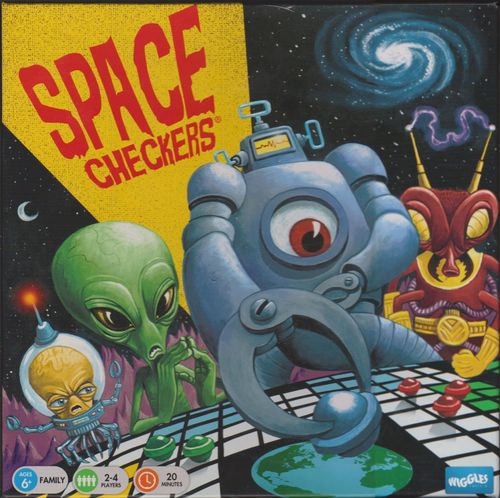
Space Checkers
Space Checkers Rulebook
Table of Contents
Table of Contents
Object of the Game
To capture any 10 opponent pawns before any other player. A player captures an opponent's pawn by jumping over it.
What's Included
- Game board
- Four sets of 12 flying saucer pawns (in yellow, green, blue and red)
- Regular die
- Direction die
Warning: Choking hazard. Small parts. Not for children under 3 years.
Getting Started
Each player selects a color and places their fleet of 12 flying saucer pawns on the matching section of the playing area. (When only two players are playing, we suggest they sit across from each other.)
(The instructions label the diagram's rows "Starting positions" and "Prison cells".)
Game Play
To play a turn, a player rolls both dice and must move one of their pawns according to the roll, if possible. The regular die gives the exact number of spaces the pawn must be moved and the direction die gives the direction the pawn must be moved. All directional movement is based on the colors on the board; if blue is rolled, the player must move their pawn towards the blue section of the board. Two sides of the direction die are marked WILD. This means a pawn can move the exact number of spaces rolled on the regular die in the player's choice of direction.
Rules for Moving Pawns
- Pawns must move in the direction shown by the direction die unless they are in the player's wild area. See Moving in the Wild Area.
- Pawns cannot jump over or onto the Earth in the middle of the game board.
- Pawns cannot jump over two or more adjacent pawns belonging to the same player.
- Pawns cannot jump over any pawns of their own color.
- Pawns must move the exact number of spaces shown on the die and end on an unoccupied space. If, on a player's turn, that player cannot move any of their pawns according to the above rules, the player forfeits that turn.
Moving in the Wild Area
When a player moves their pawn to the four last rows on the opposite side of the board from their starting side, that pawn becomes wild. A pawn that is wild may ignore the direction die and move in any direction. However, if a wild pawn moves out of its own wild area, it is no longer wild unless it moves back into the wild area again.
(The instructions show the green player's wild area, the four rows at the top of the board, shaded on the diagram.)
How to Warp a Pawn
If a player moves their pawn to the edge of the playing area and still needs one or more spaces to complete their move, the player can "warp" the pawn to the other side of the board. The player then continues to move their pawn in the same row and same direction until their move is complete.
(The instructions illustrate this with the Green player who rolled a 5 and a green.)
Note: When warping horizontally or vertically, the space at one end of the row is considered to be adjacent to the space at the opposite end of the row during the move.
Capturing Pawns
If a player's pawn jumps over opposing pawns, then those pawns are captured and placed in the attacker's prison cells.
Winning the Game
The first player to capture 10 pawns and place them in their prison cells wins the game.