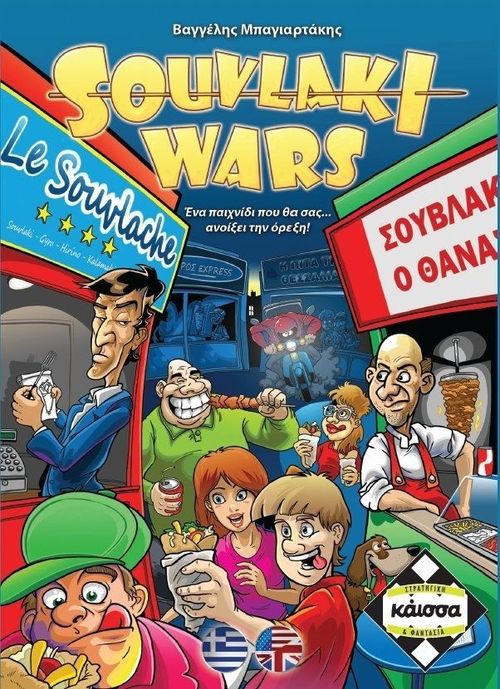
Souvlaki Wars
Souvlaki Wars Rulebook
Table of Contents
Table of Contents
Component List
- 72 Food cards
- 60 Customer cards
- 32 Unforeseen Events cards
- 4 Owner Identities
- 10 Telephone Order cards
- 2 Round Overview cards
- 1 Scoring Board
- 8 wooden disks in 4 colours
The Food cards show one or more of the following: Gyros, Souvlaki, French Fries and Soda. They are used by the players to serve their customers.
The Customer cards show a Customer and his order. They also list the amount of Money that the Customer is going to pay for his order, along with a number indicating his influence - the amount of Reputation that the restaurant will gain or lose when he is served. Among the Customer Cards there are a few "Big Telephone Order" cards. The way they are used is described later in the rules.
The Unforeseen Events cards are used by the players to give them an advantage over the other players, either by directly helping themselves or by hindering their opponents.
The Owner Identities contain important information for each restaurant like its initial Money and Reputation, its operational costs, the price to buy new food cards and the cost to advertise.
The Telephone Order cards are used as markers to distinguish the regular customers (those that actually came in the restaurant) from those orders that came via the phone.
The Round Overview cards show a summary of the game's phases. You can look at them any time during the game.
Before You Begin
Each player chooses one of the restaurant owners:
Souvlakia by Thanasis (The "Dirty" One) The usual "joint" that you find in every neighbourhood. It may not be the cleanest store, but it sure has tasty souvlakia!
Thessalia's Tavern (The "Family Business") A traditional tavern, run by a single family. Dad prepares the food, mom cooks in the kitchen, the son takes the customers' orders and the daughter sits at the cash desk.
Gyros Express (The Fast Food "Chain") Part of a famous chain of fast food restaurants.
Le Souvlache (The "Expensive" one) A high-class restaurant, for wealthy clientele.
Each player takes the Owner Identity and the two markers that correspond to the owner that he picked. He places the markers on the Scoring Board, as noted on the Owner Identity card, to indicate his initial Money and Reputation. (the first two numbers on the Identity card - see the example below)
Shuffle the Food cards, the Customer cards and the Unforeseen Events cards and place the 3 decks on the table where all players can reach them. Next to each of them leave some space for its corresponding discard pile. If at any time one of the decks runs out, shuffle its discard pile and make a new deck. Each player then draws 5 Food Cards and 3 Unforeseen Events cards.
The first time you play, don't draw any Unforeseen Events cards, leave them inside the game's box instead. Playing without them will help you grasp the main rules of the game and play your first game faster.
If a player is not satisfied by the Food cards he drew, he may discard them and draw 5 new ones. However, he can do this only once, and only before the beginning of the first round. If the new cards are worse than the first ones, he can't change them again. He will have to play with them.
Setup Example
George, Nick and Mary decide to play a game of Souvlaki Wars.
George selects to play as the owner of "Le Souvlache" so he takes its owner's Identity card from the box and the two cyan markers. According to his Identity card he places these two markers on the Scoring Board, one at the Money track at number 10 and one at the Reputation track at number 6.
The Game's Phases
Each round consists of 5 phases:
- Restaurant Maintenance (From the 2nd round)
- New Customers
- Unforeseen Events
- Customer Service
- End of Round
In every phase, whenever the players have to do something (play cards, draw new ones, serve customers etc) this is always carried out in order of Reputation.
So, the first player to play is the one with the highest Reputation at the beginning of the current phase. Next plays the one with the second highest Reputation and so on. In case two or more players have the same amount of Reputation then the one with the highest initial Reputation is the one who plays first among them.
1. Restaurant Maintenance
This phase is active from the 2nd round. (During the first round go directly to the phase "New Customers").
Each player pays an amount of Money for operating expenses which is stated on his Owner Identity card (the third number on the Identity card - see example below). He then draws 1 Food card and 1 "Unforeseen Events" card.
If you are playing the game for the first time, don't draw an Unforeseen Event card.
After the above, a player may purchase new supplies if he wants (new Food cards that is) and/or advertise his restaurant in order to raise his Reputation. For every owner these costs are different and they can be found on the corresponding Identity card (they are the ones at the two bottom lines). The left number is the amount of Money the player has to pay and the number on the right is the number of cards he draws or the amount by which his Reputation is increased.
Each cost can only be paid once per round. The only exception is the "Family Business" restaurant, the owner of which may pay the cost twice if he wishes.
Restaurant Maintenance Example
The game has reached its 3rd round and the "Restaurant Maintenance" phase is about to begin.
Nick is the owner of "Gyros Express". Looking at his Identity card he sees that the operating expenses are 2€ so he reduces his Money by that amount.
He then draws 1 Food card and 1 "Unforeseen Events" card. He now has 3 Food cards in his hand but he thinks that they will not be enough to serve all the customers. So, he decides to buy more. Looking at his Identity card he sees that the cost is 2€ for 3 cards so he reduces his Money by that amount and then draws 3 Food cards.
Finally, he decides to raise his Reputation a little bit so he pays - according to his Identity card again - 2€ and raises it by 2 points.
For the Food Cards there is a hand limit of 7 cards. If at any time a player ends up having more than 7 Food Cards in his hand he must immediately discard as many as he needs in order to be left with 7 again. (For the Unforeseen Events cards though there is no hand limit)
In the rare case that a player is required to pay his operating expenses, (which are mandatory), but is unable to do so (due to not having enough Money), he gets a 10€ loan. However, to be eligible to win the game, he will have to subtract 11€ first from his Money.
2. New Customers
In this phase, depending on the number of the players, you reveal a number of Customer cards. More specifically, you reveal 2 cards per player plus 1 more. So in a 2 player game you reveal 5 cards, in a 3 player game 7 cards and in a 4 player game 9 cards. These cards are placed at the centre of the table so all players can easily look at them.
Each player then - beginning with the one with the highest Reputation up to the one with the lowest - picks a Customer card and places it in front of him. In case two or more players have the same Reputation, the one with the highest initial Reputation picks first. When all players have picked one Customer card, the last player picks another one, then the second to last player and so on up until the first one. After that everyone should be with 2 Customer cards in front of him and there should also be one left on the table which is discarded.
Picking up a Customer card is mandatory. A player cannot refuse to pick one just because he can't serve that Customer during his round.
The Customer cards each player takes are placed in front of him, face up, in the order that he picked them up, each one on the right of the previous one. This way a "line" of Customers is formed in front of each player.
The order in which the new Customers are placed in the line is very important. The players are NOT allowed to change the order of the line, unless a card specifically states so.
The players then receive orders by phone. Each of them draws the first Customer card from the deck, puts it at the end of his line and places a Telephone Order Card on top of it in order to show that the order came by phone. Although it doesn't represent an actual customer who came in the restaurant, it is served in the same way as all the other Regular Customers. Their difference lies in that they are picked randomly and that some "Unforeseen Events" Cards affect only Regular Customers or only Telephone Orders.
New Customers Example
This phase is now beginning and since there are 3 players in the game, they draw 7 Customer cards and place them face up at the centre of the table.
The current Reputation values for George, Nick and Mary are 13, 13 and 14 respectively. This means that Mary gets to be the first one to pick up a Customer.
So, she picks up one and puts him next to her Identity card.
The other two players have the same Reputation. That mean that th first one between them to choose a Customer will be the one with the highest initial Reputation. In this case George has an initial Reputation of 6 while Nick has 4 so George gets to pick up a Customer next, followed by Nick. After everyone got their first Customer, Nick - who was last - is the first one to pick a second Customer, followed by George and Mary.
Mary places him on the right of the first Customer.
Then, beginnng with Mary they all draw a card from th Customer deck and place it at the end of their line, putting a Telephone Order card partially on top of it.
Some of the Customer cards are quite different from the others, showing a telephone. These are considered "Big Telephone Orders". They may be revealed like all the other Customer cards at the beginning of this phase and they can be picked by players and placed in their lines like Customers. They then act like regular telephone orders with the difference being that in this case, the players draw 2 Customer cards from the deck instead of one. They put one slightly diagonally on top of the other, and the Big Telephone Order card on top of them as a marker. The order is then considered to be the sum of the orders on the two cards and the same applies to the Money and the Fame that they provide. For all other purposes this order is treated like all the other telephone orders.
Although there are two actual cards below the Big Telephone Order card, they are considered to be ONE order and it has to be served as a whole. Also, a player who gets a Big Telephone Order instead of a Customer still receives a regular order by phone afterwards like in every turn.
If when drawing cards for a telephone order (either a big one or a normal one) a new Big Telephone Order Card is drawn, it is discarded and the player draws a new card in its place.
3. Unforeseen Events
When you play the game for the first time ignore this phase and go directly to the "Customer Service" phase.
In this phase each player is given the chance to play the Unforeseen Events cards in his hand, before the Customers are served. These cards affect the game in various ways by changing the current state of play. Each player may only play one Unforeseen Events card during this phase. However this is not mandatory. If he wants he can choose not to play any card.
If a card refers to a Customer, without stating its owner, then it can be played on any Customer, belonging to any player. The same applies for cards referring generally to a player. The one playing the card may choose either himself or one of the others. However, if a card states specifically "an opponent" or "another player" he can't choose himself.
4. Customer Service
In this phase each player serves the Customers in his line. The important thing however is that they all have to be served in the order in which they came in the restaurant. To do that, the player plays from his hand Food cards that contain the foods mentioned in the first Customer's order. When he does that, the Customer is removed from the line (the card is discarded) and he is considered to be satisfied. Thus, he gives the Money that correspond to his order and he increases the player's Reputation by the amount stated on the card. If the player has the required foods he can also serve the next customers in line as well, but always in order. Moreover, foods in the Food cards that were played for the first customer and weren't used can be used to serve the next customers.
Basically, as long as the line order is kept, a player can serve as many Customers as he wants using as many Food Cards as he wants. He may happen to serve a single Customer with 3 Food Cards or he may even serve 2 Customers with a single Food Card. The important thing is that they all must be served in order.
On-The-House: If after serving the Customers there are foods in the used Food Cards that weren't in their orders, then they are considered to be "on-the-house", offered to them by the restaurant for free. In that case, since the Customers appreciate the gesture, the player gets +1 Reputation at the end of the phase.
If a player gives foods "on-the-house" he gets +1 Reputation in total, not +1 for every food he offered or customer he served.
In the end of this phase, any Customers that were not served become a bit anxious. To show this, turn their card 90 degrees clock-wise. If a Customer at the end of this phase, was already anxious and he still wasn't served, then he leaves the line (his card is discarded) and is considered to be disappointed with the restaurant's service. He doesn't give any money to the player and instead of increasing the restaurant's Reputation, he LOWERS it by double the amount stated on his card (minimum 2).
Even though some Customers don't increase the player's Reputation when they are served (their card states 0 next to the Fame Icon), if they become disappointed with the restaurant then they will affect its Reputation in a negative way and they will lower it by 2. After all, negative feelings are usually stronger than the positive ones. At least when souvlaki is concerned!
Customer Service Example
Mary now has to serve the Customers she picked up earlier.
The first Customer in her line has an order of 1 Souvlaki and 1 French Fries, the second one has an order of 2 Gyros and the telephone order consists of 1 Souvlaki and 1 Soda.
Mary looks at the Food cards in her hand and decides to play 3 of them. The first one shows a Gyros and a French Fries, the second one just a Souvlaki and the third one a Gyros and a Soda.
With the French Fries of the 1st card and the Souvlaki of the 2nd one, she serves her first Customer. The second using the two Gyros in the 1st and in the 3rd card.
For the telephone order she has the Soda (the one in the 3rd card) but she lacks a second Souvlaki. Thus, she can't serve it.
The first Customer in Mary's line, increases her Money by 1€ and her Reputation by 2 points. The second Customer who is also served increases her Money and Reputation by 3€ and 2 points respectively.
The Soda that remained in one of the Food cards, since it was not given to any Customer, it is "on-the-house". This makes Mary gain an additional point of Reputation. In total, Mary gained 1 + 3 = 4€ and 2 + 2 + 1 = 5 points of Repuation.
The telephone order, since it was not served, gets "anxious" so it is turned 90 degrees clockwise.
During this phase if a player wants to remove a Customer from his line (usually because he can't serve him) he can do it, however it will have a big impact in his Reputation: He will have to lower it by 5.
A player's Reputation can never have a negative value. If for any reason a player ends up losing more Reputation than they have, it will become 0.
5. End of Round
In this phase all the effects that last until the end of the round cease. Moreover this is the time when the players check if one of them has won the game by fulfilling the win conditions.
End of the Game
The game ends when at the end of a round one player has both 25€ (or more) Money and 25 (or more) Reputation.
If more than one player satisfies these conditions then the winner is the one with the highest sum of Money and Reputation. If there is still a tie then the players share the victory.
Card-Specific Comments
The plans are off This card can only cancel cards that will be played after it. If there is another card already in play then "The plans are off" can't do anything about it.
Dirty Store This card reduces the amount of Reputation that the Customers would give. However, it doesn't make a Customer "give" negative Reputation. If a Customer was to give 0 Reputation he will still give 0 Reputation.
Wrong Number When the Customer Cards change line they retain their status (standing or turned).
I'll have the same The Customer on which this card is played has to be a Regular Customer (not a phone order). However, the Customer in front of him in the line (of which he becomes a copy) can be either a Regular Customer or a phone order. (If he copies a phone order though, he still remains a Regular Customer) This card cannot be played on the first Customer in a line.
Generous Tip If the Customer on which this card is played, leaves his line due to another card and goes to another player's line, then if he is served in the same round, he will still give the extra 2€ but to the new player that served him.