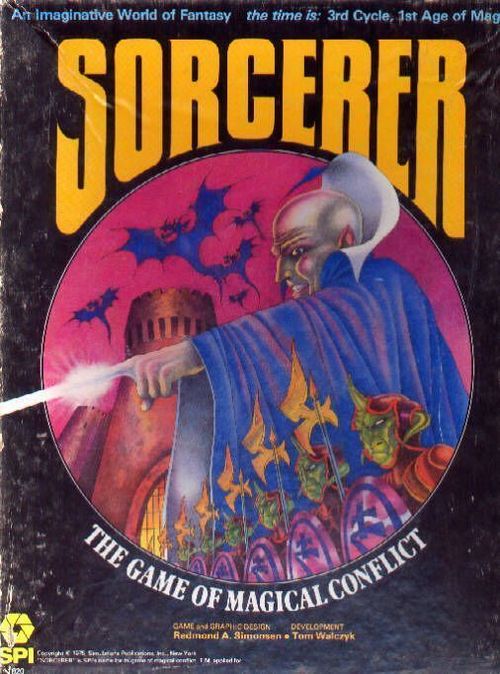
Sorcerer: The Game of Magical Conflict
Sorcerer: The Game of Magical Conflict Rulebook
Table of Contents
Table of Contents
- 1.0 Introduction
- 2.0 General Course of Play
- 3.0 Game Equipment
- 4.0 Sequence of Play
- 5.0 The Colors of Magic
- 6.0 Movement
- 7.0 Magic Bolts
- 8.0 Vortexes
- 9.0 Hex Conversion
- 10.0 Stacking
- 11.0 Attrition
- 12.0 Sorcerers
- 13.0 Combat
- 14.0 Enchanted Fortresses and Garrisons
- 15.0 Victory Conditions
- 16.0 Introduction to the Scenarios and How to Set Up the Game for Play
- 17.0 One-Player Scenarios
- 18.0 Two-Player Scenarios
- 19.0 Multi-Player Scenarios
- Optional Rules
- 20.0 Cloak of Invisibility
- 21.0 Shir, the Black Sorcerer, Son of Gorm
- 22.0 Clones
- 23.0 Hiding and Assassination
- 24.0 Magic Flux
- 25.0 Discovering New Spells
- 26.0 Creating Scenarios
- 27.0 Players' Notes
- An Examination of the Relative Values of the Various Unit/Hex Color Relationships
- Components Not Transcribed
1.0 Introduction
Sorcerer is a game which takes place in an alternate universe where magic actually works. There are three basic categories of units: Sorcerers (of various powers), human infantry, and magical units (trolls, demonic infantry and air dragons); and seven types of magic, each represented by an actual color.
2.0 General Course of Play
Sorcerer is a game for between two and six Players, in which each Player controls the forces of a certain color (or colors) of magic. The game is played in sequenced segments called "Game-Turns." Each Game-Turn is composed of a number of Player-Turns equal to the number of Players involved. Each Player uses his Player-Turn to maneuver his forces, create new units, participate in combat and to fulfill various victory conditions.
Combat may occur between opposing units occupying the same hex during a Combat Phase. Combat is resolved by comparing the total Combat Strength Points of the attacking force to the total Combat Strength Points of the defending force. The Combat Strength of a magical unit depends on its color and the color of the hex it is in.
3.0 Game Equipment
3.1 The Game Map
The 22" x 34" mapsheet depicting part of an imaginary magical world is the playing area on which the unit counters are maneuvered. A hexagonal grid is superimposed on the mapsheet to regularize the movement and positioning of the playing pieces and to show various boundaries and terrain features. Each hexagon ("hex") on the mapsheet is of one of eight different colors or shades. The exact relationship between the color of the hex and the color of a unit in that hex is important throughout the play of the game.
3.2 The Playing Pieces
Differently colored sets of playing pieces (henceforth known as "units") are supplied. These units represent the military forces, either magical or human, of the Players. The units are distinguished by their color, and by the numbers and symbols printed on them. The units are printed on both sides. One side represents a unit's maximum Combat Strength (henceforth known as "full strength"). The other side represents the diminished ("depleted") strength of the unit after it has suffered losses due either to attrition or combat. It is strongly recommended that the Players sort the units by type and color as this greatly facilitates setting up and playing the game.
3.21 Sample Unit
The sample unit's counter is marked 5-9: the first number is its Combat Strength (5) and the second is its Movement Allowance (9).
3.22 Unit Types
Non-Magical Units
- One-Color Sorcerers: 3 each of 6 colors; total 18. (Front: Combat Strength 2-15 shown; back 0-6.)
- Two-Color Sorcerers: 1 each of 15 combinations; total 15.
- Three-Color Sorcerers: 1 each of 20 combinations; total 20.
- White Sorcerer: 1 each of 1.
- Black Sorcerer: 1 each of 1.
- Human Infantry: 6 sets of 7; 1 set of 4; total 46.
Magical Units
- Air Dragons: 6 sets of 9; 1 set of 2; total 56.
- Demonic Infantry: 6 sets of 8; 1 set of 2; total 50.
- Trolls: 6 sets of 6; 1 set of 2; total 38.
- Enchanted Fortresses: 7 sets of 1 "(16)"; 6 sets of 1 each "(8)&(4)"; 6 sets of 3 "(2)"; total 37.
Game Markers
- Vortexes: total 28.
- Color Conversion Markers: 6 sets of 10; 1 set of 8; total 68.
- Attrition Markers: 1 each of 6; used in random draw process.
- PIN Markers: 1 set of 14.
- Game-Turn Track Marker: 1 each of 1.
- Phase Record Track Marker: 1 each of 1.
3.23 Definition of Basic Terms
Combat Strength is the basic offensive and defensive power of a unit quantified in Combat Strength Points.
Movement Allowance is the maximum number of Movement Points which a unit may expend in a single Movement and Conjuration Phase.
Color is a visual representation of the various types of magic, each color being a separate type. All magical units are of a certain color; while human infantry are considered to be gray (neutral) in color. Sorcerers are said to be of a certain "color," (i.e., they have power in that color), and may, in fact, be of more than one color. A Sorcerer has equal power over all the colors that he controls.
Color Augmentation is the number added to the Combat Strength of stacks of units which contain at least one magical unit due to being in a hex of a certain color.
Dominance is a term referring to the color relationship between opposing units. A magical unit which would attack another unit on the "Best" differential line on the Combat Results Table is said to "have dominance" over that unit. For example, Blue has dominance over Green.
Color Value Movement Point Cost is the number of Movement Points required for a magical unit to leave a hex when unassisted by a Friendly Sorcerer.
3.3 Game Charts and Tables
The game makes use of various charts and tables as part of its play system and also to organize information. The most important of these are the Color Value Chart, the Movement Point Cost Schedule, and the Combat Results Table. The use of these and other graphic aids is explained in the appropriate rules sections.
3.4 Game Equipment Inventory
A complete game of Sorcerer should include the following parts:
- One Game Map (22" x 34")
- One Rules Folder
- One Sheet of Die-Cut Counters (400 pieces)
- One Die
- One Game Box
- One Cover Sheet
If any of these parts are missing or damaged, please write: Customer Service, Simulations Publications, Inc., 44 East 23rd Street, New York, New York 10010.
Questions regarding the rules of the game will be answered if accompanied by a stamped, self-addressed envelope. Send rules questions to the above address and mark the envelope "Rules Questions: Sorcerer." Questions must be phrased so that they may be answered by a simple "yes" or "no" or by a single phrase or case reference. Theoretical and design questions will not be answered.
3.5 Game Scale
Each hexagon measures a scale ten kilometers in diameter; each Game-Turn represents two days.
4.0 Sequence of Play
4.1 Sequence Outline
All game activity must take place strictly within the sequence imposed by the following outline; any action performed out of sequence is a violation of the rules.
A. First Player Movement and Conjuration Phase: The First Player may move all, some or none of his units in any sequence he desires within the limits and restrictions of the movement rules. A Friendly Sorcerer unit may expend Movement Points to conjure new units and vortexes, return depleted units to full strength, and attack Enemy units through the use of Magic Bolts, up to the capabilities of his units. The effects of Magic Bolts are applied immediately.
B. Joint Attrition Phase
-
Attrition Segment: Both Players' magical units that are not in the same hex with Friendly Sorcerers undergo attrition.
-
Vortex Movement Segment: The First Player rolls the die to randomly move all vortexes on the map, placing and moving new vortexes as they are created. Both Players apply the results of vortex attacks upon their units immediately as they occur.
C. Joint Combat Phase: Both Players may simultaneously attack Enemy units in hexes occupied by Friendly units. Both Players apply the results of combat at the end of this Phase, after all attacks have taken place.
D. Second Player Movement and Conjuration Phase: (See A)
E. Joint Attrition Phase: (See B)
F. Joint Combat Phase: (See C)
G. Game-Turn Interphase: Players should record the passage of one Game-Turn by advancing the Game-Turn Marker.
4.2 Multi-Player Version
In games involving three or more Players, simply have each Player repeat Phases A, B, and C in the manner of the Second Player before advancing the Game-Turn Marker.
4.3 Game-Turn Sequence of Play Variance
In games involving three or more Players, the Sequence of Play may vary from Game-Turn to Game-Turn. Specifically, the order in which the Players move may change, with different Players becoming the "First Player," the "Second Player," etc.
Procedure: At the end of every Game-Turn, the Player who was the last to move his units (in other words, the Player who has just completed his Player-Turn) rolls the die to determine the sequence in which Players move during the following Game-Turn. Refer the die roll to the Color Value Chart. The Player who controls the color indicated by the die roll becomes the First Player. The other Players then determine the position of their Player-Turns by revolving around the wheel in a clockwise direction. For example, if a "3" were rolled on the die, the Player who controlled Yellow would be the First Player in the following Game-Turn, with the Player who controlled Orange becoming the Second Player, etc. If no Player controls the color indicated (possible in some Scenarios) then the Sequence of Play of the previous Game-Turn is repeated.
5.0 The Colors of Magic
Commentary: The Sorcerer game posits a world in a weakly magical universe which is at the intersection of six strongly magical universes, with each of the six types of magic being represented by a color (Blue, Green, Yellow, Orange, Red, Purple). Each hex of a certain color denotes an area where that variety of magic is most effective, i.e., a Blue unit would be most effective in a Blue hex. There are also White (a combination of all six colors of magic) and Gray (non-magical) hexes.
The colors of magic are arranged in a non-transitive relationship of relative power, as the effectiveness of a color depends on the color it is being used against. For example, a Blue unit would be most effective when attacking a Green unit and least effective when attacking a Purple unit. The actual Combat Strength of a unit depends both on the color of the unit itself and the color of the hex that the unit is in. To determine the exact Combat Strength of a unit in a given situation, it is necessary to use the Color Value Chart.
Cases:
5.1 Color Value Chart
(See the Mapsheet.)
5.2 Explanation of the Color Value Chart
The Color Value Chart has three separate and distinct functions. It is used to determine the Movement Point cost for a magical unit to leave a given hex without a Sorcerer (if it is the first hex which the unit is exiting). It is also used to determine the Color Augmentation added to a magical unit's Combat Strength in a given combat situation. Lastly, it is used to determine the probability of attrition for magical units.
Use the following procedures to determine the required figure:
5.21 To determine the Color Value Movement Point Cost for a magical unit to leave a hex (without a Sorcerer), find the color of the unit in question with the color of the hex that the unit is in. The number shown is the Color Value Movement Point Cost. For example, the cost for a Blue unit to leave a Green hex would be five Movement Points. Players should note that the Color Value Cost is paid only when a unit is not moving with a same-color Sorcerer, and only for the first such unaccompanied exiting of a hex during the Movement and Conjuration Phase; subsequent hexes exited without the Sorcerer cost one Movement Point each.
5.22 To determine the Color Augmentation to be added to the total Combat Strength of a stack containing a magical unit, find the color that the unit is in on the Color Value Chart. The number given in the box is the Color Augmentation to be added. Note that the Color Augmentation is not added to each individual Friendly unit in the hex, but only to the total Combat Strength of all Friendly units in the hex. For example, a Blue 7-3 stacked with a Blue 3-15 in an Orange hex would have a total Combat Strength of 13 after Color Augmentation has been added in (7+3+3 for the Color Augmentation = 13). When by themselves, human infantry units never receive Color Augmentation, nor do Sorcerers.
5.23 To determine the probability of attrition for a magical unit, find the color of the unit in question shown with the color of the hex that the unit is in. If the die roll for that unit is lower than, or equal to the number indicated on the chart, the unit suffers attrition. For example, a Blue unit in an Orange hex would suffer attrition on a die roll of "1," "2" or "3." Note that units which undergo attrition have a 100% chance of attrition in a White hex or a hex of their own color, but that (except for White hexes) units undergo attrition only if the color of the hex they are in is chosen during the Joint Attrition Phase (see 11.0).
6.0 Movement
General Rule: There are three basic types of movable units in the game: Magical units, Human infantry units, and Sorcerer units (henceforth referred to as "Sorcerers"). During the Movement and Conjuration Phase, the Phasing Player may move as many or as few of his units as he desires. The units may be moved in any direction or combination of directions.
Procedure: There are two types of movement: regular (hex-by-hex through the mapgrid), and teleportation (from one hex to another without traversing the hexes between). Only Sorcerers may use teleportation, although they may be used to "pick up" and "transport" human infantry units. Units may always be moved independently or as a stack, within certain restrictions. Unlike most other SPI games, units pay a cost of one or more Movement Points from their Movement Allowance to leave a hex. There is never any cost to enter a hex.
Cases:
6.1 Regular Movement
6.11 Magical units leaving a hex independently (i.e., unaccompanied by a same-color Sorcerer) must pay the Color Value cost to exit the first such independently exited hex in that Phase; all other hexes are exited at a basic cost of one Movement Point per hex. This cost may be increased by terrain and the presence of Enemy units in the hex being exited. The Movement Point cost to leave a hex is the number given for that color unit in that color hex on the Color Value Chart. For example, a Blue magical unit in a Green hex would pay five Movement Points to leave that hex.
6.12 Human units, Sorcerers and magical units "picked up" by Sorcerers expend one Movement Point to leave a hex (and move into an adjacent hex), regardless of the Color Value Cost. Again, this cost may be increased by terrain and the presence of Enemy units (see page 16).
6.2 Movement by Teleportation
6.21 Sorcerer units expend one Movement Point to teleport (move) from any hex of their color (that is not occupied by an Enemy unit) to any other hex of their color, regardless of distance and intervening terrain. Two additional Movement Points must be expended by a Sorcerer when teleporting from an Enemy occupied hex (see 6.35).
6.22 A human infantry unit may be picked up and transported by teleportation movement by any Friendly Sorcerer at a cost to the Sorcerer of five Movement Points and a cost to the transported unit of one Movement Point (see page 16).
6.23 Units may combine both regular and teleportation movement in any sequence or combination of sequences so long as the unit's Movement Allowance is not exceeded.
6.24 Units may not teleport into a hex occupied by Enemy units, nor into or out of a White or Gray hex (regardless of the presence or absence of Enemy units). Units may teleport out of Enemy occupied hexes, with all units doing so paying two additional Movement Points for leaving an Enemy hex.
6.25 Magical units may not use teleportation.
6.26 Pinned units may not move (by any method) until they are unpinned by a Friendly Sorcerer (must be same-color for magical units). This can be accomplished at any time during the Movement and Conjuration Phase.
6.3 Movement Restrictions and Prohibitions
6.31 Movement may never take place out of sequence. A Player's units may be moved only during his own Movement and Conjuration Phase. During all other Phases, that Player's units may not be moved.
6.32 A unit may never expend more Movement Points than its total Movement Allowance in any Movement and Conjuration Phase. A unit may expend all, some or none of its Movement Points in any one Game-Turn, but unused Movement Points may not be accumulated for use in a later Movement and Conjuration Phase or transferred to another unit.
6.33 A unit may not end a Movement and Conjuration Phase in violation of the stacking limits (see Stacking, 10.0). However, units may freely enter or move through hexes containing other Friendly units, regardless of stacking restrictions. There is no additional Movement Point cost for stacking or unstacking with other Friendly units.
6.34 A unit may never leave a hex unless it has sufficient Movement Points to pay all appropriate Movement Point costs implied by terrain effects, Color Value Cost, and the presence of Enemy units.
6.35 A unit may leave an Enemy occupied hex at a cost of two additional Movement Points. There is no additional Movement Point cost to enter an Enemy occupied hex. Opposing units may occupy the same hex at the end of any Movement and Conjuration Phase. Units may enter and leave Enemy occupied hexes in the same Movement and Conjuration Phase if they have sufficient Movement Points to do so.
6.36 Units may never exit the map.
6.37 There is no additional cost to enter or leave a hex containing a vortex. However, units entering a hex containing a vortex are immediately attacked by it (see 8.23). They may then continue their movement.
6.4 The Lack of Zones of Control
Unlike many other SPI games, units do not have a "Zone of Control." Units influence only the hexes that they physically occupy, and only to the extent of requiring Enemy units to expend additional Movement Points to pass through such hexes.
6.5 Conjuration
During the Movement and Conjuration Phase, Sorcerers may expend Movement Points to perform a variety of magical tasks. These include conjuring (creating) new magical units, restoring depleted units to full strength, removing PIN Markers, creating vortexes, attacking Enemy units with Magic Bolts, and converting White hexes to a certain color. Only the first three of these tasks will be discussed in this section, as the others are so complex as to warrant rules sections of their own. All conjuration, except in the case of Magic Bolts and White hex conversion, occurs with a Sorcerer and a Friendly affected unit of the same color stacked together in the same hex. Players should note that conjuration may be performed at any time during the Movement and Conjuration Phase and in any sequence. The types of conjuration listed occur between Sorcerers and Friendly units of the same color, and in the same hex as the Sorcerer.
6.51 Creating Magical Units: A magical unit may only be created in a hex which is (1) of the same color of the Sorcerer and the unit being created, or a white hex, and (2) not occupied by any other magical unit (except a fortress), nor occupied by any Enemy unit. Moreover, a Sorcerer may only create magical units of any of his colors. Magical units must be created individually. The cost in Movement Points to the Sorcerer to create a given unit is equal to that unit's Combat Strength. Newly created units may move in the Movement and Conjuration Phase in which they were created. White units may only be created in White hexes. Only full strength units may be created; units may not be created in a depleted state. Previously eliminated units may be re-conjured, but the total available is limited by the number given on the counter sheet.
Examples of Conjuration:
- (A) A full strength Yellow-Purple Sorcerer teleports from a Yellow hex into a Purple hex with a human infantry, at a total cost of 6 Movement Points (MP's). He then creates a Purple troll by expending 7 more MP's, and has two MP's remaining.
- (B) In a Blue hex, a full strength Blue Sorcerer creates a Blue air dragon by expending 3 MP's; the air dragon then leaves the hex (paying the basic cost of 6 MP's). The Blue Sorcerer then creates a Blue troll (at a cost of 7 MP's), and then has 5 MP's remaining.
- (C) In a White hex, a full strength Blue-Yellow-Red Sorcerer expends all 15 of his Movement Points to create three demonic infantry: one Blue, one Yellow and one Red. Note that, as in the preceding example, these units would be created in sequence, with each of the newly-created units leaving the hex before the next unit is conjured.
6.52 Depletion: Units may be depleted either through attrition or as a result of combat (see 13.0). To restore a unit to full Combat Strength, a Sorcerer must expend the appropriate number of Movement Points while stacked with the unit. This may be done in any hex not occupied by an Enemy unit. There is no limit to the number of times that a unit may be depleted and returned to full strength.
To determine the Movement Allowance of a depleted unit which is returned to full strength during the Movement and Conjuration Phase, use the following procedure:
- If the unit expended any Movement Points before it was returned to full strength, it is considered to have its old (depleted) Movement Allowance for the entire Phase.
- If the unit did not expend any Movement Points before it was returned to full strength, it is considered to have its new (full strength) Movement Allowance for the entire Phase.
6.53 PIN Markers: Units which suffer a PIN combat result have a PIN Marker placed on them. The PIN Marker may be removed by a Sorcerer expending the appropriate number of Movement Points while stacked with the unit(s). Removal of a PIN Marker may occur in any hex, regardless of the color of the hex or the presence of Enemy units. In order for a PIN Marker to be removed from a magical unit, the Sorcerer used must be of the same color.
6.6 Movement Point Schedules
6.61 Movement Point Cost Schedule for Sorcerer Units
| Action by Sorcerer | Movement Point Cost to Sorcerer |
|---|---|
| Exit any hex by normal movement | 1 MP |
| Cross river hexside by normal movement | +1 MP |
| Cross mountain hexside by normal movement | +2 MP |
| Exit any hex occupied by Enemy unit(s) | +2 MP |
| Teleport (alone) from hex of power to hex of power | 1 MP |
| Teleport with one human infantry unit | 5 MP |
| Undeplete self or remove PIN Marker from hex | 3 MP |
| Undeplete human infantry or same-color magical unit | 2 MP |
| Fling Magic Bolt from hex of power to hex of power or dominance | 5 MP |
| Conjure or destroy vortex | 5 MP |
| Conjure air dragon in same-color hex or White hex |
6.62 Movement Point Cost Schedule for Sorcerers Using Optional Rules
| Action by Sorcerer | Movement Point Cost to Sorcerer |
|---|---|
| Cast Cloak of Invisibility around one unit | 3 MP |
| Maintain Cloak per unit per Game-Turn | 1 MP |
| Take any action while maintaining Cloak | Double MP |
| Clone multi-color Sorcerer into one-color Sorcerers | 15 MP |
| Reconstitute multi-color Sorcerer from clones | 15 MP |
| Reconstitute if one clone is missing | 30 MP |
| Reconstitute if two clones are missing | 45 MP |
6.63 Movement Point Cost Schedule for Human Infantry
| Action by Human Infantry | Movement Point Cost to Human Infantry |
|---|---|
| Exit any hex by normal movement | 1 MP |
| Exit any Enemy occupied hex | +2 MP |
| Exit hex by teleportation (with Sorcerer) | 1 MP |
| Cross river hexside | +1 MP |
| Cross mountain hexside | +2 MP |
6.64 Movement Point Cost Schedule for Magical Units
| Action by Magical Unit | Movement Point Cost to Magical Unit |
|---|---|
| Exit the first Color hex unaccompanied by a same-color Sorcerer | (Notes) (see 6.0) |
| Exit a Gray hex unaccompanied by a same-color Sorcerer | 1 MP |
| Exit as the first hex a White hex unaccompanied by a same-color Sorcerer | 6 MP |
| Demonic infantry crossing river hexside | +1 MP |
| Demonic infantry or troll crossing mountain hexside | +2 MP |
| Full-strength air dragon crossing river or mountain hexside | +0 MP |
| Troll crossing river hexside | +0 MP |
| Exit any hex accompanied by a same-color Sorcerer | 1 MP |
6.65 Terrain Notes on Movement
A magical unit pays the Color Value Movement Point Cost to exit a hex whenever that hex is the first hex exited during that Phase while not accompanied by a same-color Sorcerer. Even if the unit begins moving in the company of a same-color Sorcerer, if the Sorcerer unit leaves it, and the magical unit continues to move, it must pay the Color Value cost for the first color hex it exits unaccompanied by the Sorcerer.
Whenever such a hex is a White hex, the exit cost is six Movement Points (as indicated on the Schedule).
A full strength air dragon never pays the crossing costs for mountain or river hexsides. If depleted, it pays the same costs as a demonic infantry unit to cross a river (and cannot cross a mountain hexside).
Terrain Description: Rivers are the deep blue wavy lines which run along the hexsides. Mountains are the black splash contours that also follow hexsides. Cities are the named hexes with the pictures of fantastic buildings in them.
The Colors of the Magic Hexes: It should be pointed out that the colors shown on the map are "pastel" versions of the same colors shown on the counters. The map colors were deliberately muted to prevent the Players from going dazzle-happy looking at the multi-colored field. It also allows the more intense colors of the counters to be seen easily. In case any Player should have a doubt as to which map color is which (should he be slightly color blind or whatever) we refer him to the large multi-colored hex in the center of the Color Value Chart on the map: Color nr. 1 is Blue; 2 is Green; 3 is Yellow; 4 is Orange; 5 is Red; 6 is Purple.
7.0 Magic Bolts
General Rule: During the Movement and Conjuration Phase, Sorcerers may fling (throw) a Magic Bolt (analogous to artillery) at an Enemy occupied hex which is of the Sorcerer's color or a color over which the Sorcerer has dominance (a "Best" relationship on the Combat Results Table). For example, a Blue Sorcerer could fling a bolt at a Blue hex or a Green hex, but not a Yellow, Orange, Red, Purple, Gray or White hex. There is no range limitation for Bolts; nor does terrain or the distance they are flung affect their Strength. There is no limit to the number of Magic Bolts which may be flung at a given hex during a Movement and Conjuration Phase.
Cases:
7.11 Bolts may only be flung by a Sorcerer in a White hex or a hex of his color. Bolts may not be flung at hexes occupied by Friendly units, nor at Gray or White hexes, nor hexes of a color over which the Sorcerer does not have dominance or power. The color of the Bolt must be the color of hex from which it is flung; except in a White hex, where the color of the Bolt can be any of the Sorcerer's powers appropriate to the target hex.
7.12 Bolts cost a Sorcerer five Movement Points each. A single (undepleted) Sorcerer may fling as many as three Bolts per Movement and Conjuration Phase (thereby expending all 15 Movement Points). A Sorcerer may fling Bolts at the same hex or at different hexes. Bolts from the same Sorcerer are resolved individually (i.e., in sequence). Bolts from different Sorcerers directed at the same hex are cumulative if the Bolts are the same color. The Bolt attacks are resolved separately (in sequence) if they are of different colors. All Bolt attacks are resolved during the Friendly Movement and Conjuration Phase in which they were flung, as if a unit of the same color as the Bolt(s) were in the "target" hex and attacking the Enemy units in that hex. The basic Combat Strength of a Magic Bolt is equivalent to the Sorcerer's Combat Strength. The Bolt benefits from the appropriate Color Augmentation.
Magic Bolt Examples:
- (A) A Blue Sorcerer in a Blue hex flings a (Blue) Magic Bolt at a Yellow air dragon in a Green hex. The attack is "3" on the "Good" line. The die roll is "6", the air dragon is eliminated.
- (B) A Blue-Yellow-Red Sorcerer in a Yellow hex flings a (Yellow) Magic Bolt at an Orange Sorcerer stacked with an Orange troll and demonic infantry unit in a Yellow hex. The attack is "-3" on the "Best" line. The die roll is "6" (no result). The Blue-Yellow-Red Sorcerer then repeats the attack flinging another (Yellow) Magic Bolt. The die roll is "1" (loss of one step); the Orange demonic infantry is depleted. The Blue-Yellow-Red Sorcerer flings a third (Yellow) Magic Bolt at the Orange units. Since the demonic infantry is now depleted, the attack is "0" on the "Best" line. The die roll is "2" (loss of two steps), the Orange Player eliminates his demonic infantry and depletes his troll. The Phasing Player then has a Blue-Green Sorcerer in a Green hex fling a (Green) Magic Bolt at the Orange units and the attack is "+3" on the "Good" line. The die roll is "5" (a three-step loss). The troll is eliminated, the Orange Sorcerer loses one step, the balance of the loss is ignored.
- (C) A Red-Green Sorcerer combines with a Red Sorcerer (both are in White hexes) to fling a (Red) Magic Bolt at two human infantry in a Red hex. The attack is "+8" read on the "Neutral" line. The die roll is "3" (a four-step loss). Both human infantry are eliminated.
8.0 Vortexes
General Rule: Vortexes (or vortices, if you prefer) are magical storms of chaos which may be created by Sorcerers and which move randomly on the map. Vortexes may be created by the Sorcerer through the expenditure of five Movement Points in a hex of the Sorcerer's color. The vortex is immediately placed in the hex; it does not attack the Sorcerer who created it in that Phase. Vortexes may not be created in White or Gray hexes, nor in hexes containing Enemy units.
Cases:
8.1 Movement of Vortexes
8.11 At the end of each Joint Attrition Phase, the Player who has most recently moved rolls the die to determine the direction of movement for each vortex. The die number corresponds to one of the six numbers found on the large multi-colored hex that forms the hub of the Color Value Chart. For example, a die roll of "1" would direct a vortex to move in the direction of the charts on the map. All vortexes move three hexes in a straight line. For example: start in 0710, end in 0707.
8.12 Whenever a vortex passes through a White hex not already occupied by a vortex, another vortex is created. The "parent" vortex completes its movement; then the newly-created vortex is moved in the usual random fashion, and may, in fact, create other vortexes by entering other White hexes. There is no limit to the number of vortexes which may be created in this manner.
8.13 A vortex which enters a hex already containing a vortex counter is considered destroyed and is immediately removed from the game. There may never be more than a single vortex in a hex; for this reason, vortexes which end their movement in a White hex do not create an additional vortex in that hex.
8.14 Vortexes which are directed to exit the map or pass through a mountain hexside are destroyed instead.
8.15 Whenever a vortex enters a Gray hex, it is immediately destroyed and removed from the game.
8.16 The movement of vortexes is not considered to be simultaneous. They are moved sequentially, and the exact sequence in which they move is determined by the Player whose Movement and Conjuration Phase immediately preceded that Joint Attrition Phase.
8.2 Effects of Vortexes
8.21 Whenever a vortex enters a White or color hex, it reduces any human infantry unit in that hex by one step, completely eliminates all magical units, and reduces any one-color Sorcerer by one step. (Exception: see 8.22.)
8.22 One-color Sorcerers in a hex of their own color are not affected by vortexes, although the units with them are. Two- and three-color Sorcerers and the units with them are never affected by vortexes. Enchanted fortresses and the units in them are never affected by vortexes. Units in Gray hexes are not affected by vortexes.
8.23 Units entering a hex containing a vortex during a Movement and Conjuration Phase immediately undergo the effects of the vortex. There is no penalty or additional Movement Point cost to leave a hex containing a vortex.
8.3 Deliberate Destruction of Vortexes
8.31 A two- or three-color Sorcerer may destroy a vortex by entering a hex containing a vortex during a Friendly Movement and Conjuration Phase and expending five Movement Points for that purpose. A one-color Sorcerer may do so only in a hex of his own color.
9.0 Hex Conversion
9.1 White Hex Conversion
9.11 A full strength Sorcerer must begin his Movement and Conjuration Phase in a White hex in order to convert it to one of his colors. All fifteen of the Sorcerer's Movement Points must be expended in this conversion effort. At the end of the Movement and Conjuration Phase, place a blank conversion counter of the proper color on the converted hex in order to designate its new color. A converted hex is in all respects treated as a hex of its new color.
9.12 A White hex may only be converted once. It may not be reconverted to another color (exception: see 9.22).
9.13 A White hex converted by a two- or three-color Sorcerer may be converted to any of the Sorcerer's colors at the Owning Player's option.
9.2 Color Hex Conversion (White Sorcerers Only)
9.21 A White Sorcerer may convert a color hex to a White hex by expending all 15 of his Movement Points in the hex, in the same manner as outlined in Case 9.11. Place a White conversion counter in the converted hex.
9.22 There is no limit to the number of times that a color hex may be converted to a White hex and back to its original color.
9.3 Conditions of Conversion
9.31 Only White and color hexes may be converted. Gray hexes may not be converted.
9.32 No Enemy unit may be in a hex undergoing conversion. Additional Friendly units (other than the Sorcerer) may be in the hex.
9.33 The presence of a vortex or a city in a hex has no effect on conversion.
10.0 Stacking
(More Than One Unit Per Hex)
General Rule: More than one Friendly unit may be placed in the same hex (i.e., end the Movement and Conjuration Phase in the same hex). The limits of how many Friendly units may be stacked in the same hex depend upon the color and type of units. Enemy units in the same hex do not affect the stacking limits of Friendly units.
Cases:
10.1 Stacking Limits
No more than two Friendly units (total) of the following types may end the Movement and Conjuration Phase in the same hex: air dragons, demonic infantry, trolls and human infantry. These two units may be a combination of the preceding types (e.g., an air dragon and a human infantry unit).
10.2 Color Compatibility of Stacked Magical Units
If the two Friendly units in the same hex are magical units, they must be the same color. Differently colored Friendly magical units may never be in the same hex.
10.3 Sorcerer Stacking
There is no limit to the number of Friendly Sorcerer units that may be in the same hex (in addition to the units mentioned in Case 10.1). The color (or colors) of the Sorcerers' powers does not affect their ability to stack with each other and with Friendly non-Sorcerer units. During the Combat Phase, however, only one of the Sorcerers in a hex (Owner's choice) can assist the combat of Friendly units. The non-participating Sorcerers do not contribute any of their abilities or strength (neither offensively nor defensively), but are liable to suffer losses which other Friendly units cannot account for.
10.4 Stacking in a Hex with a Fortress
There may be only one fortress in a given hex. The presence of this fortress has no effect upon the normal stacking limits for other Friendly units (except for the color compatibility rule, see Case 10.2, which does apply).
10.5 Stacking Dynamics
The presence of Friendly units in a hex does not inhibit in any way the movement of other Friendly units into and out of that hex during the Movement and Conjuration Phase. Stacking limits and color compatibility apply only at the end of the Movement and Conjuration Phase. There is never any additional Movement Point cost to exit a hex simply because it is occupied by Friendly units.
11.0 Attrition
General Rule: Magical units which begin a Joint Attrition Phase not stacked with a Friendly Sorcerer may have to undergo attrition.
Procedure: At the beginning of the game, place the Attrition Marker of each color (excluding White and Gray) in a cup. During the Joint Attrition Phase of each Player-Turn, the Player who last moved picks two counters at random from the cup. Magical units on those two colors of hexes must undergo attrition; magical units on other color hexes do not. Units in White hexes always undergo attrition, regardless of the colors picked.
All Players roll the die separately for each of their units which may suffer attrition. A unit which suffers attrition immediately loses one step; if full strength, the unit becomes depleted (flip it over to reveal its depleted strength); if the unit is already depleted, it is eliminated and removed from the game. To determine the probability of attrition, consult the Color Value Chart. If the die roll for a unit is less than (or equal to) the number given for that color unit in that color hex, the unit suffers attrition.
Cases:
11.1 Conditions and Prohibitions for Attrition
11.11 Sorcerers, human infantry, enchanted fortresses and garrison units never suffer attrition.
11.12 A single magical unit stacked with a Friendly, full strength Sorcerer of the same color does not suffer attrition. If there are two magical units in the stack, or if the Sorcerer is depleted or not of the same color, then they do suffer attrition.
11.13 Units in Gray hexes do not suffer attrition.
11.14 Friendly magical units in the same hex are considered to be one unit when rolling for attrition. If they do suffer attrition, both of the units are affected, and both lose a single step.
12.0 Sorcerers
General Rule: A Sorcerer is a human (non-magical) figure who has become skilled at a type or types of magic. In the game this is represented by a Sorcerer being of a certain specific color or combination of colors. There are five basic types of Sorcerers. These are:
- One-color: controls only one of the colors of magic. One-color Sorcerers are either Blue, Green, Yellow, Orange, Red or Purple.
- Two-color: controls two of the colors of magic. Two-color Sorcerers are any of the fifteen possible combinations of two of the six colors (e.g., Blue-Orange).
- Three-color: controls three of the colors of magic. Three-color Sorcerers are any of the twenty three-color combinations of the six colors (e.g., Blue-Yellow-Red).
- White: controls all of the colors of magic, including White.
- Black: controls no represented magical color, but, rather, acts as an intelligent vortex. The Black Sorcerer is never affected by vortexes.
A Sorcerer of two or more colors has equal power over the colors that he controls. In other words, a Green-Red Sorcerer functions in the same manner as both a Green Sorcerer and a Red Sorcerer.
12.1 Effect on Combat
12.11 A Sorcerer may only use his full (printed) Combat Strength when stacked with Friendly magical (non-Sorcerer) units which match one of the Sorcerer's colors. No more than one Sorcerer may add his Combat Strength to a given stack of Friendly units. The Combat Strength added to the stack may never exceed the total Combat Strength of the other Friendly units in the hex.
Example: A Purple-Green-Orange Sorcerer (with a Combat Strength of 6) stacked with a Purple demonic infantry unit (with a Combat Strength of 5) would have a combined Combat Strength of 10 (5+5). The amount of Combat Strength Points that a Sorcerer adds to the stack of Friendly units is determined before any additions to the Combat Strength are made as a result of Color Augmentation. The Color Augmentation is dictated by the color of the magical unit (Purple in the example) not by any of the other colors that the Sorcerer may control (Green or Orange in the example).
12.12 When alone in a hex, a Sorcerer's Combat Strength is reduced to half the printed value (rounding downward). Note that this does not affect the power of that Sorcerer's Magic Bolts — they remain at the level of the printed strength.
12.13 When in a Gray hex (regardless of the type of units stacked with him), a Sorcerer's value is reduced to half the printed value.
12.14 When stacked with only human units, a Sorcerer's strength is reduced to one-half the printed value (maximum). The amount of strength a Sorcerer may contribute to such a stack is either equal to the Combat Strength of the human units, or one-half the Sorcerer's printed Combat Strength, whichever is less. Example: a three-color, full strength Sorcerer is stacked with two depleted human infantry units. The total Combat Strength in the hex is four (two Strength Points of human infantry, plus two out of three of the Sorcerer's halved Combat Strength).
12.15 Be aware that the only situation in which a stack gets the benefit of Color Augmentation is when that stack contains a magical unit or units (i.e., an air dragon, demonic infantry, troll unit or a fortress). Simply because a stack contains a Sorcerer, this does not mean that a stack will benefit from Color Augmentation — a Sorcerer is not a magical unit.
12.16 If a stack contains a Friendly magical unit of a color in which a Sorcerer does not have power, the Sorcerer's effective value is halved (but the stack nevertheless experiences the benefit of Color Augmentation based on the color of the magical unit).
12.17 A Sorcerer can never be reduced by more than one step in a given Phase. No matter what the combat result, no matter how many times the Sorcerer may be attacked in a Phase (by a series of Magic Bolts or by more than one Player in a multi-Player game), a given Sorcerer in a given hex can never suffer more than a one-step loss in a given Phase. Therefore, the only way in which Sorcerers can be eliminated is to successfully attack them in two successive Phases, reducing them by one step in each Phase, before they have time to recover from depletion.
12.2 Performance of Conjuration and Magical Tasks
Sorcerers are the only units which may conjure new magical units and perform other magical tasks during the Movement and Conjuration Phase (see Case 6.0). Players should note that the ability to perform magical tasks is based solely on the expenditure of the Sorcerer's Movement Allowance. A Sorcerer's Combat Strength has no effect on the ability to perform magical tasks.
12.3 Attrition Insulation
A full strength Sorcerer and a single same-color magical unit stacked with him, never undergo attrition. If there are two magical units in the hex, and/or if the Sorcerer is depleted and/or does not have power in the color of the units — then the magical units are vulnerable to attrition.
12.41 Sorcerers may undeplete Friendly units during the Movement and Conjuration Phase (see Case 6.52).
12.42 Sorcerers themselves may be undepleted only through the expenditure of their own Movement Points. A Sorcerer may never undeplete another Sorcerer. When Sorcerers become undepleted, this act occurs at the end of the Movement and Conjuration Phase.
13.0 Combat
Commentary: Sorcerer employs a unique Joint Combat Phase system which allows both Players to attack at the same time and which takes into account not only the basic Combat Strengths of the units involved, but also the color of the magical units and the color of the hex. Combat is simultaneous and may occur between opposing units which occupy the same hex during the Joint Combat Phase. Units may also be attacked during the Movement and Conjuration Phase, under certain conditions (see 7.0 and 8.0).
General Rule: During each Joint Combat Phase, all Players may resolve potential combat situations by attacking. Combat occurs between opposing forces which occupy the same hex during a Joint Combat Phase and is simultaneous. The Player who is attacking when each combat is resolved is considered to be the attacker and his opponent the defender, regardless of the overall strategic position.
A Player's option to attack is completely voluntary, but since there are never any combat results which adversely affect attacking units, there is no reason to ever withhold an allowable attack. Although combat is simultaneous, it is suggested that for the sake of simplicity the Player who last moved resolves his attacks first in each combat situation, and then the other Player (or Players in clockwise rotation).
Procedure: Combat is resolved by calculating the difference in strength between two opposing forces in the same hex (this difference is called the Combat Differential), rolling a die and cross-indexing the die number and Combat Differential number on the Combat Results Table (see the map).
Steps to be followed in resolving combat:
- Determine the total Combat Strength of each of the opposing forces in a given combat situation.
- If there are one or more magical units present in either or both of the forces, add the proper Color Augmentation for that color magical unit in that color hex (see the Color Value Chart on the map).
- Subtract the adjusted Combat Strength of the defending force from that of the attacking force (yielding the Combat Differential).
- If one or both of the forces involved consist wholly of non-magical units (Sorcerers and/or human infantry), find the Combat Differential on the "Neutral" line of the Combat Results Table. This will be the column of results which will be used to resolve the attack.
- If both of the forces involved contain one or more magical units (air dragons, demonic infantry, trolls or enchanted fortresses), one of the other five horizontal lines of the Combat Differentials must be used. To determine which one, cross-index the color of the magical units in the attacking force with that of the magical unit(s) in the defending force. Find the Combat Differential on the appropriate line. This will be the column of results which will be used to resolve the attack.
- Roll the die. Cross-index the die-number with the appropriate Combat Differential. Read the result.
- After both opposing forces have made their attacks, apply the results to the units involved.
13.1 Which Units May Attack
13.11 Only Friendly units which occupy the same hex as Enemy units may participate in an attack against those Enemy units. No combat is permitted except between opposing units which occupy the same hex during a Joint Combat Phase (exception: see 7.0).
13.12 No units may attack more than once per Joint Combat Phase. However, in games involving three or more Players, units may be attacked more than once (see Case 13.2).
13.13 There may be no more than one attack per Player per contested hex per Joint Combat Phase.
13.14 If any Friendly units are involved in combat in a hex (either as attacker or defender), all Friendly units in that hex must participate in the combat. Units may not be selectively withheld from combat.
13.2 Multi-Player Combat
In games involving three or more Players, the possibility exists for combat situations involving units of more than two Players. If so, then the following rules apply.
13.21 In any Joint Combat Phase a Player's units may attack opposing units of only one specific color in a given hex. All units of that color must be attacked. Units in a hex which are not involved are ignored for purposes of that combat.
13.22 In any Joint Combat Phase, a Player's units may be attacked more than once (by more than one Player) and all combat results are cumulative. Combat is still considered to be simultaneous and results are not applied until the end of the Phase.
13.23 Regardless of any "alliances" or "agreements" which have been made in the game, units of different Players may never combine for purposes of combat, either as the attacker or defender.
13.24 Regardless of the number of times they are attacked in a given Phase, or the combined results of these attacks, a Sorcerer or fortress unit may be reduced one step only during any Phase.
13.25 If in any Joint Combat Phase a unit is eliminated as a result of (separate) attacks by more than one Player and Victory Points are to be awarded for the elimination of the unit, the Victory Points awarded are divided equally among the Players involved. In order to gain any credit for the elimination of a unit, a Player's units must have achieved a combat result of at least "1" on that unit during the Joint Combat Phase.
13.3 Terrain Effects Upon Combat
Rivers, mountains and cities have no effect upon combat. The only feature that affects combat is the color of the hex. Note that when a depleted magical unit either begins or ends the Joint Combat Phase in a Gray hex, it is automatically destroyed (and removed at that time) regardless of the presence of Friendly Sorcerers. Full strength magical units have a Combat Strength of only one Point when in Gray hexes.
13.4 Combat Results Table
(See the map.)
13.5 Explanation of Combat Results
No effect: No effect.
P = Pinned. Place a PIN Marker on the affected units. Pinned units may not move nor attack until the PIN Marker is removed by a Friendly Sorcerer of the proper color (see Case 6.53). The defensive Combat Strength of Pinned units is not affected. There is no additional effect if units which are already Pinned are Pinned again. When a force suffers a "Pinned" result, the entire force is affected.
Number Result = Number indicates the number of steps defending units must lose. Each unit is composed of two steps; a full strength unit which loses one step is depleted (flip the unit over to reveal its depleted strength). A full strength unit which loses two steps is eliminated, as is a depleted unit which loses one step.
13.6 Loss-Taking Priority
When a force which consists of more than one type of unit suffers a loss in combat, the losses must be suffered by the various types according to a strict priority.
- If there are any magical units in the force, they must be entirely eliminated before any of the balance of the loss is inflicted upon...
- any human infantry units in the force, which units must be entirely eliminated before any of the balance of the loss can be inflicted upon...
- an enchanted fortress (which may only suffer a one step loss in any given Phase). If there are losses still to be taken, then...
- the participating Sorcerer in the force must suffer a one-step loss (a Sorcerer may never suffer more than a one-step loss in any given Phase). If there are any losses yet to be taken, they are not applied.
13.7 Examples of Combat
13.71 Two full strength human infantry units attack a single Enemy full strength human infantry unit. The combat differential is "+2" and is read on the "Neutral" line of the Combat Results Table. The attacking Player rolls the die and it reads "4," which indicates a one-step loss for the defending unit. The single human infantry unit attacks the two Enemy units (differential "-2" on the "Neutral" line) and rolls a "3," which indicates that the defending force is pinned. The single unit is flipped over. The two-unit force has a PIN Marker placed on it.
13.72 In a Red hex, a Yellow air dragon attacks a force of two human infantry units (one of which is depleted). The air dragon's Combat Strength is Color Augmented to a total of seven Strength Points (3+4); the combat differential is "+4" and is read on the "Neutral" line. The die roll is "6," which indicates a loss of one step. The full strength human infantry unit is depleted.
13.73 In a Blue hex, a Purple air dragon attacks a Green troll. The adjusted Combat Strength of the Purple air dragon is "8;" the troll's is also "8." Cross-indexing a Purple attacking unit with a Green defending unit on the Table, it is found that the zero differential is to be read on the "Good" line. The die roll is "1;" the troll is required to lose two steps (and is therefore eliminated).
13.74 In an Orange hex, a Blue-Yellow-Red Sorcerer, and a Yellow demonic infantry unit attack a Purple Sorcerer, a purple air dragon, and a human infantry unit. The adjusted total Combat Strength of the attacking units is "15;" the defending units' adjusted total is "9." The differential is "+6" and is read on the "Inferior" line of the Combat Results Table. The die roll is "6," which indicates a loss of two steps. This means that the Purple air dragon must be lost.
13.75 In a Yellow hex, a Blue-Yellow-Red Sorcerer and a human infantry unit attack an Orange troll and an Orange Sorcerer. The adjusted Combat Strength of the attacking force is "4" (the Sorcerer's Combat Strength is halved to "3," because he is not using magical units and only two of those three Strength Points may be used since the human infantry has only a Combat Strength of "2"). There is no Color Augmentation of the attacking force's strength, since no magical units are attacking. The defending force's adjusted strength is "10." The combat differential is "-6" read on the "Neutral" line. The attack has no effect.
13.76 In a Gray hex, a Blue Sorcerer, a blue troll and a Blue demonic infantry unit attack a Purple air dragon. The Sorcerer's value is halved because of the Gray hex and the troll and demonic infantry unit are each reduced to an effective Combat Strength of "1." The total adjusted attacking strength is "3." The defending air dragon is also reduced to "1." The differential is "+2" read on the "Worst" line. The die roll is "3," indicating that the air dragon is pinned.
13.77 In a Green hex, a Green-Orange Sorcerer, two Green demonic infantry units in a Green fortress (strength: 4) attack a Blue-Yellow Sorcerer and one Yellow troll. The adjusted attacking strength is "24;" the adjusted defending strength is "12." The differential is "+12" (treated as +10) read on the "Best" line. The die roll is "6," indicating a loss of five steps. The troll is eliminated and the Sorcerer reduced one step. The balance of the loss is inapplicable.
14.0 Enchanted Fortresses and Garrisons
General Rule: Enchanted Fortress units (henceforth known as "fortresses") are immobile magical units with certain special properties. Fortresses may not be conjured; instead they are assigned to each Player at the start of the Scenario. Once placed on the map, they may not be moved. Fortresses may only be placed in a hex of their color and there may be no more than one fortress in a hex.
14.1 Properties of Fortresses
14.11 Fortresses do not count for stacking purposes.
14.12 Regardless of the number of times they are attacked in a given Phase, or the combined results of these attacks, a fortress may only be reduced one step during any Phase.
14.13 The Combat Strength of fortresses is treated in exactly the same way as the Combat Strength of other magical units. Fortresses defend in the same manner as other magical units, and do receive Color Augmentation. A fortress may add its strength to an attack only if there is a same-color Sorcerer stacked with the fortress; if no same-color Sorcerer is present, the fortress may not participate in the attack (the units stacked with such a fortress, however, may attack).
14.14 Fortresses (and the units in them on garrison) never suffer attrition, nor are they affected by vortexes.
14.15 The presence of a Friendly fortress in a hex does not interfere with the conjuration of new magical units, subject to the normal conditions (see Case 6.51). This is the only case in which new magical units may be created in a hex already containing a magical unit (i.e., the fortress).
14.2 Garrisons
Demonic infantry units may be placed as "garrisons" inside Friendly, same-color enchanted fortresses. To accomplish this, a same-color Sorcerer must expend 15 Movement Points in the hex containing both the magical unit and the fortress. Units on garrison should be placed under the fortress counter to signify this fact. These garrison units nevertheless count against stacking limits. No more than one demonic infantry unit may be placed on garrison within a given fortress.
14.21 Units on garrison never suffer attrition. They are not affected by vortexes. Friendly magical units in the same hex as the fortress, but not on garrison, do suffer attrition and are vulnerable to vortexes.
14.22 Magical units placed on garrison may not leave the hex unless assisted by a Friendly same-color Sorcerer. When leaving garrison duty, no additional Movement Point cost is paid other than that which is normally paid when a Sorcerer assists in the movement of units.
14.23 Human infantry units are always considered to be garrisoning a Friendly fortress in the hex. They may freely enter and leave the fortress.
15.0 Victory Conditions
General Rule: Victory, in most Scenarios, is determined by the accumulation of Victory Points which are awarded for the fulfillment of three basic conditions. These are (A) conversion of hexes to a color controlled by a Player, (B) the control of human and magical cities, and (C) the elimination of Enemy fortresses and Enemy human infantry.
Procedure: At the end of the indicated number of Game-Turns, the game is over and the victorious Player is determined. Award each Player the Victory Points listed for the fulfillment of each condition. These Victory Points are totaled to determine overall Player victory.
Cases:
15.1 Victory Point Schedule
| Victory Condition | Victory Points awarded |
|---|---|
| For each White Hex converted to a color controlled by the Player | 5 |
| For each color hex converted to a White Hex (White Sorcerers only) | 5 |
| For each Enemy fortress eliminated | 15 |
| For each Enemy human infantry unit eliminated | 3 |
| For each Gray city hex controlled | 3 |
| For each White city hex controlled | 5 |
15.2 Explanation of Victory Point Schedule
15.21 Total the Victory Points received by each Player. The Player with the most Victory Points is the winner. If two or more Players with the highest number of Victory Points are tied, the game is a draw.
15.22 For purposes of receiving Victory Points, control is defined as follows. Formerly White magical cities are considered controlled by the Player who controls the (converted) color hex they are in. These Points are in addition to the Points received for conversion. Human cities are considered controlled by the Player who has a human infantry in the hex at the end of the game. If two or more Players have human units in the hex, the Player with the stronger human force in the hex is considered to control it. If equal forces are present, then the city is contested and no Player is considered to control it.
15.23 No Victory Points are awarded for units eliminated by vortexes.
15.24 In multi-Player games, the Victory Points for eliminating a unit are awarded equally to all Players who inflicted a Combat Result of "1" or greater on the destroyed unit in the Phase in which it was eliminated.
15.25 If the Sorcerer designated as the "Prime Sorcerer" by the Player (see 16.0) is eliminated, that Player automatically loses the game, regardless of the Victory Point totals. Obviously, if all the Prime Sorcerers in a game are eliminated, there is no winner and the game is a draw.
16.0 Introduction to the Scenarios and How to Set Up the Game for Play
General Rule: There are a number of Scenarios presented in Sections 17.0, 18.0 and 19.0. Each of these represents a distinct situation to be played as a separate game. Scenarios are given for use by one, two, three or more Players. Each Scenario consists of starting forces, their objectives (Victory Conditions) and (in some) special conditions or limitations that the forces will operate under in that Scenario.
General Procedure: Once Players have agreed on the Scenario to be played and have chosen sides, they should begin the game in the following manner, by deploying all the units indicated for the Scenario. All indicated fortresses must be deployed in a hex of their color. This hex must be three hexes (inclusive) from any mapedge, unless otherwise indicated. Garrisons may be placed in the fortress if indicated. Sorcerers must deploy in a Friendly fortress of their color; human infantry units may deploy either in a Friendly fortress or in a Friendly city hex. Fortresses may not be deployed within three hexes of an Enemy fortress.
The First Player deploys his units first. Then the Second Player deploys his units, then the Third Player, etc. To determine who will be the First Player (in Scenarios where this is not listed), each Player should roll the die. The Player with the highest number becomes the First Player, the Player with the next highest number becomes the Second Player, etc. This sequence of play remains in effect for the entire game (exception: case 4.2).
Note that Sorcerers will always be described by their color or combination of colors.
16.1 Prime Sorcerer Designation
At the start of the game each Player must select one of his Sorcerers as his "Prime Sorcerer." This unit represents the Player himself. If a Prime Sorcerer is eliminated the Owning Player is considered to have been killed, and he loses the game, regardless of other Victory Conditions. All Friendly units are immediately removed from the game at the end of the Phase in which the Prime Sorcerer was eliminated. The unit selected as Prime Sorcerer must have a full strength Combat Strength greater than or equal to all other Friendly Sorcerers. The identity of all Prime Sorcerers must be revealed at the start of the game. A record of their names should be kept.
16.2 Variation from General Procedure
In certain specific Scenarios, the Players will be given more specific set-up directions, differing Victory Conditions, indications of rules modifications or additions, and limitations on forces available. These specific directions always supersede any contradictory general directions.
16.3 Suggested Starting Scenario
It is recommended that Players play Scenario 18.1 as their first two-Player game.
17.0 One-Player Scenarios
These Scenarios are designed to be played solitaire. In addition to being played for the sake of the game, they may be used as learning devices by the new Player.
17.1 The Education of Periandrenn
A few cycles after capturing the city of Fan-nyan, Periandrenn (the first Sorcerer), grew restless. He resolved to tour the other cities of his kind to "broaden his mind" (and not incidentally, to see what he could get in the way of tribute). Taking a company of his guardsmen, his nine-string kyry, and one of his ladies of the court, he set off on his grand journey. Soon along, however, he found that his path was not to be strewn with rurri leaves. Magical hordes appeared and attacked the innocent band at every turn. It seems that word had gotten around that Periandrenn could summon and command (to a limited extent) the fiends of the other universes. And the fiends didn't take to the idea. In their own disorganized way, they were attempting to terminate Periandrenn's career before he grew too wise in the way of magic. Or told another human how to do it. Gods knew what that could lead to. By great good luck, the various fiends did not have their way. Periandrenn toured the cities and returned triumphant to Fan-nyan. By the back gate. Without the guardsmen. Without the lady (who took a liking to a city where a matriarchy prevailed). And without a single brass leient to show for his troubles. He did, however, learn several new spells, which increased his power, and ultimately his fame. So much so that no one today quite believes any of the stories about him.
17.11 Starting Forces (Active Player): One Green Sorcerer; one human infantry unit.
Deployment: in the city of Kel-Fannyan (hex 0416).
17.12 Victory Conditions: The Player's objective is to enter all the Gray city hexes on the map and return to the city of origin. Only the Sorcerer unit need survive the tour, to fulfill this Victory Condition.
Special Rules:
17.13 Sequence of Play
A. Enemy Magic Unit Selection B. Green Sorcerer Movement and Conjuration Phase. C. Joint Attrition Phase. D. Joint Combat Phase. E. First Color Enemy Magic Unit Movement Phase. F. Joint Attrition Phase. G. Joint Combat Phase. H. Second Color (if any) Enemy Magic Unit Movement Phase. I. Joint Attrition Phase. J. Joint Combat Phase.
(Repeat until all the Enemy Magic Units selected in that Game-Turn have moved). Game is played until the tour is completed or the Sorcerer destroyed.
17.14 Magic Unit Selection Phase: Take all the mobile magical units (except the Green Demonic Infantry units and all the White units) and place them in an opaque container (e.g., a coffee mug). Add ten vortex counters. Each Selection Phase, draw four of these units and arrange them in color order. Roll the die once and note the color (in the center hex of the Color Value Chart) that corresponds to that number. It will be the selected units of this color (or those nearest to that color in a clockwise direction around the order of colors) that will be the first newly selected units to appear on the map (at the beginning of the First Enemy Magic Unit Movement Phase). The other newly selected magical units (as well as those already on the map) have their Movement Phase (and appearance) in color-order.
17.15 Green Sorcerer Movement and Conjuration Phase: The Green Sorcerer and the human infantry unit move normally within the following restrictions: The Green Sorcerer must never leave the human infantry unit. During the course of the game, the Green Sorcerer may conjure one Green demonic infantry unit once. The Green Sorcerer may not teleport, fling Magic Bolts, nor conjure other types of Green magical units.
17.16 Enemy Magical Unit Movement Phase: Newly appearing Enemy magical units arrive on the map in the hex of their color which is nearest to the Green Sorcerer (and may even appear in the same hex as the Green Sorcerer). They appear and have their Movement Phase in the color-order determined in the Selection Phase. They move towards the Green Sorcerer's position by the most direct route. Their objective is to enter the Sorcerer's hex and engage him in combat. Magical units already on the map (those that appeared in previous Game-Turns and who have survived) are moved in proper color order as determined by the die roll during the Selection Phase of the present Game-Turn. Note that there may be as many as seven Movement Phases in a single Game-Turn (one for each color and one for the Sorcerer). Normal attrition procedure is followed. Note that if any vortexes are drawn in the Selection Phase, they appear and move in the nearest White hexes (one per hex) during the final Attrition Phase of that Game-Turn. Green air dragons or trolls appear and move in color order; the green demonic infantry unit moves in the Sorcerer Movement and Conjuration Phase.
17.17 Joint Combat Phase: Enemy magical units that enter the same hex as the Sorcerer automatically attack the Sorcerer and his human infantry unit. If there are Enemy magical units of different colors in the same hex as the Sorcerer, they attack separately (as if each color of Enemy magical unit was being operated by a different Player in a multi-Player game). Note that Green trolls or air dragons attack any Green demonic infantry on the "Neutral" line of the Combat Results Table.
17.2 The Magic Tide
In the fifth cycle of his rule, Periandrenn and his apprentice, Foel, saw humankind (as they knew it) threatened by the massed hordes of the Other Realms. Waves of air dragons swept across the face of Bannorkhemea. Hordes of demonic infantry followed in their wake. Their aim was simple: destroy every human city and soldier, kill every flower of human sorcery, bud and bloom. Fortunately for all of us, their aim was off. The fiends attacked in a simple-minded line abreast fashion with little coordination. For a time, it seemed that they might win the day by sheer weight of numbers. Only the quickness and sang-froid of the two Green Sorcerers and the stoutheartedness of their allied infantry kept the monsters from their evil victory. That plus the fact that they were stupid monsters.
17.21 Starting Forces (Active Player): Two Green Sorcerers (one of whom represents the Player himself). Ten human infantry units.
Deployment: one human infantry unit in each Gray city hex. Green Sorcerers in any hex or hexes on the map.
17.22 Victory Conditions: The Player wins if, at the end of the game, the total surviving human infantry units and undestroyed Gray cities exceeds ten (and six or more of that total is composed of cities). A total of eleven or twelve is a Marginal Victory; thirteen through sixteen, a Substantive Victory; seventeen or higher is a Decisive Victory. The game is a Draw if the count is exactly ten (or if the count exceeds ten and five or less of the total is composed of cities). The Player loses if the count is ten or less and less than six Gray cities survive.
The game ends at the end of the Game-Turn in which all the Enemy magical units have been destroyed or when it is no longer possible for the Player to win.
Special Rules:
17.23 Sequence of Play: The Enemy magical units appear and move first. They do not move in color-order, rather they all move in one common Phase. The normal Sequence of Play is used.
17.24 Appearance of Enemy Magical Units: At the beginning of the first Enemy Magical Unit Movement and Conjuration Phase, place one randomly selected air dragon in each of the following hexes: 0401, 0501, 0701, 1001, 1201, 1301, 1701, 1901 and 2001. Note that these positions are in hexrows in which there are Gray cities. With each randomly selected air dragon, place a demonic infantry unit of the same color (if one is available). All of these units are considered to have already expended one-third of their Movement Allowance in the act of appearance. After the First Game-Turn, Enemy magical units are made to appear in this fashion on every Game-Turn evenly divisible by "4" (i.e., the Game-Turns Four, Eight, Twelve, etc.).
The air dragons are randomly selected from a pool of all the Blue, Yellow, Orange, Red and Purple air dragons. Green and White air dragons are not used, nor are trolls of any color. At the beginning of the game, place all of the air dragons in an opaque container. Keep the demonic infantry units out of the pool, arranged by color. When there are fewer than nine air dragons remaining in the pool, simply bring on as many as are left until all are destroyed in combat. If, that that point, there are any unused demonic infantry remaining, place them in the pool for selection (in which case only one unit per starting hex will be placed).
Air dragons that are removed from the map due to attrition results or due to having destroyed a Gray city, are placed back into the pool. Demonic infantry removed from the map for the same reasons, are eligible for re-entry via the procedures described.
Note that whenever all the Gray cities in a hexrow are destroyed, magical units no longer appear in that hexrow. Any magical units still on the map in such a hexrow are immediately removed (unless Pinned) and made available for re-entry.
17.25 Movement of Enemy Magical Units: Enemy magical units are moved each Game-Turn to the limit of their Movement Allowance. They will automatically stop whenever they enter a hex containing a human infantry unit, Sorcerer or undestroyed Gray city. Enemy magical units may pass through positions occupied by other magical units and they may end the Phase in the same hex as another Enemy magical unit of a different color. Enemy magical units do not leave a hex containing a human infantry unit or Sorcerer until they destroy or Pin that unit, or until they themselves are forced off the map (by attrition or destruction).
The magical units always move in a perfectly straight line, remaining within the hexrow in which they appeared. They never penetrate further into the map than the furthest Gray city in that hexrow.
17.26 Joint Combat Phase: Whenever Enemy magical units are in the same hex as an Active Player human infantry or Sorcerer, they must attack that force. Enemy magical units in a Gray city hex are assumed to have destroyed that Gray city at the end of any Joint Combat Phase in which there are no human infantry or Sorcerer units remaining in that hex. These magical units are then removed and made available for re-entry.
17.27 Active Player Movement and Conjuration Phase: The Active Player may only conjure Green demonic infantry units; he may never have more than two such units in play at any time. The Green Sorcerers may not use teleportation. They may perform all other Sorcerer functions. The Active Player's units are not restricted to the hexrow in which they start; they move normally. Note that Green demonic infantry units do not force Enemy magical units to stop.
18.0 Two-Player Scenarios
It is suggested that Players use Scenario 18.1 for their first game. Note that the two-player scenarios may be converted to multi-Player scenarios by having other Players assume the roles of the subordinate Sorcerers.
18.1 The Rivalry of Balt and Dnai
In the 37th cycle of the First Age, Dnai grew fearful of the growing power and popularity of Balt. He resolved to humiliate (or eliminate) Balt by the conversion of the White realms, thus drawing his enemy into a confrontation in which (Dnai assumed) he would be able to shatter Balt's power base. And shower as much glory as possible on the wonderful and awesome Dnai. He almost succeeded.
18.11 Starting Forces
First Player (Dnai): One Green-Orange-Purple Sorcerer (Dnai); one Orange Sorcerer; three human infantry; one Orange (8) fortress.
Deployment: Within three hexes of Cessa-Abirran (2017).
Second Player (Balt): One Blue-Yellow Sorcerer (Balt); one Blue Sorcerer; one Yellow Sorcerer; five human infantry; one Yellow (4) fortress.
Deployment: Within three hexes of Amma-Avattar (0711).
18.12 Victory Conditions: As described in 15.0. Judged at the end of eight Game-Turns.
Special Rules:
18.13 Only the multi-colored Sorcerers may use teleportation.
18.2 Ussa, Balt's Son, Challenges Old Dnai
In the 45th cycle of the First Age, Balt disappeared under suspicious circumstances. Ussa, who had surpassed his father in powers, immediately accused Dnai of murder before the Convocation of Citylords. The Citylords, ever equivocal in their deliberations concerning Sorcerers, did nothing. Ussa, with a temper as bad as his father's was good, immediately set about committing provocations in the White Realms, not to mention assaulting Dnai's strongholds. Just as Ussa was about to do something indescribable to the defeated Dnai, Balt returned from his torm-fishing trip in the Blue universe. For his precipitous action in taking the law into his own hands, Ussa was fined 3,456 silver leients and Dnai was awarded 2,345 gold leients as compensation. Ussa, of course, paid none of this. But he did have to answer to his father (worse luck for Ussa).
18.21 Starting Forces
First Player (Ussa): One Blue-Yellow-Red Sorcerer (Ussa); one Blue Sorcerer; one Yellow Sorcerer; one Red Sorcerer; seven human infantry; one Yellow (8) fortress within three hexes of Amma-Avattar (0711); one Blue (4) fortress within three hexes of Ivor-Vorranna (1016); one Red (4) fortress within three hexes of Bannorka (0507).
Deployment: Sorcerers in fortresses; human infantry in, or within three hexes of fortresses. Alternatively, set-up as per 16.0.
Second Player (Dnai): One Green-Orange-Purple Sorcerer (Dnai); one Green Sorcerer; one Orange Sorcerer; one Purple Sorcerer; five human infantry; one Orange (4) fortress within three hexes of Cessa-Abirran (2017); one Green (4) fortress within three hexes of Lyann-Dritta (1205); one Purple (4) fortress within three hexes of Riddella-Bes (1710).
Deployment: Sorcerers in fortresses; human infantry in, or within three hexes of fortresses. Prime Sorcerer in Orange Fortress. Alternatively, set-up as per 16.0.
18.22 Victory Conditions: As per 15.0. Game is a maximum of ten Game-Turns, unless Balt returns early from his fishing trip (see special rule 18.23).
Special Rules:
18.23 Ending the Game: Victory is judged at the end of ten complete Game-Turns, unless Balt comes home from his trip earlier. At the end of each Game-Turn, from the Sixth Game-Turn onward, roll the die. If the number rolled is less than half the Game-Turn number in which the die is rolled, Balt returns and the Game is over immediately. For example, at the end of Game-Turn Seven, a roll of "3" or less ends the game.
18.24 Only the multi-color Sorcerers may use teleportation.
18.3 The Uprising of the City States
In the 56th Cycle of the First Age, Faln proclaimed direct rule over the cities of Demma and Riddella-Bes. No one would have objected had not Faln so rigorously and repressively implemented his usurpation of the Citylords' authority. He doubled taxes, erected statues of himself in every square, and generally made a nuisance of himself. His final excess came on Planter's Day, when he decreed that the heretofore joyously bacchanalian festival day was now to be spent in ascetic contemplation of the majesty of Faln and the exercise of correct Falnetic thought. The populations of the two cities revolted; Faln reacted with a heavy hand, and the armies of the other eight cities moved to free Demma and Riddella-Bes from the depredations of the megalomaniacal Faln. The Sorcerers Noli and Chir, seeing the justice of the cities' struggle (and sensing an opportunity to grab off some of Faln's power), came to their aid. Upon the liberation of Demma, Faln had a rare attack of good sense and capitulated. All were reasonably pleased with the result (except Noli and Chir, who wound up with no more substantial reward for their efforts than a certificate of appreciation). Planter's Day was held a few weeks late, but with more than the usual fervor. Even Faln enjoyed himself.
18.31 Starting Forces
First Player (City States): One Blue Sorcerer (Chir); One Red Sorcerer (Noli); Fourteen human infantry; One Blue (2) fortress within three hexes of Kel-Fannyan (0416); One Red (2) fortress within three hexes of Bannorka (0507).
Deployment: Human infantry in Gray cities, except Demma and Riddella-Bes. At least one human infantry unit in each of the eight cities. Sorcerers in fortresses.
Second Player (Faln): One Green-Purple Sorcerer; Four human infantry; One Purple (4) fortress within three hexes of Riddella-Bes (1710); Five Purple demonic infantry.
Deployment: Two human infantry in Demma (1313); two in Riddella-Bes (1710). Sorcerer in fortress; demonic infantry within three hexes of fortress.
18.32 Victory Conditions: The City States win if they capture either Demma or Riddella-Bes, or if the Purple fortress is destroyed. Faln wins if he avoids the City State victory condition for six Game-Turns, or if he destroys one of the Enemy fortresses.
Special Rules:
18.33 The Red Sorcerer must be designated as the Prime Sorcerer of the City States Player. Only the Red Sorcerer and the Green-Purple Sorcerer may teleport.
18.34 "Capture" of a city for victory is defined as having one or more full strength, unpinned human infantry units in the city hex for two consecutive Joint Combat Phases.
18.4 The War for Dominance
At the dawn of the Second Age, the fragile structure of agreements and unstated compacts that had kept the growing Sorcerer community relatively at peace, broke down over the Incident of the Red Glove. The Red Glove had been fabricated by artisan Banforl for an unknown Sorcerer-client. Supposedly it would have allowed a non-Red Sorcerer to conjure in Red magic. Whether it would have worked or not will never be known, since the Glove, Banforl and his client were all incinerated by a Red magic bolt just as the transaction was to have been completed. Accusations flew and tempers flared. Charms of power were stolen and stolen again. The Academy of Conjuration was burned to the ground. Chaos reigned and ordinary humans hid in their cellars. A full-scale battle developed between the so-called Free Sorcerers Guild and the more conservative Brothers of the Colors. The end result was a lot of dead young Sorcerers and a blood compromise on the question of exclusivity of powers, charms and spells. Most of the magical beings managed to remain unavailable throughout the battle due to the cancelling effect of the many conflicting spells and summonses.
18.41 Starting Forces
Each Player: One Three-Color Sorcerer; Nine One-color Sorcerers (three in each of the colors of the Three-color Sorcerer); One (8) fortress; Two (4) fortresses; Three (2) fortresses; Seven human infantry.
Deployment: as per 16.0.
18.42 Victory Conditions: As per 15.0, excluding the Points for Gray cities. Victory is judged when all White hexes have been converted, or at the end of ten Game-Turns, whichever comes first.
Special Rules:
18.43 No magical units may be conjured; vortexes may be conjured. All Sorcerers may teleport and fling bolts.
18.44 Determining the Colors: One Player should pick a three-color Sorcerer at random; the other Player gets the three-color Sorcerer of the remaining colors. The Players determine the color of the fortresses secretly with the limitation that each of their colors must have two fortresses.
18.45 Multi-Player Variant: Substitute two-color Sorcerers for the three-color Sorcerers (leaving six one-color Sorcerers per Player).
19.0 Multi-Player Scenarios
The following Scenarios are designed to be played by three to six Players.
19.1 The Broken Triumverate
After the War for Dominance, a somewhat stable period ensured, during which a triumverate (who unimaginatively called themselves "The Three") reigned. The Graylands were divided amongst them, the White Realms allowed to revert, and a new Academy built with the Examiners consisting of The Three. As with all egotistical humans, The Three eventually had a falling-out over trivial matters. Cire attempted to pass his wife's inept cousin into the Second Circle of Apprenticeship by feeding him answers and surreptitiously helping him on his spells. Lume, meanwhile, was skimming off about 10% of all the tuition money. Gorm had fallen in love with a she-demon and had given her a child. All of these indiscretions and lapses came to light during a stormy session of the Examiners (wherein the unfortunate cousin was attempting to pass and Lume caught him out). Accusations and recriminations brought the pot to a boil. The Three each retired to their respective fortresses, and each determined to be The One.
19.11 Starting Forces
Blue-Orange Player (Cire): One Blue-Orange Sorcerer (Cire); One Blue Sorcerer; One Orange Sorcerer; Seven human infantry; One Blue (4) fortress within three hexes of Ivor-Vorranna (1016); One Orange (4) fortress within three hexes of Cessa-Abirran (2017).
Green-Red Player (Lume): One Green-Red Sorcerer (Lume); One Green Sorcerer; One Red Sorcerer; Seven human infantry; One Green (4) fortress within three hexes of Selvass (1905); One Red (4) fortress within three hexes of Lyann-Dritta (1205).
Yellow-Purple Player (Gorm): One Yellow-Purple Sorcerer (Gorm); One Yellow Sorcerer; One Purple Sorcerer; Seven human infantry; One Yellow (4) fortress within three hexes of Amma-Avattar (0711); One Purple (4) fortress within three hexes of Riddella-Bes (1710).
General Deployment: Sorcerers in fortresses; human infantry within three hexes of fortresses. Alternatively, Players may deploy as described in 16.0.
19.12 Victory Conditions: As per 15.0. Player with the second highest Victory Points total should be considered second-place winner. Victory should be judged at the end of eight Game-Turns.
19.2 The Task of the Stones of Power
When Ussa grew wise in years (and not too right in the head), he foresaw his own death. The runes told him it would be connected somehow with cooking meat. He resolved to pass along his powers to one of his three sons 'ere he depart and some upstart two-power Sorcerer usurp one of the colors of his line. Since he loved (and mistreated) all his sons equally, he set them a task to decide who would be his prime beneficiary. He called his sons to his townhall in Amma-Avattar, and to them he said: "In nine cities have I placed three Stones of Power each. And upon each Stone have I set a Seal of chaos. The first of my sons who shall gather up six Stones of his color and set them in a field of power beyond this city gate shall have set upon him a robe of three colors, the ring of three colors, the book of three colors... robe, ring and book. And I shall pass from this vale."
Opa, Acu and Dorn crashed into each other as they beelined to the door of the townhall. Now their father had enjoined them from killing each other (so they couldn't just simply stab each other in the alleyway). But they had not become Sorcerers by shirking their duty to practice deviousness. As each to a separate city sped, he set upon the other's path demons, brigands, magic bolts and whatever. As Stones were gathered by one, they would be stolen by another. Acu actually managed to get himself killed by one of the Seals; Dorn was severely beaten by some freelance thugs in Lyann-Dritta; Opa lost his Color Sword in a gambling house. As time sifted by, Ussa grew impatient with his sons, and in a peevish manner of old men bestowed his charms of power on his very good old friend, Shamma, the RiverWitch (who for so long had bestowed her charms on him). Dorn and Opa returned to find a three-color Sorceress in mourning for their capricious father (who had died of food poisoning after eating a meal of raw chopped meat).
19.21 Starting Forces
Blue Player (Acu): One Blue Sorcerer (Acu); Five human infantry.
Yellow Player (Dorn): One Yellow Sorcerer (Dorn); Five human infantry.
Red Player (Opa): One Red Sorcerer (Opa); Five human infantry.
General Deployment: Each Sorcerer and as many as two of his human infantry deploy in a hex of his color within two hexes of Amma-Avattar. Each Player may deploy the remainder of his human infantry in two or more of the nine other Gray cities. These units may be deployed secretly or openly.
19.22 Victory Conditions
The first Player to accumulate six Stones of Power of his color in his starting hex, wins. The Stones must be under the Player's undisputed control in order to count for victory.
Special Rules:
19.23 Setting up the Stones of Power: Before the start of the game, one Player takes nine Color Conversion Markers in each of the three colors (a total of 27 Blue, Red and Yellow Markers), and lays them flat in a mixed order on the table. The second Player now places a vortex marker on each of the Color Conversion Markers. The third Player then mixes these stacks of two markers thoroughly so that no one knows which vortex conceals which color. The first Player now places three of these two-marker combinations in each Gray city except Amma-Avattar. The Color Conversion Markers represent the Stones; the vortexes represent the Seals of Chaos.
19.24 Secret Deployment of Human Infantry: If the Player desires, he may deploy any number of his available human infantry in any of the Gray cities (except Amma-Avattar). No more than two infantry units per city. These units are maintained off the map, and their locations (by hex number) recorded on a piece of paper. Hidden units may not move. They may come out of hiding (placed on the map) at the start of any Joint Combat Phase or at the start of any Owning-Player's Movement and Conjuration Phase. They may not be re-hidden. As long as they remain hidden, they are for all purposes not in play. Human infantry revealed during a Joint Combat Phase attack at doubled Strength in that Phase (defend normally).
19.25 Removing the Seals of Chaos and Revealing the Stones of Power: In order to remove a Seal from a Stone, the Sorcerer must be in the Gray city hex; he must be unpinned (though he may be depleted); he must announce his intention to remove the Seal and the number of Movement Points that he is expending to break the Seal. This may only be done during the Sorcerer's Movement and Conjuration Phase. The presence of Enemy units in the same city hex has no effect upon this action. Seals are removed singly, although more than one Seal can be removed by the same Sorcerer during the same Movement and Conjuration Phase. The above conditions must be met for each Seal removed. Each time a Sorcerer removes a Seal he is exposed to an immediate attack by that Seal. If the Sorcerer spends zero Movement Points to remove the Seal, the attack is read on the "0" Differential Column of the "Best" line of the Combat Results Table. For every Movement Point expended in breaking the Seal, the differential is reduced by one point. If, therefore, the Sorcerer spent eight Movement Points to remove a Seal, the attack would be read on the "-8" column and would have no effect upon the Sorcerer. Unlike other combat, the attack is unrelated to the Combat Strength of the Sorcerer or any of the units with him. The results of the attack affect only that Sorcerer and are applied immediately. Sorcerers may suffer a two-step loss in the same Movement and Conjuration Phase (and be eliminated) when breaking a Seal or series of Seals. Regardless of the effect on the Sorcerer, the Seal is always removed, and the Stone freed, whenever a Sorcerer announces he is breaking the Seal.
It is always the topmost Seal and Stone combination in a city that is subject to removal and revelation. When a Seal is broken, remove the vortex marker from the map and take the exposed Color Conversion Marker off the remaining stack of Seals and Stones, leaving it in the city hex.
19.26 Moving and Controlling the Stones of Power: Once a Stone is revealed (freed) it may be moved by any Sorcerer or human infantry unit (magical units may move Stones of their own color). When a unit is carrying a Stone, it expends one Movement Point for each Stone carried for every Movement Point it expends in actual movement. If a Sorcerer carrying a Stone moved three hexes he would expend six Movement Points; if he were carrying three Stones, he would expend twelve Movement Points to travel the same distance. Any number of Stones of any color(s) may be placed in the same hex. A Player has possession (control) of a Stone only when it is under one of his units (of any type). Players may steal Stones from one another by eliminating the owner's units possessing the Stone and replacing them with his own units. Magical units may not move Stones into or out of Gray hexes.
19.27 Limitations on Sorcerers: Sorcerers may not use teleportation. They may not engage each other in direct combat. They may throw bolts at each other and each other's units. They may attack Sorcerer units with magical and human infantry so long as they are not actually present in the hex in which the attack on a brother is made. Vortexes may not be created.
19.28 Ending the Game: The game ends as soon as one Player has placed six Stones of his power color in a hex of the same color within two hexes of Amma-Avattar. The Stones must be under his control and his Sorcerer must be present in the hex. If this is not accomplished by the end of the Tenth Game-Turn, each of the surviving Players rolls the die to see if Ussa has given the charms of his power to Shamma, thereby preventing any of the remaining active Players from winning. If all of the surviving Players get a die roll greater than the number of Stones of their color under their control, then the game ends. For example, if three Players are still in the game and each controls five Stones of their respective color, each would have to roll a "6" in order for the game to end without a victory. This procedure is followed at the end of every Game-Turn from the Tenth onward.
19.29 The Scenario may be played by four, five or six Players by adding a Green, an Orange, and/or a Purple Sorcerer with their human infantry complements. These odd color Sorcerers use the Stones over which they have direct dominance in color for victory purposes (e.g., a Green Sorcerer seeks the Yellow Stones). Their magical units may carry the Stones they seek.
19.3 Fane of Kennfane and the Pride of Isya and Pairn
In the tenth Cycle of the Third Age, the Citylords of Demma, Ivor-Vorranna, and Riddella-Bes appealed to the newly-created League of Sorcerers for relief from the depredations of Fane, the White Sorcerer. Fane (who had gone mad struggling to control his six powers) had been creating enormous, very obscene apparitions in the public squares and in the skies over the three cities. Fane answered all reasonable appeals with a haughty giggle and the well-known pinky-finger-in-the-ear gesture. Isya and Pairn simultaneously volunteered to humiliate Fane by converting some of his White Realms into their own colors. Not exactly the best of friends, Isya and Pairn each insisted that the other was unequal to deal with Fane (who, though mad, was quite powerful). They went their separate ways to challenge Fane and gave only lip service to the oath of cooperation that the League exacted from them. Only Fane's erratic behavior saved the two pompous Sorcerers from utter destruction. They did, however, convert the Realms (almost in spite of themselves) and so embarrassed Fane that he spent the rest of his days giving puppet shows to his court. Obscene puppet shows.
19.31 Starting Forces
White Player (Fane): One White Sorcerer (Fane); Four human infantry; One White (16) fortress in Fennfane (1112).
Deployment: Sorcerer in fortress; human infantry in White cities.
Blue-Green-Yellow Player (Pairn): One Blue-Green-Yellow Sorcerer (Pairn); One Green Sorcerer; Four human infantry.
Deployment: within three hexes of Riddella-Bes (1710).
Orange-Red-Purple Player (Isya): One Orange-Red-Purple Sorcerer (Isya); One Red Sorcerer; Four human infantry.
Deployment: within three hexes of Ivor-Vorranna (1016).
General Deployment: White deploys first, Blue-Green-Yellow second, Orange-Red-Purple last. Only White may initially deploy in White hexes. Blue-Green-Yellow moves first; White last.
19.32 Victory Conditions
The non-White Players win if they convert more than half of the White hexes. If the non-White Players win, the one who has converted the most White hexes is the primary winner. The White Player wins by avoiding the non-White victory condition. Victory is evaluated at the end of ten Game-Turns.
Special Rules:
19.33 Fane's Madness: At the beginning of each Joint Combat Phase and each White Movement and Conjuration Phase, the White Player rolls the die and reads the color corresponding to that number in the center of the Color Value Chart. This is the color that the White Sorcerer, his fortress and units will effectively be during that Phase. When engaging in combat with Enemy units of the same effective color, the attack is resolved on the "Neutral" line. During Enemy Movement and Conjuration Phases, the White Player's units are pure White.
19.34 The Aegis of Chaos: The White human infantry units are immune to the effects of vortexes at all times, whether or not their Sorcerer is with them. Fane himself is always immune to the effects of vortexes, regardless of the color he's using.
Optional Rules
The following sections give the Players Optional Rules that they may add to any of the various Scenarios as they deem fit and wherever they seem applicable. Some, all or none of them may be used; the Players are advised that some of the Optional Rules will distort the play of some Scenarios.
20.0 Cloak of Invisibility
General Rule: At the start of the game or at the start of any Owning Player Movement and Conjuration Phase, a Sorcerer may make himself and some of his units invisible (i.e., remove them from the map and move them secretly). A Sorcerer must expend a number of Movement Points of his Movement Allowance in order to make the units invisible and additional Points to keep them invisible. All moves and positions of invisible units must be accurately recorded. If illegal moves are made, the Player making such a move forfeits the game. Opposing Players may examine the movement plots of invisible units after they have returned to visibility.
Cases:
20.1 Casting the Cloak of Invisibility
Units may be made invisible (i.e., have the Cloak of Invisibility cast around them) at any time during the Owning Player's Movement and Conjuration Phase. The Cloak can only be created by a Sorcerer. For each unit placed under the Cloak (i.e., made invisible), the Sorcerer must expend three Movement Points. The Sorcerer must be in the hex with the unit. Note that the Sorcerer must spend three Movement Points in order to make himself invisible, although it is not required that the Sorcerer be invisible to cast the Cloak around other units. Units may be placed under the Cloak only in the hexes of the Sorcerer's color (or White hexes). Magical units under the Cloak must be of the Sorcerer's color.
20.2 Maintaining the Cloak of Invisibility
After the Phase in which the Cloak was cast, for each whole or partial Friendly Movement and Conjuration Phase that a Sorcerer is casting the Cloak, he must expend one Movement Point for every unit under the Cloak (including himself). Additionally, the Sorcerer (not the other units) must pay double any of the normal Movement Point costs usually imposed upon him for moving, teleporting, casting bolts, etc. while maintaining a Cloak. Units remain under the Cloak only so long as they are stacked with the Sorcerer who is casting the Cloak.
20.3 Reappearance
A unit will reappear from under a Cloak if it is no longer stacked with its Sorcerer; if the Sorcerer does not spend the Movement Points to maintain it in the Cloak, or if it engages in an attack. Additionally, the Sorcerer can voluntarily allow a unit to appear (or dissolve the Cloak altogether) during any of his Movement and Conjuration Phases or during any Joint Combat Phase. If there are visible and invisible Friendly units in the same hex, the invisible units can only be effective in combat if they are allowed to reappear. They do not suffer the results of combat if they remain invisible. They do suffer the normal effects of vortexes and attrition.
20.4 Task Limitations on Invisible Units
While invisible, Sorcerers cannot convert White hexes. They may fling Magic Bolts (careful documentation must be maintained in order to prove, after the fact, that the bolts were flung from an appropriate hex). Sorcerers may conjure units while invisible, but those units are only conjured invisibly if the initial three Movement Point cost is added to their basic conjuration cost. Invisible units do not impede the movement of Enemy units exiting their hex. Invisible units cannot control cities.
20.5 Stacking Limitations While Invisible
Invisible units do count against total Owning Player stacking limitations.
20.6 Starting the Game in an Invisible State
One Sorcerer per Player can start the game with the Cloak already created and units stacked with him under that Cloak. This act is considered to have taken place in a Game-Turn preceding the start of play.
21.0 Shir, the Black Sorcerer, Son of Gorm
General Rule: The Black Sorcerer (Shir) is the offspring of Gorm's liaison with a female demon. Shir can be introduced into any two-Player or multi-Player Scenario (to be operated by an additional Player). Shir may perform any action that any multi-colored Sorcerer can, at the same Movement Point costs, except conjuring magical units and converting hexes. Shir's most powerful feature is his ability to act as an intelligent vortex.
21.1 Shir's Objectives in a Game
The Black Player (Shir) seeks to create confusion and disunity amongst the color Sorcerers. Shir wins a Scenario if he can prevent any other Player from winning. He also wins if he can destroy the winning Sorcerer in the Game-Turn in which he has fulfilled his Victory Condition. Shir always moves last in any sequence of play.
21.2 Shir as Vortex
As part of his normal movement, Shir affects all hexes he passes through as if he were a vortex (at his option). He does not, of course, act as a vortex in Gray hexes, although he may safely enter them. Shir automatically creates a regular vortex whenever he enters a White hex (he may choose not to do so). Shir does not have to expend any Movement Points to create a vortex in a White hex (other than those he expends to leave such a hex). Shir may (as he wishes) also destroy vortexes at no additional cost, simply by passing through them or entering their hex. Shir, himself, is never affected by vortexes.
21.3 Black Magic Bolts and Teleportation
Just as do other Sorcerers, Shir may fling Magic Bolts. Shir may fling Magic Bolts to and from Gray hexes only (using the "Neutral" differential line). Shir may teleport to and from Gray hexes.
21.4 Shir in Combat
Shir may engage in combat in any hex (using the "Neutral" line). He uses his face-value Combat Strength in Gray hexes; he attacks and defends at half face-value in all other hexes.
21.5 Shir and the Undead
Whenever an opposing Player's human infantry is destroyed in combat, Shir may resurrect that unit regardless of where it was destroyed (or by whom). He does this (in Gray hexes) as if he were conjuring a unit of that strength. Such undead human infantry automatically die again at the end of any Joint Combat Phase in which they are not stacked with Shir.
22.0 Clones
General Rule: Any multi-color Sorcerer may, at the beginning of any of his Movement and Conjuration Phases, split himself into magic clones (i.e., an individual one-color Sorcerer of each of his colors) by expending all fifteen of his Movement Points. These one-color Sorcerers are used exactly as any other one-color Sorcerer. They may be recombined into the multi-colored Sorcerer in any subsequent Owning Player Movement and Conjuration Phase.
Cases:
22.1 How and Where Cloning May Be Performed
The multi-colored Sorcerer must be in a hex of one of his power colors. This hex must be free of Enemy units. The multi-colored Sorcerer must be at full strength and unpinned. The Owning Player simply replaces the multi-colored Sorcerer with one-color Sorcerers. The act of cloning is considered to have expended all the Sorcerer's/Clones' Movement Points for that Phase. For example, a Red-Purple Sorcerer in a Purple hex clones himself into a Red Sorcerer and a Purple Sorcerer. Record the names of the one-color Sorcerers so that the proper clones are brought together when and if the multi-colored Sorcerer is reconstructed.
22.2 What Functions Clones May Perform
Clones may perform any action that any other one-color Sorcerer may perform. They are in all respects treated as one-color Sorcerers.
22.3 Vulnerability of Multi-Colored Sorcerers When in a Cloned State
In order for a cloned multi-color Sorcerer to be killed and thereby permanently removed from the game, all his component clones must be eliminated. As long as one of the clones remains the original multi-colored Sorcerer can be reconstructed.
22.4 How Multi-Colored Sorcerers Are Reconstructed From Their Clones
All of the surviving clones must begin the Owning Player's Movement and Conjuration Phase in the same hex, which must be either a White hex or a hex of the power color of one of the clones. The hex must be free of Enemy units. All the clones must be undepleted and unpinned. If all of the original clones are present, each spends its entire Movement Allowance. At the end of that Movement and Conjuration Phase, the clones are removed and the original multi-colored Sorcerer is put in their place. If all of the clones have not survived, the surviving clones must spend an additional Owning Player Movement and Conjuration Phase reconstituting themselves for each missing clone. For example, if two out of three of a three-color Sorcerer's clones had been killed, the single remaining clone would spend three full Owning Player Movement Phases in the act of reconstituting the original three-color Sorcerer. Reconstituted multi-colored Sorcerers are in all ways identical to the original multi-colored Sorcerer; they may again clone themselves if they wish. There is no penalty for ending the game with a multi-colored Sorcerer in a cloned state; a Prime Sorcerer that has been cloned is not considered killed unless all his clones have been killed.
23.0 Hiding and Assassination
General Rule: Human infantry may hide in Gray hexes and make a surprise attack against any Enemy Sorcerer that enters that hex. This surprise attack is made at the end of any Enemy Movement and Conjuration Phase.
Cases:
23.1 Hiding an Assassination Unit
Only one human infantry unit per Gray hex per Player may be hidden. The positions of the hidden units must be secretly recorded on paper. Players may start the game with up to half of their human infantry units hidden. They may hide more units during the game by bringing the unit to the city under a Sorcerer's Cloak of Invisibility (see 20.0) and then hiding the human infantry unit.
23.2 Revealing a Hidden Unit
A hidden unit can be revealed at the beginning of any Owning Player's Movement and Conjuration Phase; or during any Enemy Player's Movement and Conjuration Phase in which an Enemy Sorcerer enters that hex (if the unit is revealed, the Enemy Sorcerer must stop in that hex). A hidden unit may also be revealed at the beginning of any Joint Combat Phase in which there are Enemy units in its hex.
23.3 Making the Surprise Attack
When an Enemy Sorcerer unit enters the Gray hex containing the hidden unit, the Player owning the hidden unit announces a surprise attack. The human infantry unit attacks at double its printed Combat Strength. The attack is resolved normally, with the exception that the Sorcerer takes losses first before any Friendly units that may be accompanying him (he may still only lose one step per Phase, but this loss sets him up for a subsequent attack in the Joint Combat Phase). The human infantry unit may not be attacked during the Movement and Conjuration Phase. Alternatively, the human infantry unit may make the surprise attack during the Joint Combat Phase, but to be treated as such it may not be assisted by Friendly non-hidden units.
23.4 Re-hiding Units
Once a unit is revealed, it is placed on the map and functions normally. It may be rehidden in any Gray city hex in which there are no Enemy units. Hiding the unit costs no Movement Points.
23.5 Limitations on Hidden Units
Hidden units do not control cities while hidden, nor do they impede the egress of Enemy units from those cities while hidden. They may only make surprise attacks against a force containing an Enemy Sorcerer. They do count against Owning Player stacking limits in that hex.
23.6 Opposing Units Hidden in the Same Hex
Opposing units may be hidden in the same hex (assuming that the last Player to hide is technically unaware of the presence of the Enemy unit). If one Player makes a surprise attack in such a hex, the other Player has the option to reveal his unit and cancel the doubling effect of the attacking human infantry. In other respects, the surprise attack is executed as previously described.
24.0 Magic Flux
General Rule: In actuality, the color realms of Bannorkhemea shift in and out of phase with the "real" (i.e., Gray) world. To simulate this effect, at the end of every Game-Turn, a designated Player picks one Attrition Marker. All hexes which are the same color as that Attrition Marker are treated as Gray hexes for the next Game-Turn.
Cases:
24.1 Effect of Flux on Conjuration
When a color goes Gray for the Game-Turn, no new magical units of that color may be conjured during that Game-Turn. This includes conjuration in White hexes. No Magic Bolts may be flung in that color. No hexes may be converted to that color and all Conversion Markers in that color disappear permanently.
24.2 Effect of Flux on Combat
Hexes which have been turned temporarily Gray by Flux are treated as Gray hexes, in all respects, during that Game-Turn. Existing magical units of the temporarily fluxed color, are not affected in any way other than not being able to benefit from maximum color augmentation.
25.0 Discovering New Spells
General Rule: Players may invent new magical tasks and abilities for their Sorcerer units and introduce them into the game during the course of play. In order to do so, Players must agree upon the limits of the new spell (write them down) and the costs involved. Only the Prime Sorcerer can be involved in "developing" the new spell (at some risk of killing himself and losing the game). Players are limited only by their own imaginations, and their common sense perceptions as to what any new spell will do to the fabric of the game.
Cases:
25.1 Deciding the Nature of the Spell
Generally, spells will affect one or more of four distinct areas: 1) Offensive combat during the Movement and Conjuration Phase (e.g., Magic Bolts or any spell that does not fall into one of the other three categories); 2) Combat during the Joint Combat Phase; 3) Conjuration of magical units or effects which limit the amount of magical units or effects which limit the amount of information available to the Enemy; 4) Movement.
25.2 Risk of Developing the Spell
The risk of developing a spell will depend upon into which of the preceding four categories the spell falls; spells of the first order (combat during the Movement and Conjuration Phase) are the most risky; those of the fourth order, the least risky. Only multi-colored Sorcerers may develop a spell.
The spell is developed by attempting to use it three times (once per Game-Turn). Each time the spell is tried, the Sorcerer undergoes an attack. The first time he uses it the attack is read on the "Best" line; the second time on the "Good" line; the third time on the "Neutral" line. The differential used is dependent upon the order of the spell: first order spells are read as "-1" differentials, second order spells as "-2," etc. When developing spells, the Sorcerers can lose more than one step per Phase. This means that a Sorcerer would be killed by a "2" result while attempting the spell or by the combination of a "1" result in development and a "1" or more result due to Enemy action. Spells are developed in the Phase(s) in which they are to be used. It is prudent to develop spells in a strong fortress. Once the spell is developed, it may be used routinely by the Player who developed it. Thereafter, opposing Players may develop and use the same spell in two tries (roll "Best" and "Good").
25.3 Suggested Spells
Counter-invisibility, clairvoyance, spells of confusion (covering Enemy units so that the Owning Player can't see them), time travel (back to previous Game-Turns; would require written moves), spells of immortality for human units, ubiquity (being in more than one place at one time), mind control (forcing a Player to make a given move), foretelling the future (making the Enemy reveal his next move), etc.
26.0 Creating Scenarios
Using the Victory Points and the standard deployment rules, Players can easily generate an almost endless number of Scenarios. Some randomness in the initial selection of who shall have what Sorcerer units and what number of human infantry is desirable. Only space and time prevents us from including more Scenarios involving the White Sorcerer; he is a suitable subject for a number of games. Multi-Player Scenarios using one-color Sorcerers can easily be developed. Scenarios involving a central three-color Sorcerer allied with two two-color Sorcerers of overlapping colors provide another avenue of exploration. Players should feel free to experiment with their own home-brewed situations. It is advisable to write a short description of what is being simulated (as precedes the Scenarios given) to create "atmosphere" and a framework for each Scenario.
27.0 Players' Notes
Sorcerer is a game quite unlike any that SPI has produced before. Success in the game centers around the ability of the Players to deal with the two main elements presented to them: that of the color relationship between attacking and defending units, and the relationship between the color of the units and the hex they are in, in order to develop the best overall strategy.
For this, a correct mix of units is important. Each of the three types of conjured magical units are suited for different tasks. Trolls are shock troops. They are very strong, but almost immobile by themselves, and for this reason should be stacked with a Friendly Sorcerer. Demonic infantry, on the other hand, have average strength and mobility. Use them whenever the high conjuration costs and low Movement Allowance of trolls makes the trolls unsuitable. Demonic infantry are also the only magical units which may be placed on garrison inside a fortress, a very valuable characteristic. Air dragons are the light cavalry of this magical world. Fast and cheap, they may be used with a free hand. Since their strength is equal to that of any other magical unit in a Gray hex they are frequently (along with human infantry) the attackers and defenders of the Gray cities. They are also useful in quick raids to pick off isolated or depleted enemies, especially since their Combat Strength remains the same when depleted. The colors of these units are also important and must depend on the color of the Sorcerers which are available and on which color is most effective against a specific Player or target.
Of the other units, human infantry are vital to your cause. Once destroyed, they cannot be replaced. Stack them with Sorcerers, fortresses or in Gray hexes. Fortresses should be strongly protected with either magical or human garrisons. They are useful as a staging area for attacks and as a haven for depleted Sorcerers, as well as being worth a considerable amount of Victory Points. Sorcerers, of course, are what the game is all about. They serve as leader, organizer and recruiter. Without them victory is impossible (literally, in the case of the Prime Sorcerer), as they alone can convert White hexes or stand a good chance of success in combat against fortresses or other Sorcerers. Players with fewer numbers of Sorcerers in a Scenario must usually take direct action against these last two, since the Player with the most Sorcerers should be able to convert more hexes on a given Game-Turn.
Needless to say, always expend all of a Sorcerer's Movement Allowance (or as much of it as possible), since unused Movement Points represent wasted potential. Remember that magical units do not count towards victory. Therefore, magical unit casualties are in themselves meaningless. Never worry about losing magical units or about creating too many of them. Excess units may be "stored" in Gray hexes to protect them from attrition. In theory, the strongest stack of units in the game is a Sorcerer with two troll units. In practice, however, such a stack is vulnerable to attrition, and there is an element of risk involved, especially in multi-Player games with their numerous Attrition Phases. The most versatile stack is a Sorcerer with a troll and a human infantry, particularly in a White hex, where attrition would otherwise always occur.
Vortexes, while not strictly magical units, are an interesting aspect of the game. Their chief function is to suppress one-color Sorcerers and "poison" the White area of the map for them. But beware for your own units, since vortexes are impartial things and will attack all sides. They can spread like wildfire, especially in the multi-Player games. The only real defense against them is to convert their White hex breeding grounds to color.
Magic Bolts are also a useful weapon, particularly when used by the more powerful Sorcerers or in combination. Since they attack in the Movement Phase, their attack can soften up an opponent for the Combat Phase, especially fortresses and Sorcerers, who can only lose a single step in a given Phase.
As to movement, teleportation is the easiest and most common form, at least when not otherwise restricted. Teleportation has the obvious advantage of taking units from one hex to another without worrying about conditions in between. Even when carrying a human unit, the teleporting Sorcerer will still have enough Movement Points left to create a magical unit in the destination hex. Incidentally, it is possible to screen areas against Enemy teleportation (since no one can teleport into an Enemy occupied hex) by placing a Friendly unit in hexes of your Enemy's color(s). Such a screen is an effective way to protect a stationary target, such as a fortress. Screening units will be vulnerable to attrition, but can be maintained without too much expense if cheap units such as air dragons are used.
When deploying, choose your hexes carefully. Unless you are the First Player, never deploy units in the open. Instead, restrict them to fortresses or Gray hexes. The First Player has an advantage because he can perform a "first strike" against the other Players. Deploy fortresses in areas where your own colors are numerous; this will make Enemy attacks difficult and screening easier.
The above notes are generally valid, regardless of the number of Players or the specific Scenario involved. Actual tactics and moves should obviously be based on the situation at hand. Multi-Player games tend to be bloodier and more intense, if only because of the increased number of Phases (not to mention whatever diplomacy is going on among the Players themselves). Optional rules, such as invisibility, can be a lot of fun, even with the paperwork involved. Regardless of what rules are used, Players are, as always, encouraged to create additional Scenarios of their own.
An Examination of the Relative Values of the Various Unit/Hex Color Relationships
The accompanying diagram is a graph of the absolute differentials between opposing units. It assumes that the printed Combat Strengths of the opposing forces are identical. The differentials are given including the built-in differential in the Combat Results Table (for example, a "Best" relationship is an effective +3 increase compared to the standard "Neutral" differential). Obviously, it can be seen that the best combat situation is when a magical unit attacks (in its own color hex) an Enemy magical unit that is of the subordinate color, e.g., Blue against Green in a Blue hex. Not so obviously, it can be seen by the graph that effective true differential of a "Best" relationship remains at "+2" for all hex colors other than Gray, White and the attacking unit's own color. The converse is true in a "Worst" relationship. In a "Good" relationship, the true differential remains at zero in all hex colors except the attacking unit's own color, and the color over which it is dominant (where it is +6) and in a Gray or White hex (where it is +2). Note carefully, the one instance in which a "Good" relationship is actually better than a "Best" relationship! When a unit is in a hex over which it is dominant, the true effective differential of a "Good" relationship is three times better than the "Best" relationship. Note also, that an "Inferior" relationship is inferior only in a statistical sense; there are three hex colors in which an "Inferior" relationship is actually superior. Interestingly, a "Poor" relationship represents an even situation in four hexes out of eight. As might be expected, the true differential of opposing units in Gray or White hexes is an expression of the average differential between the same pair in the six color hexes.
[The source includes a graph titled "Color of Hex (as indicated by Attacker's Color Augmentation)", plotting the "True Diff" from -8 to +8 against hex color (Gray, 1 through 6, White) with lines for the "Best", "Good", "Infer", "Poor" and "Worst" relationships. The graph is a figure and is not reproduced as text.]
Components Not Transcribed
The counter sheets (source pages 17-20) and the fold-out map sheet (source page 21), which carries the Color Value Chart, the Combat Results Table and the Game-Turn and Phase Record tracks, are colour-coded graphics. They are not reproduced here; the rules above refer to them as "the map" and "the Color Value Chart" and their printed values are not transcribed.