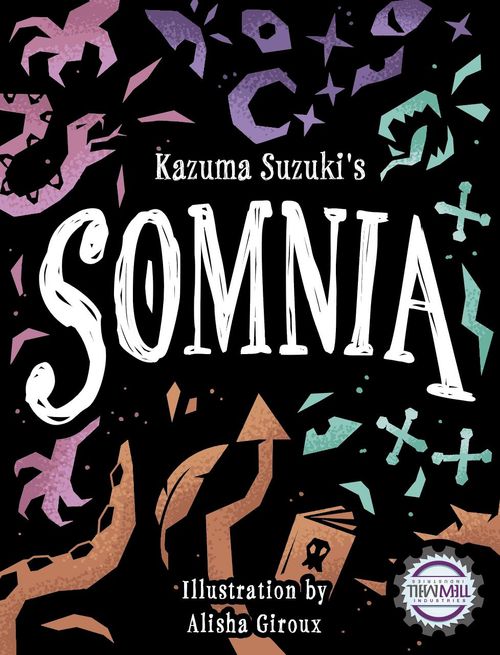
Somnia
Somnia Rulebook
Table of Contents
Table of Contents
Components
- 36 Dream Cards
- 12 Life Chips
- 1 Nightmare Chip
- 1 Manual
Dream Cards
A game deck consists of 36 dream cards of 4 suits (or colors), each suit containing 9 ranks from 2 to 10.
Somnia is a trick-taking game. Players are dealt equal cards to play several tricks. During the deal, one suit turns into the Nightmare, i.e. trump suit.
Numbers on the corner of a card represents a rank of that card. Small number next to the ranks with a devil icon represents card points (fragments of dreams). These points are summed up at the end of the deal.
In cards of ranks 5 and 7 are indicated Nightmare rank and points. As the suit of those cards becomes the trump suit, their ranks immediately change from 5 to 11, 7 to 12. Also, their points change from 0 to 13, 2 to 20. These promotions of ranks and points do not apply to the non-trump suits.
The total number of card points is 151 in most cases. However, when the Nightmare suit has not been determined until the end of the deal, the total number of points will be 120.
The Deal
Each player receives 3 life chips. Place a nightmare chip near the lid of the box. A player who remembers their most recent dream will be the first dealer. The deal and play are clockwise.
In 3- or 4-player game, the dealer shuffles all 36 cards and deals them all equally, one by one. In 3-player game, each player has 12 cards in hand; in 4-player game, each has 9 cards.
In 2-player game, cards of rank 2 to 4 of each suit are not used: put them back inside the box. The dealer shuffles 24 cards and deals 6 cards to each player, one by one. Remaining 12 cards are placed face down as a draw deck.
The Play
In 3-player game, 12 tricks are played. In 4-player game, 9 tricks are played. In 2-player game, each player draws a card from the deck after each trick is played, and 12 tricks are played.
The player to the dealer's left leads to the first trick. Any card may be led and each player in clockwise order must play a card of the suit led if possible.
A player cannot follow suit may play any card, and the suit of the first card that does not follow the suit led immediately becomes the Nightmare suit (see "The Nightmare"). If you revoked (played a card of the different suit than the suit led though you had a card of that suit), you immediately lose a life chip.
The trick is won by whoever played the highest card of the suit led, unless a Nightmare card was played in which case the highest Nightmare wins. The winner of the trick takes all the cards played in that trick and places them in front of the winner, face up. All cards taken should be visible to anyone during the deal.
Here, in 2-player game, the winner takes a card from the top of the deck, then the loser takes one. If the deck is emptied, play continues with remaining hands.
The winner of each trick leads to the next one, until all players run out of their hands.
The Nightmare
The suit of the first card that does not follow the suit led immediately (including that trick) becomes the Nightmare or trump suit throughout the deal. Put a nightmare chip onto the corresponding color on the lid to show the trump suit. Once the Nightmare suit is determined, any card that cannot follow the suit led has nothing to do with deciding the trump suit.
Any card of the Nightmare suit becomes possible to be played at any time: that is, even if you have a card of the suit led, you can play a Nightmare card instead.
There are two exceptions: firstly, if you play a Nightmare card when the suit led is not the Nightmare (i.e., ruffed), you can only play a stronger card than any card played. If the Nightmare is led, you do not have to do so.
Secondly, you do not have to play the strongest Nightmare of rank 12, if desired, even when the Nightmare is led. You can play that card at any time.
Scoring
Each player sums up the card points on the cards they took. Then, one or more loser will be determined as follows. All losers lose a life chip.
2-Player Game
- A player with 86 points or more loses. [Ending: Captive of Dream]
- If not (1) and both players take the equal points, both loses. [Ending: A Black String]
- If not (1) or (2), a player with less points loses. [Ending: Dreamless Child]
3-Player Game
- A player with no trick won loses. [Ending: Sleepless Child]
- If not (1), a player with 100 or more points loses. [Ending: Captive of Dream]
- If not (1) or (2), all players whoever take equal points lose. [Ending: A Black String]
- If not (1), (2) or (3), a player who comes second in total points loses. [Ending: Between Dream and The Dawn]
4-Player Game
- A player with 86 or more points loses unless they take all the points (not all tricks), in which case other three players lose. [Ending: Captive of Dream / Monopoly]
- If not (1), when all players take equal points, they all lose. [Ending: A Black String]
- If not (1) or (2), when top 2 players take equal points, a player who comes third loses; when bottom 2 players take equal points, a player who comes second loses; when top 2 players take equal points AND bottom 2 players take equal points, they all lose. [Ending: Solitude / Two Black Strings]
- If not (1), (2) or (3), players who come second and third in total points lose. [Ending: Between Dream and The Dawn]
The player left to the current dealer will be the next dealer. The game continues until someone loses all the life chips they had. A player who has most life chips wins the game.
Developer's Message
Somnia is a transcription of Mittlere Jass (aka Middler) and Molotov Jass, which are Swiss traditional trick-taking games. Mittlere Jass is for 3 players and Molotov Jass is for 4 players. Rules are quite close to original ones, while allocation of card points and card ranks are simplified, with fantastic art works and readable graphical design.
2-player rules are our original variant, an hommage to the traditions. I am afraid if they are comparable to the original games, but I really hope you might have enjoyed that variant for two.