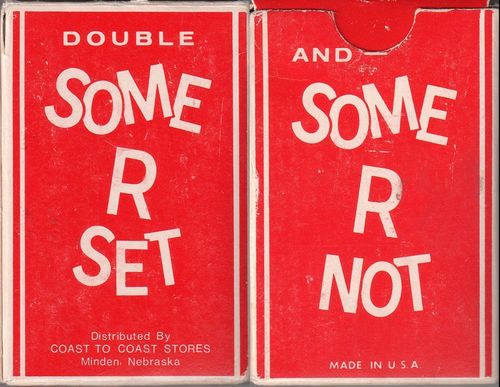
Some 'R' Set
Some 'R' Set Rulebook
Table of Contents
Table of Contents
Objective of the Game
To take tricks and point cards so you and your partner can either:
A) Win at least as many points as you bid at the beginning of each hand—if you were the high bidder.
or
B) If you and your partner weren't the high bidder(s), win as many points as possible in order to "set" the bid-winning team. A team that bids too high might find that "Some Are Set."
The Points
In each round of Some'R'Set, there is a total of 24 points available to win: 12 points total from the various Point Cards in the deck, and 1 for each of the 12 tricks that occur in each round.
Example: You and your partner win three tricks. One of those tricks had a point card worth 3 points in it! Your total number of points is 6.
The Cards
Denominators (suits) – In this game, a card's "suit" is its denominator, so a "0/12" is the lowest number in the 12's suit. The suits are 0's, 2's, 4's, 6's, 8's, 10's, and 12's.
Numerators – This is the value of your card within a suit. These values start at 0 and don't exceed the value of the denominator. For example, the entirety of the 2's suit looks like this: "0/2," "1/2," "2/2."
Point Cards – Red cards are all point cards, and their point value is circled in red to the right of the regular numerator/denominator on the card. If red cards are won in a trick, the winning team earns the total of the red cards' point values plus the automatic 1 point for winning a trick.
Trump Cards – At the end of the bidding round, the bid-winner will declare a "Trump" suit. Any card of this suit will now beat any card of any other suit. The only thing that can beat a trump card is a higher trump card.
S/S – The S/S card is a 3-point red card, and serves as the lowest value of the trump suit, regardless of the trump suit chosen.
0/0 – The "0/0" card turns the highest "double" in the trick (i.e. 12/12, 10/10, or even 0/0 itself) into a trump card, and the highest double in that trick takes the trick (as long as no regular trump has been played).
Example: The cards that have been played so far (in order) are: 5/6, 3/3, 4/6. Since your partner dealt the 3/3, you play the 0/0, turning the 3/3 into a trump card, and the 3/3 takes the trick.
If 5/6, 4/6, and 3/6 had been played, then 0/0 would be the only double in the trick, so it would become trump and win it!
The 0/0 would be useless in both these examples if 6's were trump.
Gameplay (4 Players)
1. The Bidding
Deal 12 cards to each player and 2 cards to the center. The player to the left of the dealer now bids how many points of the available 24 she believes she and her partner (seated across from her) can win in twelve tricks. Going clockwise, each succeeding player bids higher or passes until there's a winning bid. The bid-winner gets to declare which suit (denominator) is "trump." (she may declare "no trump," in which case there are no trump cards).
Note:
If the bid-winning team wins at least as many points as they bid, then they keep however many points they won, as does the other team. But…
If the bid-winning team does not win at least as many points as they bid, then they are "set," which means they must deduct from their total score double the difference between this hand's score and their initial bid.
Example: John became the high bidder by wagering that he and Jane could win 20 points, but they only won 12. Therefore, 16 points, [(20–12)x2=16] will be deducted from John and Jane's total score.
Alternate "Horsley Rules" If you play "Horsley Rules," the team that gets set loses exactly the amount of points that they bid. In the above example, John's team would have to deduct 20 points rather than 12.
2. The First Trick
Now that she's declared trump, the bid-winner must lead the first trick with a trump card (a card in the newly declared trump suit). All players, going clockwise in order, must "follow suit" by playing a trump card if they have it, or they may play any other card they like if not. Whoever played the highest trump card takes the trick. For this trick only, the winner also reveals the two cards in the middle and takes them.
3. The Rest of the Tricks
Whoever took the last trick now leads with whatever card they want. The rest of the players now must follow suit by playing a card with the same denominator as the leading card if they have it. Otherwise, they may play any card they like. The highest card in the leading suit wins, or if trump enters the trick, the highest trump wins.
4. Counting Points
After the last trick, count everyone's points. You get one point for each trick that you won (easily countable if you divide your winnings into groups of 4 cards), and however many points you won with point cards (their point value is circled on the card).
If the bid-winning team won at least as many points as they bid at the outset, then each team keeps the points they won.
If the bid-winning team does not make their bid, then they are "set." They must deduct from their total score double the difference between their bid and their score.
5. Do it again!
You repeat steps 1–4 until one team reaches at least 66 points. That team is declared the winner. If both teams reach at least 66 in the same round, the team with the higher score wins. In the unlikely event of a tie, the highest score after the next tie-breaking round wins.
Alternate Versions
3 Players
Deal 16 cards to each player, two in the middle. The game moves exactly the same, except without partners. Instead of bidding how many points your team can take, you bid only how many points you believe YOU can take alone (out of 28 points this time). Instead of taking some tricks and helping your partner take others, you try to take all tricks possible. There will be 16 tricks per hand.
5-Player Somerset
Deal 10 cards to each player (this time there will be no extra cards to leave in the middle). Each hand, the person who wins the bid declares trump and then names a single trump card that she wants (Example: if she had named 12's as trump, and she already has the 12/12, then she might name 11/12). The player who has that card then becomes her partner, and the remaining three players become the other team trying to set them. This happens each hand, so teams do not stay consistent in this version of the game. During the game, you score with your team each hand, but because your team changes each hand, final scores are individual. (see example on next page)
Example of 5-player Somerset: John and Jane are teammates in the first hand and they win 16 points together. The next hand, they're on different teams and John's team loses 12 points and Jane's team wins 14 points. By the beginning of the third hand, John therefore has 4 points (16-12), and Jane has 30 points (16+14).
6-Player Somerset
Deal 8 cards to each player, two in the middle. This time you're partners with every other person going clockwise, making two teams of 3. Bid according to how many points you believe your team of three can earn out of 20. The rest of gameplay including the final point count is as normal.
Horsley Rules
Regular Some'R'Set except the team that gets set loses exactly the amount of points that they bid. You may not declare "No Trump" under Horsley Rules.