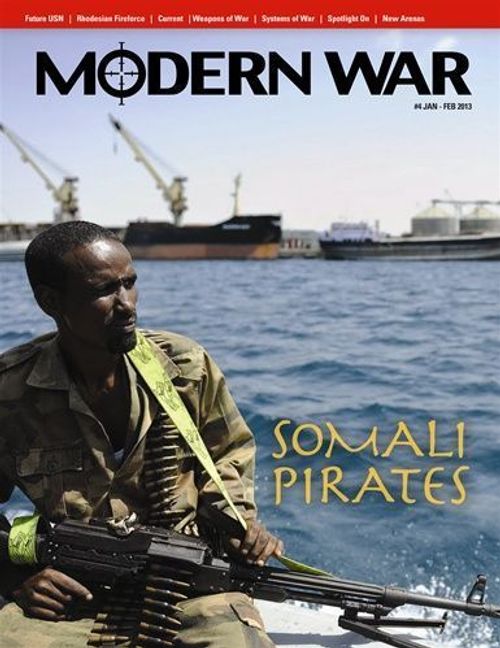
Somali Pirates
Somali Pirates Rulebook
Table of Contents
Table of Contents
- 1.0 Objective of the Game
- 2.0 Components
- 2.1 The Game Map
- 2.2 Zone Boxes
- 2.3 Underground Boxes
- 2.4 Movement Routes
- 2.5 Netwar Value
- 2.6 Area Affiliation
- 2.7 Petroleum Zones
- 2.8 Off-Map Bases
- 2.9 Map Displays
- 2.10 Game Charts & Tables
- 2.11 The Playing Pieces
- 2.12 Naval Units
- 2.13 Ground Units
- 2.14 Air Units
- 2.15 Special Operations Forces (SOF) Units
- 2.16 Backprinting
- 2.17 Coalition Factions
- 2.18 Pirate Factions
- 2.19 Unit Identifications
- 2.20 Netwar Chits
- 2.21 Terminology & Definitions
- 2.22 Dice
- 3.0 How to Set Up the Game
- 4.0 How to Play
- 5.0 How to Win
- 6.0 Netwar Index
- 7.0 Control of Forces
- 8.0 Initiative
- 9.0 Mobilization
- 10.0 Organization of Forces
- 11.0 Movement
- 12.0 Kinetic Combat
- 13.0 Underground Combat
- 14.0 Kinetic CRT Results
- 15.0 Asymmetrical Warfare
- 16.0 Going Underground
- 17.0 Return Phase
- 18.0 Control of Zones
- 19.0 Netwar Chits
- 20.0 Special Units
- 21.0 Air Basing
- 22.0 Sealift
- 23.0 Helicopter Transport
- 24.0 Strategic Redeployment
- 25.0 Base Units
- 26.0 Off-Map Bases
- 27.0 Fog of War
- Optional Rules
- 28.0 Optional Units
- 29.0 Standoff Attacks
- 30.0 Logistics
- 31.0 Full Spectrum Dominance
- 32.0 Al Qaeda Infiltration
- 33.0 Chinese Combat Shock
- Coalition Netwar Chit Explanation
- Pirate Netwar Chit Explanation
1.0 Objective of the Game
Somali Pirates is a wargame set in a hypothetical Coalition campaign to destroy the power of pirates based in Somalia, as well as to otherwise gain control of that country. The assumption of the game is that the pirates, in league with local warlords and Al Qaeda, have become strong enough to be an even bigger threat to the region than they are now. In response, various powers launch military action against them.
There are two players in Somali Pirates: the Coalition, who wants to destroy the Pirates, and the Pirates, who want to survive, as well as to maximize their own power and wealth.
Central to play of the game is the Netwar Index. Each player has a Netwar Index that indicates how successful he is in achieving its goals—effectively, representing the amount of public support that each side is getting. The Netwar Index affects various aspects of the game, such as mobilization of reinforcements, and is also part of gaining victory.
Both players have a set of counters that represent their naval, land, air and special operations forces (SOF). Players move their pieces across the spaces on the map and engage in various kinds of conflict in order to destroy enemy forces, seize critical geographical regions, and change the Netwar Index (hopefully in their favor). Both sides can mobilize new units by paying for them with Netwar Points.
Given the asymmetry of the situation, each side in the game will have several unique rules.
There is also a set of Netwar Chits, representing various fortunes of war.
2.0 Components
2.1 The Game Map
The game map shows Somalia, the Red Sea, the Gulf of Aden, and adjoining areas of the Indian Ocean.
Somalia: Somalia is divided into three Regions: Southern Somalia, Puntland and Somaliland. These are playable by both sides.
Note: "Somali Pirates" is a general term for these three factions from Southern Somalia, Puntland and Somaliland.
Djibouti. This is not part of Somalia. Djibouti the Region and Zone is playable by both sides. Coalition Off-Map bases. Only Coalition units may enter these. Sea Zones. These are playable for both sides.
2.2 Zone Boxes
The large boxes represent Land and Sea zzones. They generally function in the same manner, with different types of units being able to deploy in them. When both sides have units in the same zone, conflict may occur.
2.3 Underground Boxes
The small boxes within certain zones represent the underground, sanctuaries where certain Pirate units can hide.
2.4 Movement Routes
The connecting arrows between boxes are the routes by which units move. Movement may be by land or sea routes.
2.5 Netwar Value
The number is the amount of Netwar Points that players receive for controlling the zone.
2.6 Area Affiliation
The color of a Zone Box indicates whether that area begins the game as a Pirate area or a Coalition area.
2.7 Petroleum Zones
These have an oil-well symbol. See the Terrain Effects Table and victory rule for their effects when occupied by one side or the other.
2.8 Off-Map Bases
These represent Coalition bases outside of Somalia. Only Coalition forces may enter Off-Map Bases (for example, Aden).
2.9 Map Displays
The following map diplays are defined as follows.
Coalition & Pirate Netwar Assets
Available. This is a convenient place for each player to place Netwar Assets when not being used to attack targets on the map. Netwar Index. Each player has a Netwar Index. This records the player's current Netwar Points on a scale of 0-100. Use blank markers, or pen and paper to record the current number of points. Time Record Chart. This indicates the current turn. Use a blank marker to record the turn.
2.10 Game Charts & Tables
The following charts and tables are defined as follows.
Conflict Resolution Tables. These are used to resolve various kinds of conflicts. They include: Kinetic and Asymmetrical Combat.
Errata: The column headers of the Asymmetrical Warfare Results chart should be S1, S2, S3 and F (not 1, 2, S3 and F).
Mobilization Chart. This gives the cost of building units, recruiting factions, and picking Netwar chits with Netwar Points. Terrain Effects Chart. This shows the effects of the various types of terrain on play. Netwar Chit Explanation Chart. This explains the effects of Netwar chits. Transportation capacity. This summarizes which units can carry other units.
2.11 The Playing Pieces
Each player has a set of counters. There are four general types of units, and each unit has the following information on it.
Naval. Task forces of warships. Land. Ground forces from battalion to division sized. Air. Air units from 'flight' to 'squadron' sized. Special Operations Forces (SOF): these represent forces that can conduct unconventional warfare. SOF generally function as land units with special abilities
Kinetic Combat Strength. Each unit has a large number representing its combat strength. Depending on the type of unit, this combat strength can be used to engage enemy units at sea, on land or in the air. Asymmetrical Warfare Strength. This is the number in the parentheses. If a unit has an Asymmetrical combat strength, it can engage in asymmetrical (unconventional) operations. Movement. This is the basic number of areas a unit can move in a turn. Unit movement will also be restricted by its general type. Air Movement. An "infinity" sign means that the unit can use air movement. Amphibious Capability. An "anchor" sign (in the unit box) means a ground unit can make special amphibious assaults. Faction. Each unit belongs to a faction. A faction is a particular force within the overall side. This is indicated by the unit color and code.
2.12 Naval Units
Pirate Type Ships
Pirate mothership Pirate attack craft
Coalition Type Ships
AWG: Amphibious Warfare Group C2: Command Ship CVG: Aircraft Carrier Group DD(Z): Zumwalt Class Destroyer Group LCS: Littoral Warfare Group Q-Ship: Warship disguised as civilian ship. SWG: Surface Warfare Group
2.13 Ground Units
The various ground units in the game are divided into two general categories, heavy and light.
Heavy Units
Mechanized Armor Stryker Amphibious Mechanized Airborne/Air Assault Combined Arms Technical Riverine Base
Light Units
(movement factor highlighted)
Infantry Marines Mountain Security Militia Warlord Terrorist Petroleum Engineers
2.14 Air Units
Coalition Type Air Units
Strike Air Carrier Air Group Patrol Air Special Operations Aviation
Errata (from the companion "Rules for e-rules errata in green", Nov 2012, not in the 2013 text): There are several air units on the Somali Pirates sheet erroneously marked as "C" (carrier air). Row 7, counters 3-4-5-6, and row 9, counters 6-7-8 are strike air units. They should have an "S".
2.15 Special Operations Forces (SOF) Units
Special Operations Forces
2.16 Backprinting
Units that can transport other units have the word "transport" printed on the back.
2.17 Coalition Factions
The Coalition is divided into several separate contingents, called factions. Each Coalition faction has an abbreviation and a color, although Coalition bases are in a generic color.
Coalition Factions
AU: African Union China: People's Republic of China CJTFHOA: Combined Joint Task Force Horn of Africa Contractors: Private Military Forces Djibouti JSOTF: Joint Special Operations Task Force NATO: North Atlantic Treaty Organization USAFCOM: US Africa Command USNAVAF: US Naval Forces Africa Somali Transitional Federal Government (STFG)
Note: In some cases the abbreviations are not the same as the official ones. This is owing to space limitations on the counters.
2.18 Pirate Factions
Each Pirate faction has an abbreviation and color. Additionally, Pirate bases are in a generic color. The Pirate forces are divided up into the following factions.
Pirate Factions
Southern Somalia Pirates Somaliland Pirates Puntland Pirates Al Qaeda
Designer's Note: Each of the factions also includes various warlord and insurgent forces whom are assumed to have aligned themselves with the Pirates.
2.19 Unit Identifications
Certain units have their actual identification. This has no effect on play other than historical interest.
Coalition Unit Abbreviations
CIA: Central Intelligence Agency Special Activities Division CJTF: Combined Joint Task Force CSOF: Combined Special Operations Force DBLE: Foreign Legion Demi-Brigade DNA: Djibouti National Army EGF: European Gendarmerie Force EU RR: European Union Rapid Reaction Fr: French GMR: Guangzhou Military Region Special Forces Unit MAW: Marine Amphibious Wing MEB: Marine Expeditionary Brigade MEU: Marine Expeditionary Unit MN: Multi-National PMC: Private Military Company PRT: Provincial Reconstruction Team R: Ranger RMC: Royal Marine Commando SBCT: Stryker BCT TF: Task Force UAV: Unmanned Aerial Vehicle (drone aircraft) UK: United Kingdom US: United States
Pirate Abbreviations
AA: Abdullah Azzam AQS: Al Qaeda in Somalia
2.20 Netwar Chits
Each player has a set of Netwar Chits. These represent a use of modern communication technologies, as well as unconventional methods of warfare.
Netwar chits are initially placed in a wide mouthed opaque container, called a Netwar Pool. Each player has their own Netwar Pool.
2.21 Terminology & Definitions
The following terms are used throughout the rules, and are defined as follows.
Adjacent: a zone that is connected to another zone via a movement route. May: the player has the option to take this action or not. Must: the player is required to take this action. Open Unit: a unit that is located in a zone, not in the Underground Box. Pick (at random): the player chooses from the pool without looking at the chit to be taken. Select: the player looks at the chits and then selects the indicated number. Underground Unit: a unit which is located in the Underground Box of a zone.
2.22 Dice
Players will need one six sided die to play the game. Two would be useful.
3.0 How to Set Up the Game
To set up the game, do the following (in the given order).
A) Decide which player will control the Pirates, and which will control the Coalition. Each player then takes his units and sorts them out according to their Faction.
B) Determine the Starting Netwar Points:
- Both sides initially start at a base of 40.
- One player rolls one die; multiply that number by ten (to get a number from 10 to 60) to determine how may additional points both players receive.
- Add that number to 40. Set the marker at this total for both players (to get a final from 50 to 100).
Note: It does not make a difference which player rolls the die above. The same number is used for both players. The idea is that the bigger the Pirate threat, the bigger the response from the Coalition.
C) Starting Player Forces
- The Pirate player receives the three Pirate factions (Southern Somalia, Puntland, Somaliland) plus Al Qaeda automatically and at no cost in Netwar points.
- The Coalition player expends Netwar points to mobilize his own Factions.
D) Deploy Coalition Units
- The Coalition deploys in Djibouti: one base unit. This is received at no cost in Netwar points.
- The Coalition deploys all the units of mobilized Factions on the map. They must all be placed in locations per the Coalition Mobilization Rules and Chart.
E) Deploy Pirate Units
- For each of the three Somali Pirate Factions: roll one die, then for that faction, deploy on the map any combination of the following units (player's choice) equal to the number rolled: warlords, militia or attack craft. Place them in regions of the same name. Bases may be placed in Southern Somalia, Puntland and Somaliland. Attack craft must be placed in ports or adjacent sea zones. These units are received at no cost in Netwar points.
- For Al Qaeda: roll one die, divide by two, and round up any fractions (to get a number from one to three). Then deploy that number of Al Qaeda units (player's choice) anywhere in Southern Somalia, Puntland, Somaliland or Djibouti. These units are received at no cost in Netwar points.
- Expend Netwar Points to mobilize bases and additional units for Pirate and Al Qaeda factions.
Note: See rule 9.0 and the Mobilization Chart for specific deployment instructions.
3.1 Turn One
The game begins during Turn One, per the sequence of play. Units are mobilized normally on Turn One.
4.0 How to Play
Somali Pirates is played in game turns. The routine for each game turn is a sequence of play. Players must follow each step in the order given, noted as follows.
4.1 Sequence of Play
-
Initiative Determination Phase. Determine who will be the first and second players. (See 8.0).
-
Mutual Mobilization Phase.
a) Each player secretly and simultaneously does the following: purchases Netwar chits, mobilizes factions, and builds individual units where applicable. b) The first player reveals all purchased units and deploys them on the map. c) The second player reveals all purchased units and deploys them on the map. d) The Coalition places any replacement units due this turn.
- First Player Turn.
a) First Player Movement Phase. The first player moves his units in accordance with the Movement & Faction rule (see 11.0). b) First Player Combat Phase. The first player initiates conflict with his units in accordance with the Combat & Faction rule (see 12.0). c) First Player Return Phase. The first player moves units qualified to move in the Return Phase.
- Second Player Turn.
a) Second Player Movement Phase. The second player moves his units in accordance with the Movement & Faction rule (see 11.0). b) Second Player Combat Phase. The second player initiates conflict with his units in accordance with the Combat & Faction rule (see 12.0). c) Second Player Return Phase. The second player moves units qualified to move in the Return Phase.
- Control Phase.
a) Check each Zone. If one player's forces control that zone, then that player receives the Netwar points listed for his side and adds them to his Netwar Index (see 18.0).
- End of Turn Phase.
a) Protracted conflict phase. Players must now decide to continue the scenario or not.
Example: At the end of game turn two, the Coalition player would have to expend two Netwar Points to continue the game.
If neither player extends the scenario, then the game comes to an end and victory is assessed. Note that if the Coalition has decided to expend the points, the Pirate player is under no obligation to do so to continue the scenario.
Designer's Note: This represents the political realities of the situation, that the Coalition would have to make more of a political effort to continue the campaign.
4.2 Sudden Death
Also, the game may come to an end if one player seizes a Sudden Death Victory at any time during the game (see 5.2).
b) Move the Turn Record marker one space to reflect the passing of one turn. If this is the end of Turn 12, the game automatically comes to an end and victory is assessed.
5.0 How to Win
A game of Somali Pirates can end in the following ways.
5.1 Military Victory
If the game comes to an end because both players have chosen to not extend the game, or Turn 12 has been completed, then check the situation on the map. Players gain Victory Points (VP) for the following:
a) The total of any Netwar Points on their Index. b) Pirate Bases: five points for each Pirate base in a Port Zone. c) Oil Wells: five points for any Petroleum Zone that is both Coalition-controlled and contains a friendly petroleum engineer unit.
The player who has more VP wins the game. The number of points ahead you are indicates how big a victory you have seized.
0-25 points: Draw 26-50 points: Marginal Victory 51-75 points: Regional Victory 76 or more points: Decisive Victory
5.2 Sudden Death Victory
If, at any point in the game, one side's Netwar Index goes to under zero, the game immediately comes to an end. That player loses. The other player checks the number of VP he has, and adds 50 to it to get his level of victory.
Example: Player A has 20 points. Player B's Netwar Index drops to zero. The game comes to an end and the final Points for Player A becomes 70, a Regional Victory.
6.0 Netwar Index
Each player has a Netwar Index. The current number of points are indicated by using the Netwar markers.
When your side gains Netwar points, move its marker up the Netwar Index track. If you lose or expend points, move the marker down the appropriate number of spaces (or simply record it using pen and paper).
If a player's Netwar Index goes to 100, it can go no higher. It can still go lower. If an event occurs which would raise your Netwar Points to above 100, then deduct those points from the enemy.
Example: You have 100 points. The enemy has 70 points. If you eliminate enemy units that would cause you to gain three more points, you drop the enemy index to 67.
If a player's Netwar Index drops to zero or lower, the game comes to an end. See Victory 5.0.
6.1 Combat Results
After each combat, check the Netwar Points Table. This will give the number of points received for eliminating units or sometimes for the zone itself.
The player gaining the points for combat has a choice to either raise their own index by that number, or to decrease the enemy's (but not a combination).
The "IA" combat result will give the Pirate player points (but representing Coalition casualties below the scale of the game), regardless of who attacked. The "OK" result will give the enemy a number of points equal to or double the zone's value.
6.2 Control of Zones
You gain a zone's points for controlling it during a Zone Control Phase. See rule 18.0 for definition of control.
6.3 Petroleum Zones
If the Coalition player has a petroleum engineer unit in a zone with a petroleum symbol, and has control of that zone, then the Coalition receives double the number of points for it.
6.4 Netwar Chits
Certain Netwar Chits will cause Netwar points to be gained or lost.
6.5 Expending Netwar Points
You expend Netwar points to accomplish various game functions (such as mobilizing factions). You must have the points to expend prior to using them. There is no deficit spending in the game!
Only as a result of combat do you have the option of raising friendly or lowering enemy Netwar points. All other actions will dictate if the points are either added or deducted.
7.0 Control of Forces
Each player controls forces composed of different Factions. All factions of a side are friendly to each other, but there are limits on how they can operate together.
Each Faction has a name and specific units that are associated with it. The associated units are given a unique designation and color code.
Example: The Coalition Combined Joint Task Force Horn of Africa includes all units marked "CJTFHOA."
7.1 Faction Movement
When activating a Faction, moving units of a Faction must complete their movement before moving any units of another Faction.
Example: The Coalition player moves two units of the CJTFHOA. He then moves a NATO unit. He cannot go back and move another unit of the CJTFHOA.
7.2 Combat
When activating a Faction, attacking units of a Faction must complete their attacks before attacking any units of another Faction. Units of different factions may not join together in a single attack.
7.3 Concentration
Units of one friendly faction may be in the same zone as another friendly faction, but they may not stack together (see 10.0) to attack or be moved together.
7.4 Transport
Generally, units of one faction may not transport units of another faction, except as noted below.
7.5 Common Factions
The following units are exempt from the above restrictions.
Bases. Both players' Bases are a faction common to all units of the same side. Units may always stack with a friendly base, but only one faction's units may do so.
Coalition JSOTF and Contractor Factions. Coalition JSOTF and Contractor faction are considered to be factions common to all other Coalition units. Coalition JSOTF and Contractor units may stack with any other Coalition units, move with them, and attack together, and transport and be transported by them.
Example: the Coalition player could have a combined attack of NATO, JSOTF and contractor units. However, US NAVAF units could not be added to the attack (unless the NATO units were removed).
Warlords Netwar Markers. Netwar markers which can be played in combat, etc., can be played at any time and are not subject to the Faction restrictions. Also, certain Netwar markers will allow players to use units of different factions in coordinated movement and combat actions. (See Joint Operation and Leader Node chits.)
7.10 Geographical Factors
Pirates
Pirate units, regardless of faction, may move anywhere in Somaliland, Puntland, Southern Somalia and Djibouti, as well as all Sea Zones. They may not enter Coalition Off-Map Bases, Kenya or Ethiopia.
Coalition
Coalition units, regardless of faction, may move anywhere on the map, although they must stop when they enter an open area that is occupied by any Pirate unit(s).
8.0 Initiative
During the Initiative Phase, players determine who will be the first player and second player.
8.1 Initiative Determining Initiative
The player who currently has the higher number of Netwar points can determine who controls the initiative and thus goes first in this turn. That player is known as the first player. The other player is the second player and goes second. In the event of a tie, the Pirate player controls the Initiative.
Initiative remains in effect for the remainder of the turn, and this can change on a turn-by-turn basis.
Note: There are times when there are advantages to being the first or the second player.
9.0 Mobilization
9.1 Mobilization of Factions
A player may bring friendly factions into play during his Mobilization Phase by expending his own Netwar points. Each Faction's cost is indicated on the Mobilization Chart. You can bring in some or all factions in the course of a game.
Note: This is in addition to any mobilization conducted in the initial setup.
A Faction with a cost of zero can be brought in without expending Netwar points.
9.2 Mobilization of Faction Procedure
Mobilization is conducted via the following procedures.
- Pay the Netwar point cost and the faction is activated.
- For the Coalition: deploy all units of that faction on the map in the locations indicated.
- Bases & Contractor Units: coalition bases and contract units are an exception. The Coalition player builds these units individually by paying the Netwar point cost on the Mobilization Chart.
- For the Pirates: you can now build units of that faction. You can also build bases that are used by any faction.
Note: The Mobilization Cost for all Pirate factions is zero. Also, note that the Pirates receive randomly-determined numbers of units for each faction during initial set up at no cost in points.
- Bases: Pirate bases can be purchased by paying Netwar points for individual bases.
9.3 No Withdrawal
Once any Faction has been mobilized, it remains in play for the rest of the scenario. No additional costs are required to maintain it in play. Once in play, you cannot de-activate a Faction (and thereby regain its points).
9.4 Deployment
A player places mobilized units on the map in locations as per the instructions on the Mobilization Chart. Units may be placed in Open status or in the Underground box of a zone, depending on whether or not the units can enter those boxes, and if they are available.
If a unit is required to be placed in the same zone as another unit of a particular type, then that other unit must have been in place at the start of the Mobilization Phase.
9.5 Control
The presence of enemy units has no effect on placing units. You do not have to control a zone to place units in it (unless otherwise specified).
9.6 Netwar Chit Generated Units
Units mobilized via Netwar Event Chits do not cost Netwar points. They are placed automatically per the instructions in the event.
9.7 Recruiting Limits
The number of units in the counter mix is a purchase limit.
9.8 Purchasing Netwar Chits
Netwar chits have an escalating cost. The first Netwar chit you buy in a particular Mobilization Phase costs one point; the second two, the third three, etc.
Example: A player purchases four Netwar chits. The total cost would be 1+2+3+4 = 10 points.
Note: This cost is reset each turn. So if on the next turn the player bought two more chits, then the cost for that turn would only be three points (1+2=3).
9.10 Replacements
When units are removed from the map for any reason, they become available for replacement.
Pirate Replacement
Replace Pirate units by going through the normal mobilization process.
Coalition Replacement
If a Coalition unit is eliminated, immediately roll one die for it (see exceptions below). Results are:
1-5 = The unit is received as a reinforcement that number of turns later. Place it on the Turn Track on the designated turn. If any unit would return after the last game turn, then it is lost permanently. This costs no mobilization points.
6 = Permanently remove the unit from play.
Exception: this automatic replacement does not apply to bases and gontractor units. If these are eliminated, they must be purchased to be returned to play. They can be replaced on the very next turn (do not roll for them).
Designer's Note: Coalition units have much more resiliency than pirate units; therefore an elimination in the game represents a temporary state of combat ineffectiveness, shown by its removal from the map for a number of turns. The "6" result represents a unit losing cohesion sufficient that it is out of action for the duration, or has been withdrawn for political reasons.
10.0 Organization of Forces
Generally, you can have an unlimited number of units in a zone. You can stack units of the same Faction together by piling them on top of each other. It costs no movement points to stack or unstack, but this can be done only during a friendly Movement or Return phase.
10.1 Stacking Restriction
You can have units of different friendly factions in the same zone, but they cannot stack together (this may impact on combat, see below).
10.2 Common Units Stacking
Both sides' bases, and Coalition JSOTF and Contractor units may stack with any other friendly units.
10.3 Stack Movement
Units move individually, unless transporting other units. Stack movement provides no particular advantage during play.
10.4 Combat & Stacking
The effects of stacks on combat is explained under the combat rules (see 12.0).
10.5 Hostile Occupation
Both players may have units in the same zone, and this can lead to conflict (see 12.1).
10.6 Unit Status
Units are in one of two statuses when occupying a zone.
Open status if they are in a zone but not in an Underground Box.
Underground status if they are in an Underground Box.
10.7 Concentration in the Underground
See rule 16.4.
11.0 Movement
A player moves his units during his own movement phase. A player may move some, none or all of units, in any order he prefers.
11.1 Movement (General)
Units move from region/zone to region/zone via connecting movement routes. A unit may move only via routes that its type can move through. A unit can move a number of regions/zones up to its movement factor (though see special rules for air movement).
11.2 Movement by Faction
A player must complete the movement of one faction before moving the next one. You do not have to move all units of a Faction, but once you have moved on to the next Faction, you can not go back and move the units of a previously moved faction.
11.3 Naval Movement
Naval units can only move via naval movement routes. They can enter sea zones, and land zones which have ports.
A Pirate naval unit must cease movement as of the instant that it enters a zone or a port containing a Coalition naval unit or Coalition air unit on patrol. Coalition naval units can move through Pirate naval units without stopping.
11.4 Ground Movement
Ground units can move only via ground movement routes (with the exception of naval transport and airmobile units).
A ground unit must cease movement the instant that it enters a zone containing an enemy Open-occupying unit of any type.
11.5 Static Units
Units with a zero movement cannot move from zone to zone, nor may they ever be transported. However, they may move to and from the Underground Box of a zone if otherwise qualified.
11.6 Pulling Out
Units can exit a zone containing enemy units, regardless of their type. They would have to stop in the first zone containing any units blocking them, however.
11.7 Air Movement
Air units can move via any routes and enter any type of zone or region. The presence of enemy units does not affect them. See also rule 21.0 Air Basing.
11.8 Airmobile Movement
A ground unit may use airmobile movement if it has an infinity symbol. It does not need any transport air unit to do this, as it is assumed to be moving via organic airlift or helicopters. A unit uses airmobile movement in one of the following ways.
- It begins the movement phase in a zone with a friendly base. The player can then move the unit an unlimited number of spaces if it ends the move in a zone with another friendly base.
- It begins the movement phase not in a zone with a friendly base. The player can then move the unit up to four (4) spaces and end the move in a zone with a friendly base.
- It begins the movement phase in a zone with a friendly base. The player can then move the unit up to four (4) spaces and ends the move in a land zone.
In other words, an airmobile unit must either begin and/or end its move in a friendly base. They cannot move otherwise. "Friendly base" is defined as a zone containing a base unit of the same side, or an Off-Map Region with a base. See below for naval units as bases.
Note: Airmobile movement can be through enemy units without stopping.
11.9 Naval Units as Bases
Coalition naval units capable of transporting land units can also be used as bases for airmobile movement. The airmobile units must be of the same faction, or of a common faction.
Example: The USNAVAF carrier could base the JSOTF 75th Ranger Regiment.
11.10 Amphibious Movement
See the Amphibious movement rule (22.5).
11.11 Underground Movement
This is explained below (16.1).
12.0 Kinetic Combat
Kinetic combat represents various types of conventional operations. Kinetic combat may occur when there are enemy units in the same zone during a Conflict Phase. Kinetic combat is resolved using the Kinetic Combat Resolution Table. It is conducted by open units against enemy open units.
12.1 Attacking & Defending
The player whose turn is in progress is the attacker. The other player is the defender. Attacking units must be in the same zone as the units that are to defend. Units in adjacent zones cannot attack each other. Generally, all attacking and defending units must be in the open.
Attacking is entirely voluntary. The attacker chooses to attack or not on a case by case basis. However, defending is mandatory if the attacker chooses to attack.
Once you declare an attack, you cannot call it off. You must finish all attacks of one faction before moving on to using units of the next faction. The attacker does not have to declare all of his attacks ahead of time; he resolves them on a one by one basis.
12.2 Procedure: Kinetic Combat
- Each individual attack can utilize units of only one Faction, plus any units of common Factions (such as JSOTF for the Coalition).
- The attacker designates which units will be in the attack. The attacker may attack with some or all of the Open units of that Faction.
- If there is more than one enemy Faction in a zone, the attacker designated which ones he will be attacking. He can choose to attack some or all enemy Factions, but once one enemy faction is chosen, then all units of that faction there must be attacked.
- Determine Combat Odds a) The attacker totals his units' kinetic combat strength. Make any adjustments for terrain, warlords, and/or Netwar chits. b) The defender totals his units' kinetic combat strength. Make any adjustments for terrain, warlords, and/or Netwar chits. c) Divide the attacker's strength by the defender's strength. This will produce a combat odds ratio. Drop any fractions. If the defender's strength is more than the attacker's strength, then the conflict must be resolved on the <1-1 column.
Example One: 8 factors attack 6 factors. Odds are 1.33/1. Drop the fraction and it comes out as 1/1.
Example Two: 3 factors attack 4 factors. Odds are 0.75, so resolve on the <1:1 column.
- The attacker rolls one die. Cross-index the die roll with the odds column on the selected CRT. This will give the Kinetic Combat Result.
- Apply the result immediately. The results are given in terms of a code, explained adjacent to the CRTs. Apply any Netwar point adjustments.
12.3 Allowances & Restrictions
If the attacker has more than one unit in a zone, then he may combine them for attacks, or each may attack individually.
No unit may attack more than once per combat phase.
All units of a single Faction automatically defend together as a single combined defensive total. A particular defending unit may be attacked more than once per Combat Phase if they are attacked by different units.
Example: the attacker has three units in a zone and all three are of a single faction. The defender has two units, one each from two different factions. The attacker could combine all three units into one attack on one faction. Or use one unit to attack one defending faction a second unit it attack a second defending faction, and simply not use the third unit.
Example: The attacker has two units in a zone, the defender one. The attacker uses the first unit to launch an attack against that one defending unit and the defender survives. The attacker could then use the second unit to launch another attack against it.
12.4 Bases
A base unit applies it defense strength only to the units of the Faction with which it is stacked. If it is not stacked, then it may be attacked by itself, using its defense strength solely.
12.5 Coalition Contractors & JSOTF
These units can attack in conjunction with any other Coalition Factions (or by themselves). When defending, if they are stacked with other faction's units, they defend with that faction. If not stacked, then they each are one separate Faction, and the Pirates can attack them separately.
12.6 Eligible Targets
Air units may attack any kind of enemy units in the same Zone.
Naval units may attack any kind of enemy units in the same sea zone.
Naval units in a port may attack any kind of enemy units in the same port.
Note: This is known as naval unit bombardment, as referenced Terrain Effects Chart (under the combat effect line of the port row) on the map.
Ground units may attack enemy ground and SOF units in the same zone. If in a zone with a port, they may attack enemy naval units in that port.
Exception: Units in open status can only attack enemy units in Underground boxes via kinetic combat if the attacking player plays an ISR marker.
SOF units may attack enemy ground, naval and SOF units in the same zone (SOF units can attack enemy naval units at sea; see the SOF special rules).
Attacks may be against different kinds of enemy units, as long as all those units are of the same Faction, and all friendly units involved are qualified to attack them.
12.7 Increasing Kinetic Combat Strengths
Certain game functions will double unit combat factors.
Terrain. Certain units will have their attack and/or defense strength doubled when fighting in certain terrain types. See the TEC on the map for specifics.
Warlords. The presence of a warlord in a force will double the kinetic strength of one other unit of the same Faction. The owning player can select which unit will be doubled. Other warlords cannot be chosen for doubling.
Netwar Chits. Certain Netwar chits will double the combat strength of one or more units. The owning player selects which units will be doubled.
Note: A unit which is doubled twice is thus tripled. A unit which is doubled three times is thus quadrupled. Units can never be more than quadrupled, however.
13.0 Underground Combat
A player can only use units in Open status to attack enemy units in Underground boxes via kinetic combat if (and only if) playing an ISR marker. Each such attack requires an ISR marker. This is known as underground combat.
13.1 Procedure
Units in the underground do not receive any bonuses for terrain. They do receive bonuses for other normal modifications.
Units in the underground ignore all retreat results.
Underground units defend separately from Open units, and vice versa. No attack can be combined against units in Open status and Underground, regardless of commonality of factions.
Underground units may never, themselves, ever attack.
14.0 Kinetic CRT Results
The Kinetic CRT uses a two-letter code to indicate the outcome of the combat. The results are specified on the Kinetic Results Chart.
14.1 Eliminations
If the result is 100% elimination, then all of the units participating in the combat on the affected side are eliminated.
If the result is 50 % elimination, then units which total at least 50% of the printed kinetic strength on affected side are eliminated. The player controlling the affected force can choose which units will be eliminated as long as the total is 50% or more of the total strength.
14.2 Retreats
If a result calls for one side to retreat, that player moves all surviving units from the zone it is in, as follows.
- Into an adjacent zone. This must be a zone the units could otherwise enter via movement. Retreating units must end the retreat in the Open Box.
- Into an empty Underground Box of the same zone (if it could otherwise be entered).
- Airmobile qualified units and air units may retreat back to a friendly base in range. They may retreat through regions/zones with enemy units, but there can be no enemy units in the terminal region/zone.
- Amphibious units may retreat back to a friendly amphibious naval unit if it is in a sea zone adjacent to the zone occupied by the retreating units.
- Naval units can retreat to a sea zone or port.
- You may split up retreating units.
- Zero movement factor units may retreat into an Underground Box if qualified; they may not otherwise retreat.
- A unit may retreat into a zone containing enemy units at no penalty. They may be attacked by those units if they are qualified.
Note: Units which retreat into a position where they may be attacked again may be attacked a second time.
14.3 Retreat Elimination
If a retreating unit has no location to which it can retreat, it is eliminated instead.
14.4 Bases Exemption
Bases are never affected by any retreats. Also, units in the same zone as a friendly base that survives the combat may ignore retreats (even if the base itself was not the target of the attack). This is at the owning player's option.
14.5 Underground Exemption
Units in an Underground Box are not affected by retreat.
15.0 Asymmetrical Warfare
Asymmetrical Warfare includes various types of unconventional operations. The types of Asymmetrical Warfare attacks players can conduct are listed as follows.
Pirate Attack Terrorist Counterinsurgency Attack High Value Target Attack UAV Attack
15.1 Asymmetrical Warfare Value
Asymmetrical Warfare is executed during the combat phase. Only units printed with an asymmetrical warfare value of "1" (one) or more can make asymmetrical warfare attacks.
Note: Enemy units may be affected by the outcomes of asymmetrical attacks, regardless of their asymmetrical value.
15.2 UAVs
Additionally, UAV markers may conduct drone attacks.
15.3 Restrictions
A unit can conduct either a kinetic or asymmetrical warfare attack during a single combat phase, but not both. A unit may not conduct more than one asymmetrical warfare attack per combat phase, although an enemy unit may be the target of more than one asymmetrical warfare attack per phase.
Once you declare an attack, you cannot call it off.
15.4 Asymmetrical Warfare Procedure
- The attacker designates the type of Asymmetrical Warfare attack (per 15.7).
- The attacker totals the asymmetrical combat values of the units making the asymmetrical attack. All such units must be of the same faction (with the exceptions noted for common Faction units).
- The defender totals the asymmetrical combat values of all defending units with an asymmetrical warfare value of one (1) or more. The units which can contribute to the defense depend on the type of attack being made, and is explained under the individual attack types.
- Subtract the defender's value from the attacker. The difference is the column on the Asymmetrical Warfare CRT that will be used to resolve the combat.
Note: Asymmetrical warfare is resolved differently from kinetic combat insofar as it uses an add-subtract differential as opposed to a combat odds ratio.
- Roll one die, and then apply the results. The results will be explained by the individual rules sections.
15.5 Increase Asymmetrical Combat Strength
Certain game functions will increase unit asymmetrical combat factors.
Note: Terrain and warlords have no effect on asymmetrical combat.
Netwar Chits. The effects of Netwar chits are explained in section 19.0. ISR. Certain asymmetrical attacks have a prerequisite that an ISR chit is expended.
15.6 Netwar Points for Casualties
Units eliminated by asymmetrical combat generate Netwar points per the Netwar Points for Combat table, printed on the map.
15.7 Types of Asymmetrical Warfare Attacks
Sea Raiding (Pirate only)
The Pirate player may conduct Sea Raiding Attacks. The objective is to gain Netwar points and possibly hijack ships that the Pirates can then use. Sea Raiding attacks are not made against actual Coalition units. Rather, they are presumed to be conducted against civilian shipping which is not shown in the game. To conduct a Sea Raiding attack, the Pirate player must have a naval unit in a sea zone.
Sea Raiding Procedure
- Designate the Sea Zone in which the Pirate attack will take place.
- Add the total asymmetrical warfare value of all attacking Pirate units.
- Subtract from the Pirates' total the asymmetrical warfare value of Coalition units in the same Sea Zone (that have an asymmetrical warfare value), regardless of the faction.
Note: These include all Coalition naval units, all Coalition air units flying patrol, and all Coalition SOF (even if being transported!)
- Roll a die on the Asymmetrical Warfare Table, and then apply the result listed on the Asymmetrical Warfare Results Chart
Terrorist Spectacular Attack (Pirate only)
These are conducted by Pirate units against Coalition ground and SOF units in land zones, but require the Pirate player to expend an ISR marker; they may also be conducted against naval units in ports and Sea Zones (if at sea, only Pirate naval units can attack.) The objective is to gain Netwar points and possibly to destroy Coalition units.
Terrorist Spectacular Attack Procedure
- The attacking units must be in the same zone as a Coalition unit. Designate one Faction to be the target.
- Add the total asymmetrical warfare values of all attacking units.
- Subtract from the Pirates' total the asymmetrical warfare value of all units of the targeted Faction (including units of common factions, i.e., Contractors, JSOTF).
- Roll one die on the Asymmetrical Warfare Table. Apply the result listed on the Asymmetrical Warfare Results Chart
Counterinsurgency Attacks
These are conducted by either player's units against enemy units in the Underground. The objective is to force units out of the Underground and into the Open. This is not the same as kinetic attacks enabled by the play of an ISR marker.
Counterinsurgency Attack Procedure
- The attacking units must be in the same zone as enemy underground units.
- Add the total asymmetrical warfare values of all attacking units.
- Subtract from this total the asymmetrical warfare factors of all enemy units in the Underground Box.
- Roll one die on the Asymmetrical Warfare Table. Apply the result listed on the Asymmetrical Warfare Results Chart.
High Value Target (HVT) Attacks (Coalition only)
These are conducted by Coalition units against Pirate warlord units, but require the Coalition player to expend an ISR marker. The objective is to kill warlords and possibly gain intelligence (modeled by the gain of Netwar points).
HTV Attacks Procedure
- The attacking units must be in the same zone as the warlord unit (the warlord can be open or underground, or even at sea being transported!)
- Add the total asymmetrical warfare value of all attacking units.
- Subtract from the Coalitions' total the asymmetrical warfare values of all enemy units in the zone of the same Faction.
- Roll one die on the Asymmetrical Warfare Table. Apply the result listed on the Asymmetrical Warfare Results Chart
Drone Attacks (Coalition only)
These are conducted by Coalition UAVs against Pirate warlord units, similar to HVT attacks, requiring the Coalition player to expend a UAV marker (per attack).
Note: Drone Attacks cannot be combined with units making HVT attacks.
Drone Attacks Procedure
- Designate any one warlord on the map.
- Determine the attack strength by rolling one die and subtracting "one" (-1). This will give a number from zero to five. Use this number to determine the column on which the attack will be executed. Do not apply any modifiers to combat strength.
- Roll one die on the Asymmetrical Warfare table. Apply the result listed on the Asymmetrical Warfare Results Chart.
16.0 Going Underground
Certain units can "go underground." These include the following.
- All Pirate units with an asymmetrical warfare value.
- Coalition SOF type units.
- Coalition Somali Transitional Federal Government units with an asymmetrical warfare value.
Note: Qualified Pirate naval units may go Underground if in a Port Zone which has an Underground Box.
16.1 Moving Underground
You may move qualified units into and out of the Underground Boxes during the friendly Movement or Return phase.
16.2 Procedure
Move the unit(s) from the Zone Box, and place them into the Underground or vice versa. A unit that goes into or out of 'the Underground' can conduct no other movement that phase. Simply move the unit from Open status to Underground, or vice versa. A unit can move into or out of an Underground box regardless if there are enemy units in the zone.
16.3 Retreating into the Underground
An Open unit that receives a retreat result may be retreated into the Underground box of the same zone, if otherwise qualified to enter it (see above).
16.4 Counterinsurgency Attacks
Counterinsurgency attacks may possibly force defending units out of the Underground and into the Open.
16.4 Concentration
There can be an unlimited number of units in an Underground box. However, if one player has any units in an Underground box, then the other player's units may not enter it.
16.5 Static Units
Militia units can move from Open to Underground and vice versa, even though they have a movement of zero. Bases may never enter or be placed in an Underground box, however.
16.6 Deploying into the Underground
Qualified units may be placed in an Underground box when initially set up, or when mobilized as reinforcements.
16.7 Underground Combat
Units in an Underground box may not attack.
Note: An eligible unit could be moved out of the Underground, attack, and then move back to the Underground in the Return phase. This is the very nature of insurgencies and guerilla warfare.
16.8 ISR
Open units can attack enemy units in the Underground box via Kinetic Combat only if the player plays an ISR Netwar chit (see 13.0).
16.9 Retreat & Advance
Units in the Underground never retreat. Units which attack into an Underground box (with a Netwar chit) may advance into it if they clear all enemy units from it (and if they are otherwise qualified).
17.0 Return Phase
During the Return Phase, the following functions must be effectuated.
- The Coalition player must move all his air units that flew missions back to a base or carrier.
Exception: Patrol aircraft (see 21.5).
- The Coalition player may move all airmobile units per airmobile movement (but does not have to). However, any airmobile units that are in a Sea Zone while not being transported are eliminated.
- The player may move Open units capable of going Underground into an Underground box, or vice versa if otherwise qualified.
Note: Units moving during the Return Phase otherwise use the normal rules of movement.
18.0 Control of Zones
Control of a zone is checked during the Control Phase. By controlling a zone, a player collects the Netwar points designated for his side.
18.1 Controlling a Ground Zone
Control of a Ground Zone is defined when a player has at least one ground or SOF unit in the Open, and there are no enemy ground or SOF units also in that zone in Open status.
Note: Units in Underground status do not affect control.
A ground zone's control becomes disputed in all other circumstances. In case of a dispute, neither player controls that zone.
18.2 Controlling a Sea Zone
Control of a Sea Zone is defined when a player has at least one naval unit in that space, and there are no enemy naval units in that Sea Zone.
A Sea Zone's control becomes disputed in all other circumstances. In case of a dispute, neither player controls that Sea Zone.
18.3 Controlling an Off-Map Base
The Coalition player always controls all Off-Map bases. There is no need to garrison them.
18.4 Control Phase
During the Control Phase, both players check the map to see which zones their forces control. Each player adds to his Netwar Index the Netwar points for each zone his side controls, as printed in each such regional space. But unlike conflict, a player can only add to his own Netwar Index via control, never subtract from the enemy's index.
19.0 Netwar Chits
Each player has a unique set of Netwar Chits. These are initially placed in the player's Netwar Pool.
19.1 Purchasing Netwar Chits
A player may purchase Netwar chits during any Mobilization Phase by paying Netwar points for them. See 9.8.
19.2 Picking Netwar Chits
A player always picks Netwar chits at random. He examines them, then places them face down in his Available Box. They remain there until played, at which point it is read aloud then returned to the pool.
19.3 Netwar Chits Explanations
The Netwar chart designates the point in a game turn in which each chit may be played, and their effects. Upon being played, the played Netwar chit is returned to the pool (unless otherwise stated). There is no limit to the number of chits that may be played in a turn. Netwar chits may negate certain game functions.
19.4 Netwar Chits & Combat
Certain types of Netwar chits may be added to a friendly force conducting attack or defense. The attacker declares any chits first, then the defender.
20.0 Special Units
20.1 Warlords
Each warlord unit involved in an attack or defense can double the kinetic combat factor of one Pirate unit it is stacked with. The warlord must actually be involved in the combat (not simply be in the same zone). This applies to all types of kinetic combat.
Also, if the Pirate player has a warlord in a zone, then all units in that zone may attack together, regardless of their Faction.
Exception: Different Factions may never defend together.
20.2 Helicopter Units
These are land units, but with airmobile movement. They can each transport one friendly "light" unit.
20.3 SOF
SOF units, in addition to their other abilities, can attack enemy units at sea. They move to a Sea Zone as if they are naval units during normal movement, execute the attack during the Combat Phase, but then must return to a friendly base during the Return Phase. If they fail to return, then they are eliminated.
20.4 RIVRONS
The Coalition Riverine Squadron is treated as a "heavy" land unit. It can move only into Sea Zones which are adjacent to ports (but it can also use Strategic Redeployment & Sealift).
20.5 Long Range Missile Attacks
Naval units printed with an arrow after their kinetic factor* can launch kinetic attacks against any zone (land or sea) on the map, either by themselves or in conjunction with other friendly units. In such a case, they use the kinetic combat strength. This is subject to Faction restrictions.
*Littoral Combat Ships (LCS) and Zumwalt Class Destroyers (DDZ). These units are printed with an arrow symbol after their Kinetic factor.
Long Range Missile Attack units are not affected by eliminated or retreat results, nor is their strength counted for extraction of friendly losses. However, if in the same zone/region as the enemy units being fought, then these ships are affected by combat results normally.
20.6 Petroleum Engineers
Engineers' presence will double the point value of any Petroleum Zone they occupy for the Coalition.
21.0 Air Basing
Air units must be based on Off-Map bases or on base units. This is indicated by placing them in the same region as the base. Any/all Off-Map bases can support an unlimited number of air units. Base units can each support up to three air units, maximum.
21.1 Sorties
To fly a mission, move the air unit from the base (during the friendly Movement Phase) to a zone to be attacked (within range). Then, execute the attack during the combat phase. Finally, move the air unit back to a base during the Return Phase.
Note: This may be any base, not only the one from which the mission was flown.
21.2 Aircraft Carriers
Certain naval units (carriers, amphibious warfare groups) can base air units. These function as bases per above, except that each aircraft carrier can only ever base a single air unit, and only those air units denoted as "carrier air units" (printed with a carrier "C" symbol). Carrier air units may base on land bases as well, but other air units may never be based on carriers.
21.3 Defensive Air Support
An air unit in a zone (on a base) automatically adds its kinetic strength to any defenses of the same Faction. Similarly, an air unit with an asymmetrical warfare value can add that value against an asymmetrical attack.
21.4 Evacuation
If a base is eliminated where any air unit is present, the air unit(s) there must be relocated (immediately) to another base within range on the map.
21.5 Patrol Aircraft
Certain air units are designated as patrol aircraft. They can either fly normal missions, per above, or they can simply remain flying over any zone for as long as the player wants, within the limits stated below.
Patrol aircraft may remain aloft (i.e., not at a base) in any zone if they do not conduct any attacks in that zone. While aloft, a patrol aircraft will automatically add its kinetic or asymmetrical value to the defense of a zone attacked by Pirate units.
Moreover, the Coalition player may choose to use a patrol aircraft to conduct an attack during any combat phase, but after doing so, that patrol aircraft must then land in the ensuing Return Phase.
The player can move a patrol aircraft unit from any one zone to any other zone during the Movement Phase normally, and even return to base normally during any Return Phase.
22.0 Sealift
Certain naval units may transport other units. The number and types of units they can transport are listed on the Transport Table, printed on the map.
22.1 Procedure
A transporting unit may embark and/or may disembark units during the Movement Phase. The transporting unit must be in the same zone as the unit being transported to do so. A unit is embarked by being placed beneath the transport. That transport then moves normally. A transported unit is disembarked by being placed in a zone separate from the transport itself. Embarking and disembarking units costs no extra movement points.
22.2 Transport Capaczity
All embarking must be within the capacity of the transporting unit (see the Transport Capacity Chart).
22.3 Transport Restrictions
A transport may start in the same zone as the unit it is transporting, or pick it up after moving to that zone. But, after disembarking a transported unit, the transport must cease movement. Furthermore, the transported unit may not itself move during the same phase it has embarked or disembarked.
Embarking and disembarking is permitted regardless of the presence of enemy units, and there is no limit to the number of turns that a transported unit may remain embarked. However, only units of the same Faction may be transported together during the same movement (and aboard the same transporting vessel).
Note: Common Factions—JSOTF and Contractors—are exempted and can be transported with any faction's units.
Units may only ever be embarked while in a zone with a port, and only ever debarked in a zone with a port, except as an amphibious assault which allows embarkation from or debarkation into any zone, regardless of the presence of any port.
Transported units have no combat ability whatever while being transported, and may not contribute its printed values to combat in any way while still embarked.
Exception: Embarked SOF units only do indeed apply their Asymmetrical combat strength in defense against Pirate Sea Raiding attacks.
Transport may never occur during the Return Phase.
22.4 Pirate Motherships
A Pirate "mothership" can transport warlords, Pirate units and attack ships. Motherships may only ever embark or debark while in port, although attack ships are uniquely capable of being embarked or debarked in Sea Zones.
22.5 Amphibious Assault
Some units are qualified as being amphibious capable (such as US Marines), and these units may move from transport to a zone without a port, and vice versa, provided that the transport is presently occupying a Sea Zone directly adjacent to that zone. In doing so, however, the amphibious unit must either start end its move in the zone, or vice versa—it cannot continue to move after to moves from transport to a zone, or from a zone to a transport. However, a transport may be moved first to an adjacent Sea Zone before the unit itself is moved.
22.6 Drowned
If a transport is eliminated, any transported unit aboard that transport is also eliminated.
23.0 Helicopter Transport
Each helicopter unit is eligible to transport one friendly light unit during the Movement Phase.
23.1 Procedure
To transport a light unit, a helicopter unit must begin in, or be moved to, a zone with that light unit (of the same Faction, or a common Faction), at which point they are both picked up and immediately moved together to another zone, but only if that zone is within the printed range of the helicopter unit. Both units must end that move in the same space.
Any unit moved by helicopter transport may not itself move further afterward during that same Movement Phase.
Helicopter transport may never occur during the Return Phase.
22.43 Airmobile Embarkation/Debarkation
Airmobile movement qualified ground units may move to and from a carrier or amphibious group simply by flying to or from it per airmobile movement.
24.0 Strategic Redeployment
Strategic redeployment is a special type of Coalition movement representing lift that is not represented in the game as actual game pieces. Strategic redeployment is conducted during the Movement Phase.
Simply, strategic redeployment allows any unit to be moved from a zone with a base or port to any other zone with a base or port (but not from a base to a port, or a port to a base). Simply pick up the unit and place it in the desired location where another base or port is present. There is no limit to the distance moved during Strategic Redeployment.
Note: The presence of Pirate units do not interfere with any Strategic Redeployment.
Developer's Note: Pirate units would not have any organization or cohesion to directly challenge the movement of any Coalition force, on land or at sea.
Any unit moved by strategic redeployment may not itself move further afterward during that same Movement Phase.
24.1 Limits
No more than one 'heavy' unit or two 'light' units may be strategically redeployed from or to any single base or port per Movement Phase. If a zone contains both a base and a port, than each (the base and the port) may be nominated as a redeployment junction for one heavy or two light units each.
Exception: There is no limit to the number of units that may be strategically redeployed from any Off-Map base.
24.2 Base Redeployment
A Coalition base itself may be redeployed as if it is a single heavy unit.
Note: The Coalition player can build bases in any Zones that have a friendly unit. This does not require a Strategic Redeployment.
25.0 Base Units
Base units provide certain benefits to all Factions their own side.
25.1 Placement
Bases are static units, and thus can only be placed in the Open box. Once placed on the map, bases may not move, although Coalition bases can be moved as if a heavy unit via Strategic Redeployment (see 24.2 above). No more than one base may ever be placed into the same zone, however.
25.2 Effect
Bases themselves may participate in combat in a zone, although bases may never advance after combat.
Coalition bases also function to allow the placement of Coalition air, ground and SOF that have been reconstituted. In addition, if a zone contains a port, Coalition naval units that are replaced may be placed in a zone where a base is present.
26.0 Off-Map Bases
Off-Map bases, which only the Coalition side possesses, function exactly like normal bases in all respects, except that no Pirate unit may ever enter an Off-Map base (and thus there is no need to ever garrison any Off-Map base).
27.0 Fog of War
Players are free to examine all enemy units and stacks anywhere on the map during play. In effect, there is no fog of war. However, a player may not ever examine the enemy player's Netwar chits.
Exception: Some Netwar chits will allow a player to examine the other player's Netwar chits.
Optional Rules
Players use Optional Rules to increase the game's realism, complexity and play balance.
28.0 Optional Units
The Coalition player may include the following optional units:
Zumwalt Class Destroyers (DD(Z)). To deploy the DD(Z), the Coalition player must recruit the USNAVAF Faction, and then pay an additional five Netwar points (during the initial recruiting of USNAVAF only). Contractor Q-Ship. To deploy the Q-Ship, the Coalition player must recruit it individually as if a common Contractor Faction.
29.0 Standoff Attacks
29.1 Standoff Attack Defined
Standoff attacks are a special kind of combat that the Coalition player can conduct when attacking using the Kinetic CRT. To make a Standoff attack, the Coalition expends one ISR or one UAV marker. Combat is resolved normally, except that attacking air and naval units are not affected by "MD" combat results. Ground and SOF units are affected normally. The strength of air and naval units is not considered when extracting the 50% loss for "MD", nor do air and naval units retreat.
29.2 Eligible Targets
A Standoff attack can be made against enemy units in an Underground box, but this would require two ISR/UAV markers to be expended (one to make the Standoff attack, and one to attack into the underground).
Note: These attacks are made by units in the same zone as the defending force.
30.0 Logistics
To reflect the effect of logistical constrains, impose the following limitations on the Coalition side.
30.1 Movement
Ground units which have a movement of two or more must begin their movement in or adjacent to a zone containing a friendly base unit or Off-Map base to use their full movement. Otherwise, their movement is reduced to one zone. This does not affect Strategic Redeployment or transport by sealift or helicopters.
30.2 Combat
Coalition Ground units which are in the same or adjacent Zone as a friendly base use their full Kinetic combat factor. Otherwise, they are halved. Asymmetrical Warfare is not affected.
30.3 Automatic Supply
The following Coalition units are always in supply and are not affected by this rule.
Base units Air Units Naval Units Units being transported by naval units, and units in or adjacent to an Off-Map base. Airmobile units within four Zones of a Coalition base. Amphibious units if they are in a coastal Zone adjacent to a friendly Amphibious naval unit in a Sea Zone. No port is needed for this supply.
Note: Pirate units are always in supply.
31.0 Full Spectrum Dominance
Full Spectrum Dominance is combining global level information operations and cyberwar. This may be conducted at the start of any friendly Combat Phase.
31.1 Procedure
A player may play one ISR Netwar chit with one Information War Netwar chit, and then roll two dice. The net result of that dice roll allows that player to subtract the same amount from the enemy player's Netwar index, and if subtracted to zero, ending the game thereby. A player may instead, though, simply add the amount of his dice roll to his own Netwar index, if he prefers, or add some of that amount to his Netwar index while also subtracting the remainder from the enemy's Netwar index.
31.2 Negation
The enemy player may, however, negate an enemy Full Spectrum Dominance by playing a Black Ops or a Fatwa Netwar chit. In such a case, simply return all Netwar chits played in the attempt back to the pool without a Full Spectrum Dominance occurring.
31.3 Negation Negation
A player can even negate the play of a Black Ops or Fatwa chit by also then playing another Black Ops or Fatwa chit, if available, and this reinstate the Full Spectrum Dominance.
32.0 Al Qaeda Infiltration
Pirate Al Qaeda warlord and terrorist units may perform Strategic Redeployment from any zone containing an airport or port to any other zone containing an airport or port (except any Off-Map bases), respectively. This is done during the Pirate Movement Phase.
33.0 Chinese Combat Shock
Unlike the normal rule, Chinese units may make kinetic attacks against defending enemy units located an Underground box without having to expend an ISR marker.
33.1 Procedure
If all of the attacking units are Chinese, the Coalition player may declare "Shock Combat" and follows the procedure for kinetic combat against Underground units (as if he had expended an ISR marker). After the combat has been completed, the Pirate player then rolls one die and gains that number of Netwar points (this is on top of any other points gained in the combat by either side).
Designer's Note: The idea of this rule is that the Chinese, being of a totalitarian society, would be much more brutal and perhaps atrocious in dealing with the pirates, but would thus quickly incur condemnation from human rights groups and the media, who would then begin to call for a cessation of operations against the pirates.
Coalition Netwar Chit Explanation
| Type | When Played | Effects |
|---|---|---|
| Black Op | Any time | Negate the play of one enemy Netwar chit. That marker is returned to the pool without going into effect. This may negate the play of an enemy Fatwa, in which case the original marker goes into effect. |
| InfoWar | Coalition or Pirate Combat phase | Play after a combat result has been determined. Double the number of Netwar points gained by the friendly side or lost by the enemy for the combat. |
| ISR | Coalition Combat phase | Do one of the following: 1) friendly units in one region can use the Kinetic CRT to attack enemy units in the Underground Box; OR 2) examine all enemy Netwar chits; OR 3) Initiate certain asymmetrical attacks; OR 4) conduct Standoff Attack (optional rule 29.0). |
| Joint Operation | Coalition Combat | Combine units from more than one Faction into the same attack. |
| Somali Civil War | Pirate Mobilization phase | Designate either Southern Somalia, Puntland or Somaliland and roll one die. If the result = 1 or 2, then no Pirate units may be recruited there or leave it for the remainder of this turn (Pirate units may enter it and conduct combat normally). Place the chit in the affected region as a reminder and return it to the pool at the end of the turn. If the result is 3, 4, 5 or 6, then no effect and return the chit to the pool. |
Pirate Netwar Chit Explanation
| Type | When Played | Effects |
|---|---|---|
| Dar al-Harb | Coalition Mobilization | Designate one Coalition off-map base zone and roll one die. If the result = 1, 2 or 3, then no Coalition units may enter or leave it for the remainder of this turn. Place the chit in the zone as a reminder and return it to the pool at the end of the turn. If the result is 4, 5 or 6, then no effect and return the chit to the pool. |
| Fatwa | Any time | Negate the play of one enemy Netwar chit. That marker is returned to the pool without going into effect. This may negate the play of an enemy Black Ops, in which case the original marker goes into effect. |
| InfoWar | Pirate or Coalition Combat phase | Play after a combat result has been determined. Double the number of Netwar points gained by the friendly side or lost by the enemy for the combat. |
| ISR | Pirate Combat phase | Do one of the following: 1) friendly units in one region can use the Kinetic CRT to attack enemy units in the Underground Box; OR 2) examine all enemy Netwar chits; OR 3) initiate certain asymmetrical attacks. |
| Jihad | Pirate Mobilization phase | The Pirate Netwar Index must be at 76 or high. Roll four dice, total the results, and add them to the current turn number. Raise the Pirate Netwar Index by this amount. Then remove this marker from play permanently. |