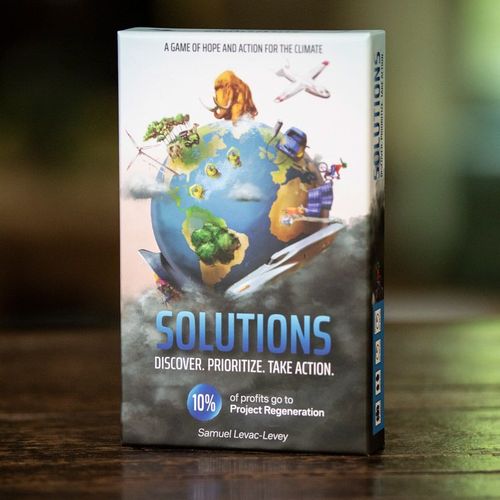
Solutions
Solutions Rulebook
Table of Contents
Table of Contents
Components
We provide
- Reversible Game board (1). Flip it over to play Short Mode.
- Solution cards (76). Play Solution cards to decrease the global temperature. Careful not to flip them over to reveal the ranking prematurely!
- Silver cards (5). For advanced play. Silver cards are not ranked to avoid double counting. Play them on top of associated cards for a bonus.
- Gold cards (13). For advanced play. Gold cards are high-risk, high reward solutions. Spend Research Points to play them for a shot at a lucky break.
- Feedback Loop cards (12). As the world warms, you may trigger dangerous feedback loops.
- Event cards (9). Draw an Event every round after the first round. Events can help or hurt you. Good luck!
- Blue Event cards (8). Shuffle these into the Events deck once you've reached the blue spaces on the time track.
- Reward cards (8). Reward cards are earned from certain Event cards. They can help counter the Feedback Loop cards and give you hope.
- Turn Summary cards (8). So you don't forget what to do!
- Year Marker (1). Marks your place on the year track of the board.
- Temperature Marker (1). Marks your place on the thermometer track of the board.
- Dice (1). Roll the dice when in a danger zone to determine whether you must draw a Feedback Loop card.
You provide
This game has been designed to minimize waste, so you will have to provide a few common supplies!
- 30 and 60 second timer, needed for some event cards. Your smart phone is fine, or search the internet for 'timer'.
- Pencil and paper, needed for one of the event cards.
Setup
(1) If you're not playing with Advanced Rules, remove the Silver and Gold cards, and remove the Reward cards 'Major Breakthrough' and 'Rushed Science.'
(2) Shuffle the Solution cards and deal 3 to each player, blue side down. Stack the remaining Solution cards blue side down near the game board. Note: The 'answers' to the cards are on the back, so don't flip the cards over! If a player accidentally sees the back of a card, shuffle it back into the deck and draw a new one.
(3) Shuffle and place all other decks face down near the game board. Leave room below the game board as the playing area.
(4) Choose the difficulty level and place the Year and Temperature markers in their respective spots. The details of each one are in the table below:2,3,4
| MED | HARD | X-HARD | |
|---|---|---|---|
| Starting year | 1990 | 2020 | 2030 |
| Starting temp | 0.5 ℃ | 1.0 ℃ | 1.4 ℃ |
| Temp increases by _ spaces each round | 3 | 3 | 4 |
| You can play max _ solutions per round | 4 | 5 | 6 |
| Start here if you're | a first timer | a climate pro | crazy |
Why these years?
Medium starts in 1990, when the IPCC released their first climate change report.1 'What if we had listened to climate scientists and taken immediate action?'
Hard starts in 2020 because this is the year referenced in Project Drawdown's research.
X-Hard: The world has failed to take decisive action before 2030. Let's not try this in real life!
Player order
You can determine the starting player by playing 'Coal, Solar, Wind' (ok you caught us, it's really just rock, paper scissors).
Gameplay
Every round of the game, global temperatures increase due to human activity. Players must propose climate solutions to keep temperatures down. However, some solutions can have more impact, globally, than others! The goal of the game is to inspire interesting conversations and critical thinking about climate solutions. The group will debate which solutions can have the most global impact in reducing climate change. Your goal is to rank the solutions in order from most to least impactful, according to Project Drawdown. After a lively discussion, flip the cards to see if you were right. If you were, the next player has a dangerous decision to make: if they propose another solution, they can further cool the planet, but they also run the risk of losing some of the progress of the round.
The Thermometer
(1) Your goal is to keep global temperatures at or below 1.5 ℃ by 2050.
(2) You lose the game if you let the global temperature rise above 2 ℃ by 2050 (it may rise above this as long as you bring it down by 2050). Between (1) and (2) is a partial win.
(3) Danger Zones. If, at the start of any round, global temperatures are in a 'danger zone' marked by the flaming dice, you must roll to see if you have triggered a Feedback Loop. If the dice lands on a number indicated by the board for that zone, you must draw a Feedback Loop card.
(4) If you reach the 5.0+ mark, you have broken the thermometer (see Game End).
Why these numbers?
(1) & (2) The 2015 Paris Agreement's central aim is to "strengthen the global response to the threat of climate change by keeping global temperature rise this century well below 2 ℃ above pre-industrial levels and to pursue efforts to limit the temperature increase even further to 1.5 ℃."5 However, many scientists estimate that an increase of 2 ℃ would be catastrophic.
(3) Danger Zones: As global temperature increases, it is more and more likely that the Earth will experience climate feedback loops. Feedback loops are dangerous events that trigger even more warming, contributing to a vicious cycle.
(4) Many estimates for the worst-case scenario for our fragile ecosystem are around 5 ℃. However, some estimates go much higher.
(5) The 2015 Paris Agreement is a non-binding pledge between countries to reduce emissions. It is estimated that even if countries meet their current emissions reduction pledges, emissions will continue to grow and peak by 2030, putting the world on a perilous path to 3-3.5 ℃.6
The Time Track
(1) Starting conditions for your difficulty level.
(2) On the blue spaces, you can now play 1 extra solution card for the rest of the game.
(3) Pick up 1 Reward card at the beginning of this turn only.
(4) On the last turn you may play infinite solution cards. Good luck.
(5) Do not play a round for 2050. Temperature still increases.
The printed time track diagram shows these markers for each difficulty level:
| Track marker | MED | HARD | X-HARD |
|---|---|---|---|
| Starting year | 1990 | 2020 | 2030 |
| Max cards per round (printed) | 2030: max 5 cards | 2037: max 6 cards | 2038: max 7 cards |
| Blue space (+1 extra solution card) | 2035 | 2040 | 2044 |
| Infinite solution cards | 2045 | 2047 | 2048 |
| Final year | 2050: +3 temp | 2050: +3 temp | 2050: +4 temp |
Temperature increase per round, as printed on the time track: MED +3 temp/round, max 4 cards; HARD +3 temp/round, max 5 cards; X-HARD +4 temp/round, max 6 cards.
Solution Card Details
(1) Solution Rank; 1 is the most impactful and 76 is the least impactful.
(2) The amount of CO2e that the solution can plausibly reduce between 2020-2050.
(3) A bar graph that helps give a sense of the global scale of the solution.
(4) A short explanation about why the solution is ranked as it is.
(5) Scan this QR code if you're interested in learning more about the solution.
(6) Some cards have hints on the front in italics.
Round Steps
Note: these steps are summarized in the 'Turn Summary' cards.
All players must always have 3 solution cards in their hand.
Quick tip: If turns are taking too long, set a timer on your phone.
Skip steps 1 & 2 for the first round.
1) Roll for Feedback Loop. If the global temperature is in one of the 3 Danger Zones, roll the dice. If you roll one of the numbers depicted on flaming dice, draw a Feedback Loop card and play it.
2) Draw an Event card. Draw an Event Card and perform any necessary actions. Events can help or hurt you. Event cards with a reward icon earn you a Reward card if the challenge is successfully completed. Shuffle the blue Events with the white ones once you reach the blue year spaces.
Action Phase
3a) Propose solution. The next player must propose one of their three solution cards. Read the text out loud and slide the solution to the middle of the playing area. Draw a Solution card so that you always have 3 in your hand. If this is the first solution of the round, the next player should propose another solution. Note: no one may help the player decide which card to propose!
The impact track is a guide. Propose more impactful solutions to the left and less impactful solutions to the right.
First proposed solution of the round.
Second solution can be proposed either to the left or to the right of the first solution. Place it halfway down to indicate that its position is still up for debate.
3b) Discuss. All players discuss how impactful the new solution is globally compared to the other solutions on the table.
3c) Vote. If there is disagreement, take a vote. Ties are broken by the player who proposed the solution.
3d) Reveal. Flip the unrevealed cards. If a solution was placed in the wrong order, the turn is over. Skip to Step 4.
3e) Continue/end round. If the solution was correctly placed, the next player can either pass their turn, or risk proposing another solution and repeat Step 3. The Action Phase ends if:
- a solution is revealed to be in the wrong order
- two players have passed their turn in a row
- OR the maximum number of solutions has been played.
3a #2) Propose. If the next player proposes another solution, repeat Step 3. The solution could also have been proposed in one of these spots.
3b,c,d #2) After discussion and voting for the new solution, flip the unrevealed card. Then repeat Step 3e).
4) Scoring. Reduce global temperature by the number of solutions successfully proposed. Incorrect cards cause a penalty of 1: discard another card that would have otherwise been successful.
Example from the diagram: two correct solutions reduce global temperature by 2 spaces. Rank #35 is in the wrong order, so it is discarded. Because #35 is a penalty, discard an extra card.
5) New year & increase temperature. Advance the year marker to the next space and increase the global temperature by the number of spaces based on the difficulty level you chose.
Game End
There are two ways the game can end:
1) Breaking the Global Temperature Thermometer
If, at any point during the game, the global temperature exceeds the top of the Thermometer, you have broken it. The world will experience runaway climate change if you do not act quickly. Your group has one more round to bring global temperature back down to the Catastrophic Limit (2.0 ℃). You must play the maximum number of cards (determined by the difficulty level and year).
If successful, move the temperature marker to the Catastrophic Limit (2.0 degrees). You do not need to increase temperature at the end of the year. Continue playing the next round as normal.
If unsuccessful, the world has experienced runaway climate change: you lose.
Note: If the global temperature exceeds the Thermometer by more than once space, simply treat it as one space. For example, if you pick an Event card where you need to decide to do an action OR increase temperature, you can increase temperature with no ill effects.
2) Surviving to the year 2050
Congratulations, you made it to the year 2050 without causing runaway climate change! However, the fate of millions of lives and species depend on how well you survived.
If global temperature is at or below 1.5 ℃, you win! The lower you kept the global temperature, the better. Next time, try and beat your "low score" or increase the difficulty level.
If global temperature is at or below the Catastrophic Limit (2.0 ℃), you have at least prevented widespread ecosystem collapse. Take this as a consolation prize, but try and do better next time.
If global temperature is above the Catastrophic Limit (2.0 ℃), please try again once you have found a new planet for humanity to live on.
Solution Map (optional)
As you progress through the game, we encourage you to make a map of the solutions you've played near the board, if you have the room. You can make two types of maps:
- In ranked order. This can help give you perspective on the solutions you've already played. (Left picture)
- By turn. Each row in the map is of one turn that you played, whether or not you got the order correct. (Right picture)
If you pick up an Event card that asks you to reshuffle the 'discard pile' and you don't want to lose your Solution Map, try this to pick your card: secretly roll the dice 2 times. The first roll indicates the row of the map, and the second indicates the column. Choose the last row/column available.
Advanced Rules
More about Wildcard Solutions
We suggest adding these cards on your second playthrough. Every standard solution card you play counts as 1 Research Point. You can spend Research Points at the start of any round to buy Silver or Gold cards.
These solutions are unranked, to avoid double counting their impacts. For example, Building Retrofitting involves other solutions such as Insulation and Dynamic Glass.
Wildcard Solution Cards (Silver)
There are 5 silver solution cards in the game that do not have a rank, and instead display "N/A" as the rank.
At the start of a round, you may spend 7 Research Points to draw the bottom Silver card from the deck. Set the card aside in view.
You may play a Silver card on top of an associated solution card that has been proposed but not yet revealed. For example, you may play Building Retrofitting on top of Insulation. The back of the silver card has a list of suggested associated solutions. However, you may play it on another solution if you can reasonably argue as to why they are associated.
When you flip the associated Solution card, if it has been placed in the wrong order, discard it without penalty. Whoever proposed the card must propose another one in its place. Discard the Silver card.
Coming Attraction Cards (Gold)
At the start of a round, you may spend 10 Research Points to draw the top 3 Gold cards. Pick one of them as a team and shuffle the other 2 back into the deck.
Flip the card to reveal its bonus. If you roll the amount indicated on the card, reduce Temperature by the indicated amount immediately.
Ex: For the Microbial Farming card, if you roll a 3, 4, 5, or 6, reduce Temperature by 1.
More about Coming Attractions
Coming Attractions are solutions that have the potential to be highly impactful, but the science isn't totally in yet. Some are still concepts. Others just haven't been quantified yet by the Drawdown team.
Short Mode
Short Mode is meant for classrooms with limited time, or to be played at social events as a "warm-up game." The only difference is that the number of turns are cut in half, so players will see much fewer solutions cards. Short mode takes approximately 30-45 minutes to play, however this varies depending on how long the group takes to discuss solutions. A group that decides quickly may be able to finish in 20 minutes or less, while a group that deliberates on every decision may take 60 minutes or more.
Solo Play
Solutions is best played with 2-8 players to encourage fun debates and collaboration. However, it can be fun and challenging to try and save the world all by yourself!
The rules of solo play are the same, except you may have 4 cards in your hand at all times, instead of 3. Instead of discussing the solutions with others, simply discuss it with yourself. You can even make up different voices in your head for different perspectives - we won't judge.
FAQ
Q: If an Event card tells me to draw a Feedback Loop card, do I still need to roll for a Feedback Loop card? A: Yes, if the temperature requires it.
Q: I'm beginning to memorize the solutions - is this a problem? A: That's amazing! It means the game is working. Feel free to bump up the difficulty level. If you ever feel like you've gotten too good at the game, we hope you pass the game along to someone new, or donate it to a local board game store or cafe, so others can learn about climate solutions as well.
Q: I disagree with a solution! A: All models are wrong, in one way or another: they are all based on assumptions. The most important things are that you're thinking critically and having great discussions! The solutions in Project Drawdown have been extensively researched by hundreds of scientists, who have attempted to account for every part of the lifecycle of every solution, and even the interactions between solutions. However, the rankings are based on a model and no model is perfect, no matter how good it is. If you disagree with a solution, we encourage you to follow the QR code on the card to the Drawdown website and explore in-depth how it was calculated. Different models are also possible with different assumptions. Drawdown itself has two different models for different scenarios on its website. Even more importantly, your actions can change the outcomes of these models! If one of these solutions inspires you to take action, hopefully your efforts can make that solution 'rank' even higher.
Q: Will these solutions become out of date? A: Project Drawdown updates their solutions every year or two. However, the rankings in the game represent the impact each solution can have between 2020-2050, and so should remain relevant in this context.
Q: On the Drawdown.org website, I see "Scenario 1" and "Scenario 2." What does this mean for the game? A: Drawdown modeled two different scenarios. Scenario 1 is the plausible scenario. It shows a path to keeping global temperatures from rising above 2 ℃ by 2050, which is the catastrophic limit set by the Paris Agreement. Scenario 1 will not be easy to achieve, but it is possible without a herculean effort. Scenario 2 is the optimum scenario. It pushes the Drawdown solution to their realistic limits - as if the whole world began collaborating swiftly and decisively on climate action. Scenario 2 shows a path to keeping global temperatures from rising above 1.5 ℃ by 2050, which is the "safe" limit set by the Paris Agreement. This game is based on Scenario 1.
Q: Does a low-ranked solution mean it's useless? A: No. We need all solutions in order to reach Drawdown and save our planet. The rankings in the game are global rankings. However, the way the solutions would be locally ranked in your area might be much different. For example, wind turbines are a great solution in windy areas, but not so much in less windy areas. Thus, a solution that has a low ranking in the game might still be highly impactful in your community! We encourage you to find the solution that can have the most impact in your community and try to implement it.
Q: Who decides if an Event card's challenge is achieved? Or if a Silver card is placed on an associated solution? A: You can decide this collectively. Use your best judgement. We trust you.
More Ways To Play
The Solutions Cards in this game are bite-sized, easily digestible snippets of the solutions presented in the Drawdown book and on the website, www.drawdown.org. This short and accessible format can be a valuable tool to educate and innovate around climate solutions. Here are some alternate ways in which you can use the cards:
Cue cards: Can't remember a solution? Unsure if one solution should be prioritized over another? Use the Solutions Cards for a quick refresher! If you need more information, don't forget to scan the QR code on each card.
Solutionstorming (great for innovation and design thinking workshops): Whether in a group or by yourself, assign each person or team 3 cards at random. Each person/team has 15 minutes to pick one and brainstorm as many solutions as possible. A friendly competition can ensue, for which team comes up with the most ideas. Don't worry about the quality of the ideas, for now just worry about quantity! Once this is done, give each team another 15 minutes to refine their list into a single idea that they will pitch in front of the group.
Climate Hackathons: There are several ways in which the Solutions Cards can be used at a climate hackathon.
- Assign each team 3 cards at random. The team must spend the weekend working on a climate idea related to one of the cards. Bonus points if they can combine 2 cards, or even all 3!
- Divide participants based on their interest in the Drawdown Sectors: Electricity, Food, Agriculture, and Land Use, Industry, Transportation, Buildings, Land Sinks, Ocean Sinks, Engineered Sinks, Health & Education. Give each team the cards relevant to their sector. Each team can brainstorm based on their sector and/or their cards. Large teams can be split into sub-teams based on the cards they're most interested in.
- Assign 1 card to each participant at random. Each participant has 1 hour to brainstorm problems and solutions based on that card. If, after 20 minutes, any participant is stuck, they may pick a new card, or swap with another participant. Willing participants may pitch their ideas to the group, to try and convince others to join them for the remainder of the weekend to work on a solution related to their card.
Climate Journalism: Assign each participant 3 cards at random. They have a set amount of time (minutes, hours or days, up to you) to research one of their cards in depth. Encourage participants to begin by scanning the QR codes on the cards to view Drawdown's full research. At the end, they will present their findings to the rest of the group.
Corporate Social Responsibility: Use the Solutions Cards to let your employees brainstorm about initiatives for the climate! You can use techniques from the above Solutionstorming and Climate Hackathons activities.
Deep Decarbonization Draft: Inspired by an episode of The Energy Gang podcast with Stephen Lacey and Shayle Kann, the Deep Decarbonization Draft is a battle of climate knowledge. Each player must collect a roster of 7 climate solutions to rule them all. Start by spreading out all 76 solution cards on the table (do not include the silver and gold cards). In turn order, choose one solution for your roster, and explain to the others why you think this is such a great choice for carbon reduction. Once all players have 7 cards in their roster, no more cards can be chosen. But be careful! Each player has one chance to steal a card from one of their opponents, swapping it with a card in their current roster. You do not need to steal a card if you don't want to. Once done, flip over your cards one at a time (for extra drama) to reveal your score. Your final score is calculated by adding up the gigatons of carbon reduced on all your cards. The winner gets the title of 'Best Carbon-based Life Form.'
Take Action
Once you're comfortable with the solutions in the game, we encourage you to pick your favorite solution and turn it into a real-world climate project. We encourage you to find a group to take action along with you.
Scan the QR code on your favorite solution to get started! Or visit: https://solutionsthegame.com/take-action/
If you're stuck choosing between multiple solutions, we recommend choosing something based on the Japanese concept of Ikigai, which roughly translates to 'a reason for being.' Find the intersection between what you love, what you're good at, what the world needs, and (optionally) what you can be paid for.
Glossary
Numbers on cards are abbreviated. M stands for million. B stands for billion. T stands for trillion.
GHG stands for Greenhouse Gas. GHGs such as carbon dioxide, methane, and nitrous oxide help trap heat in the atmosphere, like a blanket over the Earth. These gasses are naturally present in the atmosphere, and natural amounts are necessary for life to exist, however humans have emitted such large quantities of GHGs that the atmosphere is thrown out of balance, like throwing more and more blankets on the Earth, trapping too much heat and causing global warming.
CO2 stands for carbon dioxide, which is the GHG that contributes the most to global warming.
Methane is a GHG that is 86x more potent than CO2 in the short term, although it stays in the atmosphere for much less time. It is up to 34x more potent than CO2 in terms of global warming potential over a 100-year timeframe.
Nitrous oxide is up to 298x more potent than CO2 in terms of global warming potential over a 100-year timeframe.
CO2e stands for 'CO2 equivalent', which is a standard way to compare harmful greenhouse gases, compared to the most common greenhouse gas which is CO2. For example, methane is up to 34x worse than CO2 over 100 years.
GT stands for gigaton: a unit of weight equal to one billion metric tonnes.
kW stands for kilowatts. Watts are a unit of power. For reference, a traditional incandescent light bulb uses 60 watts of power. Modern LED lightbulbs can use 10 watts or less. 1 kW is equal to 1,000 watts.
TWh stands for terrawatt-hours. Watt-hours (Wh) are a unit of energy. 1 kWh is equal to 1,000 Wh. 1 TWh is equal to 1,000,000,000,000 Wh. For reference, a typical household in the USA consumes 10,649 kWh.7
Hectares are a unit of surface area. 1 hectare is equal to 2.47 acres or 0.01 square kilometer. For reference, there are over 51,000,000,000 hectares of surface area on Earth, less than 30% of which is covered by land.8
Tonnes are a unit of mass, also known as a metric ton. 1 tonne is equal to 1,000 kilograms or 2,204.6 pounds.
km stands for kilometer, a unit of length. 1 km is equal to 1,000 meters, or 0.62 miles.
t-km stands for tonne-kilometer. It's used for freight to show how far a tonne of goods has been transported.
Sources
Project Drawdown has calculated The amount of CO2e that the solution can plausibly reduce between 2020-2050, measured in Gigatons (GT). To make this more tangible, we have converted this number into the weight of the Great Wall of China: the heaviest human-made object ever built. To give some context:
| African Elephants | Blue whales | Empire State Buildings | Great Walls of China | |
|---|---|---|---|---|
| Reference - 1 GT | 150,000,000 | 9,000,000 | 3,020 | 19 |
| Solution #1 - 87.45 GT | 12,900,000,000 | 837,000,000 | 264,000 | 1,663 |
| Solution #76 - 0.09 GT | 13,000,000 | 861,000 | 272 | 1.7 |
A visualization of the most and least impactful Drawdown solutions. The areas of the circles represent the amount of CO2e that each solution could plausibly reduce between 2020-2050.
Footnotes as printed:
- Although the first calculation of the greenhouse effect was in 1896, it was widely debated at the time, and even the author thought it might be good for humanity. Scientific opinion tended to converge on global warming in the late 1970's, and consensus built throughout the 1980's. The IPCC's first assessment report came out in 1990. Detailed timeline here.
- The AMPERE database assumes 1980-1999 temperatures were 0.52 °C higher than preindustrial levels
- https://www.ncdc.noaa.gov/sotc/global/202013
- From the AMPERE database
- https://unfccc.int/process-and-meetings/the-paris-agreement/what-is-the-paris-agreement
- https://www.nationalgeographic.com/environment/2019/03/climate-change-model-warns-of-difficult-future/
- https://www.eia.gov/tools/faqs/faq.php?id=97&t=3
- https://www.weforum.org/agenda/2021/01/earth-surface-ocean-visualization-science-countries-russia-canada-china/
Tips & Prompts
- Solutions are implemented between 2020-2050. If the solution is already ubiquitous in 2020, then there is little progress to be made.
- The Drawdown solutions are modeled to be optimistic, but plausible. They will not be easy to achieve, but it is possible without a herculean effort.
- No major technological breakthroughs are needed. All solutions in the game use present-day (2020) technology that improves conservatively over time.
- Think globally! How would different regions use this solution?
- Will the cost of the solution affect adoption?
- Will population growth affect demand for the solution? Keep in mind that as global population increases, so does demand for electricity, transportation, etc. Thus, adoption of a solution can increase while still decreasing percentage-wise, relative to other solutions.
- How might other solutions affect this one? For example, if better insulation is used, there might be less demand for heating and cooling.
Example: the "Rooftop Solar" solution is not about how much impact would be made if every single person had solar panels on their roofs. It is about how many people can realistically put solar panels on their roofs, and how many emissions would this displace between 2020-2050.
Closing Note
Thank you for playing! We hope that Solutions has inspired lively, thoughtful and hopeful conversations for you.
This rulebook is still a work in progress, as we prepare to launch on Kickstarter in June 2021. We would greatly appreciate your feedback! For questions, comments, or feedback, please email us at [email protected] (the publisher's contact line, kept as printed).
We invite you to sign up to our mailing list at www.solutionsthegame.com. This will notify you when we launch on Kickstarter! Sharing this game with others could make a world of difference.