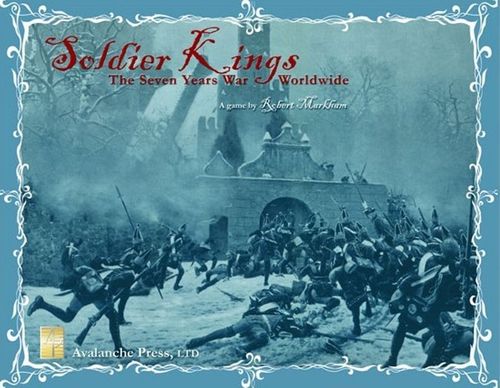
Soldier Kings: The Seven Years War Worldwide
Soldier Kings: The Seven Years War Worldwide Rulebook
Table of Contents
Table of Contents
Game Components
The game board is a map of the world at the time of the Seven Years War. Each land area has three symbols: coins, soldiers and towers. The number of coins equals the area's Money value, the soldiers its Manpower value, and the towers its Fortification value.
Most playing pieces in Soldier Kings are armies, fleets, generals and admirals:
- The first number on each army and fleet counter is its attack strength, and the second is its defense strength. The other counters keep track of players' Money and Manpower plus some events caused by event cards.
Each player gets five event cards each winter turn, and he or she can play them whenever desired in the following year. Event cards hurt your enemies or help you.
Starting a Game
Players start by choosing a scenario and which countries they want to play. Each player notes his starting Money and Manpower and randomly draws the starting armies, fleets and leaders he gets, placing them on the map in areas color-coded for their home country. Each player then gets five event cards, and all players take a ten-minute diplomacy phase to trade cards, Money and Manpower, and make alliances.
Campaign Turns
All spring through fall turns are campaign turns. Players start each campaign turn by paying Money and Manpower to buy new armies and fleets and repair old ones. Newly-bought armies and fleets go on the turn record track and are received in future turns.
Players then roll two dice each for initiative (Prussia can modify her roll by +2 or –2 if Frederick II is in play). The initiative markers go on the initiative track in dieroll order (higher rolls first).
Players then take turns in initiative order, with allies going at the same time if desired. A player taking his turn (called "the active player") first moves and fights with his fleets and then with his armies, and finally besieges enemy areas.
Armies move from land area to land area along the connecting lines. Fleets move from sea area to adjacent sea area, and/or into coastal land areas with the port (anchor) symbol. Armies can also load onto fleets for transport overseas. Fleets can move into three areas per turn. Armies can move into one land area per turn, except for those stacked with leaders which can enter two areas per turn. Prussian armies with Frederick II can enter three areas per turn.
Areas controlled by one's own country or allied countries count as only _ area each for movement purposes. If armies move into an enemy-occupied land area, they have to stop and can attack the enemy units if desired. If the enemy units don't want to fight, they can retreat before combat into any adjacent land area they control.
Note: in the printed sheet the number of areas is shown as a blank glyph ("only _ area"). The intended figure could not be read from the source and is reproduced as printed; consult the full rulebook if available.
Battles
Whenever enemy fleets are in the same sea area, any player with fleets there can roll two dice to intercept enemy fleets. Add to the dieroll the number of enemy fleets being intercepted plus the leadership rating of any admiral with the intercepting fleets, and subtract the leadership rating of any admiral with the fleets being intercepted. On a modified dieroll of 10 or more the interception is successful and the involved fleets must fight at least one naval combat round.
Attacking at sea doesn't cost Money, but attacking on land does (more money for more combat rounds). The active player pays before attacking. In each combat round, each player rolls a number of dice equal to the total combat strengths of all his units in the battle area (except for armies loaded on fleets at sea), plus the leadership ratings of any leaders he has there. Every "6" rolled is a hit.
The owning player allocates hits among his units as desired. Any unit that takes enough hits to equal its defense strength flips to its back side, and must retreat out of the battle area to an adjacent area. Eliminate all units that are already on their back sides and take hits equal to their defense rating, and all armies that have to retreat but don't have a friendly-controlled adjacent land area to retreat to. Surviving units in the battle area can stay and fight any more rounds that have been paid for, or they can retreat as above to avoid further combat.
Sieges
Armies and fleets of the active player that occupy enemy-controlled areas can besiege them if no enemy armies are there after all land combat is done. Siege is just like combat, with the player being besieged rolling dice equal to the fortification value of the area. Each hit scored by the besiegers eliminates one point of fortification value. If the besiegers eliminate all of the area's fortification points, the active player takes control of it and places a control marker there.
Siege ends the active player's turn, and the other players then take turns in initiative order until they're done. The campaign turn ends with any players that wish to surrender to an enemy player doing so (trading land for peace).
Winter Turns
Each winter turn starts with players flipping or eliminating armies in each area with more enemy armies than the money value of the area. Players then pay to maintain their armies and fleets on the board, flipping or eliminating unpaid-for units.
Then, each player adds up the Money values of the areas he's conquered and subtracts the Money values of any of his own home areas that enemy players have conquered, to arrive at his victory point total for the year. If his victory point total exceeds his Automatic Victory level, he wins the game immediately!
If nobody wins, then players get more Money and Manpower equal to the Money and Manpower values of all areas they control, discard their event cards and draw new ones, and take another Diplomacy Phase before starting the next spring turn.
Winning the Game
The game continues until someone scores an Automatic Victory or the last turn of the game ends. If nobody ever scores an Automatic Victory, the player whose victory point total is closest to his Automatic Victory level at game end wins the game.
That's it! You're ready play Soldier Kings. Enjoy!
(The closing line is printed as "You're ready play Soldier Kings"; the word "to" appears to be missing from the source and is reproduced as printed.)
Optional Rules: 22.0 Supply
Designer's note (Doug McNair): These rules worked well in playtesting Soldier Kings, but added an extra page of rules, a little extra playing time (for counting spaces to supply sources each turn), and were slightly redundant with other rules, so I ended up not including them. But players who want maximum realism will definitely want them. They work fine with Soldier Emperor and Soldier Raj as well (which is why I've numbered the section 22 rather than 21).
Fleets carry all the supplies they need. Armies, on the other hand, need constant access to supplies (food, ammunition, etc.) in order to function. Armies being transported on fleets are supplied as long as they remain loaded on the fleets. But armies on dry land get their supplies from land areas controlled by their own country or allied countries. Such land areas are known as "supply sources."
To function normally, a given army must be close enough to one of its supply sources to trace a supply line to it at the start of its owning player's Action Phase. An army that can do this is "Supplied," meaning it can move and fight normally. An army that starts its action phase supplied stays that way for the whole current turn, no matter how far from its supply sources it moves during its action phase.
Any army that starts its action phase too far away from all of its supply sources to trace a supply line to even one of them is "Out of Supply," and must move toward one of its supply sources this action phase.
22.1 Supply Lines
Any army that occupies one of its supply sources at the start of its action phase is automatically supplied. Any army that doesn't occupy one of its supply sources at the start of its player's action phase must be close enough to one of its supply sources to trace a supply line there to avoid being out of supply. Each army's supply line can extend no farther than the army could move by land this turn. Therefore, the maximum distance in land areas that an army can be from its nearest supply source and still be supplied is:
- Armies uncontrolled by leaders: 1
- Armies controlled by leaders other than Frederick: 2
- Armies controlled by Frederick: 3
22.2 Tracing Supply Lines
At the start of his action phase, each player should count the movement distance in land areas between each of his armies and any of his supply sources. Each army that could potentially move to any one of its supply sources this turn via land movement has a supply line to that supply source, and is considered supplied. Each army that couldn't move to even one of its supply sources this turn (either due to distance or enemy armies being in the way) is out of supply. There is no negative effect on an army that starts its turn in supply.
22.3 Cutting Supply Lines
Armies can trace supply lines into but not through land areas occupied by enemy armies. Also, if a friendly-controlled or allied-controlled land area is occupied exclusively by one or more enemy armies or fleets at the start of a player's action phase, it cannot be used as a supply source. Armies and fleets can therefore potentially cut the supply lines of enemy armies by moving into unoccupied enemy supply sources, or by moving into areas through which enemy armies must trace their supply lines.
Example: Ile de France is a Supply Source for French and French-allied armies as long as it remains controlled by France and is not occupied exclusively by enemy armies or fleets. All French armies in Swabia or the Austrian Netherlands can use Ile de France as a supply source. French armies occupying Holland, Hesse and/or Wurtemburg can use Ile de France as a supply source if the armies are controlled by a leader. However, if enemy armies occupy Swabia, French armies controlled by a leader in Wurtemburg cannot trace a supply line through Swabia, and will be cut off from supply unless they can trace a supply line to another supply source within two land areas of Wurtemburg.
22.4 Seaborne Supply
Armies may get their supplies from friendly or allied fleets that occupy coastal areas. If a fleet occupies a coastal area that is also occupied by friendly armies, the fleet acts as a Supply Source to all armies in the area that are friendly or allied to the player owning the fleet. This is how units conducting an Amphibious Assault (see 12.0) stay supplied.
In addition, if a fleet occupies any coastal area (even an enemy-controlled coastal area) that is not occupied by any enemy units, that coastal area acts as a temporary Supply Source for any armies that are within range and are friendly or allied to the player owning the fleet. This continues until the fleet leaves the area or enemy units enter the area.
22.5 Effects of Being Out of Supply
Any army that is out of supply at the start of its owning player's action phase must vacate the area it occupies and move at its maximum movement rate toward its nearest supply source. If it reaches a supply source it must stop there and move no further this turn. If not, it must move to or as close as possible to a land area from which it could trace a supply line to a supply source. Movement toward the target land area must be via the shortest route possible in total areas moved. This may force cut-off armies to move into land areas occupied by enemy armies, and in this case they must stop moving per the land movement rules. If no such supply source exists on the land mass where the armies are located, they must stay in the area where they're located and besiege it. If they fail to take control of it and thereby turn it into a supply source, they may suffer Attrition during subsequent Winter turns if there are too many of them for the enemy-controlled area to support.
If all of a given country's armies are forced to vacate an area due to being out of supply, remove any control marker belonging to that country from the area.