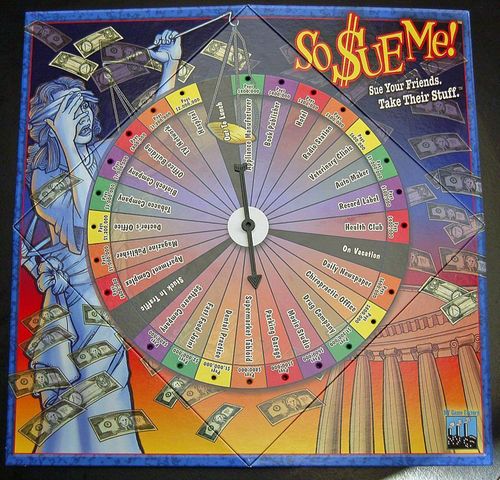
So Sue Me!
So Sue Me! Rulebook
Table of Contents
Table of Contents
Quick Rules
Every player starts So Sue Me!™ with $3 Million (5 bills of $500,000, 3 bills of $100,000, and 4 bills of $50,000).
On each turn, you have a choice: spin the spinner or roll the die.
- Spinning. You spin to acquire properties that will earn you income or to make money suing your friends. If you spin and land on an unowned property, you don't have to pay for it – just stake your claim by planting one of your pegs there if you want it, or pass. The board displays the amount of income the property pays, with riskier properties paying more. When you land on a business you already own, you earn income: the bank pays you the amount printed on the board. If you spin and land on someone else's stuff, you can sue the owner if you can afford the legal fee. If you're "Stuck in Traffic," "On Vacation," or "Out to Lunch," you do nothing. But remember, you must be in it to win it: you must own at least 2 properties to sue (3 properties in a 2- or 3-person game). If you own 10 or more properties, you collect double income.
- Rolling. If you roll the die, 1 to 4 earns you an Unfair Advantage™ card, which you hold to defend yourself against lawsuits. Keep the card face down so your opponents don't know what you have. You may hold up to three Unfair Advantage™ cards. If you already have three and you roll 1 to 4, you can try to get a better one by putting one of your Unfair Advantage™ cards at the bottom of the deck and then drawing the top one. If you roll 5-10, draw a Fortune card, which you must immediately reveal. Fortune cards usually describe something that happens to you, like earning a bonus or falling victim to identity theft – you immediately get money from or give it to the bank. Some Fortune cards give you a chance to buy insurance against lawsuits, or to sue anyone "just because!"
Every property has a color. The 5 colors each stand for a kind of lawsuit, symbolized on the Lawsuit™ cards by a particular character. Red = personal injury or "Ambulance Chaser", purple = theft of ideas or "CopyRat", orange = slander/libel or "Loudmouth!", yellow = medical malpractice or "Quack! Quack!", and green = product liability or "Bad Goods." When you land on another player's property, you may sue the owner. Let's say it's a red property, like the Office Building. Pick up the red "Ambulance Chaser" deck. Thumb through the deck until you find the first card for that property – the first card reading "Office Building" – then draw that card for your lawsuit. There are four cards for each business. You must reveal the front of your Lawsuit™ card, which shows how much you're suing for and the amount of your legal fee. But keep the back hidden! It shows your "win range" or odds of winning the suit. Cards that look the same on the front have different odds on the back – which lets you bluff about whether you have a good card or not.
To sue, first decide how much to sue for. The bigger the lawsuit, the higher the legal fee and the lower the odds of winning – you have to decide if you want to take a chance on winning more or play it safe. Announce how much you're suing for and pay your legal fee to the bank (you may also pass, and if you don't have the fee, you must pass). After you've paid, the defendant may offer you a settlement – which you may negotiate and accept or reject. If there's no settlement, you go to trial: roll the die, then reveal the back of the card – it shows if you win or lose. If you win, the defendant must pay you the amount you sued for. If he doesn't have it, you get all his money and the property you're suing; the defendant is then bankrupt! If you lose, you don't collect the money you sued for – but if you lose a "Potentially Frivolous" lawsuit, you must pay the penalty shown on the card to the defendant. Win or lose, you don't get your legal fee back.
The defendant can play one Unfair Advantage™ card before the die is rolled – it should be placed on the board face down, and after the trial it is turned face up. An Unfair Advantage™ card can reduce the amount won or allow the defendant to countersue. It can even change the odds of winning, by reducing the win range. So if you play a Lawsuit™ card that says "Win if you roll 1 to 6" and the defendant's Unfair Advantage™ card says "reduce win range by 2" – you win only on 1 to 4. That can really hurt! An Unfair Advantage™ card can even get a "Case Dismissed," which means the plaintiff loses no matter what he rolls. After the trial the Unfair Advantage™ card is replaced on the bottom of the deck regardless of the outcome.
If you go bankrupt, you have one chance to get back in the game. You are protected and can't be sued – but you also can't sue, even though you can still acquire properties. If you land on your own stuff, though, you only get half the income you would otherwise have received. You can make money from Fortune cards, but you don't have to pay on Fortune cards where you would lose money. But the best way to get out of bankruptcy is to work as a lawyer! Market your services to other players who are suing. If they hire you for a trial, you roll the die for them – not once but twice, which makes them much more likely to win. If they win on either roll, they must pay you $200K. Once you reach $1 million in cash, you must return to the game as a full player. If you go bankrupt twice, you're out of the game, and the suing player gets all your stuff (but if you went bankrupt on a bad Fortune card, all your stuff goes to the bank). Last player standing when everyone else is bankrupt or out of the game wins!
Suing your friends and taking their stuff is as easy as that. See below for Complete Rules and also for a short game version. Hint: any and all side-deals are permitted – you can sell or trade properties, Unfair Advantage™ cards, and insurance, and even help other players gang up on a property owner. All's fair in love, war, and lawsuits!
Complete Rules
The object of the game is to become the richest player by suing other players and by collecting income. The winner is the last player left when all the others are bankrupt or out of the game. In the timed game (below), the winner is simply the richest player when time is up.
Equipment
Game board with spinner, one 10-sided die numbered from 1 to 10, colored pegs, Lawsuit™ cards, Unfair Advantage™ cards, Fortune cards, and So Sue Me!™ money.
Preparation
Shuffle the Unfair Advantage™ and Fortune cards. Each player chooses a set of colored tokens.
Banker
Choose one player as Banker. The Banker must keep his personal money separate from the Bank's, and is responsible for collecting money from players for deposit in the bank as well as distributing money from the bank to the players.
The Bank
The Bank pays bonuses and collects losses. It also collects legal fees and pays income. At the start of play, each player receives $3,000,000 from the Bank: five $500K bills, three $100K bills, and four $50K bills.
The Play
Each player rolls the die. The player with the highest number starts, and play continues clockwise. When it's your turn, you have a choice:
- EITHER spin the spinner to try to get properties, earn income, and sue other players,
- OR roll the die to draw a Fortune or Unfair Advantage™ card.
If you spin, there are several things that can happen, depending where the spinner lands. The circle on the board shows properties, such as a Software Company or Hospital. If you spin the spinner and it points to an asset that does not have a peg next to it, it is unowned, and you may claim it by planting one of your pegs in the hole. If someone else's peg is on the property, it belongs to that player – you may then sue him or her. If you land on your own asset, you collect income. If you are "Stuck in Traffic," "On Vacation," or "Out to Lunch," you do nothing.
If you decide to draw a card, roll the die instead of spinning. If you roll 1 to 4, take an Unfair Advantage™ card; 5 through 10, take a Fortune card. You may hold no more than 3 Unfair Advantage™ cards at any one time, but if you've reached the limit and roll another 1 through 4, you may replace any one of your Unfair Advantage™ cards by putting it at the bottom of the deck and then drawing the next card without looking at it first.
Collecting Income
Owning properties can earn you money. If it's your turn and the spinner lands on something you own, you collect the amount of money indicated on the board. For example, if you land on your Dental Practice, you collect $1 million. Once you have acquired ten assets, you collect double income. So the more you own, the more income you can earn.
Suing
When you land on another player's stuff, you may sue that player if you have two properties of your own (you must have three properties if it's a two- or three-player game). If you win, you can take that player's money and, if he or she goes bankrupt, even seize the asset you're suing (see Bankruptcy, below).
There are five types of lawsuit, indicated by color:
- Red = "Ambulance Chaser" (Personal Injury)
- Green = "Bad Goods" (Product Liability)
- Yellow = "Quack! Quack!" (Medical Malpractice)
- Orange = "Loudmouth!" (Slander/Libel)
- Purple = "CopyRat" (Theft of Intellectual Property)
The color of the property tells you what kind of lawsuit to file. For example, if you land on someone's Parking Garage, you may sue him because you got hurt on his property, so you play a red "Ambulance Chaser" Lawsuit™ card. If you land on someone's Magazine Publisher, you may sue him for Slander/Libel because the magazine printed something nasty about you and damaged your good reputation, so you play an orange "Loudmouth!" Lawsuit™ card.
To file a lawsuit against another player, take the appropriate colored deck of Lawsuit™ cards and thumb through them until you find the first card for the property you're suing. For example, if you're suing the Record Label, find the first "Record Label" card in the purple "CopyRat" deck. On the front of the card you'll see the amounts you can sue for. On the back you'll find the odds of winning each amount. For example, if the back says "$2 million: Win 1-5," you win $2 million if you roll 1, 2, 3, 4, or 5. Roll a higher number and you lose the suit. The more you sue for, the lower your odds of winning. Choose the amount you want to sue for, and make sure the defendant can't see your odds on the back of the card. Remember that once you've decided, you cannot change the amount of the suit. If you don't want to sue, you may pass by returning your Lawsuit™ card to the bottom of the deck.
Legal Fees
When you're ready to sue, announce to the defendant how much you're suing him for. The front of the card shows the legal fee for your suit, which you must immediately pay to the bank. If you can't afford the legal fee, you must pass.
Settlement
The defendant may offer to settle with you after you've paid your legal fee. The settlement may be any combination of money and stuff, including Unfair Advantage™ cards, and is open to negotiation. If a settlement is reached, the defendant makes good on the offer and the settled Lawsuit™ card goes to the bottom of the pile face up. If there is no settlement, you immediately go to court!
Going to Court
To hold a trial, roll the die to determine the outcome using the table on the back of the Lawsuit™ card. If you win, the defendant must give you the money you sued him for. If your opponent doesn't have enough money to pay the judgment, he is declared bankrupt (see Bankruptcy, below). If you lose, you get no money, but you pay nothing extra unless the lawsuit is "Potentially Frivolous" (see Frivolous Lawsuits, below). Win or lose, you do not recover your legal fee.
If the defendant is already bankrupt when you land on his property, no lawsuit can be filed.
Frivolous Lawsuits
In real life, anyone can sue anyone for anything, no matter how silly! But in So Sue Me!™, there are consequences for losing a frivolous lawsuit. Many lawsuits are marked "Potentially Frivolous" on the back of the Lawsuit™ card. Winning a potentially frivolous lawsuit is the same as winning an ordinary one. But if you go to court and lose, then your lawsuit is declared frivolous by the court and you must immediately pay the "Frivolous Lawsuit Penalty" on the back of the card to the defendant. This includes losing through a "Case Dismissed" card. If you are unable to pay the Frivolous Lawsuit Penalty, you are declared bankrupt. Considering the risk, it might be a good idea to settle these cases out of court… But hey – it's your money!
Fortune Cards
Usually when you draw a Fortune card, you immediately get or lose money as described on the card, then replace the card at the bottom of the deck. There are two exceptions:
- Insurance. Some Fortune cards allow you to purchase insurance, and the card itself serves as your "policy," which is held until needed. Insurance may only be used for lawsuits of a particular kind. For example, Medical Malpractice insurance will only protect you when one of your yellow, or "Quack, Quack!," properties is sued. Insurance cards allow you to avoid payment when you lose a trial; the bank – not you – pays the judgment to the plaintiff! But an insurance card may only be played once, so use it carefully. Once it has been played, it must be replaced at the bottom of the Fortune deck.
- Sue Anyone, Just Because! Some Fortune cards allow you to sue anyone, for no particular reason. Just choose the player you want to sue – for the amount indicated on the card – and roll the die. Settlements are allowed when "suing anyone," but lawyers and Unfair Advantage™ cards are not. Also, there is no legal fee. If a player cannot pay a judgment in a "sue anyone" trial, he is declared bankrupt just as in any other lawsuit.
Unfair Advantage™ Cards
If you draw an Unfair Advantage™ card, you keep it for future use; do not show it to the other players. Unfair Advantage™ cards can help you swing the outcome of a trial in your favor. You don't need to play an Unfair Advantage™ card until it's clear that there will be no settlement and that you're going to trial. Then when you decide to play one, place it on the board before the die is rolled. After the die is rolled, turn the Unfair Advantage™ card face up to reveal its effect on the trial.
For example, you might have an Unfair Advantage™ card that says "Judge Presides after 3 Martini Lunch; Reduce Award by 50%." You decide to play this card in a trial against you for $1 million. If you lose, you only have to pay the plaintiff $500,000.
Or, your Unfair Advantage™ card could say "Decrease plaintiff's win range by 2." Then if the lawsuit filed against you says "$3 million, Win: 1-6," it will be judged as if it said "Win 1-4," so 1, 2, 3 and 4 will be winning rolls, but 5 and 6 will not.
No matter who wins, after the trial you must place the Unfair Advantage™ card you played face down at the bottom of the deck. You may play only one Unfair Advantage™ card per trial, and you must make it clear which card you are playing before the die is rolled.
Bankruptcy
If you owe money from a lawsuit, Fortune card, or anything else that you can't pay in full, you are declared bankrupt. Fortunately, in this game you get a second chance!
-
First Bankruptcy. If you are driven into bankruptcy by a player suing one of your properties, you must give all your cash, as well as the property that was sued, to your opponent, who must take the property! If your opponent has bankrupted you with a "Sue Anyone" or "Countersuit" card, or you owe him a Frivolous Lawsuit Penalty, he gets all your cash, but no property is forfeited. If you go bankrupt through a bad Fortune card, all your cash goes to the bank, and you keep all your other stuff.
While bankrupt, you continue to play. You can't be sued, but you also may not sue (including with a "Sue Anyone" card). If your turn requires you to pay, you are excused from that obligation, but if you draw cards that give you money, you collect the money. You also collect income, but only half the amount you would otherwise collect. You may purchase insurance at full price while you are bankrupt.
In addition to drawing good Fortune cards and collecting half income on your assets, you may also earn money to get back in the game by selling your stuff or by working as a lawyer for other players (see Becoming a Lawyer, below). Once you acquire $1,000,000, you are out of bankruptcy and must immediately return to the game as a full player.
-
Second Bankruptcy. If you go bankrupt a second time, you're out of the game. If it happens because of a debt to another player (whether through a Lawsuit, Countersuit or Frivolous Lawsuit Penalty), that player gets all your properties, replacing all your pegs with his own. Your opponent also gets your Unfair Advantage™ cards and any insurance you are holding; in other words, the winner in this case gets all your stuff! Note that the three card maximum on Unfair Advantage™ cards still applies: if acquiring your Unfair Advantage™ cards puts your opponent above the limit, he must discard any cards (of his choice) in excess of three.
If your second bankruptcy is the result of a Fortune card, your assets and cash return to the bank, and Unfair Advantage™ and insurance cards get returned to their decks.
Becoming a Lawyer
One of the best ways for a bankrupt player to get back in the game is to become a lawyer. When a lawsuit comes up for trial, the plaintiff can ask you if you'll be his lawyer (hint: say "yes" – once you're a lawyer, you can only go up from there). You'll roll the die for him – not once, as in a trial without lawyers, but twice. If the plaintiff wins on EITHER throw, you get $200,000 of the money he wins. Of course, if your client loses on BOTH throws, or if the suit is settled, you get nothing. You can never win assets when you're a lawyer, but you can always take the next lawsuit someone throws your way – that's what being a lawyer is all about! (someone's got to do it…) Remember: only one lawyer per lawsuit, and only the person suing may hire a lawyer – the defendant has "unfair advantages," after all. When you accumulate $1,000,000, you must resume regular play; you may not continue as a lawyer.
Note: When you become a lawyer, it's considered perfectly good etiquette for your friends to point at you and make that L-sign with their thumb and forefinger. Don't be insulted: it stands for "lawyer" – not "loser."
One-Hour Game Version
Play stops after one hour. At that point, add up your cash, with each property you own worth $500,000. Unfair Advantage™ and insurance cards have no value. The richest player wins.
Setup
Spinner: Attach to game board by pushing spinner base up through board and snapping arrow onto base.
Lawsuit cards: Place each colored group of cards in slot provided in tray.
Pegs: Remove from bags and store each color in space provided in tray.
Shuffle Fortune and Unfair Advantage™ cards before play.
Questions? Visit www.sosuemegame.com