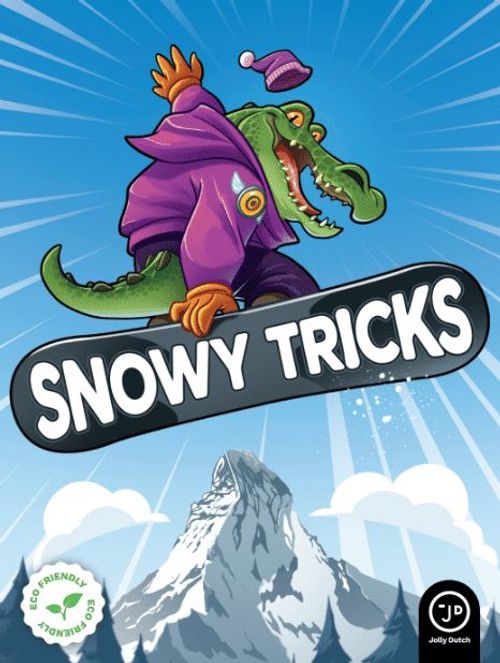
Snowy Tricks
Snowy Tricks Rulebook
Table of Contents
Table of Contents
Components
- 19 Prize Cards (4 different categories)
- 30 Instructor Cards (5 sets of 6)
- 1 Trump Card
- 55 Student Cards (5 sets of 11)
- 4 Special Student Cards (2 worst and 2 best students)
- 1 Bonus Point Overview Card
Goal of the Game
Score the most points by winning prizes. By winning or losing tricks, you collect cards to claim these prizes. Once an instructor has earned six prizes, the game ends and the final scores are tallied.
Game Setup
(Playing with 2 players? See the instructions at the end.)
- Each player chooses one instructor and takes the 6 corresponding Instructor Cards. Return any remaining Instructor Cards to the box.
- Sort the prize cards into their three categories and randomly draw one card from each category. Place these three prize cards in a row within reach of all players. The stars on the cards indicate the difficulty of the goal. You can also choose three cards yourself to adjust the game's difficulty.
- Place the Trump Card and the Prediction Prize next to the row of Prize Cards on the table.
- Take the appropriate Student Cards:
- 2 players: pink, yellow, and green
- 3 players: pink, yellow, green and blue
- 4 players: all colors
- 5 players: all colors
- Add the 4 Special Student Cards and shuffle all student cards into a face-down deck.
Quick Overview
Snowy Tricks is a trick-taking game (see Trick-Taking Game below) played over multiple rounds. In each round, players try to win the right tricks to collect cards.
At the end of the round, players check which prizes they have earned based on the cards they've won. All players place their Instructor Cards on the prizes they have claimed. Once one or more players have placed six Instructor Cards, the game ends and points are counted.
What is a Trick-Taking Game
In a trick-taking game, players play cards from their hand over a series of 'tricks'. A trick consists of one card from each player. The player who leads the trick plays the first card and determines the color to follow. Players must always follow the leading color if they can. For example, if the trick is led with a purple card, the other players must play a purple card from their hand. If they don't have one, they may play any color. The highest card in the leading color wins the trick. The winner takes all cards, places them on their personal score pile, and leads the next trick.
In Snowy Tricks, there is also a trump color. Trump is the strongest color and beats even the leading color. You can only play a trump card if you don't have a card in the leading color. If multiple trump cards are played in a trick, the highest trump wins. Players may also lead with a trump color. The trump color is determined anew at the start of each round (Phase 1).
Playing a Round
A round consists of three phases:
- Phase 1: Prepare and Predict
- Phase 2: Play Tricks
- Phase 3: Win Prizes
Phase 1: Prepare and Predict
Prepare: One player deals each player a number of Student Cards depending on the number of players (see table). Draw one additional card from the remaining Student Cards and place it face-up on the Trump Card. The color of this card determines the trump color for this round. Set aside the cards that were not dealt.
Hand size per player count:
| Players | 2 | 3 | 4 | 5 |
|---|---|---|---|---|
| Cards | 14 | 12 | 12 | 10 |
Predict: One of the prizes involves correctly predicting the number of tricks you will win this round. On the count of three, all players who wish to predict may place a Student Card from their hand face-down under their own pile of Instructor Cards. The number on this Student Card is the number of tricks you must win to claim the "Prediction Prize."
Note: Making a prediction is optional, and you can no longer use this student card during this round.
Phase 2: Play Tricks
The player to the left of the dealer leads the first trick by playing a Student Card. Once every player has played a Student Card, the trick is complete. The player who wins the trick impresses the most as an instructor — students want lessons from that instructor! All played cards go face-down onto the winner's score pile. Make sure all players can clearly see how many tricks you have won.
The winner then leads the next trick by playing a new Student Card. Players continue in this way until all cards in hand have been played. Note: The last trick may contain fewer Student Cards due to predictions.
Phase 3: Win Prizes
After all cards have been played, players check which prizes they can claim with the cards in their score pile. Then, all players place an Instructor Card under each prize they have earned. You can claim multiple prizes in a round and place multiple Instructor Cards, but you cannot claim the same prize twice in a single round.
If the game is not over, start a new round at Phase 1. The player to the left of the current dealer becomes the new dealer.
Ending the Game and Scoring
The game ends as soon as one or more players have played their 6th Instructor Card. Players then add up the points from the prizes they have earned, plus any bonus points. The player with the most points is the best instructor of the season! In case of a tie, the tied players share the victory.
Prize Points
For each Instructor Card placed, you score the points shown on the corresponding prize card. The points are equal to the number of stars on the card.
Bonus Points
- Specialist: If you have 3 or more Instructor Cards under a single prize, you earn 5 bonus points.
- All-Rounder: If you have at least one Instructor Card under each of the 4 prizes (the three categories and the Prediction Prize), you earn 5 bonus points.
Special Student Cards
The Student Deck includes two special cards: the Best Student and the Worst Student. These cards have no color and can be played at any time. You do not have to follow color when playing one of these cards, even if you have a card of the required color in your hand.
- Best Student: Automatically wins the trick.
- Worst Student: Automatically loses the trick.
Predicting with a Special Card: You may use a special card when making a prediction. With the Worst Student, you predict that you will win no tricks. With the Best Student, you predict that you will win all tricks.
Exceptional Situations: If two identical special Student Cards are played in the same trick, both cards are discarded and the players who played them no longer participate in that trick.
You may lead a trick with a special card. In this case, the first colored Student Card played after it determines the color of the trick.
Adjustments for Two Players
The game is played the same way with the following modifications:
- Use all prize cards with the two-player icon (a pause-like double bar symbol). Shuffle these prize cards and place 2 of them face-up next to the Trump Cards and the Prediction Prize.
- Play with 5 Instructor Cards instead of 6.
- Play using the colors: pink, green, and yellow.
Prizes
Card captions as printed. Some cards carry small tables or symbols that vary with player count; the printed text only gives the captions below.
Prizes in Category 1
- Win 0 tricks
- Win 0 trump color cards
- Win 0 cards of 1 color
- Win exactly X tricks (depending on the playercount)
- Win the second-most / second-fewest tricks
Prizes in Category 2
- Win the same number of tricks as the player on your left
- Win fewer tricks than the player on your left
- Win more tricks than the player on your left
- Win the last trick
Prizes in Category 3
- Win a sequence of X cards (color doesn't matter)
- Win a sequence of X cards in the same color
- Win one number in each color
- Win an exact full house
- Win fewer or equal cards of color A than of color B (see symbol between the cards)
Printed value tables on the cards (as extracted from the PDF text; the layout against the card art is not fully legible): "Win exactly X tricks" by player count 2/3/4/5: 5/2/1/1; "Win a sequence of X cards" by player count 2/3/4/5: 8/6/5/5; "Win a sequence of X cards in the same color" by player count 2/3/4/5: 6/5/4/4. The full house and color A/B cards show their required card patterns graphically.