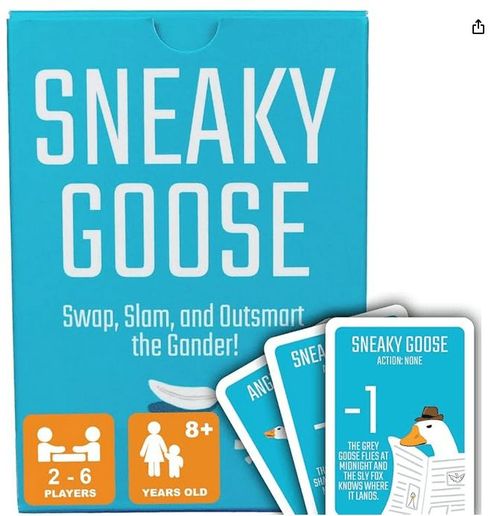
Sneaky Goose
Sneaky Goose Rulebook
Table of Contents
Table of Contents
The Basics
The Objective
The aim of the game is to have the lowest total score after playing 5 rounds.
Scoring
A player's total score is the sum of their round scores. A player's round score is the sum of the values on their cards at the end of the round.
Keep score with a pen and paper, or you can use the free online score tracker.
Cards and Actions
Some cards include actions that can be triggered when played. These cards are labeled with "Action:" followed by the description of the action. Cards without actions will say "Action: None".
During the game, you cannot look at your own or any other player's cards unless told to do so by an action.
Setting Up
Dealing
Deal each player 4 cards face down. Players arrange these cards in a 2x2 grid in front of them. Players must not look at any of their cards yet. Place the remaining cards face-down in the centre of the table to form the draw pile.
Peeking
Once all players have arranged their card grids, they may look at the two cards closest to them before the game starts. Players may only look at these cards once, then place them back into their card grid.
Starting the Game
Once everyone has peeked, play then begins with the player left of dealer and continues clockwise.
Slamming Cards
What is Slamming?
Slamming is when you place your hand on a card that you believe matches the card on top of the play pile. You may slam a card at any point in the game, even when it is not your turn (whoever's turn it is continues once the slam is resolved).
You may slam cards from any card grid, including your own.
Once you have touched a card with the intent to slam it, you must turn it over and reveal it.
What Constitutes a Match?
A "match" is when two cards have the same goose type, for example: "Magic Goose" is a goose type, so when you see a "Magic Goose" on the top of the play pile and know where another is, you may slam it.
Almost all geese of the same type have the same value. All Magic Geese have the value 12, for example. The only exception to this is Sneaky Goose. Some Sneaky Geese worth -1 and some are worth 13. Seeing as a match is only based on the goose type, you may slam a Sneaky Goose worth 13 when you see one worth -1 on the play pile and vice versa.
Slamming Outcomes
If the card is a match:
- Slammed your own card: Place the slammed card face-up on the play pile. Play with one fewer card.
- Slammed another player's card: Place the slammed card face-up on the play pile and give the player one of your face-down grid cards.
If the card is NOT a match:
- Slammed your own card: Return the slammed card to its original position. Draw a card and add it to your grid without looking at it.
- Slammed another player's card: Return the slammed card to its original position. Draw a card and add it to your grid without looking at it.
On Your Turn
1. Take a Card
Take the top card from either the face-down draw pile, or the face-up play pile.
If you chose the draw pile, you may choose to play the card, or swap it with a card in your grid. If you chose to draw from the play pile, you must swap the card with a card in your grid.
2. Play the Card
Place the card face-up onto the play pile. When playing a card with an action, you may choose to perform the action immediately after playing it onto the play pile.
2. Swap the Card
Select a card from your card grid (without looking at it first), turn it over and place it face-up on the play pile, then place the card you picked up face-down into the empty space in your card grid.
Honking and Scoring
Ending the Round
At the start of your turn, if you believe you have the lowest score or you have no cards remaining in your card grid, shout HONK to end the round. Once a player honks, all players must turn over their cards and add up the values to calculate their round score.
Honking Rewards and Penalties
- The Honker has the lowest score: Minus 10 points from the honker's round score.
- The Honker does NOT have the lowest score: Add 10 points to the honker's round score.
- The Honker and another player have the tied lowest score: Minus 5 points from the honker's round score.