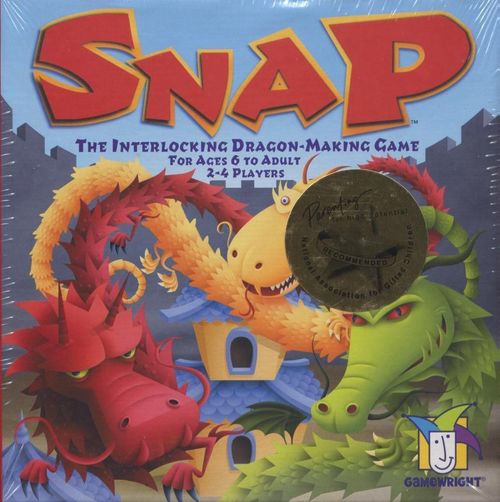
Snap: The Interlocking Dragon-Making Game
Snap: The Interlocking Dragon-Making Game Rulebook
Table of Contents
Table of Contents
Getting Started
Contents
- 36 Die-Cut Tiles
- 1 Scorepad
- 1 Pencil
You can play FOUR different games using the same tiles. For a great strategy game, play Snap. For younger players, try Double Snap or Dragon Parade. And for the ultimate solitaire challenge, try your best to conquer the Dragon King!
What's a Snap?
Before you play, it's important to know that a Snap is a connection between two or more tiles that fit together like a puzzle. Tiles can be snapped in multiple ways. In these directions a valid Snap is indicated by a white line showing the connection.
Example of Snaps:
- Side by side, one Snap.
- Side by side, two Snaps.
- End to end, one Snap.
- Side to end, one Snap.
Also, snapped tiles must match up color to color in all directions.
Valid Snaps: tiles snapped together with every connection matching in color.
Invalid Snap: colors do not line up.
Game 1. Snap
For 2 to 4 players. Ages 10 to Adult.
Object
The object of the game is to score the most points by completing dragons.
Setup
Pick a player to keep score. Shuffle the tiles and put them face down in a stack within reach of all players. Deal three tiles face down to each player. (Players look at their tiles but keep them hidden from others.) Turn over the top tile from the stack in the center of the playing area to start the game.
Game Play Overview
Youngest player goes first and play moves to the left. On your turn, select one tile from your hand and snap it to any tile in play. Tiles must fit snugly and match up color to color (see "What's a Snap?" on page one for valid moves). If you are able to complete a dragon, add up the points and write down your score. End your turn by drawing a new tile from the top of the stack to bring your hand back up to three.
Completing Dragons
Every time you are able to complete a dragon on your turn, you score points based on the length of the dragon. Completed dragons only count if they match in color and have at least one head and one tail. They can have multiple heads or tails, but you can't score points for a headless or tail-less dragon! Also, completed dragons cannot have any parts that trail off without a connection to a tail or head.
- Valid Dragon: a completed dragon with at least one head and one tail.
- Headless Dragon: this dragon doesn't count!
- Incomplete Dragon: this Red Dragon needs a second head or a second tail to be completed in order to score points.
Scoring Points
A dragon completed across one Snap is worth one point.
1 Snap = 1 point
If you complete a dragon with more than one Snap, each Snap in the dragon is worth 2 points.
2 Snaps = 4 points (2 Snaps x 2 points per Snap = 4 points)
You might also be able to complete more than one dragon on a turn. In this example, the played tile makes a green and red dragon.
4 Snaps = 8 points (2 Snaps x 2 points per Snap x 2 different dragons = 8 points)
5 Snaps = 10 points (5 Snaps x 2 points per Snap = 10 points)
Tigers
There are three tiger tiles in the game. Tigers are extremely valuable as they have special scoring powers depending on how they are used:
- Playing a tiger from your hand: If you draw a tiger tile, play it to a valid space and re-score the points for any completed dragons that it directly borders.
- Playing off an existing tiger: If you can complete a dragon with a segment on a tile that directly borders a tiger tile, collect double the score for that dragon.
Tiger Tips:
- As with dragon tiles, tigers may be snapped vertically or horizontally, across one Snap or multiple Snaps. However, they can only be snapped to connections with no dragon segments.
- Completed dragons count if any body segment - head, middle, or tail - is on part of a tile that is directly snapped to a tiger tile.
- If you draw a tiger tile, you may play it during any of your turns, when the best opportunity presents itself.
- For a really high score, try to snap a tiger tile to multiple dragons.
Playing a tiger from your hand: This player played her tiger tile to score 11 points. The existing red dragon has 5 Snaps = 10 points. The yellow dragon below the tiger is worth 1 point. Since the tiger is snapped to tiles containing segments of both completed dragons, she re-scored all of the original points.
Playing off an existing tiger: This player completed a green dragon that touches a tiger and scored 8 points. (2 Snaps x 2 points per Snap = 4 points) x 2 for the tiger = 8 points.
Ending the Game
Play until all the tiles are used, then count up the scores. The player with the most points wins.
Notes and Tips
- During your turn, take your time and explore all of the possible options for your tiles. However, once your hand leaves a tile on the board, it may not be moved again.
- Use your tiles for defensive as well as offensive moves.
Variations
- Instead of dealing three tiles to each player at the beginning of the game, stack the tiles into several face down piles within reach of all players. On your turn, draw only one tile from the top of any stack and play it to the game board.
Game 2. Double Snap
For 2 to 4 players. Ages 6 & up.
Object
The object of the game is to be the first player to run out of tiles.
Setup
Shuffle the tiles and deal them evenly to all players. Stack your tiles face down in front of you.
How to Play
Youngest player goes first and play continues to the left. On your turn, take the top tile off your stack and snap it to any tile in play. (The first player simply turns her top tile face up in the middle of the playing area.) Tiles must match up color to color in all directions. (See "What's a Snap?" on page one for valid moves.) Also, you cannot place a tile that completes a dragon without a head or tail. Completed dragons can have multiple heads or tails, but they must have at least one head and at least one tail. (See page three for examples.)
Double Snaps
A double snap is two different connections using the same tile. Make a double snap and you get to go again! Double snaps can either be with the same color or two different colors.
- Valid Double Snaps: same color, and different colors.
Triple Snaps
If you are able to make three different connections using the same tile or use your tile to complete a dragon across three or more tiles, you get to give the top tile from your stack to another player of choice.
- Three Snaps with one tile.
- Dragon completed across 3 tiles.
Tigers
Tigers are extremely lucky! If you turn over a tiger tile, play it to the board and take another turn.
Ending the Game
The first player to run out of tiles is the winner.
Variation
For an easier game, dragons can also be completed entirely using heads.
Game 3. Dragon Parade
For 2 to 3 players. Ages 8 & up.
Object
The object of the game is to create the most completed dragons of your color.
Setup
Each player chooses a different color (red, yellow or green) to be the color of the dragons they are trying to complete. Shuffle all of the tiles and stack them face down within reach of all players. Turn over the top tile face up in the center of the playing area to start the game.
How to Play
Youngest player goes first and play moves to the left. On your turn, select the top tile from the stack and snap it to any tile in play (see "What's a Snap?" on page one for valid moves). Try to position your tile so that it either completes or continues a dragon of your chosen color. If you can't connect pieces of a dragon in your color, you must still play your tile, even if it helps build another player's dragon.
Note
Completed dragons only count if they match in color and have at least one head and one tail. They can have multiple heads or tails, but you can't score for a headless or tail-less dragon! Also, completed dragons cannot have any parts that trail off without a connection to a tail or head. (See page three for examples.)
Tigers
Tiger tiles can be used to block an opponent from completing a dragon. If you turn over a tiger tile, play it to the board and take another turn.
Ending the Game
When all the tiles have been used, count up the completed dragons on the board. The player with the most completed dragons wins. In the case of a tie, the player who completed the longest dragon (the one with the most Snaps) wins.
Variation
For an easier game, dragons can also be completed entirely using heads.
- For example: a diagram of a dragon completed using only heads.
Game 4. Dragon King
Ready for the ultimate dragon-snapping experience? The object of this one or more player game is to put the puzzle back together into its original rectangle (approx. 21 by 18 inches).
Hint: The picture has no border, no holes, and some sections trail off the edge of the puzzle. Send a photo of your solution along with complete contact information to the address on the back. If we select it from the valid entries, you'll receive a free Gamewright game!