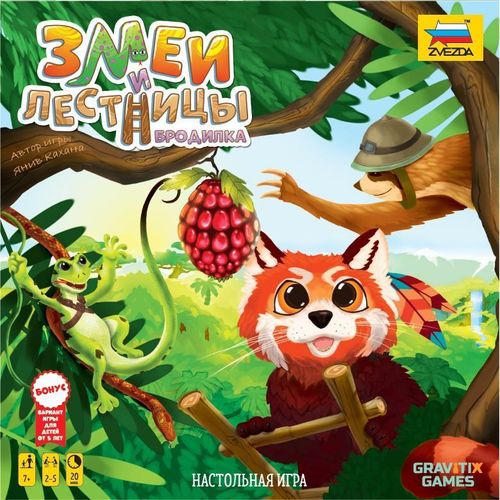
Змеи и лестницы: Бродилка
Змеи и лестницы: Бродилка Rulebook
Table of Contents
Table of Contents
Components
- 5 player pawns with stands
- 1 game board
- 1 special D6 die
- 1 notepad
- 15 ladder tokens (5 of each type: long, medium and short)
- 15 snake tokens (5 of each type: long, medium and short)
- 15 vine tokens
- 10 spray tokens
- 20 scissors tokens
Setup
- Before the first game, carefully push the tokens and pawns out of their cardboard frames.
- Each player takes one sheet from the notepad and places it in front of them. This is the player's sheet.
- Each player needs a pencil or pen for the game.
- Each player chooses a character, takes the matching pawn and inserts it into its stand.
- Place the game board in the centre of the table.
- Place the player pawns on the table next to space 1.
- Each player takes 3 ladder tokens (one long, one medium and one short), 3 snake tokens (one long, one medium and one short), 2 spray tokens, 3 vine tokens and 4 scissors tokens. This is each player's personal supply.
- Put everything left over after dealing back into the box.
- The game includes a mode for little ones. Its rules are described on page 10, but read the basic rules of the game first.
Goal of the Game
By rolling the die and moving your pawn around the board, be the first to reach the crunchfruit on space 100. Once a player's pawn lands on this space, the other players no longer take turns, and the game ends immediately.
Turn Order
The first player is the one who most recently climbed a ladder. That player begins the game. The active player is the player whose turn it is. The active player performs the following actions:
- Rolls the die.
- Moves their pawn forward by as many spaces as the die shows. Moving onto the adjacent space is called a "step".
At any moment during their turn, the active player may play one token from their personal supply. This means the player may use a token's ability before the roll, after the roll, while moving the pawn, or after moving it.
During the active player's turn, all other players cross off, on their own sheets next to the tokens, as many spaces as the active player's die roll shows. This lets them use the abilities of the tokens on their own turns. Players decide for themselves which spaces to cross off. The number of spaces to cross off depends on the number of players:
- 2 players: cross off only spaces that have no number inside them.
- 3 players: cross off empty spaces and spaces with the number 3.
- 4 players: cross off empty spaces and spaces with the numbers 3 and 4.
- 5 players: cross off empty spaces and spaces with the numbers 3, 4 and 5.
The active player does not cross off any spaces on their own sheet; they only roll the die and move their pawn.
Spaces may be crossed off next to any token on the player's sheet that has not yet been played, in any order. When a player has crossed off the required number of spaces next to a certain token, they may play that token from their personal supply when they become the active player.
(3-player example) The active player, Vasya, rolls a 4 and moves his pawn 4 spaces forward. Anya and Petya, meanwhile, cross off spaces on their sheets next to any tokens. Anya wants to lay the long ladder quickly, so she crosses off all 4 spaces next to it. Petya wants to lay the vine token and then the blue snake, so that no one else gets ahead. He crosses off 2 spaces next to the vine token and 2 spaces next to the blue snake.
If the active player does not want to, or cannot, play a token from their personal supply, they pass the turn to the next player clockwise.
Remember: no tokens may be placed on space 100, and ladder and snake tokens may not end on it. On space 99, ladder tokens may not end, but other tokens may be placed there.
Important:
- Pawns move only forward. Follow the direction and the space numbers.
- A player may not move fewer steps than the die shows.
- Several players' pawns may occupy the same space.
A player may play only one token from their personal supply per turn. Tokens may not be placed underneath player pawns, and may not be placed on spaces occupied by other pawns or tokens. Only one token may lie on a space. All tokens lying on the board affect all players.
If a player has no tokens left in their personal supply, they cannot play any (they may not use tokens from the discard pile or from other players' supplies).
There are 5 kinds of tokens in the game:
- Ladders — to climb up one or more rows.
- Snakes — to send opponents down one or more rows.
- Sprays — to scare away a snake.
- Vines — to hold a player back.
- Scissors — to cut vines and allow the player to keep moving.
Ladders
Ladders let a player climb up one or more rows. Once a player has crossed off all the required spaces next to one of the three ladders, on their turn they may play that token by placing it on a free space of the board. Ladders are always placed strictly vertically (no tilt). When a ladder token is placed on the board, the player fully crosses it off on their sheet.
To climb a ladder, the player must put their pawn on the space where the ladder begins. Climbing a ladder of any length is always one step. If a player does not have enough steps to climb the ladder, they end their turn on the space where the ladder begins (on the first rung). If they do not have enough steps to get off the ladder, they end their turn on the space where the ladder ends (on the top rung).
A ladder token affects all players and stays on the board until the end of the game — it may not be moved, and a player may not take it back for themselves.
Players may climb a ladder only from its very beginning to its very end. It is not possible to climb up or step off to the side from the middle of a ladder. However, a pawn may freely pass over spaces that lie under placed ladders. (If a pawn does not land on the start of a ladder, or the player does not want to climb it, the player moves the pawn along the spaces that lie under it.) Ladders may not be climbed downward.
Remember: if a player has crossed off all the spaces next to any token, they are not obliged to play it right away — they may do so on any other turn of their own.
(3-player example) The active player, Vasya, has his pawn on space 4, and on his sheet all the spaces next to the short ladder are crossed off. He rolls a 3. Vasya wants to get ahead, so he places the ladder token on space 5 and moves his pawn onto it, i.e., onto the start of the ladder (1 step). He then moves the pawn up the ladder by 1 row to space 16 (1 step), and then moves the pawn to space 17 (1 step). On his sheet, Vasya fully crosses off the short ladder and passes the turn to the next player. (Vasya rolled the die, played a token and moved his pawn — he used all of his actions, so his turn is over.)
Note: the active player may play a token from their personal supply at any moment of their turn.
Snakes
Snake tokens send a player's pawn down one or more rows. Once a player has crossed off all the required spaces next to one of the three snakes, on their turn they may play that token by placing it on a free space of the board. Snakes are always placed strictly vertically (no tilt), with their heads down. This token affects all players, but only when a player ends their turn on the snake's tail.
When a snake token is placed on the board, the player fully crosses it off on their sheet. After placement, the token stays on the board — it may not be moved, and a player may not take it for themselves.
If a player ends their turn on the snake's body (not the tail), nothing happens: their pawn stays on that space, because a player may slide down a snake only from the tail to the head. If a player has enough steps to pass through the space with the snake's tail, they do not slide down the snake; they continue on, ignoring it.
Remember: snakes do not get along with each other, so the tips of their tails may not lie on neighbouring spaces — there must always be at least one space between them. That space may be occupied by other tokens and pawns.
(3-player example) The active player, Anya, has her pawn on space 37, and a blue snake token lies on space 38. Anya rolls a 1, moves her pawn to space 38 and slides down the snake. Anya's pawn stays on space 18. In the same turn, Anya may play from her personal supply any token next to which all the required spaces are crossed off (since she has not yet used this action), for example the vine token. After this, the turn passes to the next player.
Sprays
Once a player has crossed off all the required spaces next to a spray token, at any moment of their turn they may remove any one snake token from the board. A spray token lies either in the player's personal supply or in the discard pile — it is not placed on the board.
When a player plays a spray token, they fully cross off that one spray token on their sheet, move one spray token from their personal supply to the discard pile, and also move any one snake token from the board to the discard pile. Both tokens that were moved to the discard pile this way take no further part in the game until the end of the game. The player may not play any other token during this turn (because they have already played one), and their turn ends.
Each player has only 2 spray tokens in total, so when a player no longer has any sprays in their supply, they will have to slide down snakes. For example, to avoid getting confused, a player may return tokens that have been moved to the discard pile to the box.
(3-player example) The active player, Petya, has his pawn on space 22, and a red snake token lies on space 24. Petya rolls a 2. Since all the spaces next to the spray token are crossed off on his sheet, he decides to play that token first and then move his pawn.
Petya fully crosses off one spray token on his sheet, takes one spray token from his personal supply and moves it to the discard pile. He then takes the snake token lying in front of him (on space 24) and also moves it from the board to the discard pile. Now Petya moves his pawn to space 24 and passes the turn to the next player. (Petya rolled the die, played a token and moved his pawn — he used all of his actions, so his turn is over.)
Vines
A vine token holds opponents back. Once a player has crossed off all the required spaces next to this token, on their turn they may play it by placing it on a free space of the board. When a vine token is placed on the board, the player fully crosses it off on their sheet. The vine token affects all players and remains on the board until any player uses protection against it — a scissors token (see the Scissors section).
If a vine token lies in front of a player's pawn, at a space the player can reach this turn, and the player has not yet crossed off all the required spaces next to the scissors token, the player ends their turn on the space before the vine token.
During this same turn, the player may play from their personal supply any token next to which all the required spaces are crossed off. Even if a player cannot move their pawn, they must still roll the die so that the other players continue crossing off spaces on their sheets. Also, if a player has crossed off all the required spaces next to any other token that has not yet been played, they may play that token.
(3-player example) The active player, Anya, has her pawn on space 44, and a vine token lies on space 46. Anya rolls a 4 and moves her pawn to space 45, where she ends her turn (before the vine token), because not all the required spaces next to the scissors token are crossed off on her sheet. During this same turn, Anya may play from her personal supply any token next to which all the required spaces are crossed off (since she has not yet used this action). Note: the active player may play a token from their personal supply at any moment of their turn.
Scissors
Once a player has crossed off all the required spaces next to a scissors token, on their turn they may remove any one vine token from the board. A scissors token lies either in the player's personal supply or in the discard pile — it is not placed on the board.
When a player plays a scissors token, they fully cross off that one scissors token on their sheet, move one scissors token from their personal supply to the discard pile, and also move any one vine token from the board to the discard pile. Both tokens moved to the discard pile this way take no further part in the game until the end of the game. The player may not play any other token during this turn (because they have already played one), and their turn ends.
If a player's pawn stands in front of a vine token and the player does not want to play a scissors token, the pawn stays where it is until that player or another player plays a scissors token against this vine token. If a player has no scissors tokens in their personal supply, they cannot use them.
(3-player example) The active player, Petya, has his pawn on space 44, and a vine token lies on space 46. Petya rolls a 3. On his sheet, all the spaces next to the scissors token are crossed off, so he may move his pawn the full 3 steps. As he passes space 46, he moves the vine token to the discard pile. He also moves one scissors token from his personal supply to the discard pile and crosses off one scissors token on his sheet. Petya ends his turn on space 47 — he has used all of his actions, so his turn is over and passes to the next player.
Quick Reference
- A player may play only one token from their personal supply per turn, and only one whose required spaces are all crossed off.
- Only one token may lie on a space.
- A token may not be placed on a space already occupied by tokens or pawns. Choose spaces free of pawns and tokens.
- Tokens placed on the board may not be moved or taken back for oneself.
- Tokens lying on the board affect all players.
- Snake and ladder tokens are placed strictly vertically and may not start or end on the same space.
- Snakes are always placed head down. They may be slid down only from tail to head (not from the middle). Tails may not lie on neighbouring spaces — there must always be at least one space between them.
- Spray and scissors tokens, once played, are moved from the personal supply to the discard pile and take no further part in the game until the end of the game.
- Ladders may be climbed only from their start to their end (not from the middle, and not stepping off early).
- Climbing a ladder of any length is always one step.
- No tokens may be placed on space 100, and ladder and snake tokens may not end on it. On space 99, ladder tokens may not end, but other tokens may be placed there.
- Several player pawns may occupy the same space.
- Pawns may not move backward.
- A player may not move fewer steps than the die shows. The exception is when a vine token lies in front of the pawn and a scissors token is not being played.
- The turn always passes to the next player clockwise: even if a player cannot move their pawn, they must still roll the die.
Mode for Little Ones
The printed rulebook (page 10) uses the same heading, "Setup", for this mode as for the standard game. It is labelled here to tell the two apart.
Setup (Little Ones' Mode)
- For this variant you will not need the notepad — put it back in the box.
- Place the game board in the centre of the table and place the ladder tokens on it as follows:
- short ladders on spaces 9–12, 59–62 and 88–93;
- medium ladders on spaces 5–25, 30–50, 37–57 and 69–89;
- long ladders on spaces 19–42 and 47–74.
- Place the snake tokens as follows (the first number is the tail):
- red snakes on spaces 46–35, 80–61 and 95–86;
- blue snakes on spaces 27–7 and 97–77;
- the yellow snake on spaces 83–58.
- Place the vine tokens on spaces 26, 45, 65, 75, 82 and 99.
- Choose characters and take the matching pawns. Insert them into their stands. Place the pawns on the table next to space 1.
The first player is the one who most recently sat on the stool. That player becomes the active player. Starting with them and continuing clockwise, the players take turns rolling the die and moving their pawns forward by as many spaces as the die shows.
In this variant there are 3 kinds of tokens, all of which affect all players:
Ladders — climb up one or more rows. A player places their pawn on the bottom rung of a ladder and moves it in one step to the top rung. They then move the pawn the remaining number of steps. If no steps remain, the pawn stays where it is and the turn passes to the next player. Whether to climb a ladder or go around it is up to the player. Passing over the spaces below ladders is allowed, but going down a ladder is not.
Example: The active player, Vasya, has his pawn on space 3. He rolls a 4. He moves his pawn to space 5 (2 steps), then climbs the ladder to space 25 (1 step), and ends his turn on space 26 (1 step). The turn passes to the next player.
Vines — slow the player down. If a vine token lies on the player's path, the player ends their turn on the space before the vine token (i.e., the remaining steps are lost). At the end of their turn, the player removes the vine token lying in front of them and moves it to the discard pile. This token takes no further part in the game until the end of the game.
Example: The active player, Petya, has his pawn on space 43. He rolls a 4. He moves his pawn to space 44 and ends his turn there, because a vine token lies on space 45 (so the remaining 3 steps are lost). Petya then removes the vine token lying in front of him, moves it to the discard pile and passes the turn. On his next turn, Petya moves his pawn as usual.
Snakes — send players down one or more rows. If a player's turn ends on a space with a snake's tail, their pawn immediately slides down the snake and stops on the space with its head. If a player ends their turn on the snake's body (not the tail), nothing happens: the pawn stays where it is, because a player may slide down a snake only from the tail to the head. If a player has enough steps to pass through the space with the snake's tail, they do not slide down; they continue on, ignoring it.
Example: The active player, Vasya, has his pawn on space 93. He rolls a 2. He moves his pawn to space 95 and immediately slides down the snake to space 86, because his turn ended on the snake's tail. The turn passes to the next player.
Victory
The player whose pawn is first to land on space 100 wins. Once a player's pawn lands on this space, the other players no longer take turns, and the game ends immediately.
Note for Pioneer Mode
You may place the snake, ladder and vine tokens on the board as you wish, but keep in mind the base rules, which are designed so that everyone finds the game interesting and fun and so that everyone takes part:
- Snakes are always placed head down. They may be slid down only from tail to head (not from the middle). A player who slid down a snake ends their turn on the space with the snake's head and passes the turn to the next player.
- The tips of snake tails may not lie on neighbouring spaces — there must always be at least one space between them (which may be occupied by other tokens and pawns).
- Snake and ladder tokens may not start or end on the same space.
- Ladders may be climbed only from their start to their end (not from the middle, and not stepping off before the end).
- Climbing a ladder of any length is always one step.
- Only one token may lie on a space.
- Tokens lying on the board affect all players. They may not be moved around the board.
- No tokens may be placed on space 100, and ladder and snake tokens may not end on it.
- Ladder tokens may not end on space 99, but other tokens may be placed there.
- Pawns may not move backward.
- Several player pawns may occupy the same space.
- The turn always passes to the next player clockwise (that is, to the left).