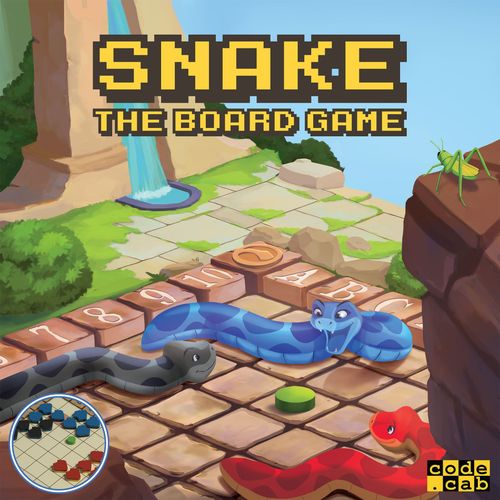
Snake: The Board Game
Snake: The Board Game Rulebook
Table of Contents
Table of Contents
- Game Components
- Basic Game Rules (2 to 4 players, 30-60 min)
- Complexity Level
- Game Setup
- Moving
- Eating
- Growing
- Dead Snake
- Biting
- Team Mode (3 or 4 players)
- Rocks
- Wormholes
- Infinity Field
- Snake Duel (2 players, 10-20 min)
- Black Adder (3 to 4 players, 30-60 min)
- Python (1 player, 20-40 min)
- Robot Snakes
- Measure Distance
- Playing Tips
- Rock Patterns
Game Components
- 60x blue/black snake segment
- 60x red/white snake segment
- 8x rock
- 4x apple
- 1x board
- 1x 12-sided die (A - L)
- 1x 10-sided die (1 - 10)
Basic Game Rules (2 to 4 players, 30-60 min)
The player whose snake outlives all others wins the game. This can be achieved by eating apples to grow in length and make it impossible for other snakes to move.
When you're playing with 3 or 4 players, consider playing in Team Mode, as described in the Team Mode paragraph.
Although the rules are simple, applying them in a correct way may require some practice and insight.
Read the Playing Tips section to get you started and to avoid beginner mistakes.
Complexity Level
Before playing Snake – The Board Game, players must agree on the complexity level. If there are first time players, you may start with a low complexity level until you master the movement technique of your snake. Note that lower complexity levels can still be very challenging and fun for experienced players.
The printed complexity graphic is transcribed below as a table, running from low complexity (top) to high complexity (bottom). A "Yes" marks that the option is used at that level.
| Complexity level | Rocks | Wormholes | Infinity Field |
|---|---|---|---|
| low | 0 | ||
| 1-4 | |||
| 5-8 | |||
| 0-8 | Yes | ||
| 4-8 | Yes | ||
| high | 4-8 | Yes | Yes |
Read the sections about Rocks, Wormholes and Infinity Field for more details about these rules.
Game Setup
The snake game pieces are called segments in this manual.
A snake is built up from multiple segments in a row where the curved side points to the previous segment of the snake. The last segment is the tail segment, and the first is the head segment. You move the snake one segment at a time by moving the tail segment to the front, making it the new head segment.
With 2 players, choose starting positions that are diagonally opposite each other.
Place one segment piece, the head of the snake, on the colored square. Then place 2 segments on the squares behind it, as indicated in the image above. Any color can be placed on any starting position.
Use the 10-sided die to determine who will play first.
Deal out the apples and rocks (if any), starting with the first player and going clockwise (based on the starting position on the board). Players can end up having different amounts of rocks or apples.
All players, starting with the first and going clockwise, use the dice to place their rocks and apples in the field. Roll the dice and use the coordinates to determine the square for the rocks and apples.
Rocks may not create unreachable squares as described in the Rocks section.
If necessary, roll the dice again if a square is not empty or allowed until all rocks and apples are on the field.
Each player chooses a snake color and one of the starting positions. When playing in teams (preferred for 3 to 4 players), take the Team Mode starting position rule into account.
Moving
The first player makes one step with the snake by moving the last tail segment to the front, thus making it the new head segment.
The snake can only move in one of three directions (forward, left or right), and only when the destination square is empty or contains an apple.
Important: rotate the head snake segment in the direction of the move so that the curved side points to the previous segment. When not done correctly, you may end up with a broken snake later.
When playing with strict rules: a player loses when a segment is placed incorrectly (not pointing with the curved side to the previous segment) at the end of a turn. For beginners it is recommended to help each other place the pieces correctly.
When the player has taken a step, it is the next player's turn (clockwise, based on the starting positions on the board).
At each step, the tail segment MUST be moved to a different empty square. Therefore, a snake is not allowed to follow its tail without any empty square between the head and the tail.
Eating
When an apple is reached, it can be 'eaten' by replacing the apple by a new snake segment. Place the apple on top of the new head segment. The snake is now 1 segment longer.
When a snake contains one or more apples at the beginning of their turn, the player must try to place only one apple back to an empty square.
Always wait for your next turn to put the apple back. If you change this rule and do it immediately, your opponent will not have a chance to react, which affects the balance of the game.
The player rolls the dice to get the coordinates of a square on the board.
- If the indicated square is empty, one apple is removed from the snake and placed on the square. The player then makes one move with the snake.
- If the square is not empty, the apple should remain on the snake and the game piece on the square depends the number of moves the player has to take:
| Square contains | Moves to take |
|---|---|
| opponent's snake segment | 0 |
| dead snake segment | 0 |
| apple | 1 |
| rock | 1 |
| own snake segment | 2 |
While making the move(s), new apples may be eaten when in reach. At the end of the turn, the snake may carry multiple apples.
Shift any remaining apples on the snake to the head segments.
Growing
When the snake grows longer, it is getting more and more challenging to determine the tail segment and to follow the path of the snake. When each segment is placed correctly with the curved part facing the previous segment, the last segment is the only segment that does not point to a previous segment.
The image shows again the importance of placing the segment correct with the curved side towards the previous segment. There are a few exceptional situations (after eating an apple or when using wormholes for example) where this may not be the case. Be aware to pick the correct tail segment in those situations.
Despite the many snake segments in the game, a player may run out of snake segments. In that case use another player's unused segments. Try to use segments of the same color or a color that is not conflicting with the existing snakes on the board.
Dead Snake
Moving is mandatory. When a snake can no longer make a valid move, it dies, and the player is out of the game.
When there is only one living snake remaining on the board, that player wins the game!
If there are more snakes, the game can continue for the other players with the following rules:
- The player hands over all of his/her apples to the next player in line.
- The segments of the dead snake remain on the board except the segments in the outer ring. This means that all dead snake segments in rows 1 and 10 or columns A and L will be removed.
- All rocks on the outer ring (rows 1 and 10 or columns A and L) must also be removed.
- The remaining segments may enclose empty squares that can never be reached by a snake without running into a dead end. Fill all unreachable squares with a new segment in the color of the dead snake. This will prevent apples from being placed there.
- All apples on an unreachable square are handed over to the next player in line. When unreachable squares contain segments of a living snake, the squares must be filled as soon as the living snake leaves them.
In the examples on the right the blue snake dies. The squares marked with an X are unreachable for a long snake. The apple on the unreachable square is removed and handed over to the next player. Then the unreachable squares are filled with blue segments. The orientation of these segments is not important.
The reason for this rule is that the other snakes can continue playing without having a death trap in the field.
Biting
Long snakes may bite short snakes on the head or on the segment just behind the head. The condition for biting is that the long snake must be at least 10 segments longer than the short snake.
Example: A snake of 14 segments or longer may bite a snake of 4 segments. Biting is not mandatory.
When a snake is bitten, the player loses. All dead snake segments must be completely removed from the board.
Team Mode (3 or 4 players)
When playing with 3 or 4 players, you can choose to play individually or to form teams. For 3 players this would be 2 against 1.
In Team Mode, players with the same starting square color are in the same team. In the example at the right the blue and the red snakes are in the same team. The black and white snakes form the other team.
Snakes in one team can cooperate to beat the snakes of the other team.
When a team has no more living snakes, the game ends, and the opposite team wins!
Rocks
Adding Rocks is a great way to break the board's regular pattern and add more variety and opportunity. The players can decide among themselves how the rocks are placed on the board:
- Rocks are placed at random positions on the board using the dice.
- Rocks are divided over the players and each player chooses where to put the rocks at the start.
- Use one of the patterns from the Rock Patterns section.
A rock may not be placed in such a way that it makes another square inaccessible. In the example below, the snake cannot reach any of the apples without dying. Remove the rock and place it on another square.
Wormholes
Another complexity rule is Wormholes. The colored starting squares act as a wormhole, a portal that can be used by a snake to move to the other side of the board.
- The blue snake has its head segment on one of the wormhole squares. Since it is the blue snake's turn and the other side of the wormhole is empty, it may choose to use the wormhole. It may also choose to ignore it and continue its way.
- The blue snake's player moves the last segment to the opposite wormhole square with the same color. The segment may be placed in any of the four directions.
- During the next moves, the blue snake continues moving the last segments to the head until the wormhole is free again to be reused.
Note that using Wormholes typically doubles the game play duration because you have more escape possibilities.
The usage of a wormhole is shown by the example.
Infinity Field
When a snake reaches one of the four walls of the board, it may choose to go through the wall, and to continue at the opposite side of the field. Snakes can only go through a wall in one place at a time, even if it is the same wall. The snake must be completely through a wall before another attempt is made.
In addition, snakes cannot go through a wall and a wormhole at the same time.
Note that using Infinity Field typically doubles the game play duration because you have more escape possibilities.
Snake Duel (2 players, 10-20 min)
The back of the board contains a halve size playing field of 10 x 6 squares. This board allows 2 players to play a shortened version of the base game. For the vertical coordinates the 12-sided letter die is used, and each row is indicated by 2 different letters. For example, both A and G point to the same row.
The style of the board pays tribute to the first Snake-like game Blockade from 1976.
Black Adder (3 to 4 players, 30-60 min)
Black Adder is an alternative one-to-many game where one player is the adder, which the other players must catch.
Be warned that it is relatively difficult to catch the adder and players really must cooperate. So, if you are an experienced player and you want to make other players enthusiastic for this game: don't be the adder.
The game starts just like a basic game. The black adder uses the black segments and starts with 3 segments, just like the other snakes.
Black Adder can very well be played with Rocks. Using Wormholes and Infinity Field is not recommended.
The adder always remains 3 segments long. When the adder encounters an apple, the apple is moved to the rear end of the adder: the apple and the last segment are swapped.
Biting the adder is not allowed.
When the adder cannot make a valid move anymore, the other snakes have won. However, if one of the other snakes is unable to move, the adder has won and the game ends.
Python (1 player, 20-40 min)
Python is a solo mode game where you must survive automated robot pythons that have only one purpose: to block you. You win by growing to a length of 15 segments and by biting all pythons until you're the only snake left. Read the Biting section for a detailed description. The robot snakes have a fixed length of 5 segments.
The difficulty level of this game is a combination of the number of apples to keep, the number of rocks and the number of robot snakes.
| Level | Robot Snakes | Rocks | Maximum Apples |
|---|---|---|---|
| low | 2 | 8 | 2 |
| high | 3 | 0 | 0 |
Note that rocks make this game a little easier as they can help you shake off the robots.
Choose your own difficulty level and place the snakes as shown. You're free to choose your own colors. Place a segment of each snake next to the board to keep track of turns. Use a separate segment as an indicator.
Use the dice to place the rocks (if any) and the apples in the field. Your snake gets the first turn, and you move your snake as described in the base game. Then move the robot snakes clockwise based on the starting position. Use the indicator to keep track of the snake to move. The movement of the robot snakes is described in the Robot Snakes section.
Your snake can eat apples which will make your snake one segment longer. If you eat one, you can choose to save the apple for later (if allowed) or try to place it directly back on the board. If you keep it, place the apple next to the board and use it whenever you want but during your turn.
If you are going to place an apple back on the board, you are allowed to make one extra turn after that. However, this number of extra turns can still be increased or decreased. Roll the dice to get the coordinates of a square for the apple. If the square is not empty, add/subtract the following number of turns and roll again.
| Square contains | Extra turns |
|---|---|
| own snake segment | -1 |
| robot snake segment or rock | +1 |
| apple | +2 |
If the square is empty, place the apple on the indicated square and immediately take the number of turns (if positive).
Robot Snakes
Automated robot snakes are moved by the player and take 1 move forward, left, or right each turn. However, the direction is not determined by the player but by fixed rules:
- Rule 1 - Move in the direction that minimizes the distance to the player's snake head segment. Use the method described in the Measure Distance section to determine the shortest directions.
- Rule 2 - If rule 1 has more than one option then move forward if this is one of those options. Otherwise go left.
- Rule 3 - If all directions are temporarily blocked, the robot will skip turns until it can move on again. If a robot cannot move, it will just wait.
- Rule 4 - In the exceptional case the robot is permanently blocked, it must be returned to its original starting position. If these squares are not free, the robot has to wait until they become available. Any apples on the starting position squares can be taken by the player.
Robots have a fixed length and are not attracted to apples. When the robot encounters an apple, the apple is moved to the rear end of the robot: the apple and the last segment are swapped. Read the Black Adder section for a detailed description.
Measure Distance
A simple approach to get the distance between a certain position and the head of a snake, is to add the horizontal difference of squares to the vertical difference. So you count the number of squares in the horizontal direction until you are exactly above/below the target. Then you continue to count in the vertical direction until the target is reached.
In this example, left and forward are the same distance (6), so the red robot continues straight ahead.
In the beginning it may be a time-consuming activity to make the robots move, but after a while you see when it is and is not necessary to count and it goes faster.
Playing Tips
For first-time players, it can be hard to figure out what to do and how to beat your opponents. Below are some playing and strategy tips that can provide a better playing experience.
- Start eating apples to grow your snake. You need a snake of a certain length to block other snakes, although there is no optimal length.
- Adding rocks is an attractive feature, but it is also more challenging and treacherous. Playtime can get very short for novice players.
- Avoid moving only in straight lines or in circles. Variations in path and direction create opportunities to block your opponents.
- Don't just focus on growing. Sometimes it's better to ignore an apple if it could endanger you. The game is not about making the longest snake.
- Moving along walls makes your snake vulnerable to being blocked from one side. Try to have multiple escape routes if you encounter other snakes.
- Observe your opponents. Try to find weak moments where you might be able to block them, such as when they are in a corner.
- Try to stop your opponent from following its own tail, allowing it to survive by moving in circles. This can force your opponent to run into a dead end.
- Don't focus on constantly trying to block your opponent. This makes the game boring and is rarely a good winning strategy.
- Create distance between the snake heads between attacks. Taking different paths between attacks can change the playing field and gives you more chances.
Rock Patterns
The printed Rock Patterns section shows a set of 4-rock, 6-rock and 8-rock layouts on the board grid. These layouts are diagrams only and are not reproduced as text here; see the printed rulebook (page 8) for the exact rock positions.