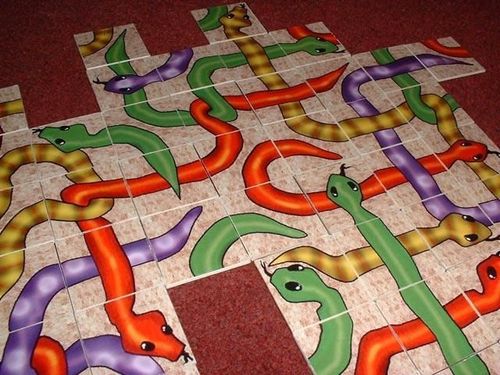
Snake Pit
Snake Pit Rulebook
Table of Contents
Assembly
Glue the front side of each counter sheet onto card. Wait for the glue to dry and cut round the edge of the coloured area. Glue the correct back side to each tile sheet. Once dry, cut out the tiles (if you look closely you'll see the cutting marks). Each tile should have the mirror image of the front on the back side.
Contents
- 54 double-sided snake tiles.
- 4 Snake Colour counters, 4 "2x" counters (used for variants).
- These rules.
You will also need something to act as a screen for each player to hide his or her tiles.
Setup
Mix all the tiles together in a bag. Draw a tile from the bag and place it in the middle of the playing area. Each player then takes five tiles and hides them behind his or her screen. Decide who is going to start, play then proceeds clockwise round the table.
How to Play
On his or her turn, a player plays two tiles. Each tile played must connect orthogonally to a tile already on the table. Tiles being played must also match colours on all edges to tiles already in play. A player may not add a tail to a snake that already has a tail at the other end, and similarly may not add a head to a snake that already has a head. It is also illegal to add a tile to the middle of a snake that would result in a snake with two tails or two heads being formed.
However, it is legal to complete a 'loop' – i.e. a snake that joins to itself without a head or a tail. After playing two tiles the player refills his or her hand to five by drawing tiles (without looking!) from the bag. If a player cannot place a legal tile, they 'pass' and miss their turn. If they can only place one tile then they do so, then refill their hand to five.
Once the tile-bag is empty, players no longer refill their hands, but continue to play until all players have laid all their tiles or until all players have 'passed' because they cannot play. The winner is the player with the highest score at the end of the game.
Scoring
A player scores whenever they lay a tile that completes a snake or a 'loop'. They score 1 point for the first tile in the snake, 2 points for the second, 3 for the third and so on. So, the smallest legal snake (a head joined directly to a tail) scores 3 points in total as it is formed from two tiles. If, in laying a tile, a player simultaneously completes two snakes, they double their score for those snakes. For example, a player who laid a tile which simultaneously completed a 3-tile-length and a 6-tile-length snake would receive (1+2+3) points for the 3 length snake and (1+2+3+4+5+6+7+8) points for the 6-length one, the scores being doubled for a total score of (6+36)*2 = 84.
| Tile Length | Score |
|---|---|
| 2 | 3 |
| 3 | 6 |
| 4 | 10 |
| 5 | 15 |
| 6 | 21 |
| 7 | 28 |
| 8 | 36 |
| 9 | 45 |
| 10 | 55 |
Variants
A) Before the game, shuffle the four snakehead counters face down. Each player takes one and keeps it hidden. If there are less than four players put the remaining counters away without revealing them. Whenever a player scores a snake with the same colour as your counter, you may reveal the counter to take the points for yourself instead. For the remainder of the game you receive all points for snakes scored in that colour.
B) Before the game, shuffle the four snakehead counters face down. Each player takes one and keeps it hidden. If there are less than four players put the remaining counters away without revealing them. Whenever you score a snake with the same colour as your counter, you may reveal the counter to gain double points for that snake. For the remainder of the game you receive double points for all snakes you score in that colour.
C) Before the game each player takes one "2x" counter. At the end of your turn you may place your "2x" counter on any tile. Any subsequent snakes that pass through this tile score double. "2x" counters cannot be moved once placed.