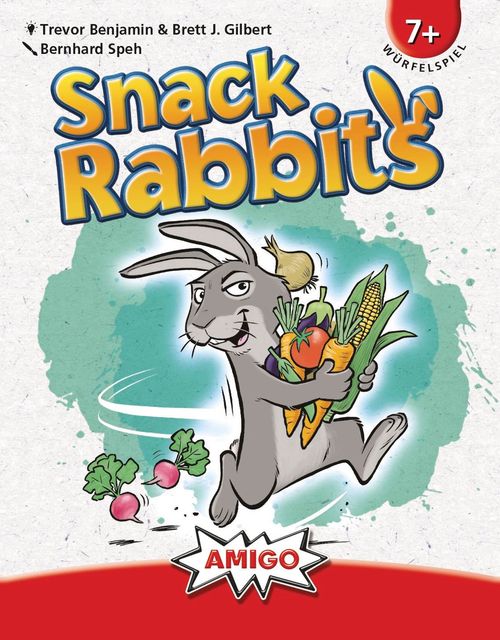
Snack Rabbits
Snack Rabbits Rulebook
Table of Contents
Table of Contents
The idea of the game
7 years and up, 2-4 players, about 20 minutes.
Game materials
- 63 vegetable cards. Each card shows 1 of 7 different vegetables and a value between 6 and 12. The value of a card indicates how many cards of that vegetable type there are in total (6x tomato, 7x carrot, etc.).
- 1 Farmer Brown
- 5 fences with heights from 2 to 6
- 4 personal rabbit dice in the four colors of blue, green, purple, and orange
- 8 white rabbit dice
Setup
Put Farmer Brown aside for now and shuffle all the vegetable cards. Place them in a face-down pile in the middle of the table. Then draw 10 vegetable cards from the pile and shuffle Farmer Brown into these 10 cards, face down. Now place this small pile under the large pile. Both of the piles together form the draw pile.
Place the fences next to each other in order of height in the middle of the table. Leave some space under each fence for vegetable cards. These are the spaces where the vegetables grow.
Now choose one of the colored rabbit dice and place it in front of you. This is your personal rabbit die. Set aside the white rabbit dice as a general pool.
Gameplay
The player who most likes to nibble on carrots starts the game. When it is your turn, carry out the following 2 actions in this order:
- TURN OVER A CARD: Turn over a card from the draw pile and place it in the space under the matching fence. (Skip this action after you reveal Farmer Brown.)
- HOP OR STOP: Decide to either roll your dice and hop or take an additional die.
1. Turn over a card
Start your turn by turning over a card from the draw pile. Look at what die symbol is shown on the card. Place the card in the space under the fence that shows the same die symbol.
If there are already vegetable cards in that space, place the card on top in a staggered position so that everyone can still see the vegetables on the lower cards.
If your revealed card shows a sun above the die, immediately turn over another card. This can happen many times, one after the other.
If you reveal Farmer Brown, put him face up on the draw pile. This signals the end of the game (see End of the game).
2. Hop or stop?
Now you can try to swipe vegetables from Farmer Brown. Want to push your luck and hop over the fence? Or would you rather prepare for a better moment?
Hop
Want to swipe some vegetables? Then try to hop over a fence. Do this one step at a time:
Announce your fence. Before rolling the dice, say which fence you want to hop over. You can only hop over one fence per turn. The higher the fence, the more difficult it is to hop over it.
Select and roll dice. You always roll your personal, colored rabbit die. If you also have white rabbit dice, you can roll as many of them as you would like. Now roll all the selected dice at once. The more dice you use, the better your chances.
Hop: Made it over the fence. If at least 1 of your rolled rabbit dice shows a number that is at least as high as the die symbol on the fence, you've made it over the fence! You may not add several dice together.
- Take all the vegetable cards that are in the space under the selected fence and put them face up in front of you. Stagger cards with the same type of vegetable on top of each other so everyone can always see how many vegetable cards you have of each type.
- Take back your colored rabbit die and return all the white rabbit dice you rolled to the general dice pool. You always put back those white rabbit dice when you make it over the fence. You keep any white rabbit dice that you did not roll.
Example: Mia says that she wants to hop over the fence with a height of 4. She decides to roll one of her 2 white rabbit dice in addition to her colored rabbit die. Mia rolls a 2 and a 6, which means her hop gets her over the fence and she can take all the vegetable cards from that space. However, she needs to give up the white rabbit die she rolled.
Hop: Didn't make it over the fence. If none of your rabbit dice show a number that is at least as high as the die symbol on the selected fence, then you didn't make it over the fence.
- Leave all the vegetable cards in that space.
- Take all the rabbit dice you rolled (your colored and all your white rabbit dice) back into your dice pool.
Example: Robert says that he wants to hop over the fence with a height of 3. He decides to roll a white rabbit die in addition to his colored rabbit die. Robert rolls a 1 and a 2, which means he didn't make the hop. He leaves the cards in that space and takes both the dice he rolled back into his dice pool.
Stop
If you don't want to hop over a fence, take a white rabbit die from the general dice pool instead and put it in your own dice pool. This gives you more dice on your next turn and therefore better chances! Note that you are not allowed to roll your dice this turn!
If there are no more white rabbit dice in the general dice pool, you get to take a white rabbit die from any other player.
Example: Olivia turns over a card. As there are not many vegetable cards in the spaces, she decides not to hop this turn. Instead, she takes a white rabbit die from the general dice pool.
After your "hop or stop" action, the player to your left goes next.
End of the game
When you reveal Farmer Brown, place him face up on the draw pile. Now continue playing as normal, with the exception that you skip the "Turn over a card" action and therefore no longer turn over any vegetable cards at the start of your turn. You only carry out a "hop or stop" action. Keep playing until there are no more vegetable cards in the spaces. Then the game ends.
Now compare how many vegetable cards you have of each type. Go through each vegetable type one after the other.
The player who has collected the most vegetable cards of a type lays them out together as a face-up pile in front of them. This pile is worth as many points as the value shown on that vegetable card. If several people have the most cards of a type of vegetable, they all receive points equal to the value shown.
Example: You have 4 onions and more than anyone else. You lay out your onions together in a pile and leave the pile face up in front of you. This pile is now worth 10 points.
Everyone else turns over their cards for this vegetable type. Each turned-over card is worth 1 point.
Example: You swiped 3 onions, but someone else has 4 onions. Turn your onions to the reverse side. These cards are worth 1 point each; that is, 3 x 1 = 3 points.
After you have awarded points for all of the vegetable types, add up your points. Whoever has the most points at the end wins! If several people have the most points, they win together.