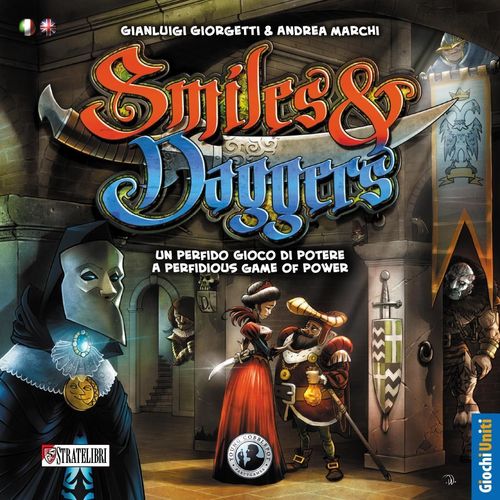
Smiles & Daggers
Smiles & Daggers Rulebook
Table of Contents
Table of Contents
Game Components
This rulebook, 36 cards (each of the six families includes 1 Lord, 2 Ladies and 3 Knights) and 1 punchboard that includes: 49 Gold coins and the Smiles&Daggers tile.
Card faces, as shown in the components illustration:
- Lord (1), Lady (2), Knight (3), Back.
- Smiles side (bright) with Gold coins.
- Daggers side (dark) with elimination icon.
The game includes 49 coins which should be more than enough for a complete match. In the rare event that you run out of coins, keep track of the new points by using pen and paper or by using real old gold coins.
Set Up
The player who has most recently smiled (or a randomly chosen player) receives the Smiles&Daggers tile.
The six families are: House Dragon, House Kraken, House Pegacorn, House Hydra, House Chimera and House Griffin.
Starting from the player who received the Smiles&Daggers tile, and continuing clockwise, each player chooses one of the 6 families and takes the 6 matching cards (1 Lord, 2 Ladies and 3 Knights). Players keep these cards in their hand. Families that are not chosen are removed from the game and put back in the box.
The Gold coins, acquired from the punchboard, are stocked in a common supply. When players gain Gold coins, they are taken from this supply. Each player keeps their Gold coins in front of them, as their personal supply.
Goal of the Game
If, at the end of any turn, one player has at least 9 Gold coins and no other player has the same amount or more coins, that player wins.
If in doubt, see the example on page 7.
How to Play
Each card represents a character of a particular rank (Lord, Lady or Knight). Each character has two sides: the Smiles side is bright, while the Daggers side is dark. The game takes place over a series of turns, during which the current player (the one with the Smiles&Daggers tile) chooses which opponent they wish to challenge.
Challenge
Challenge: This is a key part of the game. During their turn, the current player chooses another player and challenges them in order to win Gold coins or eliminate one of their cards. This simple action can require a lot of strategy, because there are a lot of elements involved.
When a challenge starts, both players have to play one card from their hand. Cards are played secretly (face down) and placed in the middle of the table. It is important to remember that the way cards are oriented affects the game.
- If a player plays their card orienting the Smiles (bright) side towards an opponent's card, it means that they are playing cooperatively. In this case they have the chance to gain a number of Gold coins equal to number printed on the card that they played (2 coins for the Lord, 1 coin for the Lady, no coins for the Knight).
- If a player plays their card orienting the Daggers (dark) side towards an opponent's card, it means that they are playing competitively. This means that they have the chance to eliminate one of their opponent's card. More specifically, the Lord eliminates the Lady. The Lady eliminates the Knight. The Knight eliminates the Lord. Two characters of the same rank cannot eliminate each other.
The players involved in the challenge can discuss any plans as they wish. They can make a deal with their opponents by proposing to play cooperatively or they may threaten each other. They do not have to respect these commitments.
After both challengers have played their card, the other players can try to guess the challenge's outcome. Before the played cards are revealed, the other players, starting from the player to the left of the current player and proceeding clockwise, can play one Knight from their hand. This card is put beside the cards played by the players involved in the challenge. Players that have no more Knights in their hand must skip this phase.
Betting on the Challenge
When players play a Knight from their hand to bet on the outcome of a challenge, they can choose to place it in a number of ways as follows:
- Beside one of the two challenge cards. By playing the Knight orienting the Smiles (bright) side towards a single challenge card, a player is betting that that challenger is playing cooperatively.
- Beside one of the two challenge cards. By playing the Knight orienting the Daggers (dark) side towards a single challenge card, a player is betting that that challenger is playing competitively.
- Beside both of the two challenge cards. By playing the Knight orienting the Smiles (bright) side towards both challenge cards, a player is betting that both challengers are playing cooperatively.
- Beside both of the two challenge cards. By playing the Knight orienting the Daggers (dark) side towards both challenge cards, a player is betting that both challengers are playing competitively.
- Beside both of the two challenge cards. By playing the Knight with the Smiles (bright) side oriented towards one of the two challenge cards, while the Daggers (dark) side is oriented toward the other, a player is betting that one of the challengers is playing cooperatively, while the other one is playing competitively.
Resolving the Challenge
Once all players have had the chance to bet on the outcome of the challenge (excluding the two challengers), the challengers reveal the cards they played. The outcome of the challenge is determined as follows:
- Every betting player checks if they have correctly predicted the outcome. If a player has bet incorrectly, partially or fully, they lose their Knight (the card is removed from the game). When a player bets on both challengers' behaviour, they lose the Knight card even though they have partially predicted the outcome. If a player has correctly predicted the outcome, they gain 1 Gold coin for every winning bet. It means that the players who have correctly predicted the behaviour of both challengers gain 2 Gold coins.
- If at least one of challenge cards has been played orienting the Daggers (dark) side towards an opponent's card, the characters' rank must be checked, because one of the two cards could possibly be eliminated. More specifically, the Lord eliminates the Lady. The Lady eliminates the Knight. The Knight eliminates the Lord. Two characters of the same rank cannot eliminate each other.
- The remaining challenge cards, that have been played cooperatively, grant Gold coins: The Lord grants 2 Gold coins, while the Lady grants 1 Gold coin. Conversely, the Knight grants no coins.
Players then take back all cards that have not been eliminated. The turn ends and, if nobody meets the victory conditions, a new turn begins. The Smiles&Daggers tile passes to the next player clockwise, who then challenges another player.
End of the Game
The game ends when one player has at least 9 Gold coins and no other players have the same amount or more.
Thank you for playing with us!
Optional Rule: Sometimes They Come Back
Optional rule for expert players. Before challenging an opponent, the current player can recover 1 card of their family (Lord, Lady or Knight) that was previously eliminated (limit 1 per turn). To do this, they must pay Gold coins (moving them from their personal supply to the common pool) determined by the number of cards still in their hand:
- 3 Gold coins if they have 5 cards;
- 2 Gold coins if they have 4 cards;
- 1 Gold coin if they have 3 cards or less.
Gameplay Example
The players are Luigi, Giacomo, Andrea, Livio, Gabriele and Demis. They are seated clockwise around the table starting with Luigi, which means that Andrea sits to Giacomo's left.
Luigi is the current player (he has the Smiles&Daggers tile) and chooses to challenge Andrea.
Both players play one card from their hand placing it face down in the middle of the table. They also decide how to orient the card they played depending on whether they want to play cooperatively or competitively. Now the other players can decide to bet on the challenge's outcome.
Giacomo chooses first. He plays one Knight orienting the Smiles (bright) side towards Luigi's card, because he believes that Luigi is playing cooperatively. Livio thinks that he can predict both challengers' behaviour and plays his Knight orienting the Smiles (bright) side towards Luigi's card, while the Daggers (dark) side is oriented towards Andrea's card. He thinks that Andrea's smile hides something really bad...
Gabriele is more cautious than Livio and decides that he does not want to bet at all. Conversely, Demis is pretty sure that both challengers want to play cooperatively. Therefore he plays his Knight by orienting the Smiles (bright) side towards both challenging cards. Now it is time to reveal the cards. Luigi played a Lady cooperatively, while Andrea played a Knight competitively.
This means that Giacomo gains 1 Gold coin, since he correctly predicted Luigi's intention. Livio played even better and gets 2 Gold coins, because he has correctly predicted both challengers' play.
Conversely, Demis has predicted Andrea's play incorrectly. This means that, even though he has correctly foreseen Luigi's play, he does not receive any coins and loses his Knight card, which is removed from the game and is put back in the box.
Now it is time to complete the challenge. Andrea's Knight could eliminate a Lord, but since Luigi played a Lady, he does not lose his card. Moreover his "smiling" Lady gives him 1 Gold coin, as shown on the card itself.
The turn ends and every player, excluding Demis, takes their played cards back in hand. The Smiles&Daggers tile then passes to Giacomo, who starts another challenge.
...
The game goes on, until both Andrea and Luigi gain a ninth Gold coin at the same time. The game must then proceed until a player has at least 9 coins and more coins than any other player.
On the following turn Andrea gains 1 Gold coin, while Luigi receives none. Nevertheless, Giacomo, who already had 8 coins, receives 2 Gold coins. This means that the game continues, since both Andrea and Giacomo now have 10 coins.
On the following turn Luigi obtains 2 Gold coins, while both Andrea and Giacomo do not get any coins. Since Luigi now has 11 coins, while nobody else has the same amount of Gold, the game ends and Luigi is the winner!