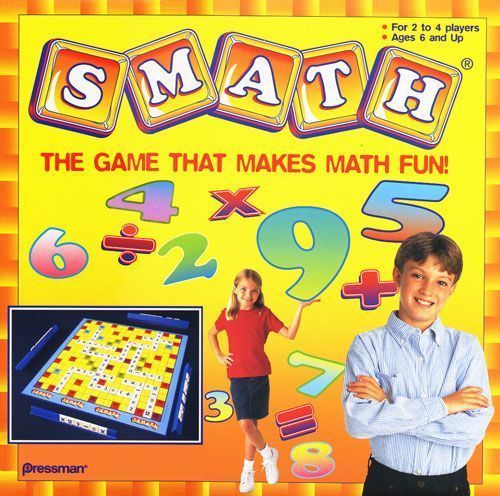
Smath
Smath Rulebook
Table of Contents
Table of Contents
To start
Place all numerals and signs (+ − × ÷) in the bag included with the game on the table. Place the brackets and equal (=) signs to one side; they can be used by any player freely, as needed. Each player takes one piece; the player with the lowest number goes first. Replace pieces in the pool and reshuffle. Each player then takes ten pieces and places them on his rack.
To play
The first player forms an equation, placing the first or last tile over the center start square. Only horizontal or vertical equations are allowed. Horizontal equations must be read from left to right, and vertical equations must be read from top to bottom. All equations formed must be complete.
The player adds up his score and then replenishes his hand.
The play continues to the next player to the left. That player must form another equation using at least one of the pieces on the board as part of his equation.
The player must form a new equation or extend an existing one (see "Hints").
If a player cannot form a new equation or add to an existing one, he may put back any or all of his pieces in the pool, face down, and pick up an equal number of new pieces. He must then wait for his next turn to play.
A calculator may be used to verify an equation if it is challenged by another player. If the equation is incorrect the player loses his turn and must take back all his pieces. The calculator may be used for challenges only.
The game ends when all possible moves have been made or all the playing pieces have been used.
Note: The largest number you may use in any equation is 12. You may not add one tile to another to make a two-figure number.
e.g. 2 × 6 = 12 correct
2 × 6 = 1 2 wrong
Keeping Score
-
Record each player's score after his turn. The player receives points for the entire equation he has formed, whether he has formed a new equation or added to an existing one. The value of each piece is shown in the lower right hand corner. Blank tiles, brackets and equal signs have no value.
-
Bonus squares multiply the value either of the playing piece or the entire equation by 2 or 3. The bonus value of a colored square is counted only when it is first covered. If an equation covers two bonus squares the score is multiplied accordingly.
-
Any player who uses all ten pieces in one turn scores a bonus of 25 points.
-
When the game ends the value of the remaining pieces on any player's rack is deducted from his score. In the case of a tie, the player with the highest score before deducting the value of the remaining pieces is the winner.
-
Blank tiles may be substituted for any number or sign. Whatever each one is used as remains constant for the rest of the game.
Scoring value of pieces
- 0's = 1
- 1's = 1
- 2's = 1
- 3's = 2
- 4's = 1
- 5's = 1
- 6's = 2
- 7's = 5
- 8's = 2
- 9's = 4
- 10's = 1
- 11's = 1
- 12's = 4
-
- signs = 1
- − signs = 1
- ÷ signs = 2
- × signs = 2
- () signs = 0
- = signs = 0
- Blank = 0
Number of playing pieces
- 9 ÷ signs
- 9 × signs
- 9 + signs
- 9 − signs
- 12 pairs of brackets
- 36 = signs
- 10 blanks
- 6 of each numeral 0-12
Scoring value of bonus squares on game board
The board has four bonus squares, marked:
| 2x playing piece | 2x equation |
| 3x playing piece | 3x equation |
Reminders in regards to the use of (0) zero
- Any number multiplied by zero equals zero. e.g. 5 × 0 = 0, or 0 × 5 = 0
- Zero divided by any number equals zero. e.g. 0 ÷ 5 = 0
- Any number divided by zero is not allowed as there is no answer. e.g. 5 ÷ 0 = no answer.
Some useful hints
Any player at any stage in the game may add more numbers and signs to an existing equation provided the result is a balanced equation.
e.g.: (i) Player one plays:
3 + 2 × 4 − 1 = 10
Player two could then play:
6 + (3 + 2) × (4 − 1) = 10 + 4 + 2 + 5
When using brackets it is not always necessary to include a multiplication sign. Where two sets of brackets are together, this means multiply.
Player one plays:
(3 + 2)(4 − 2) = 10
Player two could then play:
2(3 + 2)(4 − 2) = 10 + 3 + 7
For complete definitions of the fundamental laws of algebra, please refer to relevant text books on mathematics or algebra or to an encyclopedia.
'Smath variations for younger children
-
BEGINNERS 'SMATH. Play the same way as described above, only do not use the multiplication (×) and division (÷) symbols. This will leave you with only addition (+) and subtraction (−) and therefore you can also eliminate any use of the brackets. This will make the game much easier to play for someone just learning arithmetic.
-
PRIMARY 'SMATH. Play as directed leaving the tiles face-up and letting the children choose the numbers and signs. Limit the number of tiles per turn to seven. Equations may be played any place on the board. At some point turn some of the tiles over and eventually progress to the full game of 'SMATH.
-
CO-OP 'SMATH. This is a great family game. The idea is to achieve the highest overall score by helping each other with equations. Never replace a tile unless you absolutely have to!
Basic laws of algebra
To enable the players to play the game correctly the following basic laws of algebra will apply:
Law 1. Division (÷) and multiplication (×) take precedence over addition (+) and subtraction (−).
e.g.: (i) 3 + 2 × 4 − 1 = 10 is the same as 3 + 8 − 1 = 10
(ii) 3 + 2 ÷ 2 − 1 = 3 is the same as 3 + 1 − 1 = 3
Law 2. When the equation contains brackets, the operations inside the brackets are completed first.
(3 + 2) × (4 − 2) = 10 is the same as 5 × 2 = 10
Remember, brackets say "DO ME FIRST".
Law 3. Division (÷) takes precedence over multiplication (×).
e.g.: 6 ÷ 3 × 4 = 8 is the same as 2 × 4 = 8
Law 4. Equations may have more than two parts.
e.g.: 3 × 2 = 6 = 5 + 1 = 12 ÷ 2
Law 5. The simplest equation of all is known as a mathematical statement.
e.g.: 5 = 5
This latter law can be used to considerable advantage towards the end of the game when players attempt to use the remainder of their tiles.
Law 6. Zero (0) may be used in equations.
e.g.: 12 + 0 = 12
12 − 0 = 12
12 × 0 = 0
Law 7. Examples of the commutative property of addition (+) and multiplication (×) are:
(i) 3 + 4 = 4 + 3
(ii) 2 × 3 = 3 × 2
Law 8. Examples of the associative property of addition (+) and multiplication (×) are:
(i) (3 + 4) + 1 = 3 + (4 + 1) is the same as 7 + 1 = 3 + 5
(ii) (3 × 2) × 1 = 3 × (2 × 1) is the same as 6 × 1 = 3 × 2
Law 9. Examples of the distributive property of multiplication (×) and division (÷) over addition (+) and subtraction (−) are:
(i) 2 × (3 + 5) = 2 × 3 + 2 × 5 is the same as 2 × 8 = 6 + 10
(ii) (8 + 2) ÷ 2 = 8 ÷ 2 + 2 ÷ 2 is the same as 10 ÷ 2 = 4 + 1