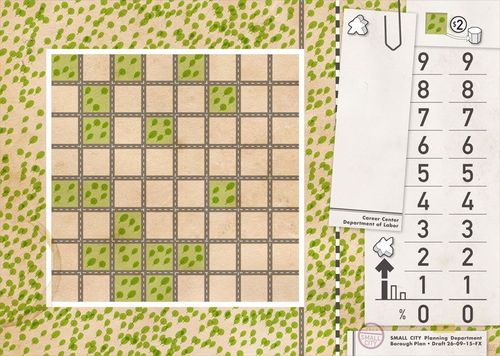
Small City: Player boards Expansion #3 – The Forests
Small City: Player boards Expansion #3 – The Forests Rulebook
Table of Contents
Table of Contents
Overview
All rules of the base game apply, with the exceptions mentioned below.
Flat spaces, which are all you had on the base game's maps, are considered plains, and thus a plain space is a flat space.
Setup
Choose whether to play the easy or expert side (marked with a star) of your Borough board. Beginners should play on the easy side, because it has more room to build, but the other players are welcome to play on the expert side.
Add the additional wood to the supply.
Components: 4 double-sided Forest Boards (easy side / expert side), 12 additional wood.
Playing the Game
Phase 1: Select Special Actions
The Special Action Cards
F. URBAN PLANNER
The player who chooses this action only pays half of their total forest-clearing cost (rounded down) during Phase 2: Build. This discount only applies to forest-clearing costs.
Example: You are playing on the easy side of the board, and you selected the Urban Planner in Phase 1. In Phase 2, if you build/upgrade over just 1 forest space, the forest-clearing cost you have to pay is $0 ($1 ÷ 2 = $½, which rounds down to $0); but if you build/upgrade over 4 forest spaces, you pay just $2 to clear the forests.
Phase 2: Build
General Building Rules
- There is no need to increase the size of your borough, because you can already build anywhere you want.
- Building over a forest space costs $1 (Easy side) or $2 (Expert side) to clear the forest; however, you are not allowed to build/upgrade Parks over forest spaces. If you cannot pay to clear a forest space, you can neither build nor upgrade over it. You can only clear forests when you are building or upgrading over their spaces.
- For each forest that you clear, you immediately get 1 wood that you set aside to track Pollution. You cannot use this building material this round to build Cultural Buildings, nor can you trade it in Commerce buildings.
- If Building Materials are running out, the mayor (first player) is first served, and then the other players clockwise. Especially if you are later in the turn order, it is possible that you pay to clear forest, but earn no wood for it.
Phase 6: Measure Pollution
- Count the Pollution as in the base game, but also add 1% for each wood produced via deforestation [that you actually receive*], then apply all the consequences, as in the base game (dead citizens, etc.).
- * Wood you don't receive due to component limits also doesn't cause pollution.
- After tallying deforestation pollution, store your deforestation wood in your Warehouses and/or City Hall (discard all that you cannot store). You can now use this wood in future rounds as usual, now that they have cured.