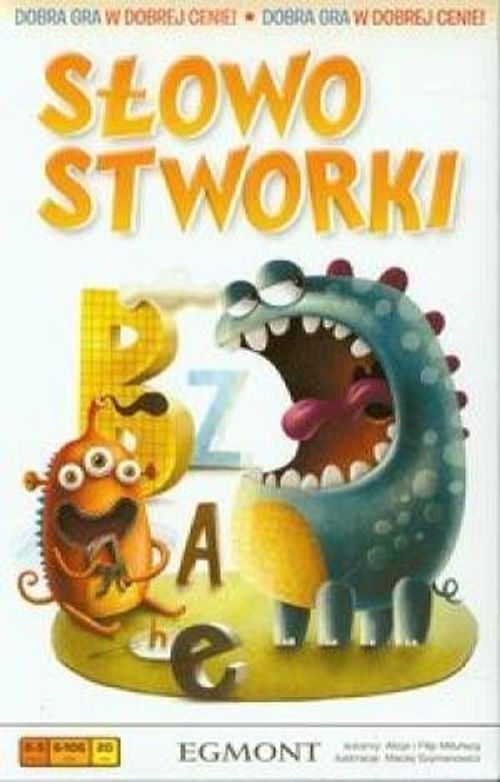
SłowoStworki
SłowoStworki Rulebook
Table of Contents
Table of Contents
Components
- 72 letter cards (each with a front and a back)
- 7 activity tiles (one side marked "V" with a green tick, the other marked "X" with a red cross)
- 7 joker cards
- 7 help cards (karty pomocy), showing the scoring for alphabet fragments
- 1 hourglass
- 1 starting-player marker
- 4 round tokens, numbered 1–4
- 4 dice (category dice)
- 24 stickers for the dice
- 40 SłowoStwory (creature tokens), in five groups of 12, 10, 7, 6 and 5 pieces
Before the first game, apply 6 stickers of one colour to each die, as shown in the illustration.
Variants
The game has two variants:
- Easier variant – for younger players (age 8+) and for people playing the game for the first time.
- Harder variant – for older players (age 12+) and for people who already know the easier variant.
Easier Variant
Goal of the Game
The goal of the game is to gain as many SłowoStwory as possible. Players gain them by coming up with words in a given category that contain the letters shown on the letter cards (for example, a city containing the letters R and W).
Setup (Easier Variant)
(A) Shuffle the letter cards and place them in the middle of the table as a face-down stack of letters (the letter draw pile).
(B) Place the hourglass in the middle of the table.
(C) Place the 4 dice beside the hourglass.
(D) Place the SłowoStwory to the side of the table.
The remaining components (joker cards, help cards, activity tiles, round tokens and the starting-player marker) are put back in the box, as they are not needed in this variant.
Gameplay (Easier Variant)
The game lasts several rounds. The first round is started by the player whose name has the most letters (or by the youngest player). The next round is started by the player sitting to the left of the previous starting player.
Each round proceeds as follows:
1. Choosing a die
The player starting the round chooses any die and places it in front of themselves.
The description of the categories on the dice is at the end of the rulebook.
The player then performs the following actions in this order:
2. Turn the hourglass, roll the category die, reveal two letter cards
- Turn the hourglass.
- Roll the chosen die with the categories.
- Reveal two cards from the letter draw pile.
Tip: to make the game easier for the youngest players, you may reveal one letter card instead of two.
All players simultaneously try to find and say the correct word. The word must contain both letters shown on the cards and must belong to the category that came up on the die.
Example: the category "fairy tale" (bajka) came up on the die, and the revealed cards show the letters "K" and "L". Correct answers could be, for example, Kaczor Donald (Donald Duck) or Koralgol.
3. Gaining SłowoStwory
- The player who is first to give a correct word gains two SłowoStwory.
- Other players who give a correct answer before the sand runs out in the hourglass each gain one SłowoStwór.
- In this variant, the number of points printed on a SłowoStwór does not matter: each SłowoStwór is worth 1 point.
- In all categories, the answer given by a player must be in the singular nominative (for example pies, dog, not psami, with dogs).
- Proper names (film titles, band names, etc.) may contain at most 3 words.
- Words given by players may not repeat within a round.
- A player who gives a correct word immediately takes 1 or 2 SłowoStwory (2 if they were first to give the correct word).
- A player can gain SłowoStwory only once per round. Players who have already gained SłowoStwory in the round do not take part in further word-finding in that round.
4. End of the round
Players have time to give words until the sand in the hourglass has run out. When all the sand has fallen, the round ends.
The letter cards that players were searching for words for are placed face up on the discard pile (stos zużytych kart). Create the discard pile beside the letter draw pile and place used cards there. When the letter draw pile runs out, shuffle the discard pile and form a new letter draw pile.
A new round begins, and the next player chooses a die with categories.
End of the Game (Easier Variant)
The game ends when one of the players gains their tenth SłowoStwór. Finish the round to its end, then all players count the SłowoStwory they have. The player with the most SłowoStwory wins. In case of a tie, the players share the victory.
Harder Variant
Goal of the Game (Harder Variant)
The goal of the game is to score as many points as possible.
- In duels on words, players gain letter cards.
- From the letter cards, players form fragments of the alphabet.
- At the end of the round, players exchange these fragments for SłowoStwory.
The longer the fragment of the alphabet, the more points you score!
Setup (Harder Variant, 3-Player Game)
The printed setup illustration is captioned "Setup for a 3-player game". Its steps are:
(A) Shuffle the letter cards and deal 3 cards to each player.
(B) Place the remaining letter cards in a face-down stack of letters (the letter draw pile).
(C) From the letter draw pile, reveal 6 cards and place them in the middle of the table, forming the letter bank (bank liter).
(D) Deal one joker card to each player. Players add it to the 3 letter cards they received earlier.
(E) Deal one help card to each player. Each player places it face up in front of themselves.
(F) Deal one activity tile to each player. Each player places it in front of themselves with the "V" side face up.
(G) Stack the 4 round tokens one on top of another in the order 1–4, so that the token numbered 1 is on the very top. Place the tokens to the side of the table.
(H) Sort the SłowoStwory by kind and place them to the side of the table.
(I) Place the hourglass in the middle of the table.
(J) Place the dice beside the hourglass.
(K) The player whose name has the most letters (or the youngest player) receives the starting-player marker.
Note: step (G) reads "płytki" (tiles) in the printed text, although the round tokens are meant; the step is transcribed as printed.
Gameplay (Harder Variant)
The game is divided into 4 rounds. Each round proceeds as follows:
- Reveal the round token.
- Duels on words.
- Gaining SłowoStwory.
1. Reveal the round token
The round tokens show which round is currently being played. At the start of the game, the token numbered 1 is on top of the stack, and round 1 is played. At the start of each subsequent round, the next token is revealed. The previous token is put back in the box.
2. Duels on words
A duel starts at the moment the second letter card is laid out. The duel is a race between two players: each must say aloud the correct word as quickly as possible. The word must contain both letters shown on the cards, and it must belong to the category that came up on the die. The first player to give a correct word wins the duel.
In each round, each player takes part in two duels. The player who wins a duel gains letter cards. The players who are not taking part in the duel may, meanwhile, exchange their letter cards with the bank.
The duels proceed as follows:
2.1. Choosing an opponent
At the start of each of the 4 rounds, the player holding the starting-player marker chooses, as the first, a person with whom to duel. The chosen person, after the duel has finished, starts a new duel by deciding whom to choose next.
Example: Michał begins the round and chooses Kuba for a duel. After that duel, Kuba starts a new duel and chooses Mateusz. Mateusz then chooses Michał for a duel, after which the round ends.
2.2. Choosing a die
After an opponent has been chosen, the player chooses any die. The description of the categories on the dice is at the end of the rulebook.
2.3. Duel / exchange of cards with the bank
After the die has been chosen, the player performs the following actions in this order:
- Turn the hourglass.
- Roll the chosen die with the categories.
- Reveal two cards from the letter draw pile.
The duel begins at the moment the second card is laid out. The players must say the correct word as quickly as possible. The word must contain both letters shown on the cards and must belong to the category that came up on the die. The first player who gives the correct word wins the duel.
Example: the category "city" (miasto) came up on the die, and the revealed cards show the letters "L" and "D". Correct answers could be, for example, Londyn (London) or Lądek Zdrój.
The following rules also apply:
- The word given must differ from the one shown graphically on the letter card. (The printed example shows the cards A and R, with a crossed-out picture of a watermelon, arbuz, which is therefore not allowed.)
- In all categories, the answer given must be in the singular nominative (for example pies, dog, not psami, with dogs). Proper names (film titles, band names, etc.) may contain at most 3 words.
- If there is any doubt whether the word given is correct, the players who are not taking part in the duel act as judges.
- If both duellists give a correct word at the same time, the duel does not end, and the players must find another word.
- If the sand in the hourglass runs out and no player has given a correct word, the duel ends without a result (nierozstrzygnięty). No player gains letter cards.
Exchange of cards with the bank
While a duel is in progress, the other players may (but do not have to) exchange letter cards with the bank. Letter cards must be exchanged one at a time. All players may do so simultaneously. Players may exchange any number of cards in this way, but only as long as the duel lasts. Once the duel ends, players may no longer exchange letter cards with the bank.
Activity tiles
The player who has been chosen for a duel turns their activity tile to the "X" side. This means that the player cannot be chosen for another duel in this round.
- A player whose tile shows the "V" side (green tick) may be chosen for a duel.
- A player whose tile shows the "X" side (red cross) may not be chosen for a duel.
2.4. Ending the duel
A duel can end in one of two ways:
- One of the two duellists gives the correct word. The winner of the duel, i.e. the player who was first to give the correct word, receives letter cards as a reward. The winner chooses one of two options:
- a) Take two letter cards. The player may take the letter cards from the bank or from the top of the letter draw pile in any combination:
- two cards from the bank,
- two cards from the top of the letter draw pile,
- one card from the bank and one card from the top of the letter draw pile.
- b) Take one random card from the player who lost the duel.
- a) Take two letter cards. The player may take the letter cards from the bank or from the top of the letter draw pile in any combination:
- The sand in the hourglass runs out and no player has given a correct word. The duel ends without a result, and no player gains letter cards.
Discard pile
The letter cards that players were searching for words for are placed face up on the discard pile (stos kart zużytych). Create the discard pile beside the letter draw pile. When the letter draw pile runs out, shuffle the discard pile and form a new letter draw pile.
New duel
The player who was last challenged to a duel chooses the opponent for the next duel. That player may choose any other player, except:
- the player holding the starting-player marker (who will be challenged last in the round), and
- players who have already been challenged to a duel in this round (their activity tiles are turned to the "X" side).
End of the duel phase
The phase of duels ends when all players have their activity tile turned to the "X" side in front of them.
3. Gaining SłowoStwory
At the end of the round, after the duels are finished, players may exchange the letter cards they have gained for SłowoStwory.
Starting with the player holding the starting-player marker and proceeding clockwise, each player in turn may (but does not have to) lay down on the table cards that form fragments of the alphabet.
- The printed example shows a valid 4-letter fragment of the alphabet, consisting of four consecutive letters.
- The printed example shows an invalid 4-letter fragment, which is not a sequence of consecutive letters.
The help card shows the points for alphabet fragments of different lengths. For example, a 5-letter fragment is worth 7 points.
- A joker card replaces any letter in a fragment of the alphabet.
- After laying down a fragment of the alphabet, the player immediately receives the corresponding SłowoStwór and places it in front of themselves.
Example: the player lays down the fragments "3-letter" and "4-letter". They receive 2 SłowoStwory worth 3 points and 5 points.
- Joker cards that have been used must be returned to the box.
- In the rare situation that one of the SłowoStwory runs out, the player's points should be written down on a piece of paper.
End of the round
At the end of each round, players must have at least 3 letter cards. Each player who has fewer than 3 cards in hand draws new cards from the letter draw pile until they have 3.
The 6 cards lying in the letter bank are discarded to the discard pile, and 6 new cards are drawn in their place.
The starting-player marker is then passed to the player sitting to the left, and the next round begins.
End of the Game (Harder Variant)
The game ends after the fourth round. Players count the points for all the SłowoStwory they have gained. The player with the most points wins.
If there is a tie:
- the player who obtained the bigger SłowoStwór wins;
- if the tie remains, the player who obtained more SłowoStwory wins;
- if there is still a tie, the players share the victory.
Example (as printed): Mateusz has 18 points, Michał has 18 points, and Kuba has 15 points. Mateusz and Michał both have 18 points, so they look at who obtained the bigger SłowoStwór: in both cases it is a blue creature. Then they compare the number of SłowoStwory gained: Mateusz has 4 and Michał has 2. Mateusz wins the game.
Categories on the Dice
Each die shows three categories. The examples in brackets are as printed.
City – Country – Profession (miasto – państwo – zawód)
- Miasto (City) – any city, e.g. Madryt (Madrid).
- Państwo (Country) – any country, e.g. Ekwador (Ecuador).
- Zawód (Profession) – any profession, e.g. policjant (police officer).
Animal – Plant – Thing (zwierzę – roślina – rzecz)
- Zwierzę (Animal) – any animal, e.g. żyrafa (giraffe).
- Roślina (Plant) – any plant, e.g. winorośl (grapevine).
- Rzecz (Thing) – any object, e.g. stół (table).
Film – Sport – Music (film – sport – muzyka)
- Film (Film) – any film title, or the surname of an actor, e.g. Rejs, Pitt.
- Sport (Sport) – any sport discipline, team name, or the surname of a sportsperson, e.g. piłka nożna (football), Real, Małysz.
- Muzyka (Music) – any music piece title, band name, or the surname of a musician, e.g. Hey Joe, Iron Maiden, Waglewski.
Fairy Tale – Toy – Joker (bajka – zabawka – joker)
- Bajka (Fairy tale) – any fairy-tale title, or the name of a character appearing in it, e.g. Królewna Śnieżka (Snow White), Kaczor Donald (Donald Duck).
- Zabawka (Toy) – any toy name, or the name of a character that is a toy, e.g. lalka (doll), rower (bicycle), and also Bakugan, Dragonoid.
- Joker – any word, e.g. księżyc (moon).