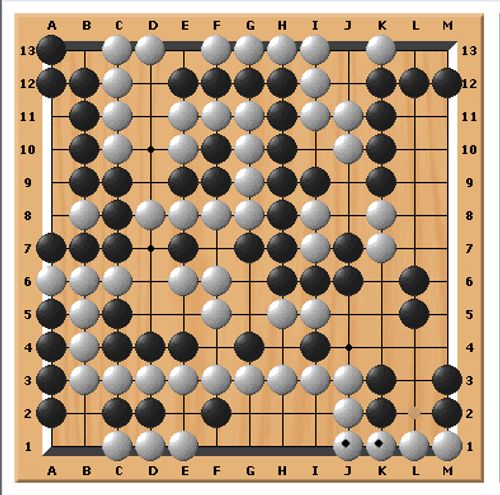
Slither
Slither Rulebook
Table of Contents
Table of Contents
Rules
Materials
Any square board as well as a supply of stones in two colors with enough stones for each player to cover half the board. You may also find something to designate a player's edges.
Objective
The objective of Slither is to create an unbroken orthogonal chain of pieces connecting your designated board edges. Black aims to connect the top and bottom and White aims to connect the left and right-hand sides.
Gameplay
The game is played on the intersections of the board. Starting with Black, on a turn, a player must place a stone of his color on an empty intersection of the board. A player may also optionally move a stone of his color which is already on the board to an orthogonally or diagonally adjacent intersection. These actions may be performed in any order, but at the conclusion of the turn, any two diagonally adjacent stones of the player's color must be orthogonally adjacent to a like-colored common stone.
Forced Passing
In the, rather unlikely event that a player has no legal move on his turn, he must pass his turn. Passing is otherwise strictly prohibited!
Advanced Slither
Seasoned Slither players or even novices may want to try an advanced form of Slither which adds a condition on stone movement. This form of the game both adds a more static character to play, suggesting perhaps a greater strategic scope. It also adds many tactical dynamics absent from the original. Advanced Slither, like its predecessor, cannot end in a draw.
Additional Rules
Movement: In Advanced Slither, stones must always be moved prior to placement. A stone may only move if, prior to its movement, it is in a group (orthogonally contiguous set) of stones consisting of both player's colors.
Pie: Due to its shown lack of efficacy in classic Slither, the Pie Rule appears here. This rule reduces the advantage of Black having an extra stone on the board. On his first turn, the White player may choose to play as Black instead of making his own move using the white pieces.
Strategy
A good strategy in Slither is to create flexible shapes for yourself while exploiting the inflexible shapes of your opponent. Generally, inflexibility comes from having your stones spaced apart by 1 intersection. Stones a knight's move apart are very flexible by contrast. A good tactic to apply in Slither is to split your movement and placement phase between two localities. If you can move a stone or place a stone in a position where it will take a placement and movement by your opponent to counteract it, you'll be able to use your other move to gain a local advantage somewhere else.
Advanced Slither Strategy
If you are playing Advanced Slither there are also strategic concepts of exploiting stones your opponent cannot make good use of and attaching a large group of your own stones to them to 'activate' these stones, allowing them to be moved in subsequent turns. This is especially effective if you can pin these stones down so they cannot deactivate your stones by moving away from them.