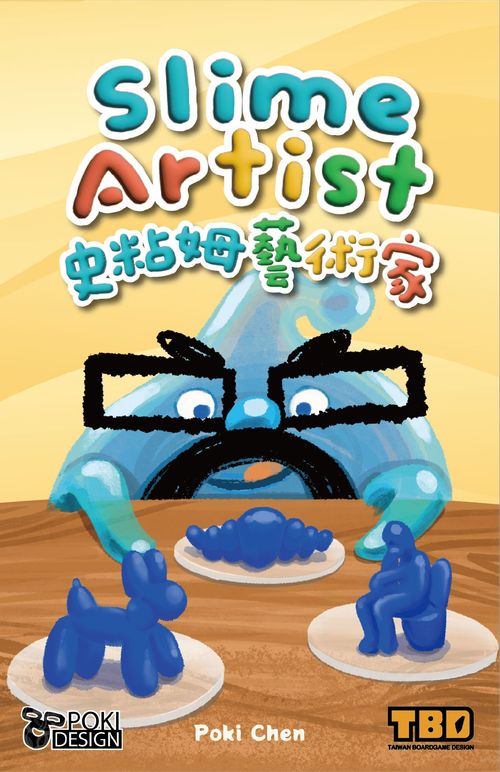
Slime Artist
Slime Artist Rulebook
Table of Contents
Table of Contents
Components
- 45g of Slime Clay
- 5 Acrylic Display Stands
- 50 Double-Sided Theme Cards
- 6 Number Cards (1–6)
- 5 Player Guessing Cards
- 2 Score Cards
- 30 Player Tokens (5 colors)
- 1 Sand Timer (30 seconds)
Setup
- Place the two Score Cards together in the center of the table.
- Each player takes one Acrylic Display Stand and chooses a color of Guessing Cards.
- Divide the Slime Clay evenly among all players, and place it on their Acrylic Display Stands.
- From the box, take all Player Tokens of each player's chosen color and place them in the center of the table.
- Each player also takes one token of every other color, used for guessing and marking.
- Leave one full set of unused tokens by the Score Cards; these will be used for scoring.
- Place the Theme Cards, Number Cards, and Sand Timer nearby.
Game Flow
The game is played over five rounds. Each round consists of three phases:
- Theme & Sculpting
- Display & Guessing
- Reveal & Scoring
1. Theme & Sculpting
Determine the Theme
- Draw 1 Theme Card from the deck and place it either side face up on the table.
- Shuffle the Number Cards (1–6). Each player secretly draws 1 card. Place any leftover Number Cards face down to the side.
- The number on your card corresponds to the theme number on the Theme Card — this is the subject of your clay creation. Keep it secret from others!
- Theme Cards come in two difficulty levels:
- Dark background = Standard Challenge
- Light background = Kids-Friendly Challenge
- You may choose which level to play or shuffle them together.
Sculpting
After all players learn their subject, everyone starts sculpting with their clay. Place your finished piece on your Acrylic Display Stand.
- You do not need to use all of your clay.
- You may not sculpt recognizable letters or symbols.
When the first player finishes their creation, they flip the Sand Timer. When time runs out, all players must stop sculpting immediately.
2. Display & Guessing
Display
- Each player pushes their sculpture forward so everyone can clearly see it. Place your own Player Token beside your work to mark your player color.
- You may explain the viewing angle of your piece (e.g., "The top of the artwork is this side."). But you cannot explain the content or meaning of your sculpture.
Guessing
- Using the tokens of other players' colors, secretly make your guesses on your Guessing Card (cover your answers with one hand).
- Try to match each sculpture to one of the six possible subjects on the Theme Card.
- Place a token of the corresponding player's color onto the numbered slot you believe is their subject.
- Each slot can hold only one token.
3. Reveal & Scoring
Reveal
After all guesses are made, reveal the results. Each player places their own colored token on the correct number of the Theme Card and flips over their Number Card to confirm their subject.
Scoring
- Guessing Points: You earn 1 point for each correct guess of another player's sculpture.
- Creation Points: If at least one player guessed your sculpture correctly, you earn 2 points total (regardless of how many guessed correctly).
- Insight Bonus: If exactly one player guessed your sculpture correctly, you gain +1 bonus point.
Mark your points on the Score Card accordingly. After scoring, players may take turns briefly explaining the idea behind their sculpture, sharing the artistic thought process with the group.
End of the Round
- Collect all Number Cards and discard the used Theme Card to the discard pile.
- Players take back their Display Stand and clay, then begin the next round.
End of the Game
The game is played over five rounds. After the final round, the player with the highest score wins!
Variant Rules
Speed Sculpting
Flip the Sand Timer when you start sculpting. All players have only 30 seconds to complete their creations.
Relaxed Sculpting
Flip the Sand Timer only when there is just one player still sculpting.
Creative Freedom
Players may incorporate the Acrylic Display Stand as part of their creation.
Parts of the creation may extend outside the stand, but players must clearly explain the intended boundaries of their artwork during the Reveal phase.
About the Clay
Q-doh silicone clay is safe, non-toxic, and odorless, tested and certified by multiple safety standards. It is ultra-soft with excellent elasticity, does not dry out, does not crumble, and does not stick to hands — making it easy to clean and fun to use.